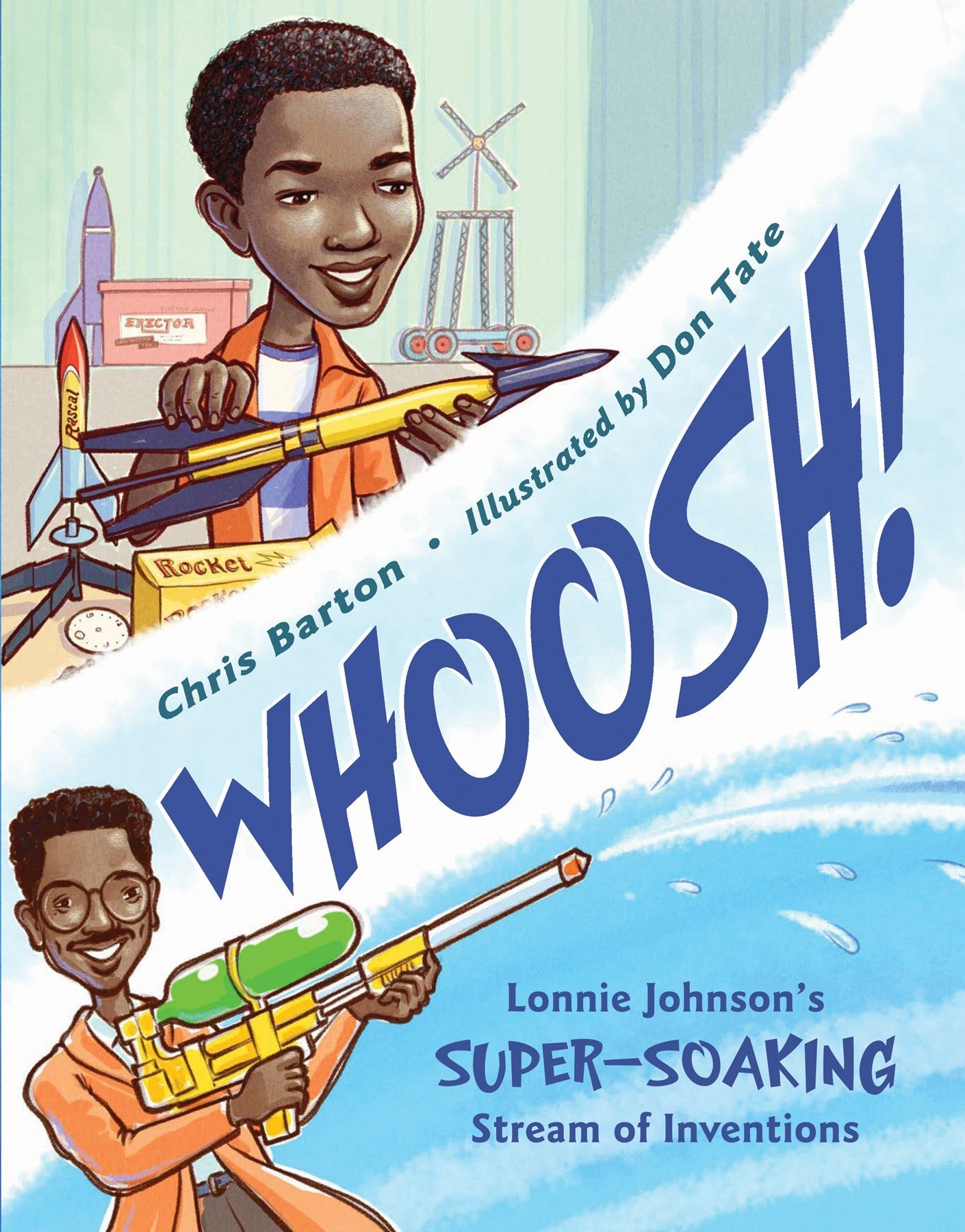
Return by Aaron Becker

Published by Candlewick Press 

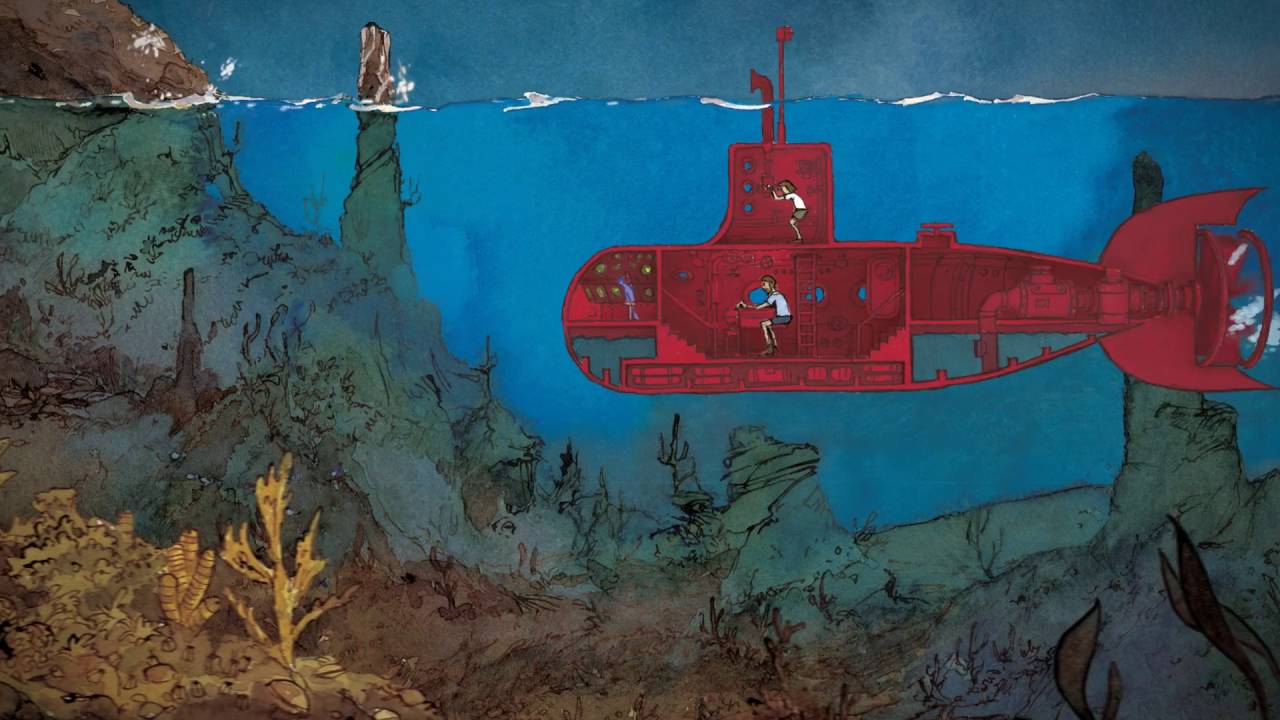
Summary:  In this third and final volume of a wordless trilogy, a girl travels once again into the magical world she discovered in Journey and continued to explore in Quest.  This time, though, her father finally looks up from his work and follows her.  She meets up with the boy, the king, and the bird from the previous books, and as usual, the bad guys make an appearance.  They have a box that draws the magical crayons and their creations inside of it.  The boy, girl, and king are powerless to stop it, but Dad turns out to have a magical crayon of his own, and figures out a way to save the day.  40 pages; grades K-5.

Pros:  Caldecott honoree Aaron Becker has risen to the occasion of creating a third amazing book in this trilogy.  I just spent quite a while with a 9-year-old who moved from one book to the other, finding all kinds of details I had missed (“Did you notice the boy always draws animals and the girl always draws machines?”).  Some of the best, most beautifully illustrated wordless picture books I have ever seen.

Cons:  If you hurry through these books, you will miss a lot!
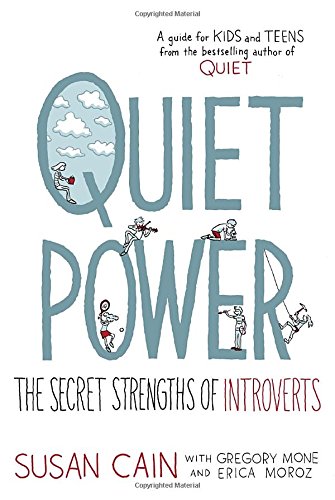
Quiet Power: The Secret Strengths of Introverts by Susan Cain with Gregory Mone and Erica Moroz

Published by Dial Books for Young Readers 

Summary:  Susan Cain wrote the best-selling book Quiet,  and delivered an extremely popular TED talk, both on the subject of people who are introverted.  Now she has written a book to help introverted kids and teens survive and thrive in a world that often favors extroverts.  Divided into four parts—school, socializing, hobbies, and home—Quiet assures introverts that being quiet and needing time alone are good things, and that they can bring unique qualities to the classroom, their friends, and organizations they are a part of.  Cain acknowledges the importance of making friends, getting along with family, and staying engaged in classroom discussions, but she also recognizes the value of the solitary time introverts need to recharge and how their quiet listening can add an important dimension to discussions.  Introverts have succeeded in many arenas, including unexpected ones such as the stage, screen, and at the helm of many corporations and nonprofits.  An afterword offers tips to teachers and parents on how to make sure the introverted kids in their classrooms and homes reach their full potential.  288 pages; grades 5 and up.

Pros:  As an introvert who was often told to participate more in class, let me say, “Thank you, Susan Cain!”  I wish I had had this book when I was in middle school and high school, busily comparing myself unfavorably to my more extroverted peers.  Put this book in the hands of those quiet kids who may tend to slip under the radar to let them know they have much to contribute to the world.

Cons:  As the mother of two introverted children, I can attest to the fact that many teachers are still nagging introverts to participate more in class.

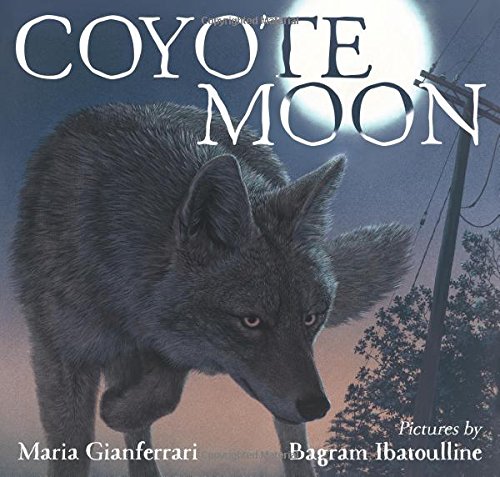
Coyote Moon by Maria Gianferrari, pictures by Bagram Ibatoulline

Published by Roaring Brook Press


Summary:  A coyote explores a nighttime suburban neighborhood, looking for food to bring back to his family’s den in a cemetery.  He is unsuccessful in catching a mouse and a rabbit; geese at a neighborhood pond chase him away before he can get to their eggs.  Just before dawn, he manages to kill a turkey.  His song awakens a little girl, who looks out her bedroom window to see him walking through her backyard.  Finally, he returns to his den, where his family eats, then falls asleep for the day.  The last two pages contain a wealth of coyote facts and some books and websites for further research.  32 pages; ages 4-8.

Pros:  An interesting and positive look at an animal that (I learned from this book) lives in every state except Hawaii, and is often considered a nuisance at best and a danger at worst.  The illustrations are stunning and realistic, capturing the coyote’s beauty and movements perfectly.

Cons:  Given the prevalence of coyotes in the U.S., it would have been helpful to offer tips about what to do if you encounter a coyote.


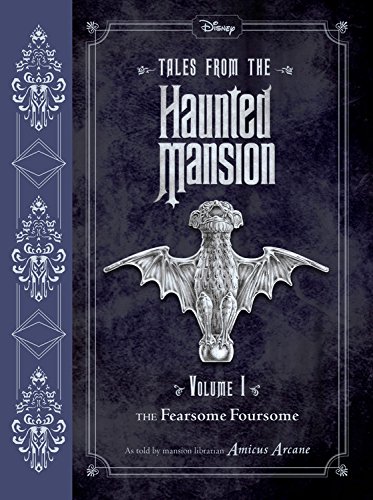
Tales from the Haunted Mansion: Volume 1: The Fearsome Foursome as told by mansion librarian Amicus Arcane, transcribed by John Espositio, illustrated by Kelley Jones

Published by Disney Press 

Summary:  Willa, Steve, Tim, and Noah love horror of all kinds.  They form a club called The Fearsome Foursome to share scary stories with each other.  One stormy night, their clubhouse is mysteriously destroyed, and in its place are four frighteningly fancy invitations to a nearby mansion.  Arriving at the creepy old place, they are met by a ghostly librarian, who offers to tell them a story about each one of them…tales so creepy they will be dying to hear the end of them.  Each narrative ends with the death or dismemberment of the main character, and at the end of the book, all four kids discover they have turned into ghosts.  This is volume 1 of a series based on Disney’s Haunted Mansion; stay tuned to learn more about some of the other 999 ghosts that live in the aforementioned mansion.  240 pages; grades 3-7.

Pros:  Fans of Goosebumps and Alvin Schwartz’s scary stories will enjoy these spine-tingling tales that add enough humor and gross details to keep the tone on the lighter side.

Cons:  I couldn’t quite wrap my head around the fact that all four kids ended up as ghosts living in the Haunted Mansion forever.

Seven and a Half Tons of Steel by Janet Nolan, illustrated by Thomas Gonzalez

Published by Peachtree Publishers 

Summary:  The USS New York is a Navy ship weighing 25,000 tons.  Seven and a half of those tons are made of steel from a most unusual source—the World Trade Center.  After the September 11 destruction of the Twin Towers, work crews removed a steel beam and had it transported from New York to Louisiana.  There it was melted down and molded into a ship’s bow.  The work of building the ship was interrupted by Hurricane Katrina, but eventually, the ship was completed and brought back to New York.  There it was greeted with a twenty-one gun salute before sailing off to do its work at sea.  An author’s note gives more facts about the USS New York and the meaning of the different colors and symbols of its crest. 36 pages; grades 2-5.

Pros:  History buffs, particularly fans of military history, will enjoy learning about the construction of this special ship.  The large, vivid paintings offer plenty of visual details to the story.

Cons:  There are only a few sentences about September 11 and Hurricane Katrina, so kids may need more information on both of these events to truly appreciate this book.

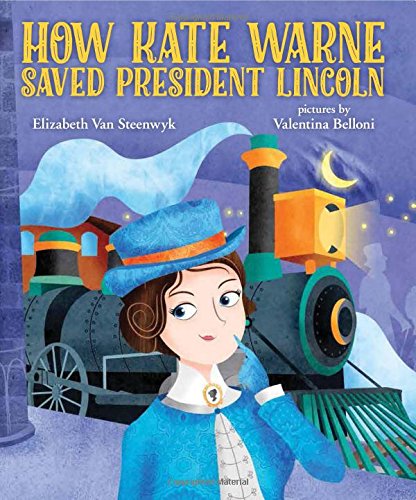
How Kate Warne Saved President Lincoln by Elizabeth Van Steenwyk, pictures by Valentina Belloni

Published by Albert Whitman and Company


Summary:  When Kate Warne walked into the Pinkerton Detective Agency in 1856, Allan Pinkerton had never considered hiring a woman to be a detective.  But Warne convinced him that women could go undercover in a variety of ways that men could not, and soon she was a valuable member of the world’s first detective agency.  She successfully worked on a number of cases, but her most famous was helping to thwart an assassination plot against Abraham Lincoln as Lincoln traveled from Illinois to Washington, D.C. to begin his term as President.  Kate infiltrated the group that was planning to kill the President, and learned that they had vowed to not let him leave Baltimore alive.  She and other detectives from the agency worked all night to make sure Lincoln got safely through the city, onto Philadelphia, and finally to Washington.  An author’s note tells a bit more about Kate Warne’s life, although little is known; a brief bibliography is also included.  32 pages; grades 1-4.

Pros:  Kate’s escapades make interesting and exciting reading, particularly given how difficult it was for women to have successful careers in her time.  The bright cartoon-like illustrations are appealing.  See last year’s The Detective’s Assistant by Kate Hannigan for an entertaining fictional account of Warne’s life.

Cons:  It’s frustrating that Kate Warne’s early life is a complete unknown.

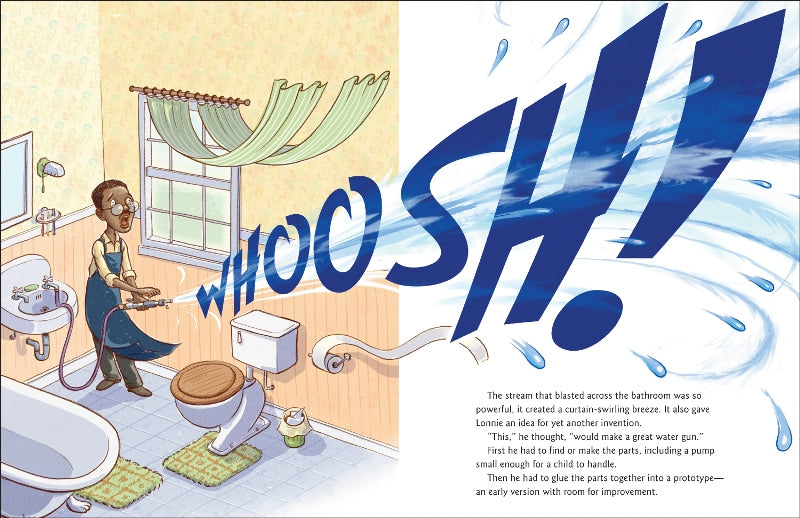
Whoosh! Lonnie Johnson’s Super-Soaking Stream of Inventions by Chris Barton, illustrated by Don Tate

Published by Charlesbridge

Whoosh!: Lonnie Johnson's Super-Soaking Stream of Inventions: Barton,  Chris, Tate, Don: 9781580892971: Amazon.com: Books

Summary:  When Lonnie Johnson was growing up in Alabama, his small house and large family didn’t leave him with much space to do what he loved best…invent.  Still, he had supportive parents (when his rocket fuel caught fire in the kitchen, his mom just sent him outside) and a lot of perseverance.  His hard work paid off in high school, when his robot won first place at a science fair at the University of Alabama—a school that African-American students like Lonnie hadn’t been allowed to attend just a few years before.  Lonnie graduated from Tuskegee, then went on to work for NASA, but he kept inventing in his spare time.  While testing an environmentally-friendly cooling system, he serendipitously invented the Super Soaker water gun.  This hit toy has given Lonnie enough income to allow him to continue working on his inventions full-time.  The author’s note explains how he learned about kids’ stereotypical ideas about scientists, leading him to write a biography of a man who doesn’t fit those stereotypes. 32 pages; grades 1-5.

Pros:  Kids will connect with this hard-working, but fun-loving scientist who invented a much-loved toy; teachers will make connections to science and African-American history curriculum; and librarians will enjoy using this book to tie in with their maker spaces.

Cons:  It seemed to me that Lonnie Johnson was a bit hasty in disregarding the advice, “Don’t quit your day job”.

Surviving Middle School: Navigating the Halls, Riding the Social Roller Coaster, and Unmasking the Real You by Luke Reynolds

Published by Aladdin/Beyond Words 

Summary:  Seventh grade English teacher Luke Reynolds draws on his experience as a former middle school student and current middle school teacher to give kids some words of wisdom on topics like peer pressure, grades, parents, and romance.  Each chapter starts with a story about one of Reynolds’ students, goes on to give advice about a particular topic, and concludes with an exercise, usually written, to help kids come up with their own answers about that issue.  A recommended resources chapter at the end includes lists of books and movies to inspire and instruct the middle school crowd.  192 pages; grades 5-8.

Pros:  I’d like to sit in on Mr. Reynolds’ class; he seems funny, caring, and insightful about the human condition.  While he speaks in a language kids will relate to, he also clearly remains the adult, empathizing with middle schoolers while helping them to understand themselves and those around them.

Cons:  I was expecting a quick read, with lots of side bars and comics; instead this is pretty text-heavy, which may not appeal to the intended audience.

Nobody Likes a Goblin by Ben Hatke

Published by First Second 

Summary:  Goblin has a happy life in his dungeon, visiting his friend Skeleton each day to play together with their treasure.  Then one day, a greedy band of adventurers invades the dungeon and steals everything, including Skeleton.  Goblin, determined to rescue his friend, sets off into the world.  The first creature he meets is a troll, who points him in the right direction, but warns him that “Nobody likes a goblin”.  His second meeting, with a farmer, confirms the truth of this statement.  Goblin manages to rescue Skeleton, but the two of them are chased into a cave by a mob of pitchfork-wielding villagers.  Just when it seems like they are doomed, a group of goblins emerges from the cave, crowns Goblin king (he happens to be wearing a crown), and fights off the enemy.  Everyone returns to the dungeon for a happy ending.  40 pages; grades K-3.

Pros:  A surprisingly engaging tale, illustrated in fantastic detail by graphic novelist Hatke.  The illustrations have a comic book-medieval feel to them that draw the reader into the story.

Cons:  The troll tells Goblin that the adventurers took his Honk-Honk, and Goblin promises to get it back. I studied the pictures in the rest of the book, but couldn’t figure out what the Honk-Honk was, and no mention was made of it again

Dara Palmer’s Major Drama by Emma Shevah

Published by Sourcebooks Jabberwocky 

Summary:  Dara Palmer is shocked and dismayed when—once again—she is passed over for a part in the class play.  Although the drama teacher suggests she and her best friend Lacey join her theater class, the two girls are certain they are destined for stardom without any outside help.  Things are no easier at home.  Dara was adopted from Cambodia, and she can’t help feeling like an outsider with her parents, older brother, and super annoying younger sister, also adopted (from Russia).  As her fifth grade year progresses, Dara slowly and painfully finds her way to a greater maturity, first by admitting she could use some help bringing her acting skills up to the same level as her passion for theater, then coming to terms with her history and learning some empathy for the friends and family members in her life.  282 pages; grades 3-6.

Pros:  Extremely annoying at the beginning of the story, Dara grows and changes without sacrificing her strong (and ultimately winning) personality.  Kids will enjoy the humor and true-to-life situations in this British import.

Cons:  Dara’s insights and maturity sometimes seemed a bit of a stretch, given how bratty and self-centered she is at the beginning of the book.