Two innovative artists

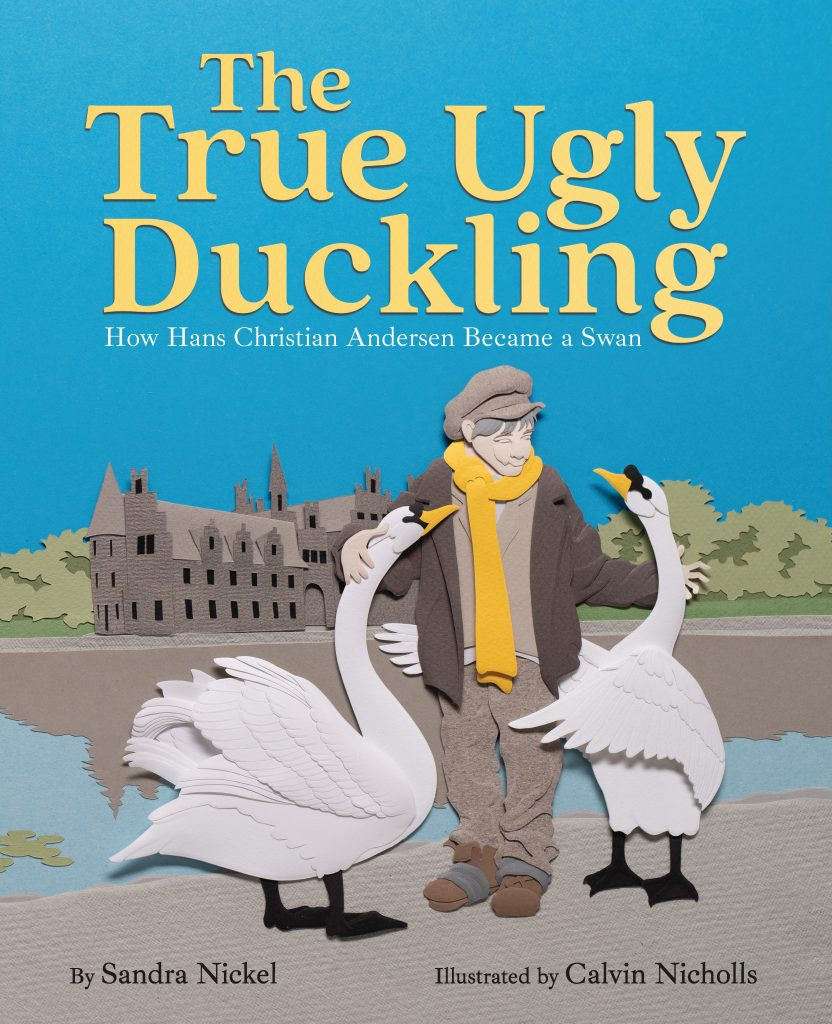
The True Ugly Duckling: How Hans Christian Andersen Became a Swan by Sandra Nickel, illustrated by Calvin Nicholls (Levine Querido, 32 pages, grades K-3). Hans Christian Andersen’s life is presented as a story that parallels his ugly duckling fairy tale. As a child growing up in a small town, he spent his days making up stories and creating costumes to act them out. While a few townspeople were kind, most made fun of him, and young Hans headed to the city of Copenhagen as soon as he could. There, he tried to make it as an actor, dancer, and singer, but he failed at each of these endeavors. Finally, a play he wrote caught the eye of a director who sent him to school. Teachers there made him put aside his storytelling in favor of Latin and history. After six long years, he was able to return to his stories, and although adults found them strange, children loved them. Hans Christian Andersen’s stories and cut paper illustrations earned him a place among the royalty of Copenhagen, and those stories live on today. Includes an author’s note with additional information about Andersen, including how her own autism drew her to write about the storyteller, who likely had both autism and Marfan syndrome.

This lightly fictionalized account of Hans Christian Andersen’s life would make a good introduction to a study of his work, with both biographical information and references to some of his well-known stories. The cut-paper illustrations are beautiful and mirror Andersen’s own work with paper.

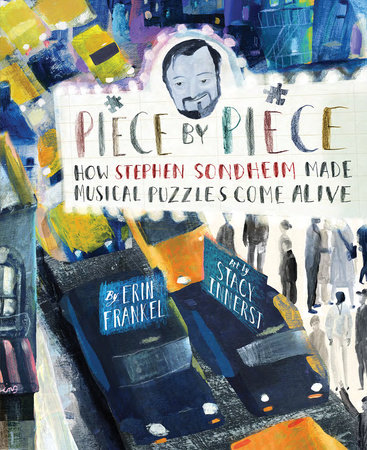
Piece by Piece: How Stephen Sondheim Made Musical Puzzles Come Alive by Erin Frankel, illustrated by Stacy Innerst (Calkins Creek, 40 pages, grades 2-5). Growing up in New York City, Stephen Sondheim was a curious kid who liked to figure out how things worked. When he saw his first musical, he was completely captivated by how the different pieces–music, story, dance–all fit together. After his parents split up, he and his mother moved to Pennsylvania, where he made a new friend Jamie, whose father, Oscar Hammerstein II, became Stephen’s mentor. Stephen wrote his first musical, By George, when he was 15. After college, he got a lucky break when he was offered the role of lyricist for the new musical West Side Story. That brought him enough recognition to start creating his own musicals, and Stephen Sondheim became a Broadway legend. Includes an author’s note, photos, a timeline of Sondheim’s life, and a bibliography.

Another good book for introducing the work of an artist, with a short enough story to easily read aloud but plenty of allusions to Sondheim plays in both the text and illustrations. The puzzle metaphor felt a little forced to me, but it did give me a deeper appreciation for all the parts of a musical that have to work together.

The beautiful game

Lionel Messi’s World Cup Triumph (History’s Greatest Games, book 1) by Chris Barish, illustrated by Nate Sweitzer (Harry N. Abrams, 136 pages, grades 4-8). This graphic nonfiction account of how Lionel Messi led Argentina to World Cup victory in 2022 is narrated by a sports commentator who takes readers through a brief history of soccer, then tells them about another Argentinian great, Diego Maradono, who was key to the 1986 World Cup win. From there, we go to Messi’s childhood, when his greatness in the sport was apparent from an early age. A growth hormone deficiency threatened his chances of becoming an athletic superstar, but he was recruited by Barcelona, who paid for the medical treatment his parents couldn’t afford. Lionel won every championship imaginable, except for the ultimate World Cup one, which eluded him for four tournaments. The 2022 final against France went into extra time and was finally decided by a penalty shoot-out. In a final chapter, two fans debate whether Maradono or Messi is the Argentinian G.O.A.T., with readers left to decide for themselves. Includes a list of sources.

There are probably few people on the planet who know less about soccer than I do, yet I found this book riveting right up until the end (and I wound up on Team Messi in the final debate). The quick pace and exciting play-by-play narration will keep fans turning the pages. I hope more entries in this series are on their way soon, as it’s sure to be a popular choice for upper elementary and middle school readers.

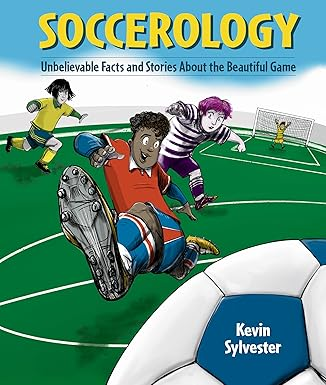
Soccerology: Unbelievable Facts and Stories About the Beautiful Game by Kevin Sylvester (Annick Press, 92 pages, grades 4-7). The author delivers on his promise in the introduction to look at all aspects of soccer: the good, the bad, and the ugly. Starting with the earliest forms of the game that go all the way back to 1600 BCE, he moves to the current era of soccer when a consistent set of rules was codified in the nineteenth century, and then the evolution of that game to the present day. The bad and the ugly parts involve the uphill battle women and people of color have faced (and continue to face) to get equal playing time, publicity, and pay, as well as various scandals and the way money has come to dominate the game. The book ends with a chapter of fun facts about soccer, including games that feature underdogs, all-time records, and quirky trivia. Includes selected references with websites for further reading and an index.

Again, I can’t emphasize enough how little I know about soccer, and there I was again, getting drawn into this book that’s chock full of fascinating information. Soccer devotees will want to read it cover to cover while more casual fans will enjoy browsing through the different sections. The selected references list includes plenty of places to look for further information.

American musicians

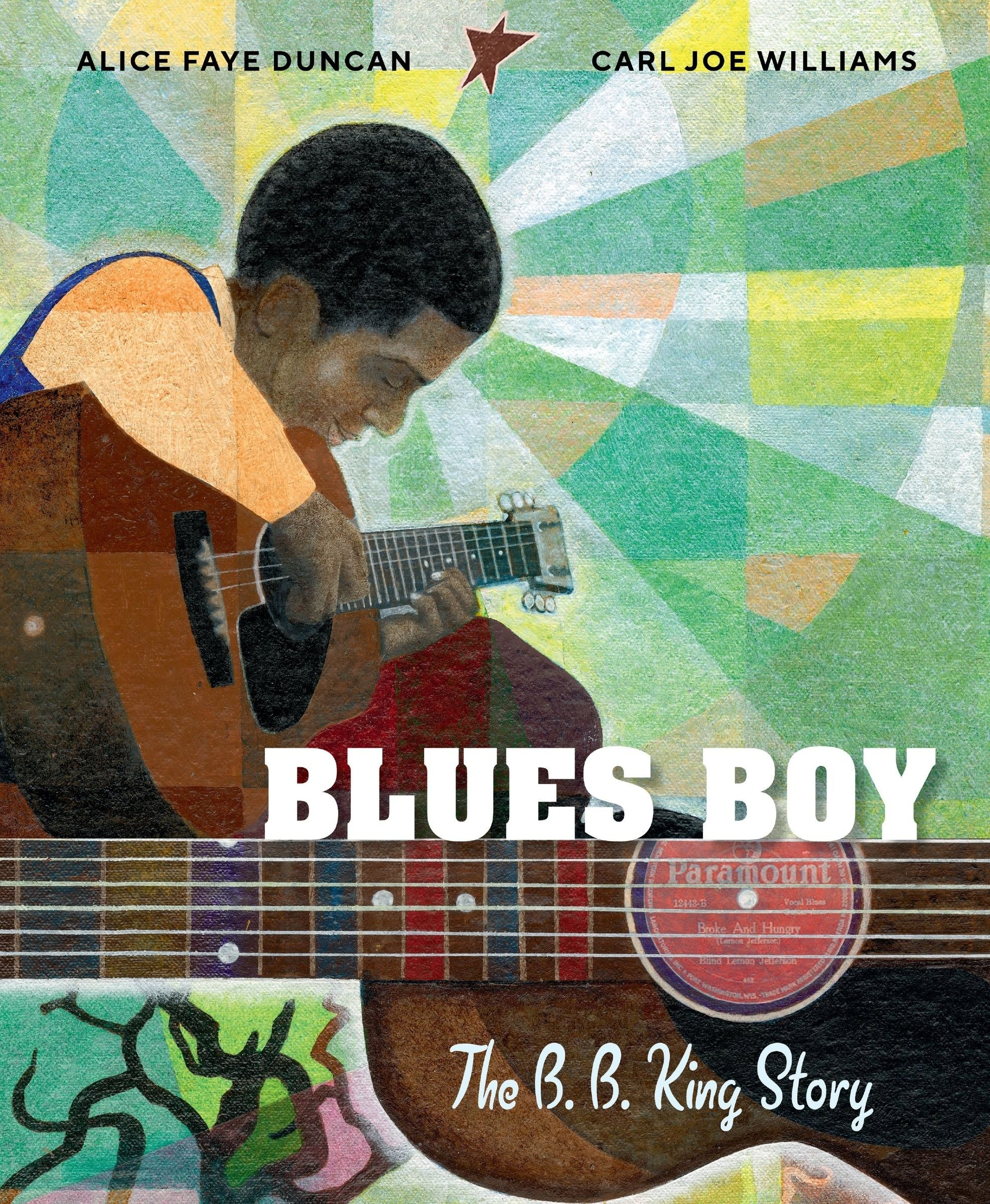
Blues Boy: The B.B. King Story by Alice Faye Duncan, illustrated by Carl Joe Williams (Greenwillow Books, 40 pages, grades 2-5). Young Riley King’s life in Mississippi during the Great Depression gave him plenty of material for singing the blues. His mother died when he was 9; he lived with his grandmother until she passed away when he was 15. He was bullied for his stutter and had to go to work in the cotton fields at a young age. But hearing blues records as a young teen inspired him to learn guitar and eventually choose a music career over the steady paycheck of a farm worker. Making his way to Memphis, he acquired a new name of Blues Boy, eventually shortened to B.B., and had his first hit in 1951 with “Three O’Clock Blues.” Following his mother’s advice to “do good and treat folks right,” B.B. soared to success, playing his blues music across the country 300 days a year. Includes a timeline, additional information, places to visit, and lists of books and music.

This biography of B.B. King shows the influences of his early life on his music, not only his tough personal life as a kid, but the effects of growing up in the Jim Crow South. Readers will be inspired to seek out “Three O’Clock Blues” as well as the other songs suggested in the playlist.

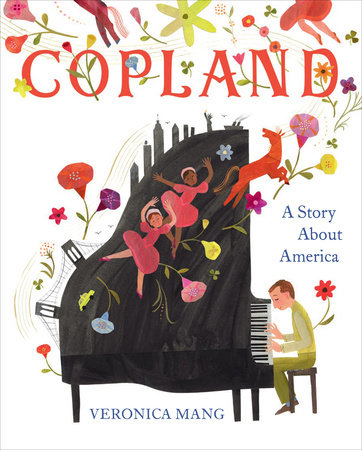
Copland: A Story About America by Veronica Mang (Viking Books for Young Readers, 40 pages, grades 2-5). The youngest of five children born to Russian immigrants in Brooklyn, Aaron Copland grew up with the music of New York City, jazz records, the klezmer sounds of the synagogue, and his sister’s piano. He particularly loved the piano and started his studies in Manhattan, moving to Paris at the age of 21, where he learned new ways of making music and looking at the world. Returning to New York, Aaron focused on making music that sounded like America. He was inspired by jazz and folk music, as well as by the protests and social movements of the 1930’s. He believed that his compositions for movies were just as important as those performed in Carnegie Hall. Aaron’s music still invites listeners to think about their dreams for America and a better future. Includes additional information and photos, an author’s note, suggested listening for kids, and a bibliography.

This biography does a nice job of celebrating Aaron Copland’s life and his vision for creating a uniquely American music. The illustrations capture scenes from Copland’s personal life as well as the America he lived in. Both books would make great introductions before sharing King’s or Copland’s music with kids.

Royal families

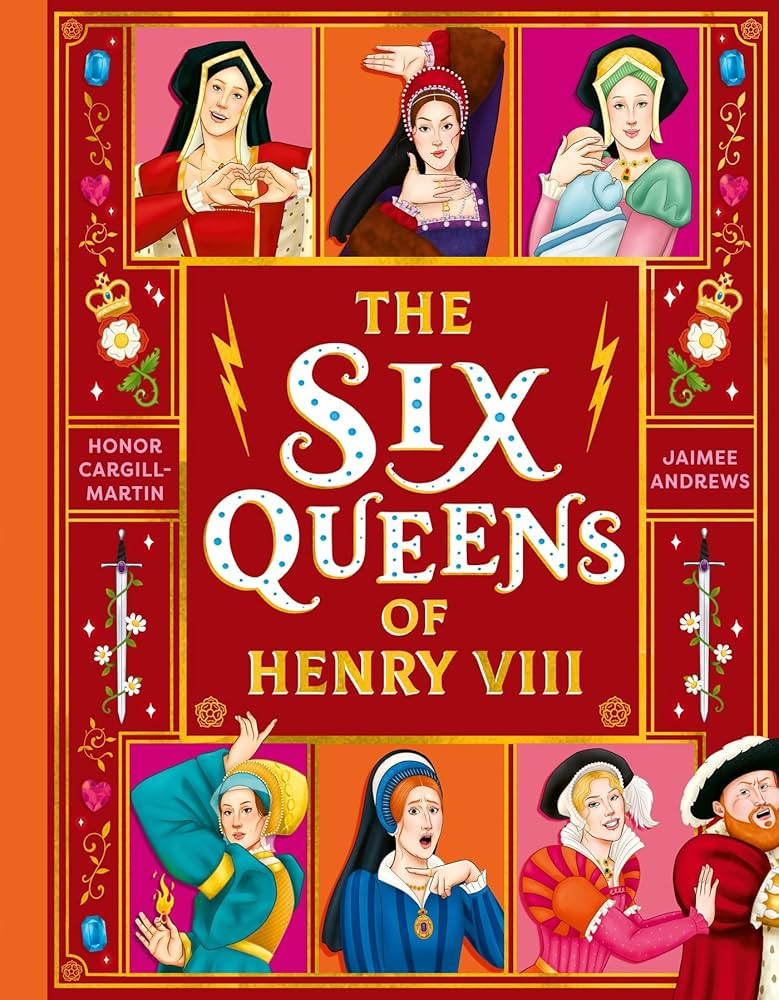
The Six Queens of Henry VIII by Honor Cargill-Martin, illustrated by Jaimee Andrews (Sourcebooks Explore, 48 pages, grades 3-8). “A Word from the Author” kicks things off by giving a brief history of the dazzling, exciting, and dangerous Tudor royal court of King Henry VIII, where six women caught the king’s eye, and, for better or worse, became queens of England. Each one is profiled with illustrations that resemble a graphic novel but contain a little more text. The emphasis is on the women, who are described as smart, educated, ambitious, and as powerful as they were allowed to be. As the author states in her introduction, “one led an army, one helped create a whole new church, and one was the first woman to publish a book under her own name in English.” After the facts of each queen’s life and marriage are given, there’s a two-page flashback scene that tells a story from the woman’s life showing her intelligence and/or courage. The book ends with a Tudor family tree, a timeline, and additional information about each of Henry’s three children, Mary, Elizabeth, and Edward.

Originally published in the UK, this book shines a spotlight on six brave, interesting, intelligent, and occasionally reckless women, relegating their husband to the background. The bold, brightly colored illustrations are lots of fun and help bring the story to life. Although there may not be a lot of interest in this topic in the US, hopefully the eye-catching cover will draw in readers who will not be disappointed.

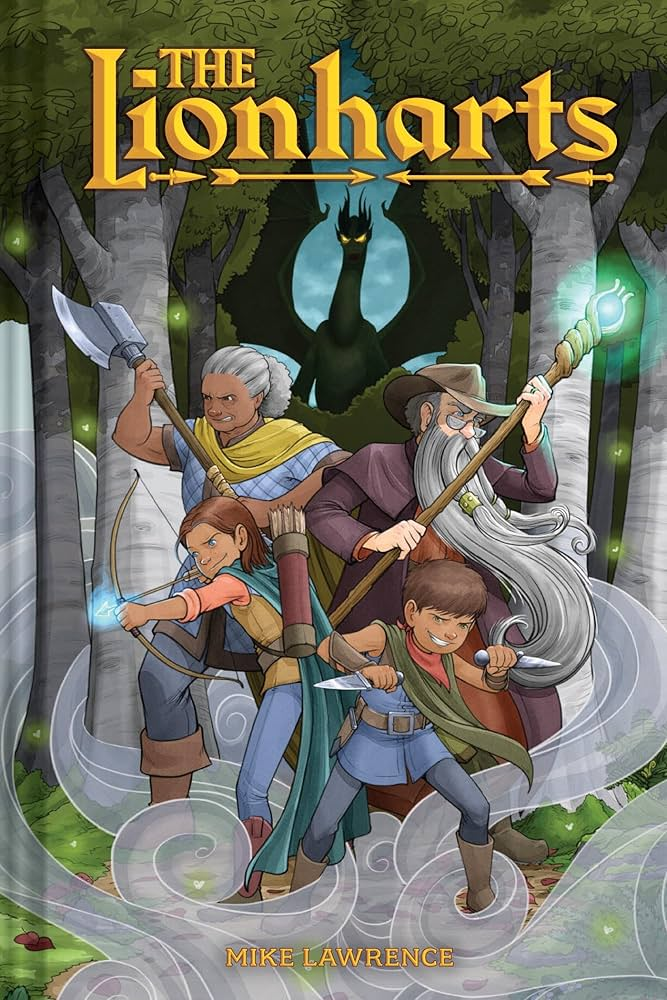
The Lionhearts by Mike Lawrence (Harry N. Abrams, 240 pages, grades 4-8). Flynt and Alder are the two sons of the renowned Lionheart family, known for fighting dragons and other troublesome creatures. While their grandparents are retired from active duty, they help out at home and with the business side of things so that the kids’ parents can go off on adventures. When the parents disappear after a mysterious woman shows up on their doorstep, the grandparents decide to come out of retirement to track them down. They insist that Flynt and Alder stay in the background, but the boys are having none of that, and when everyone realizes the enemy that they’re up against, it takes the courage, strength, and unique talents of all the Lionheart family members to defeat it. While there’s a satisfying ending for the good guys, there are also hints that their work isn’t done yet.

Although this isn’t about a royal family per se, it’s clear that the Lionhearts are treated with respect by the good people of their community and feared by the bad guys. The artwork and world building (which is based on Dungeons and Dragons) blew me away, and older elementary and middle school fantasy fans will love this graphic novel and be eagerly awaiting book 2.

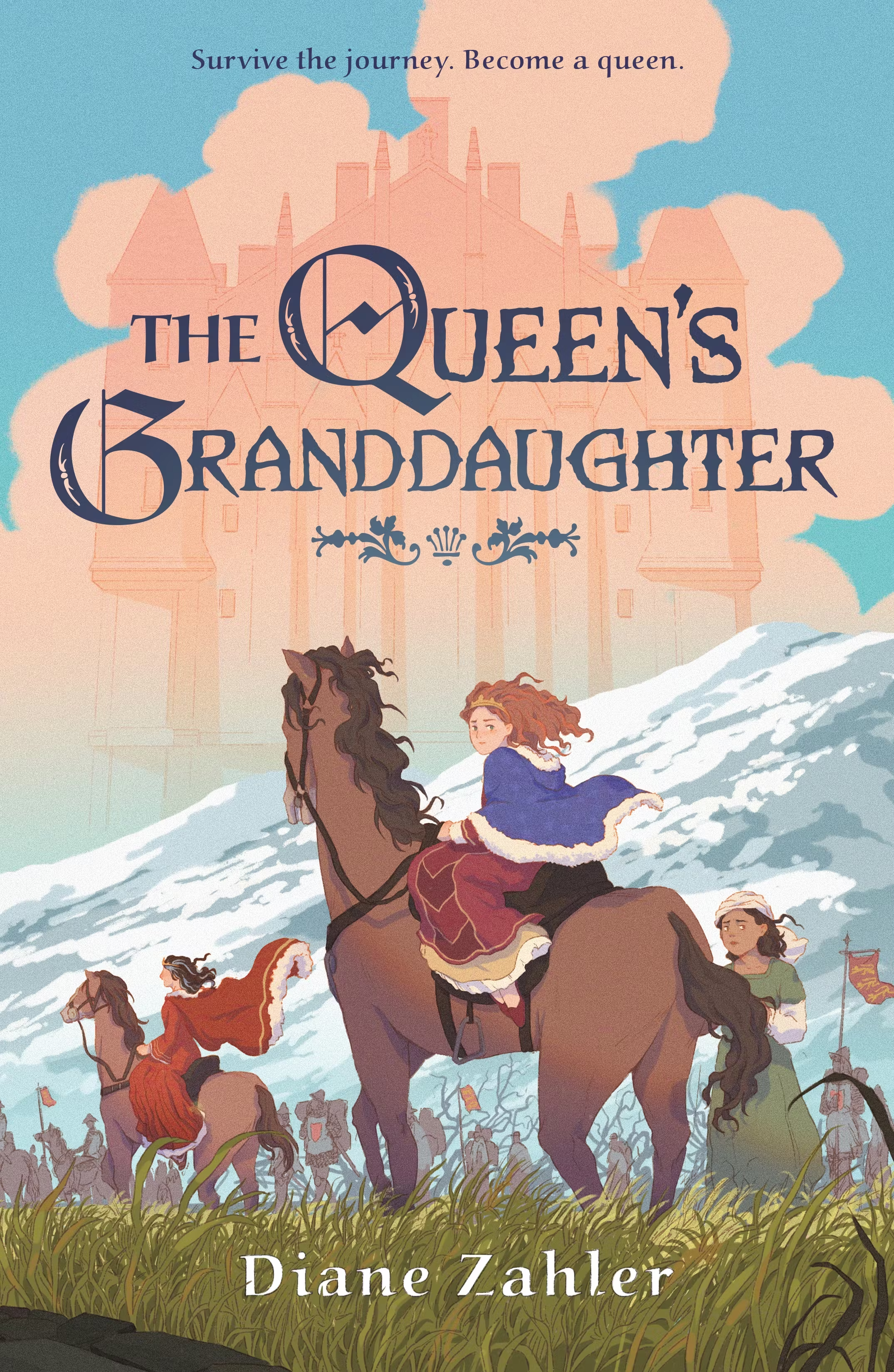
The Queen’s Granddaughter by Diane Zahler (Roaring Brook Press, 304 pages, grades 5-8). 12-year-old Blanca is excited to learn that her grandmother Eleanor (of Aquitaine) is coming to visit her family in Castille, allegedly to choose a wife for her son Prince Louis of France. Everyone is certain that Blanca’s older sister Urraca will be chosen, but at a great banquet, Eleanor makes the shocking announcement that it’s to be Blanca. Blanca is horrified to contemplate marriage, sad to leave her family, scared to move to France, but also intrigued and excited to be traveling to new places with her grandmother who is as bold and stubborn as she is. The only one from Castille who is to go with Blanca is her best friend Suna, a Muslim girl who has lived at the castle since her father died in service to the king. The travelers set off on their journey, where they face a series of dangers including a deadly blizzard and vengeful kidnappers. As she meets these challenges head on, Blanca begins to think she may have what it takes to be a queen. By the time they reach the last leg of the journey, it’s apparent that Blanca must travel to Paris alone. While she is sad to leave Eleanor and Suna, she now knows that she is ready to meet her fate. Includes additional information about Eleanor of Aquitaine, Blanca (or Blanche, as she became known), and Europe in the late twelfth century, including facts about Muslims like Suna.

It may be a challenge to convince middle schoolers to try an historical fiction novel set in the Middle Ages, but once they get to know Blanca, Eleanor, and the many other interesting characters, they’ll be hooked. The plot moves along briskly, particularly once the big journey begins, and there is plenty of page-turning adventure. I knew just about nothing about this time period, but there’s plenty of history seamlessly woven into the narrative that had me researching and learning more about the time and the people in the story.

Magic in the air

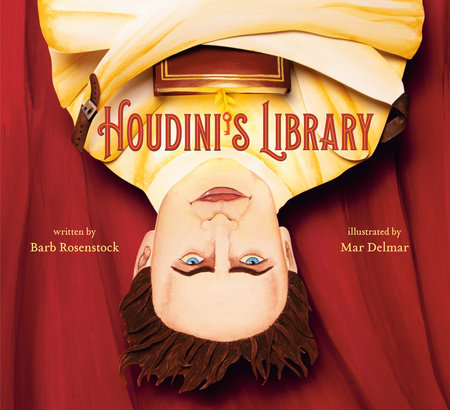
Houdini’s Library: How Books Created the World’s Greatest Magician by Barb Rosenstock, illustrated by Mar Delmar (Knopf Books for Young Readers, 48 pages, grades 2-5). As the son of a rabbi, Erik Weisz loved poring over his father’s collection of books. After the family moved from Hungary to the U.S., they fell on hard times, and Erik’s dad had to sell off his library. Young Erik (or Ehrie, as he was known in America) used the money he made working in a factory to buy his own books. A ten-cent book by Jean Robert-Houdin, Father of Modern Magic, changed his life, and he started collecting books that taught him how to do magic. The rest is early-twentieth-century-magic history, as Ehrie Weisz became Harry Houdini, master magician and escape artist. He used the money he made from that career to build a vast library of books and other memorabilia related to magic and was a voracious reader all his life. Includes an author’s note with additional information and photos of Houdini and an illustrator’s note about how she made the cut-paper illustrations.

Harry Houdini’s life and career are always fascinating to read about, and this biography really humanizes him, focusing on his early struggles and the way books launched his career and helped lift him out of poverty. The illustrations are truly amazing works of art, magically capturing both Houdini’s amazing stunts and his vast collection of books.

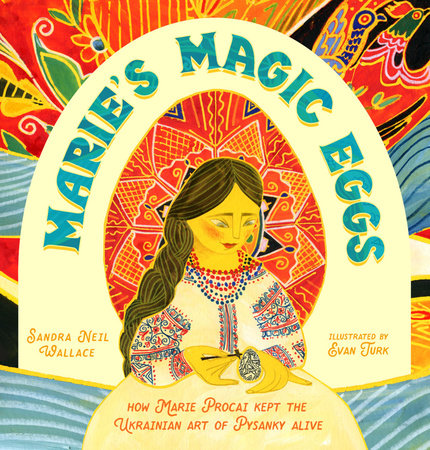
Marie’s Magic Eggs: How Marie Procai Kept the Ukrainian Art of Pysanky Alive by Sandra Neil Wallace, illustrated by Evan Turk (Calkins Creek, 48 pages, grades 2-5). As a child growing up in a Ukrainian village, Marie Procai loved making pysanky eggs with her grandmother every Easter. But when war and famine came to Ukraine, Marie followed her older brothers to North America. She settled in Minneapolis, where she married, raised a family, and learned how to continue the pysanky egg tradition in her Ukrainian community. When her son was killed in World War II, Marie channeled her grief into helping Ukrainian refugees and continuing her art. She and her family went on to open the Ukrainian Gift Shop, first in her living room and later in a Minneapolis store, where she sold pysanky eggs, supplies, and her own books about how to make the eggs. Her art reflects the legend that as long as pysanky are decorated, there will be good in the world. Includes an author’s note about her own connection to pysanky eggs through her Ukrainian heritage, plus additional information about Marie and pysanky, with photos, a pronunciation guide, a playlist, a list of museums and festivals that feature pysanky, and a bibliography.

Just in time for springtime and Easter, this fascinating biography shows how Marie Procai brought her art and love for all things Ukrainian to her adopted homeland, using it to build a community and help other immigrants. Evan Turk’s illustrations bring the eggs in all their colorful glory to rich, vibrant life.

A couple of how-to guides

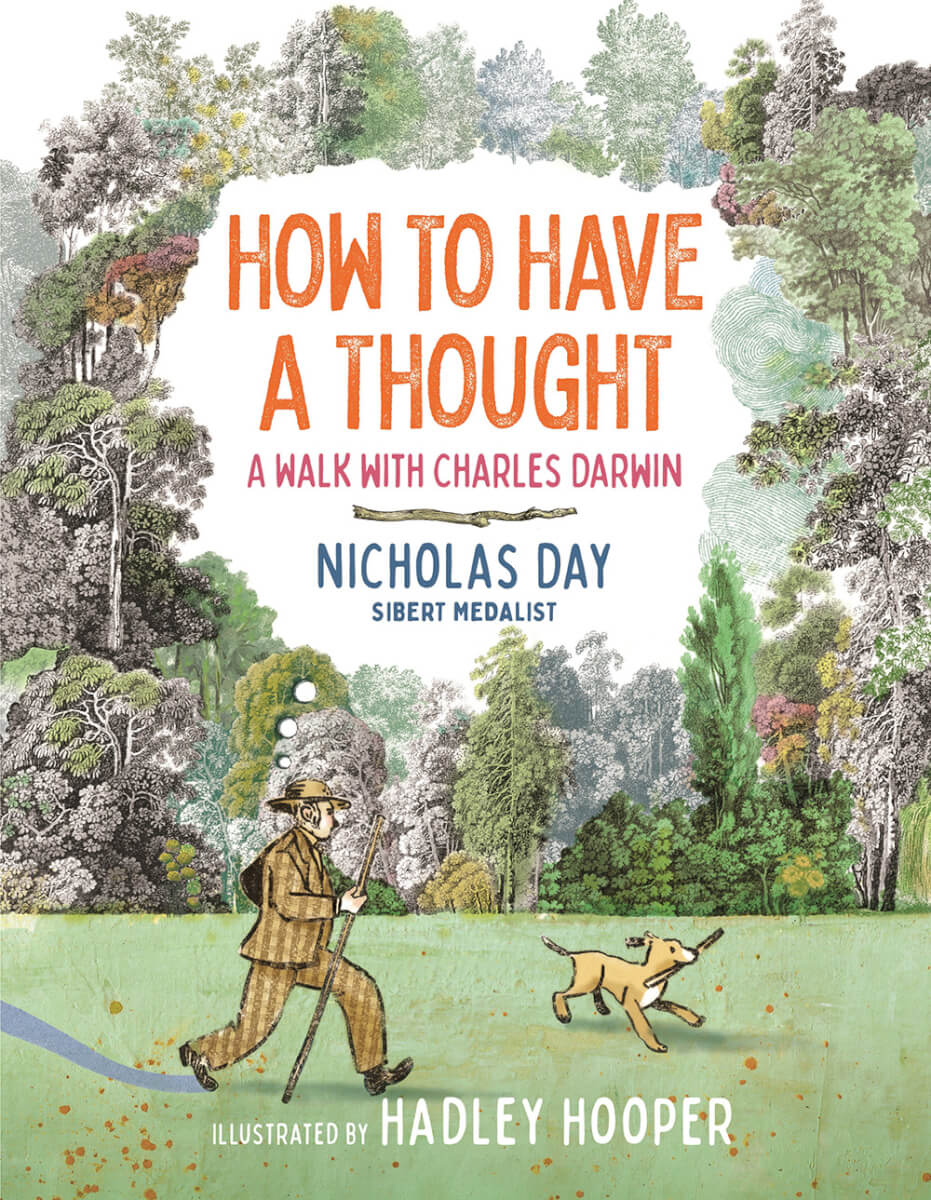
How to Have a Thought: A Walk With Charles Darwin by Nicholas Day, illustrated by Hadley Hooper (Neal Porter Books, 32 pages, grades 2-5). Start with some rocks, a stick, and a loop to walk. That’s all Charles Darwin needed for his walks. He would walk the loop and pile up the rocks to keep track of how many times he had gone around. And the whole time he walked, he was thinking. Thinking about what he had seen during his years traveling around the world on the Beagle: the fossil of a giant sloth, a flightless bird called a rhea (which he actually ate by accident), and the finches with subtly different beaks. As he walked and thought, Darwin slowly developed his ideas about natural selection. There have been many great walkers–William Wordsworth, Albert Einstein, Virginia Woolf, to name a few–and you can be one of them too, with your stick, your rocks, and your ideas. Includes a four-page author’s note with additional information about Charles Darwin and walking, and a bibliography.

I’ve loved Nicholas Day’s longer works that combined science, art, and history using a tone that invites readers to share in his discoveries. He’s done it again, this time with a picture book that focuses on Charles Darwin’s walking, then weaves in all kinds of interesting information about his work on natural selection and evolution and ends by including readers with those who can walk and have great ideas.

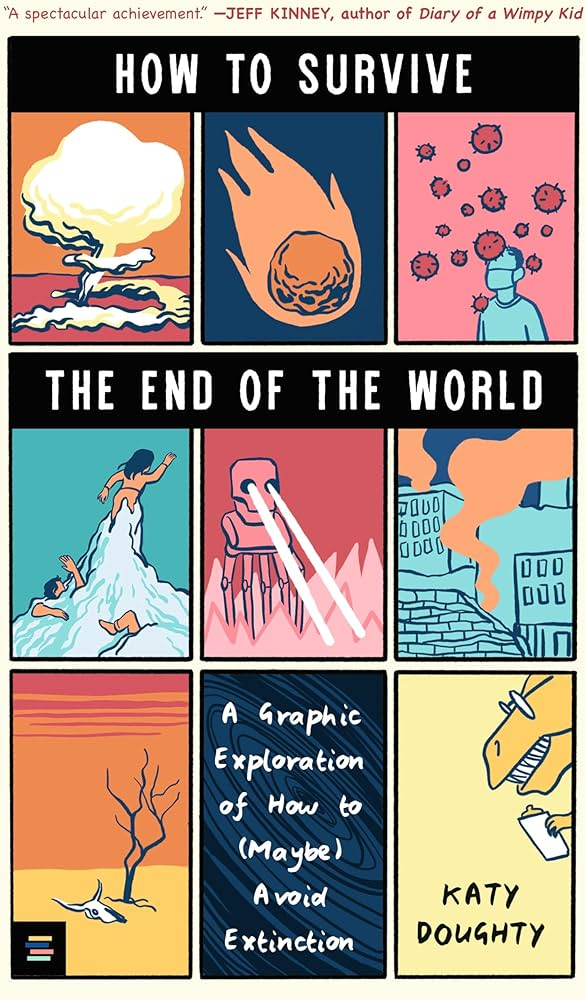
How to Survive the End of the World: A Graphic Exploration of How to (Maybe) Avoid Extinction by Katy Doughty (MITeen Press, March 31, 2026, 256 pages, grades 9-12). How will humanity end? Pandemic, nuclear winter, climate change? Katy Doughty takes a look at the history and possibility of each catastrophe in a way that is serious, yet optimistic enough to conjure up the will to keep going. Each chapter includes an “Ask an Expert” section in which a scholar of that particular topic weighs in. The final chapter, “The End?” is a brief but inspiring meditation on the courage required to face the possibilities of humanity ending and to look for your own role in possibly changing some of those outcomes. Includes a list for further reading, source notes, and a bibliography.

When this book arrived in the mail for a preview, I felt some existential dread at opening the front cover, but I forced myself to read the first chapter (Plagues and Pandemics), and was pleasantly surprised by how interesting and thought-provoking it was, with the illustrations making it a pretty quick and engaging read. The end of humanity may lurk at the back (or front) of all our minds, and teenagers experiencing this angst for the first time will find some interesting and hopefully inspiring reading here.

Courageous Journeys

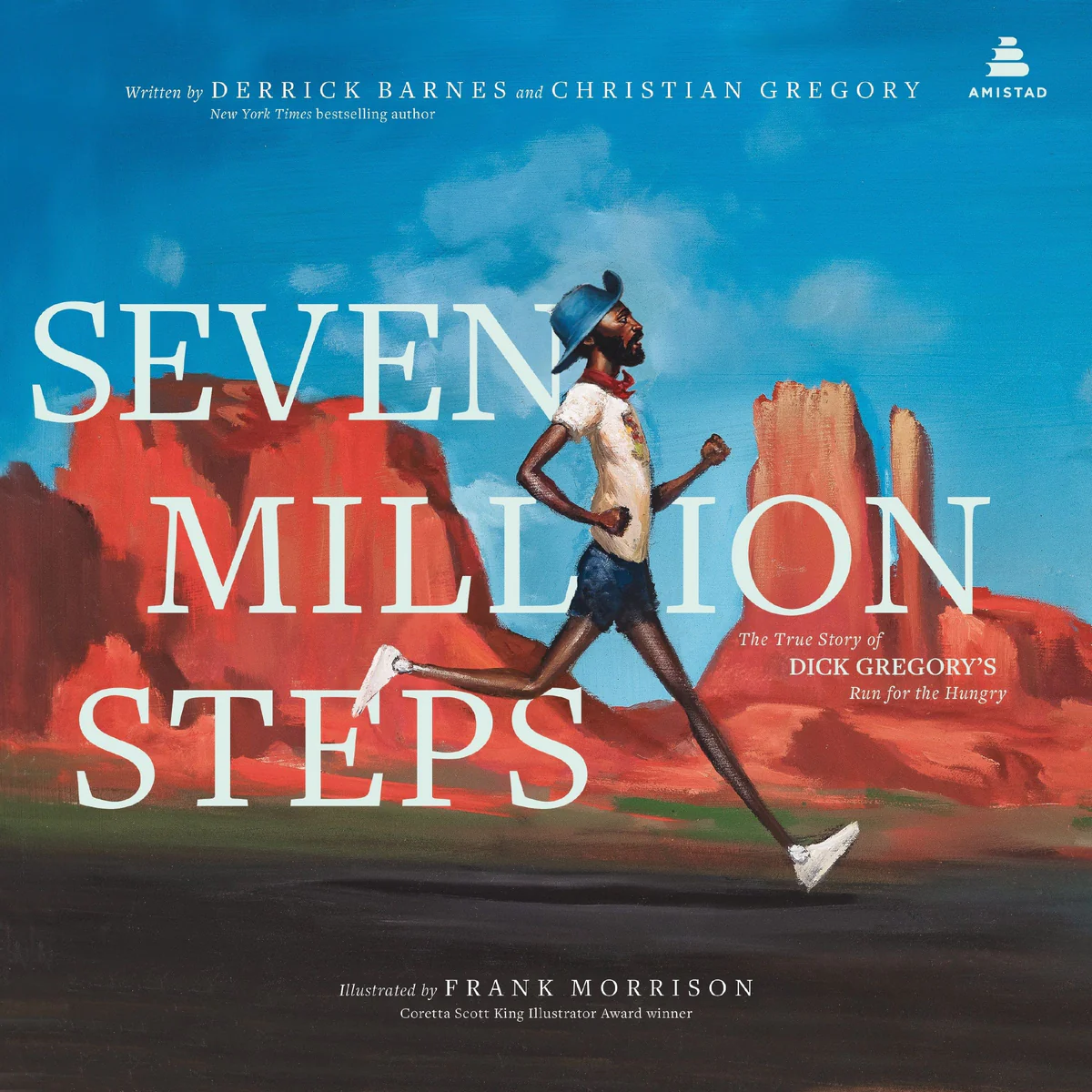
Seven Million Steps: The True Story of Dick Gregory’s Run for the Hungry by Derrick Barnes and Christian Gregory, illustrated by Frank Morrison (Amistad Books for Young Readers, 40 pages, grades 1-5). “What would you do if you knew someone who goes to bed every night without having supper?” This opening question is answered by an account of Dick Gregory’s 1976 run from Los Angeles to New York City: you would travel thousands of miles with very little food, subsisting mostly on juice, vitamins, and water to bring attention to those who are hungry across the country. You would cover 50 miles a day across twelve states, talking to anyone who would listen about what you’re doing and why. You would overcome pain and hunger to cross the George Washington Bridge into NYC on the Fourth of July, the 200th anniversary of the United States. Includes additional information about Dick Gregory’s run and hunger vs. food insecurity, as well as notes from the authors (one of whom is Gregory’s son) and illustrator, and three photos from the run.

I finished this book with more questions than answers and ended up spending some time learning about Dick Gregory and this run. His story is inspiring and is told here in a way to get kids to think about actions they can take to make the world a better place. I loved Frank Morrison’s illustrations showing different vistas of America and capturing the highs and lows of the run. I did find the story a bit confusing, particularly the second-person narration, which draws the reader in, but doesn’t give a straightforward account of the events. If you’re reading this to kids, be prepared to answer some questions.

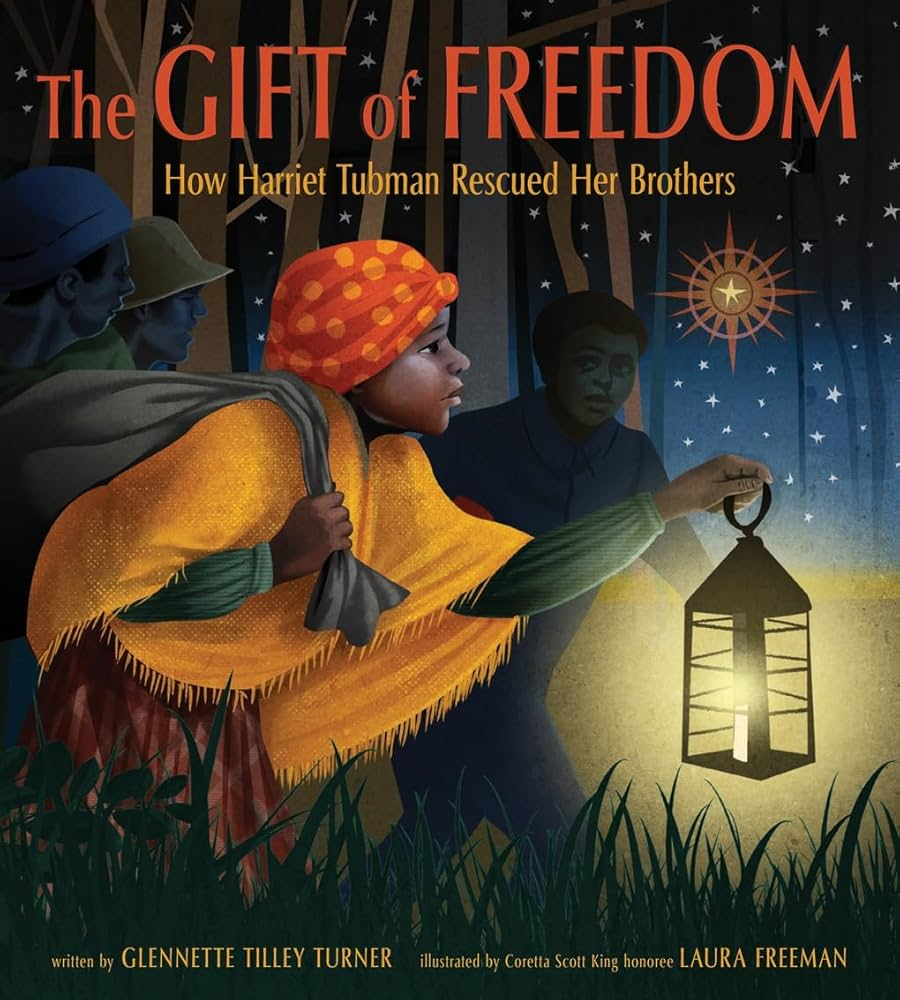
The Gift of Freedom: How Harriet Tubman Rescued Her Brothers by Glennette Tilley Turner, illustrated by Laura Freeman (Harry N. Abrams, 40 pages, grades 2-5). Starting with Harriet Tubman’s own escape in 1852, this book focuses on how Tubman helped others in her family find their way to freedom, specifically her three brothers. Her plan was to travel to Maryland at Christmas in 1854, when they were given permission to gather for a family Christmas dinner. The siblings met in secret at their parents’ home, where they were helped by their father, who averted his eyes or blindfolded himself so that he could honestly tell anyone who asked that he had not seen them. Following the familiar routes and safe houses that she had learned about, Harriet led her brothers to Philadelphia, where they were given new identities and put on a train to Canada. Includes a selected bibliography, a letter to readers, and an author’s note, which emphasizes how Harriet Tubman always learned as much as she could and befriended people with skills she lacked to allow her to be as successful as possible.

This compelling story with its striking illustrations offers plenty of drama and shows Harriet Tubman’s courage and skill that allowed her to help so many people escape slavery. The author’s note lists her other accomplishments helping to fight in the Civil War and working for women’s rights. The ending felt a bit abrupt, and there was no follow-up to the mention of Tubman’s attempts to rescue her husband, and I had to learn via other sources that he remarried and chose to stay in Maryland.

Two writers’ beginnings

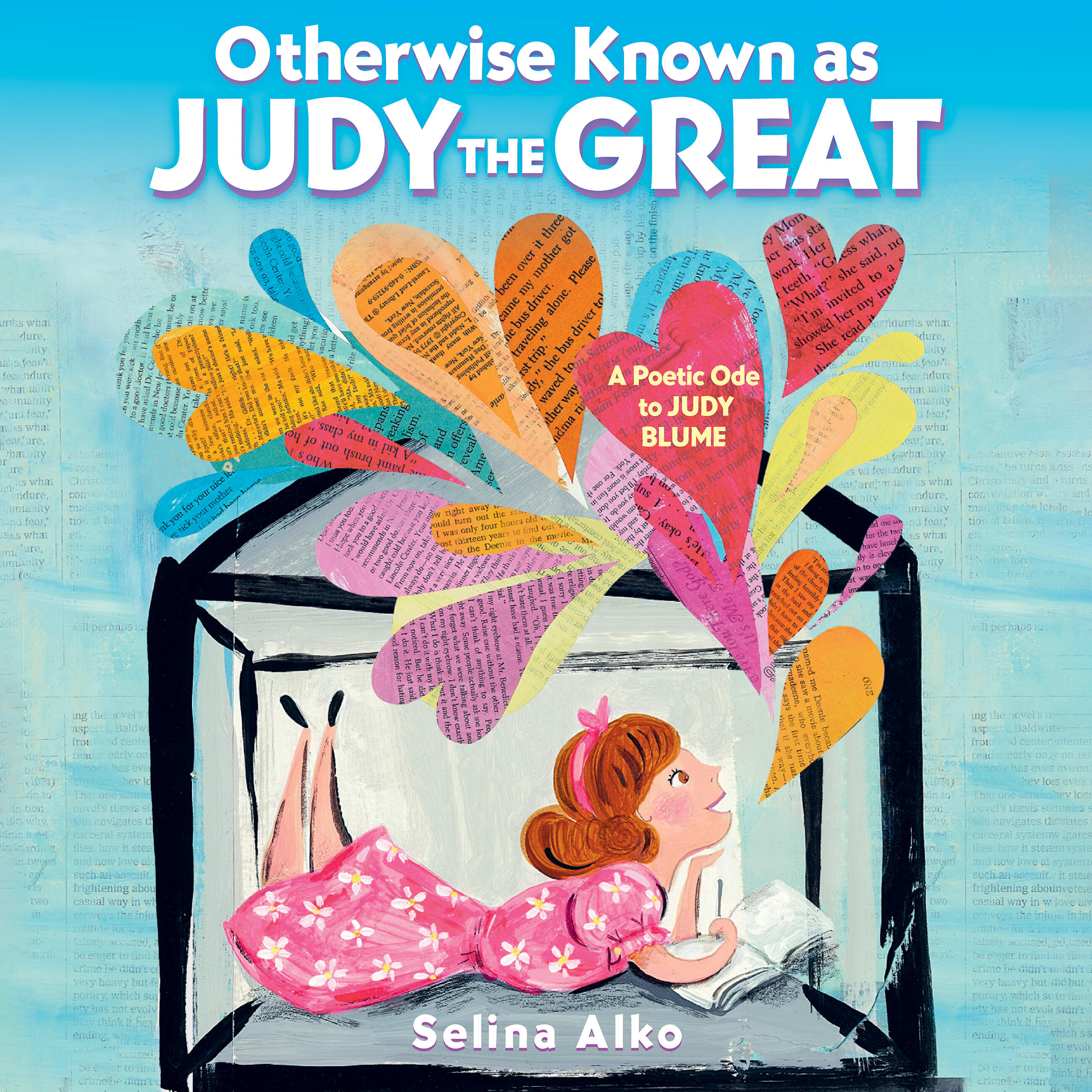
Otherwise Known as Judy the Great: A Poetic Ode to Judy Blume by Selina Alko (Christy Ottaviano Books, 48 pages, grades 2-6). This collection of poems traces Judy Blume’s life from her birth in Elizabeth, New Jersey in 1938 to her earliest days as a writer, when she started creating books based on her own childhood and that of her two children. In between, readers will learn of some of the influences on Judy’s books: her fears growing up in a Jewish family during World War II and worries about her fathers after several of his siblings passed away; her questions about growing up and her changing body that she and her friends (the Pre-Teen Kittens) explored together; and her quest for freckles that drove her to mix up a crazy concoction to try to make them appear on her face. The author’s note tells more about Judy’s life and career, as well the influence Blume’s books had on her own adolescence.

Poems and evocative illustrations show how Judy’s early years influenced her writing. Fans will enjoy learning about scenes from her life that were later turned into books and be inspired how she took seemingly ordinary events from her childhood to tell stories that so many kids rcan elate to.

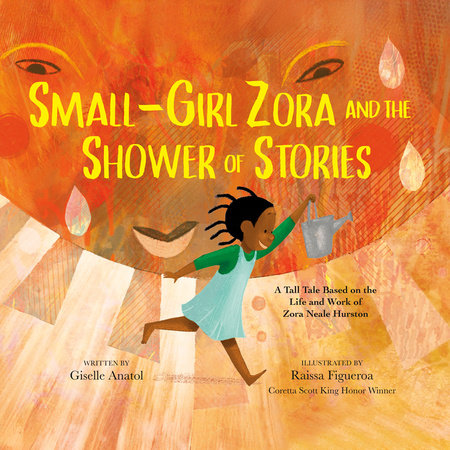
Small-Girl Zora and the Shower of Stories: A Tall Tale Based on the Life and Work of Zora Neale Hurston by Giselle Anatol, illustrated by Raissa Figueroa (Viking Books for Young Readers, 32 pages, ages 4-8). Small-Girl Zora loves telling stories and is unfazed when people like her father tell her to be quiet and more ladylike. She travels around her small town, sharing her tales and trying to collect the tears of laughter they elicit to help her family during a drought. Even though reactions are mixed, there’s enough positive feedback for Zora to keep going, and as she heads for home, she can hear the influence of her stories as she feels the first drops of rain on her skin. Includes a two-page author’s note with additional information about Zora Neale Hurston and the stories she wrote that are woven into this tall tale.

This enchanting tale, told in a style that evokes Hurston’s works, is an engaging introduction to the writer and her stories that can be enjoyed by both younger readers and older ones who are more familiar her writing. Her hometown of Eatonville, Florida is lovingly portrayed in the gorgeous illustrations, as are some of the characters from her stories.

All kinds of art

Making Art by Diana Ejaita (Rise x Penguin Workshop, 32 pages, ages 4-8). “Let’s look around and make some art,” begins this introduction to all different aspects of art. You can make new things or create from old things. It’s important to listen to your feelings, and those feelings can be communicated through your art. It can be difficult (and frustrating) to come up with ideas for your art, but then sometimes inspiration will strike like magic! Works of art can be given away or kept as a gift to yourself. No matter what, art adds beauty to the world, so thank you for your art!

This introduction to art could be used for anyone from a preschool class exploring art for the first time to a group of retirees rediscovering their creativity. The message is simple, yet wise and universal, and invites anyone to use art to express themselves. The illustrations portray a wide range of visual arts, as well as music, dance, and writing.

A Knot Is Not a Tangle by Daniel Nayeri, illustrated by Vesper Stamper (Knopf Books for Young Readers, 48 pages, grades 1 and up). A boy narrates the process of creating a Persian rug with his grandmother in Iran. “All of this takes weeks, but in my memory, it’s one long wonderful day.” In that day from his memory, he and his grandmother wash, card, and spin wool that his grandfather has sheared from their sheep. They dye it and plan the pattern and colors for the new rug on graph paper, then finally start knotting on the loom. The boy keeps wanting perfection, but his grandmother reminds him that the most important part of their rug is that it will become a place for the family to gather, just like the old one that they’re replacing has been. She even pulls one knot out, the “Persian flaw,” symbolizing that that there is no such thing as perfection. Finally, the new rug is done, and the old one gets moved underneath the loom, and “It feels just right to have it there.” Includes an author’s note with additional information on Persian rugs.

Award-winning author Daniel Nayeri has crafted a beautiful picture book celebrating an art form that will be new to many readers. The illustrations do a great job of showing the process of knotting–although, I’ll be honest, I still don’t really get it, but this may whet readers’ appetites to dig deeper. The message about tempering perfectionist tendencies is delivered gently by a wise grandmother who clearly values her heritage and enjoys passing it on to her grandson.

Can You Imagine? The Art and Life of Yoko Ono by Lisa Tolin, illustrated by Yas Imamura (Atheneum Books for Young Readers, 48 pages, grades 2-5). Yoko Ono spent her childhood moving between Japan and the U.S. during a time when she felt unwelcome in both places. After enduring wartime hardships in Japan, she moved permanently to the United States, where she studied art and music. Refusing to embrace norms in either field, she explored her own ways of creating art, which often involved audience participation designed to provoke thoughts and ideas. Her greatest fame came after she met and married John Lennon, when racism, misogyny, and the idea that she broke up the Beatles unleashed waves of public hatred toward her. After Lennon’s murder, Ono has continued to create art while working to preserve her husband’s legacy. Includes quite a bit of additional information about Yoko Ono and her art, as well as a bibliography.

I confess I grew up with a pretty negative impression of Yoko Ono, having absorbed the “she broke up the Beatles” message, but my daughter, an episode of the You’re Wrong About podcast, and now this beautiful book have helped me to see her in a completely different light. She had a pretty horrific childhood but instead of being broken by it, she emerged resilient and with a desire to work for peace through her art. It’s pretty clear that the Beatles broke themselves up, and this book focuses on the positive aspects of the Lennon-Oko collaboration. I’m grateful that this talented author-illustrator team continues the revisionist history, although it may be more appreciated by adults than children.

Pioneering women scientists

Magic in a Drop of Water: How Ruth Patrick Taught the World about Water Pollution by Julie Winterbottom, illustrated by Susan Reagan (Rocky Pond Books, 48 pages, grades 1-5). Encouraged by her father, Ruth Patrick grew up exploring woods and streams, fascinated by what she saw when she looked at her collections under a microscope. She went on to study biology, specializing in diatoms, the microscopic algae found in all bodies of water. Her questions about the effects of pollution on water led her to study both healthy and polluted streams, documenting all the life forms found in each, and discovering that pollution destroyed the balance of life that healthy water had. She became a lifelong advocate for clean water, including helping to write the Clean Water Act of 1972, and continuing to wade into streams and rivers just a few years before her death at age 105. Includes additional information, a timeline, and a bibliography.

Ruth Patrick lived up to her father’s advice to leave the world a better place than she found it, following her passion at a time when women weren’t particularly welcome in the scientific world and making many contributions to our understanding of water pollution and biodiversity. Her story is told in an engaging fashion, and the illustrations do a magnificent job of capturing Ruth’s work and her underwater observations, although I wouldn’t have said no to a slightly larger font for the text.

Through the Telescope: Mae Jemison Dreams of Space by Charles R. Smith, Jr., illustrated by Evening Monteiro (Orchard Books, 40 pages, ages 4-8). A young Mae Jemison peers through the telescope, dreaming of traveling into space. Rhyming text and illustrations explain what she sees: the moon, planets, constellations, and galaxies. As she looks, she imagines floating through space, and the final illustration shows an adult Mae in her astronaut suit standing behind the child. Includes ten facts about Mae Jemison.

This would make a good introduction to Mae Jemison for younger readers, and it includes quite a few astronomy terms and facts which they will find interesting as well. Like Mae Among the Stars, there’s very little biographical information. It would be great to get a longer picture book biography that gives a fuller picture of Jemison’s life.