Take Your Time: A Tale of Harriet, the Galapagos Tortoise by Eva Furrow and Donna Jo Napoli, illustrated by Laurel Molk

Published by Henry Holt and Co.
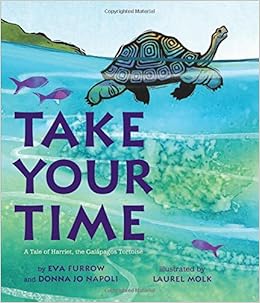
Summary:  Harriet is a Galapagos tortoise who enjoys taking life at her own leisurely pace.  Other animals tell her she’s too slow, but she is untroubled.  One day she decides to travel to a nearby island to see a penguin parade.  Although the parade doesn’t happen until summer, she leaves in the winter and enjoys a nice slow swim.  When she gets there, she has fun meeting other animals and taking in the sights.  A couple of years pass by, and Harriet decides it’s time to return home.  At the end of another deliberate swim, she meets a pod of dolphins, one of whom offers to give her a ride on his back.  Harriet tries it out, but doesn’t like the speed.  When she gets back to her island, she reflects with satisfaction on all the animals she’s met, and how each one moves to its own rhythm. An author’s note tells the story of the real Harriet, who lived to the ripe old age of 175, becoming the world’s oldest animal in captivity. 32 pages; ages 4-8.

Pros:  A fun and leisurely look at the life of a Galapagos tortoise, including quite a few other animals who live in that ecosystem.  The prints colored with watercolors are unique and beautiful.  Readers will be fascinated to learn more details of Harriet’s long life, and there’s a good lesson about finding your own rhythm.

Cons: Like Harriet, the story meanders without much of a plot.
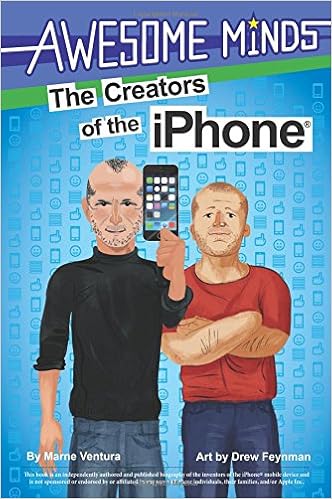
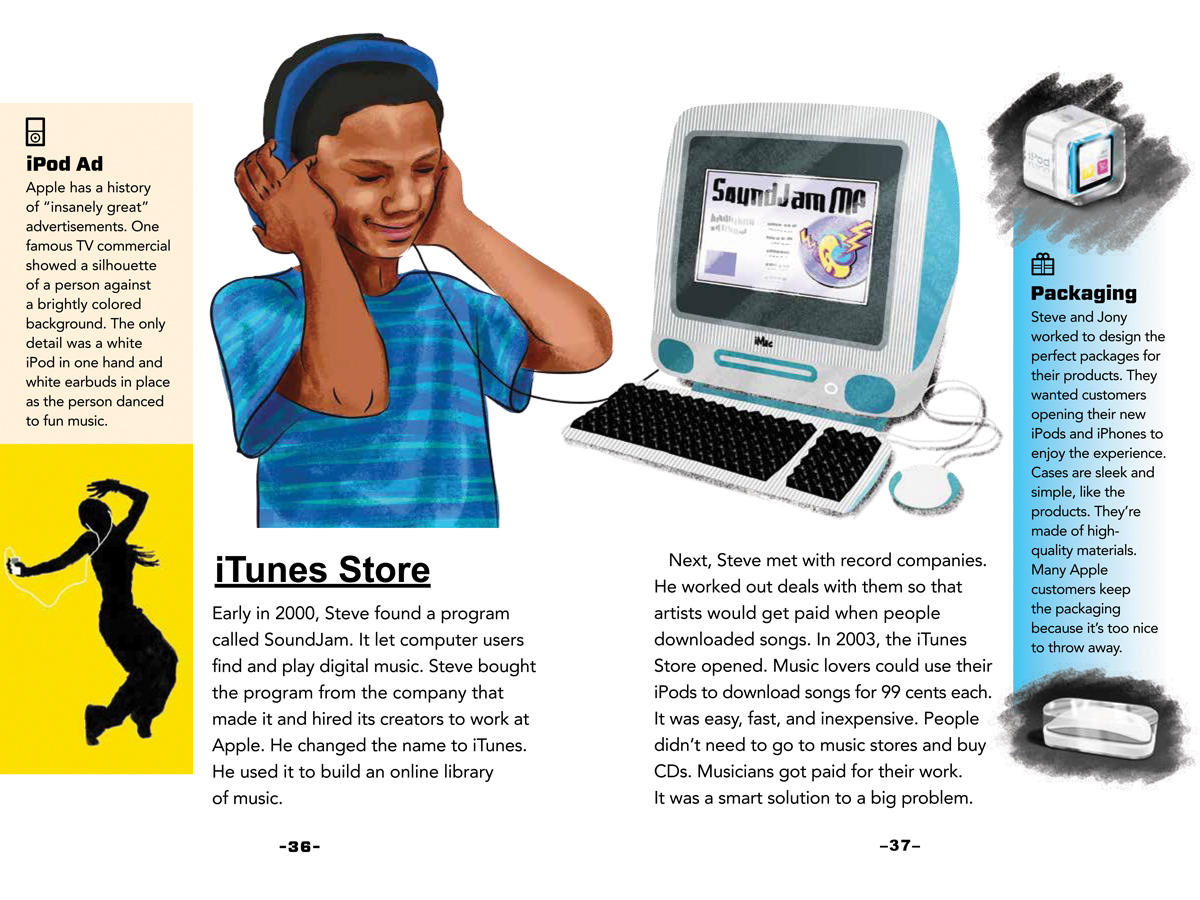
Awesome Minds: The Creators of the iPhone by Marne Ventura, art by Drew Feynman

Published by duopress

Summary:  We all take our smartphones for granted these days, but it wasn’t so long ago that portable phones were roughly the size and weight of a brick (at least it doesn’t seem that long ago to me).  It was the genius of Steve Jobs and industrial designer Jony Ive that created the first iPhone.  It was a long road to get there, though, beginning with the creation of the Apple company, and continuing with the many machines and software that came before the iPhone: personal computers in a variety of shapes and sizes, the iPod, iTunes, and more.  This book takes a brief look at the whole history, starting with the creators’ early lives, and concluding with Steve Jobs’ death and the iPhone today.  Includes a glossary, list of books and websites, and index. 56 pages; grades 2-5.

Pros:  A fast-paced, colorful look at a topic that’s sure to be of interest to kids.  The design is appealing, with plenty of sidebars and graphics .

Cons:  So much material is covered in such a short book that it sometimes seems disjointed and choppy.

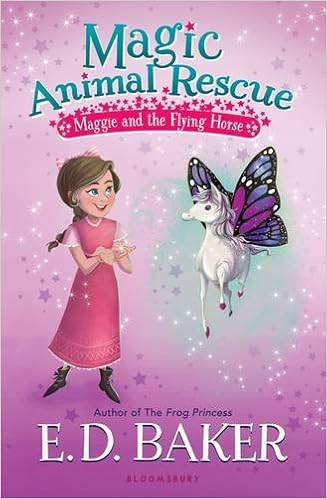
Maggie and the Flying Horse (Magic Animal Rescue book 1) by E. D. Baker

Published by Bloomsbury USA

Summary:  Maggie is a kind-hearted girl who lives in the Enchanted Forest with her father, stepmother, and many step-siblings.  Her father has to be away a lot for his job as a woodcutter, leaving Maggie at the mercy of her wicked stepmother.  Maggie’s greatest joy is finding magical animals in the forest.  When she accidentally injures the wing of a tiny horse-fly, she decides to go in search of the legendary Bob the Stableman, whom her grandmother has told her lives outside the castle and cares for magical creatures.  Defying her stepmother’s orders, she sets off to find Bob.  Along the way, she encounters a griffin, some goblins, and a nasty troll.  She makes it to Bob’s, though, and gets help for the horse as well as for herself.  Stay tuned for more adventures in book #2, Maggie and the Wish Fish.  128 pages, grades 1-3.

Pros:  Don’t be fooled by the page count–the font is large and there are lots of pictures.  Fans of Rainbow Magic and other fairy tales will be eager to read about Maggie and her magical animal friends, and the reading level is manageable for those just moving into chapter books.

Cons:  Maggie occasionally comes across as a bit of a goody-two-shoes.

Horizon (Book 1) by Scott Westerfeld

Published by Scholastic

Summary:  Four kids from a robotics team are traveling to a competition in  Japan.  Disaster strikes, and the plane crashes, most of the passengers ripped through the ceiling before impact.  There are eight survivors:  the robotics team, plus four other kids.  Before crashing, each of the survivors experienced a jolt that felt like a mind probe.  Although the plane was flying over the Arctic Circle, it has landed in the middle of a tropical jungle.  Before long, the teens discover dangerous birds and vines, as well as a mysterious device that allows them to adjust gravity.  There is one adventure after another as they struggle to stay alive in the jungle and try to figure out where they are.  Could it be another planet?  The cliff-hanging ending assures a sequel, most likely more than one.  256 pages; grades 4-7.

Pros:  Strong, intelligent characters and a fast-moving, action-driven plot will make this a popular choice for many readers.

Cons:  Given the premise, I didn’t find this to have the page-turning excitement as I was expecting.

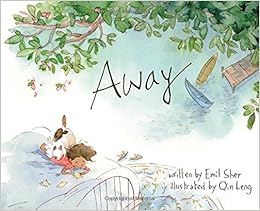
Away by Emil Sher, illustrated by Qin Leng

Published by Groundwood Books

Summary:  A young girl (who could also be a boy, but is referred to as a girl on the book flap) is worried about her first summer at sleepaway camp.  She and her mother have a lot to do before she goes, but they find ways to stay in touch through post-it notes.  The entire story is told through these brief messages.  The girl’s grandmother, Mimsy, arrives, and shows her pictures of her mother crying before she went to camp.  The mom replies that her tears didn’t last, but her memories did.  Finally, the big day arrives, and the girls goes off on the camp bus, with notes from her mother to write and have fun.  The penultimate page shows three post-its with these messages, “So far I have two new friends.  And 3217 enemies [accompanied by a picture of a mosquito].  Next year’s goodbye will be easier!”  And the final page shows the happy girl hugging her mother upon her return.  32 pages, ages 4-7.

Pros:  Kids will want to pore over the busy watercolor illustrations to understand all the details of the story.  The post-it notes are an unusual but effective way to show how a mom stays connected with her daughter despite their busy lives.

Cons:  A notation on the calendar reading “hearing aid battery” made me wonder if one of the main characters had a hearing loss (which would maybe explain all the written communication), but I couldn’t find any other evidence for this.

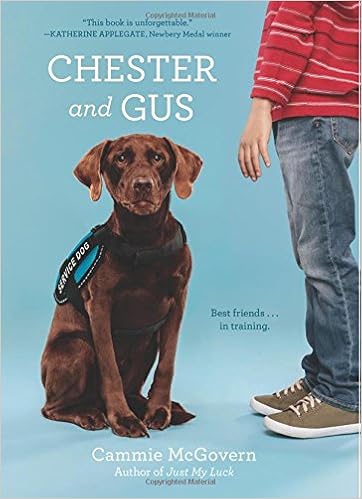
Chester and Gus by Cammie McGovern

Published by HarperCollins

Summary:  Since birth, Chester has aspired to be a service dog like his mother was.  He’s got everything it takes, except that he can’t overcome his fear of loud noises.  When a thunderstorm rolls in on the day service dogs are being chosen, Chester is left behind.  Instead, he is sold to a family with an autistic son, Gus.  Although he is brought into the family as a pet, Chester takes it upon himself to serve Gus.  Gus is almost completely nonverbal, but Chester can occasionally communicate with Gus through their thoughts.  Eventually, Chester is allowed to go to school with Gus, where the dog sees things that the humans are missing.  When the principal discovers Chester isn’t a certified therapy dog, he’s barred from the school, unable to help Gus when he’s beaten up by a bully with no witnesses around.  When Gus starts having seizures, his parents are at their wits’ end, but Chester may have the answer to turn the situation around and move Gus’s life in a positive direction.  272 pages; grades 3-7.

Pros:  Chester is funny and lovable, as one would expect of a dog narrator.  His insights about Gus and his parents will give readers a new understanding of severely autistic kids.  I flew through this book in two days.

Cons:  At times, Chester’s intelligence and communication with Gus strained credulity.  Also, I’m pretty sure dogs can’t perceive what’s on a TV screen to pick up the many lessons about humans that Chester does.