The Perfect Tree by Corinne Demas, illustrated by Penelope Dullaghan

Published by Harry N. Abrams

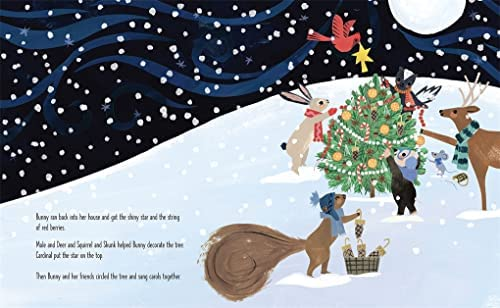
Summary:  Bunny goes out the day before Christmas looking for a tree that is just her size.  Along the way, she meets different animals who all have ideas about what makes the perfect tree: Squirrel says it should be bushy like his tail, Mole looks for a tree with a point like a mole’s nose, Cardinal thinks color is the most important ingredient, and Skunk says that it’s smell.  Each tree Bunny finds lacks one of those characteristics.  Finally, too cold to look any further, she heads for home.  To her surprise, she discovers the perfect tree not far from where she lives.  She runs to get her saw but can’t bring herself to cut the tree down.  The animals get together and decorate their outdoor tree, then gather around it to sing carols.  32 pages; ages 3-8.

Pros:  Kids will love this heartwarming Christmas story with its repeating text, adorable animals, and happy ending.

Cons:  The final tree doesn’t seem to fit Bunny’s criteria for being “just her size”.  

Scout Is Not a Band Kid by Jade Armstrong

Published by Random House Graphic

Summary:  Scout’s greatest dream is to go to AlmonteFest and meet her favorite author.  When she finds out her school band is going, she decides to join, pretending that she can play trombone.  The only other trombone player is Merrin, a dedicated player who is trying to get into an exclusive arts high school.  Merrin has been wanting to have first and second trombone parts and is annoyed that Scout is faking her way through all the music.  A disastrous concert forces a reluctant Scout to take lessons from Merrin, and much to the surprise of both girls, they discover they actually have quite a bit in common.  By the time of the festival, they’ve become pretty good friends.  A falling out on the trip reveals to both how much they need each other, and that having dreams come true isn’t always as important as having a best friend to count on.  Includes several pages from the artist showing how they developed the characters and story.  272 pages; grades 4-8.

Pros:  As I revealed a couple of years ago, I too was a band kid, so I always enjoy reading about the fun if slightly cringey world of teen musicians.  This particular ensemble has a pretty stellar cast of unique characters, and I found it satisfying to watch Scout gradually realize that her true friends are in the band.  Raina Telgemeier fans will enjoy this when they’re ready to move onto something a little bit edgier.

Cons:  Occasionally some of the characters looked like they were sketched in instead of fully drawn.  I think there was probably a reason for this, but I couldn’t figure it out.

Killer Underwear Invasion! How to Spot Fake News, Disinformation & Conspiracy Theories by Elise Gravel

Published by Chronicle Books

Summary:  In six chapters, Elise Gravel covers the bases of information literacy: fake news, disinformation, how social media spread such things, confirmation bias, and how to check for accuracy.  Her drawings and examples are funny, with cute monsters talking to each other about why doctors are bad, pollution is okay, and how drinking shampoo will make you healthy, but underwear might kill you.  The final chapter gives ten tips for telling real news from fake.  No back matter, alas.  104 pages; grades 2-6.

Pros:  This would make a great text to use for an information literacy class, using the humorous examples to springboard to real-life ones.  Kids will definitely be entertained, and there’s plenty of great information.

Cons:  Feels like librarians have been teaching this stuff for my whole twenty-plus-years-long career, yet the spread of disinformation is worse than ever.

Caves by Nell Cross Beckerman, illustrated by Kalen Chock

Published by Orchard Books

Summary:  Addressing the reader in the second person (“You want to go in…do you dare?”), the book introduces different features of caves, then shows unusual examples of each one in seven caves around the world.  There’s the Cueva de Los Cristales in Mexico, filled with 39-foot crystals that had to be pumped dry for people to explore. And the Bracken Cave in Texas, summer home to twenty million bats.  The realistic illustrations convey the magnitude of the caves, often showing how small the human explorers are in comparison.  Includes notes from the author and illustrator, lists of cave rules and spelunking equipment, and more fun facts about three of the caves.  40 pages; grades 1-4.

Pros:  The poetic text and gorgeous illustrations combine to make a nonfiction book that invites readers on an adventure, in the spirit of Candace Fleming’s Giant Squid or Jason Chin’s Grand Canyon.  I’d love to see this get some Siebert Award recognition.

Cons:  I wish that there were more fun facts about all of the caves mentioned in the book, not just three.

You Only Live Once, David Bravo by Mark Oshiro

Published by HarperCollins

Summary:  Middle school is off to a rough start for David. On one particularly bad day he messes up a presentation on his family heritage (he’s adopted), gets food poisoning before a big cross-country race, and causes an accident that injures his best friend, Antoine, ruining Antoine’s dreams of making the varsity cross-country team.  When he wishes for a do-over, he gets a visit from a wisecracking time-traveling dog.  Fea, as David nicknames her, is on a mission to help him straighten out his life. Reliving the most recent day doesn’t take care of it, so David has to travel deeper into his past. Fea also helps him acknowledge the romantic feelings he has for Antoine by sharing her regrets from her own life. It turns out she was once a human who loved a girl in high school but never had the courage to tell her.  The forays into the past start to reveal interesting clues about David’s birth and adoption, and everything comes together with a few surprising plot twists.  384 pages; grades 4-7.

Pros:  Although this story addresses the serious topics of being yourself and living life without regrets, it is also a ton of fun with a narrator who has a great self-deprecating sense of humor and a plot that adeptly handles the intricacies of time travel.  Betsy Bird has this on the fall edition of her Newbery predictions list.  We shall see in just a few short months.

Cons:  The plot twists at the end required some suspension of disbelief.

The Tower of Life: How Yaffa Eliach Rebuilt Her Town in Stories and Photographs by Chana Stiefel, illustrated by Susan Gal

Published by Scholastic Press

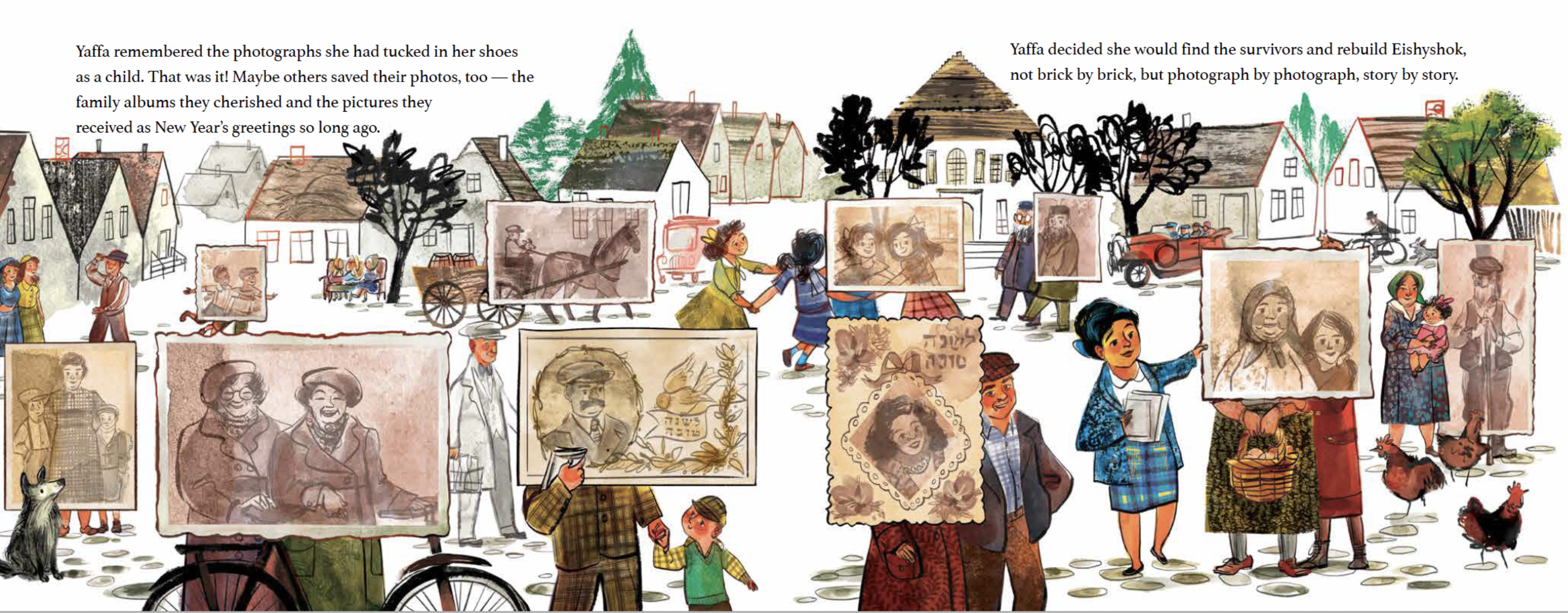
Summary:  Yaffa Eliach had a happy childhood in the Jewish town (shtetl) of Eishyshok, playing with her friends and older brother and helping her grandmother in her photography studio.  But when Yaffa was six years old, German tanks rolled in and the village, along with most of its inhabitants, was destroyed.  Yaffa’s family managed to flee and lived in hiding for the next several years.  They left their possessions behind except for a few photographs Yaffa hid in her shoe.  After the war, Yaffa moved first to Israel, and then to the United States, where she became a history professor specializing in the Holocaust.  When the Holocaust Museum was built in Washington, DC, President Jimmy Carter asked Yaffa to create an exhibit to show the lives of people who were lost.  Yaffa searched all over the world for photographs of people who had lived in Eishyshok.  Over the course of 17 years, she traveled to six continents to collect over 1,000 photos that were turned into the “Tower of Life” exhibit at the Holocaust Museum.  Includes a timeline of Yaffa’s life, a bibliography, and a brief author’s note.  40 pages; grades 1-4.

Pros:  An inspiring story of an amazing woman who emerged from tragedy to create a beautiful tribute that celebrates the lives of those who died in the Holocaust.  The illustrations capture those lives as well, incorporating photos into the paintings.

Cons:  I would have liked more information about Yaffa in the back matter.

Adventuregame Comics: Leviathan by Jason Shiga

Published by Harry N. Abrams

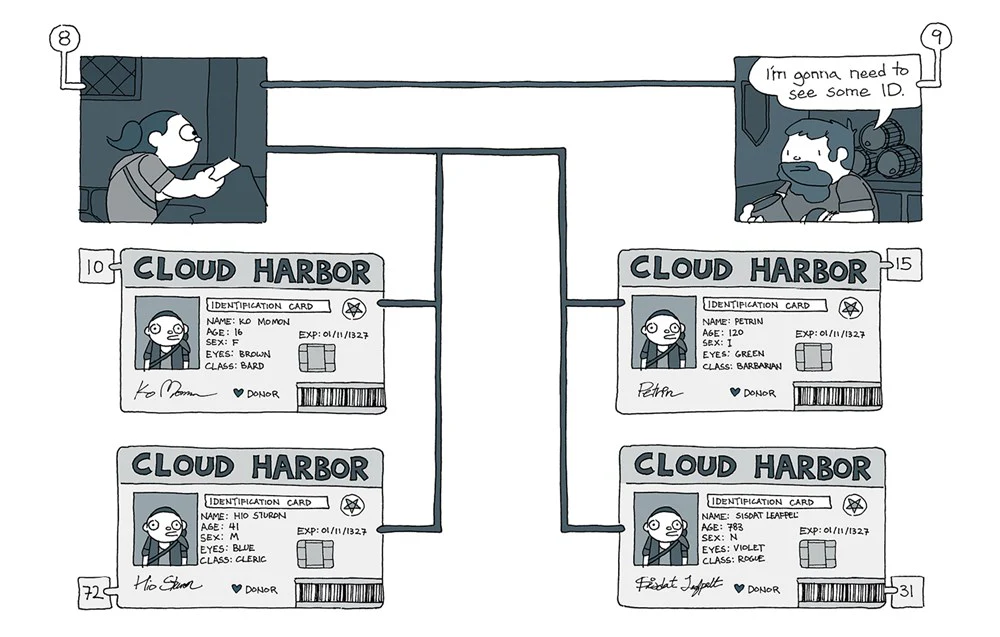
Summary:  In this choose-your-own-adventure graphic novel, a giant sea creature called Leviathan is terrorizing the villagers.  It’s up to you to find a way to defeat it.  On almost every page, a choice is given with page numbers attached to comic panels or different parts of the illustration.  Turn to that page to continue your story.  Be sure to read the first page before starting, as it contains important information about how to navigate your way through the book.  144 pages; grades 3-7.

Pros:  According to the author’s introduction, this deceptively small book contains hundreds of adventures.  Kids raised on video games are going to love going back and forth to discover the different stories.  I can’t even imagine creating this!  It’s billed as book 1, so look for more to come.

Cons:  Personally, the format of this just about drove me mad.  Guess I am a linear reader.

Going Places: Victor Hugo Green and His Glorious Book by Tonya Bolden, illustrated by Eric Velasquez

Published by Quill Tree Books

Summary:  Victor Hugo Green had a successful career as a mail carrier in Leonia, New Jersey, but he also liked to travel.  In the 1930’s, more people were buying cars and using them to visit new places.  Black travelers were less hassled in their cars than on trains, but they also faced Jim Crow laws that prevented them from using certain hotels, restaurants, and other establishments, and sundown laws that prohibited them from being in certain towns after dark.  Green used newspaper ads and articles and the knowledge of friends and co-workers to put together a directory of places that were safe to go.  Known as the Green Book, it started as a pamphlet in 1936, covering the New York City area, but continued to grow to cover the entire U.S. as well as Mexico and Canada.  In 1953, Victor Hugo Green retired from his postal career to spend his time running a travel agency and keeping up with the Green Book.  He died in 1960, a few years before the Civil Rights Act of 1964 made much of the Green Book obsolete.  Includes a timeline, selected sources, and a list of places to learn more about the Green Book.  40 pages; grades 2-5.

Pros:  This fascinating look at the man behind the Green Book weaves in plenty of details about the ways racism affected Black travelers for much of the twentieth century.  The vivid oil paintings bring traveling to life with their colorful postcards, reproductions of black-and-white photos, and maps.  Worthy of a consideration for a Coretta Scott King award or honor.

Cons:  While I was hoping to see a page from the actual Green Book, the illustrations offer only tantalizing glimpses.  Guess I will have to peruse the digital editions listed in the back matter.

Bessie the Motorcycle Queen by Charles R. Smith, Jr., illustrated by Charlot Kristensen

Published by Orchard Books

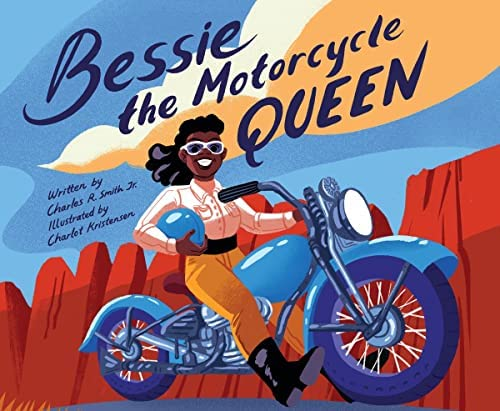
Summary:  A daredevil motorcycle rider named Bessie takes the challenge to ride the Wall of Death, fearlessly showing off with no hands and riding sidesaddle.  When she takes off her helmet, the audience is surprised by her “hidden brown face.”  The year is 1929, and a Black woman riding her motorcycle alone across the country faces potentially dangerous situations, especially in the Jim Crow south, where she outruns a truck full of angry KKK members.  But Bessie is undeterred, choosing her destinations by flipping a penny onto a US map, repairing her bike herself, and sleeping on it when she can’t get a room.  The word VROOM is repeated throughout the story as Bessie zooms off to her next location.  Includes additional information about Bessie Stringfield and a bibliography.  40 pages; grades 1-4.

Pros:  The bouncy rhyming text and beautiful illustrations tell an inspiring story about this little-known woman. Although kids may need some explanations about Jim Crow laws and the KKK, this would be a good Black history read-aloud for primary grades.

Cons:  Unfortunately, not much is known about Bessie, so facts about her life like her birthdate and hometown are uncertain.


Playtime for Restless Rascals by Nikki Grimes, illustrated by Elizabeth Zunon

Published by Sourcebooks Jabberwocky

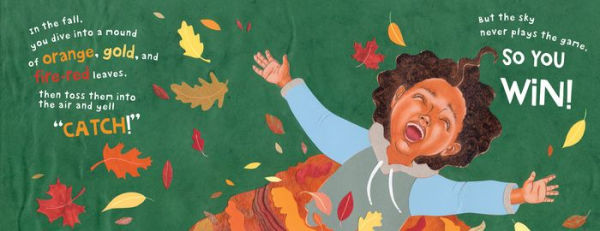
Summary:  In this follow up to Bedtime for Sweet Creatures, a mother wakes her child up by saying it’s time to get to work…which, for the child, is play.  There is playtime indoors and out, with different types of outdoor play depending on the season and the weather.  Afternoon brings imaginary play: tea parties, trains, trucks, and cars.  By late afternoon, Mom is ready for a nap, and the two snuggle briefly on the couch, but when Daddy comes home, it’s back to the business of play.  Finally, the parents sit together, watching their child: “Your job is called play, and your daddy and I both know, you’re an expert.”  32 pages; ages 4-8.

Pros:  A celebration of all types of play, empowering children to use their imaginations.  The collage illustrations add plenty of color, texture, and interest.

Cons:  It would have been nice to see some other kids join in the fun.