Oh, Sal by Kevin Henkes

Published by Greenwillow Books

Summary:  Sal Miller is four years old, the younger sister of Billy Miller, the protagonist of two previous Kevin Henkes books.  There’s a lot going on in Sal’s house right now, with a new baby sister who arrived on Christmas Eve, and a visit from Uncle Jake, who annoys Sal by calling her Salamander.  Sal’s favorite Christmas gift was a set of underpants, each one labeled with both a day of the week and a flower.  When she discovers that the Wednesday/Poppy pair has gone missing, she’s devastated.  Her mother promises that by the end of the day they’ll find the missing underwear and name the baby (who has been called “Baby” for a week).  This prediction comes true in a way that ties the two events together, and Sal decides that this bodes well for a happy new year.  240 pages; grades 1-3.

Pros:  As always, Kevin Henkes perfectly captures the small details of a child’s everyday life, creating realistic characters and situations.  I wish I had been as patient and kind with a new baby in the house as Mama and Papa are to Sal and Billy.

Cons:  While this has the look of a middle-grade novel, a book with a four-year-old protagonist may be a hard sell to elementary kids.
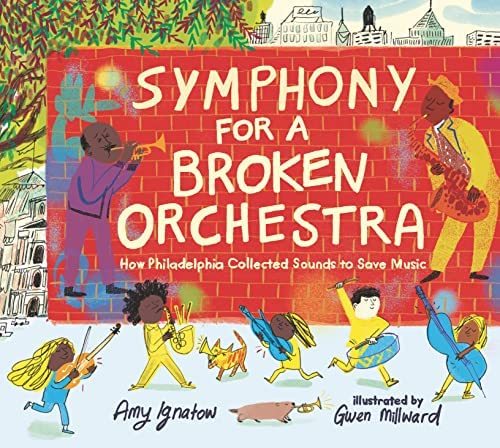
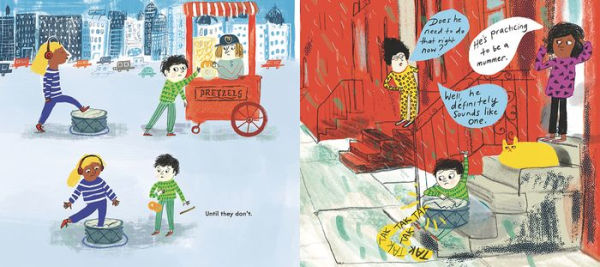
Symphony for a Broken Orchestra by Amy Ignatow, illustrated by Gwen Millward

Published by Walker Books US

Summary:  Kids love to play music, but what happens if their instruments break and families can’t afford to fix them?  Unfortunately, they often get locked away, and the students have to put their music education on hold.  Robert Blackson, the artistic director of Philadelphia’s Temple Contemporary, discovered some of these broken instruments in a closed city school.  He had the idea to get musicians to see what kind of music they could create with them, and the Symphony for a Broken Orchestra was born, using the money raised from the performance to buy new instruments for kids.  Includes an author’s note with additional information and a link to hear the performance as well as a note from Robert Blackson.  40 pages; grades 1-4.

Pros:  This true-life story provides plenty of inspiration and humor (the kids torturing those around them trying to play their broken instruments) with cute and colorful illustrations.  The performance is worth a listen. 

Cons:  Those not familiar with Philly’s Mummer’s Parade may not understand the reference made to the boy playing a broken drum.

A Leopard Diary: My Journey Into the Hidden World of a Mother and Her Cubs by Suzi Eszterhas

Published by Owlkids

Summary:  When Suzi Eszterhas hears about a pregnant female leopard living in Botswana, she decides to travel there to photograph her and her cubs.  The leopard, named Camp Female, is more relaxed around humans than most leopards, making opportunities for photographing more likely.  This book is written like a diary, from Suzi’s arrival on April 19 when the cubs are just a few weeks old, until February two years later, when those two are grown and living on their own, and Camp Female has a new baby.  Suzi makes several trips during that time, capturing the leopards on film as the play, hunt, and rest.  She also records other animals she sees on her trips, like elephants, giraffes, and baboons.  The narrative ends when the newest cub is still a baby, but Suzi promises she’ll be back to continue her work.  Includes an interview with Kambango, her guide and friend, and a glossary.  40 pages; grades 3-5.

Pros:  I’m always thrilled to see a new book by Suzi Eszterhas, because they’re so popular with kids.  And why not?  High quality photos of adorable animals and stories written engagingly for elementary students make a winning combination that is continued in her most recent work.

Cons:  Camp Female seemed like a pretty dreary name for a leopard, with not much improvement when she was renamed “Mom”. 

The Door of No Return by Kwame Alexander

Published by Little, Brown Books for Young Readers

Summary:  11-year-old Kofi has a good life as part of his West African community.  He finds his English-speaking teacher pretentious but likes to learn and enjoys hanging out with friends at school, especially Ama, the girl he has a crush on.  His cousin is his rival, and Kofi is preparing for a swimming race between the two of them that may determine his future with Ama.  When his older brother Kwasi accidentally kills a prince in a wrestling match, life begins to take some dark turns.  The prince’s family kidnaps both Kwasi and Kofi; Kofi is eventually shackled and crowded onto a ship (the door of no return) with others to be taken away from their homes.  A plot twist in the end leaves the readers in suspense, preparing the way for the next book in this planned trilogy.  Includes a Twi glossary and guide to Adinkra symbols that appear in the book.  432 pages; grades 6-9.

Pros:  Kwame Alexander has produced another masterpiece novel in verse that is sure to win some awards.  The transition from Kofi’s life in Africa to his captivity is stark, violent, and may be disturbing to younger or more sensitive kids, but the whole story adds so many important dimensions to the narrative of slavery.

Cons:  The story takes place in 1860, which seemed late to me.  I thought the slave trade ended well before that.  I wish there had been more historical notes at the end to explain what was going on at that time.

Murray Christmas by E. G. Keller and A Very Mercy Christmas by Kate DiCamillo, illustrated by Chris Van Dusen

Published by Harry N. Abrams

Published by Candlewick

Summary: Murray is a dog who takes his job as family protector very seriously. When the family starts doing odd things like bringing a tree into the house and hanging laundry by the fireplace, Murray tries to get things back to normal. He starts seeing a weird guy in a red suit everywhere, and then one night the guy appears in his house! Murray tries to get him out, and the ensuing chaos nearly ruins Christmas. But Santa turns out to be pretty helpful, and the two of them work to set things back to rights. Although Murray can’t figure out why this man doesn’t use the front door like everyone else, he’s happy to find a present waiting for him on Christmas morning…his own Santa hat. 40 pages; ages 4-8.

Many readers will be familiar with the characters and setting of A Very Mercy Christmas. Stella wants to go caroling, but the humans are all too busy. She heads down the street with Mercy and General Washington the cat and decides to try singing a solo carol. When the animals join in (in their own ways), they’re joined by Maybelline the horse. All the ruckus brings the humans out to join in, and then they all head back to the Watsons’ for some buttered toast. 32 pages; ages 4-8.

Pros: Kids are sure to get a chuckle out of both of these Christmas books featuring some pretty loveable animals and warm holiday spirit.

Cons: Those who haven’t read the Mercy Watson books may be a bit mystified by some of the characters and situations.

A Pilgrim-free Thanksgiving book list

With the Thanksgiving “history” we learned in school being largely debunked, many of the traditional holiday books no longer feel appropriate. Here’s a list of books I’ve reviewed over the years that focus on other aspects of the holiday, like family, feasts, and gratitude.

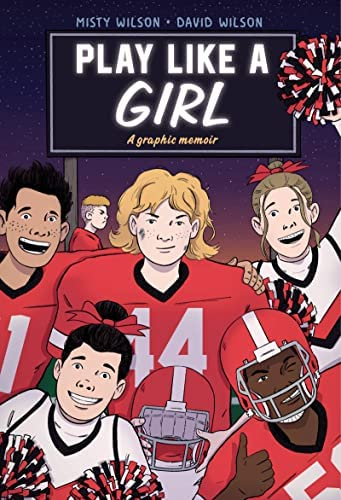
Play Like a Girl: A Graphic Memoir by Misty Wilson, illustrated by David Wilson

Published by Balzer + Bray

Summary:  Misty’s always loved competing with the boys, so when they tell her football’s not for girls, she decides to prove them wrong. It’s the summer before seventh grade, and she convinces her best friend Bree to sign up for seventh grade football with her.  Practices in the August heat are grueling, and the girls have to learn new skills like tackling and learning how to wear football pads.  It proves to be too much for Bree, but Misty sticks with it and becomes an important part of the team.  Most of the boys eventually accept her as a teammate, but a couple never do, which results in some uncomfortable situations.  In between practices and games, Misty deals with friendship issues, a crush on a teammate, and being part of a large blended family.  In the end, she learns the importance of being herself and surrounding herself with people who believe in her.  Includes an author’s note with some additional information about her football career.  272 pages; grades 3-7.

Pros:  This husband-and-wife team has produced an excellent graphic memoir that will inspire kids to try something outside of their comfort zones.  Sure to appeal to the many fans of the ever-growing middle school graphic novel genre.

Cons:  I was bummed that Misty quit football after seventh grade.

Your Pal Fred by Michael Rex

Published by Viking Books for Young Readers

Summary:  “Welcome to the future!”  “The future stinks” read two signs on the opening page.  The evidence is there in chapter one when brothers Pug and Plug are traveling through a post-apocalyptic world, each one only looking out for himself.  When they accidentally awaken an AI boy named Fred, they get a few lessons in friendship and sharing.  When Fred learns about the world war going on, he decides to take his lessons to the two warlords to try to negotiate a peaceful settlement.  Fred befriends everyone he meets in his travels, a gift that later is returned when he’s rescued from the warlords’ attempts to destroy him.  A surprising revelation unexpectedly brings peace, and Fred decides to wander the world, helping anyone who may need him.  Includes Fred’s six-step guide to making friends.  272 pages; grades 3-6.

Pros:  A graphic novel with equal parts fun and heart, as Fred’s unstoppable kindness saves the day in a grim future populated by all sorts of unusual creatures.  As I have mentioned, Mike Rex grew up down the street from me, and I appreciated his dedication, “To my father, who was, above all, kind.”

Cons:  Kindness does not always feel like its own reward here.

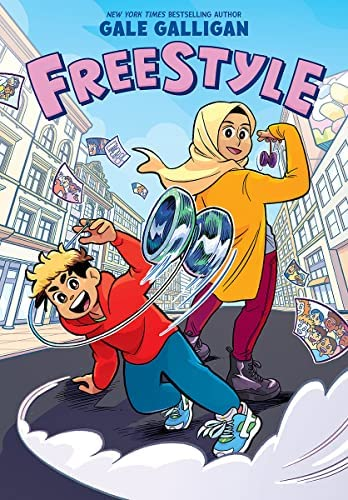
Freestyle by Gale Galligan

Published by Graphix

Summary:  Cory’s part of Eight Bitz, a dance team getting ready for the annual Bronx Kids Battle dance competition.  When progress reports come out, though, his straight C’s upset his parents, who insist that he cut back on dance and get a tutor.  That tutor winds up being Sunna, his science lab partner who Cory has dismissed as a nerd.  But when he accidentally discovers her passion for yo-yo’ing, he changes his mind completely.  Sunna proves to be a good tutor of both the yo-yo and the more academic subjects, and before long Cory has come a long way with both and earned his way back into Eight Bitz.  There are rifts within the team, including Cory’s new friendship with Sunna, and the eight kids have to work hard and compromise to keep the group together.  A yo-yo competition and the Bronx Kids Battle wrap things up, with realistic successes for everyone.  272 pages; grades 3-7.

Pros:  It’s graphic novels week after a bunch of them arrived for me at the library all at once. This one, from Baby-Sitters Club alum Galligan, is a high-energy middle school story with plenty of action and early teen angst.  The artwork beautifully captures the dance and yo-yo moves, and the kids do an admirable job of working out their differences pretty much without parental assistance

Cons:  There’s a good review on Amazon by a Muslim parent who mentions some of the ways Sunna is not accurately portrayed, including being alone with Cory in her bedroom and holding his hand when they dance together.

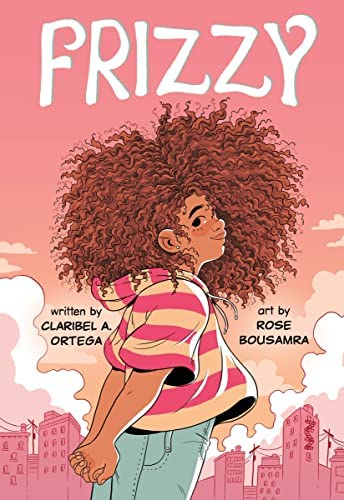
Frizzy by Claribel A. Ortega, illustrated by Rose Bousamra

Published by First Second

Summary:  Marlene’s curly hair has been the bane of her existence for the last several years, as her mother insists on the two of them making weekly visits to the salon to have their hair straightened.  Not only is this physically painful, but it makes Marlene feel like her natural look isn’t beautiful.  After a few disastrous attempts to style her hair on her own, Marlene gets into trouble and is sent to her tía Ruby for a weekend of gardening.  Ruby has fully embraced her Dominican heritage, including her hair, and she shows Marlene how to manage her curls and make them beautiful.  Marlene is nervous to show her new look to her mom, but it serves as a catalyst to a much-needed conversation that brings them closer together.  224 pages; grades 3-7.

Pros:  Marlene is a character many tweens will relate to, torn between wanting to fit in, wanting to please a parent, and wanting to be herself.  This graphic novel also has a great message about the Eurocentric standard of beauty and embracing beauty from all cultures.  

Cons:  I always enjoy a good subplot or two, but this story stuck pretty closely to the main hair-related plot.