May is Asia American and Pacific Island Heritage Month. To celebrate, I’ve put together a list of more than 50 fiction and nonfiction books. You can also access it by going to my blog and moving the cursor to Book Lists near the top of the page. A list will appear, and the AAPI link is the first one on the list.
Month: April 2023
Kittens Are Monsters! (Pets Rule! book 3) by Susan Tan, illustrated by Wendy Tan Shiau Wei
Published by Scholastic


Summary: Ember is a chihuahua who believes he is in training to become a Dark Lord and one day rule the world. One night a strange orange cat shows up with an assignment: if he looks after her kittens for a week, teaching them everything he knows, she will give him an army. Assisted by the other pets in the house and the neighborhood, Ember begins training the kittens, who turn out to have some ideas of their own. In between those adventures, Ember is trying to figure out the perfect birthday gift for his girl, Lucy. By the end of the week, the pets have defeated Ogre, the evil cat next door, figured out what to do for Lucy, and assembled an army…of kittens. The final page introduces a nemesis for Ember, a pet is sure to be the centerpiece of book #4. 96 pages; grades 1-4.
Pros: You can generally count on Scholastic Branches to produce good early chapter books, and this series is no exception. Lots of cute animals, plenty of illustrations, and a fast-moving plot with twists at the end of every chapter make this a series that those just getting into chapter books will want to get their hands on. I missed book 1 last year, which is why I’m reviewing 2023’s book 3.
Cons: Ember was too kind and friendly to be believable as an aspiring Dark Overlord.
The Red Ear Blows Its Nose by Robert Schechter, illustrated by S. Federico
Published by Word Galaxy Press


Summary: This little poetry book contains 99 poems, most of them fitting on one page and one (“Question”) only two lines long (“When livestock salesmen cannot sleep, do they lie in bed discounting sheep?”). Many are accompanied by black and white line illustrations. There’s a wide range of topics, including how people see colors, the relative size of things in the universe, a horse who wants to moo, and many, many more. The author has published poems in quite a few magazines, but this is his first collection. 118 pages; grades 1-5.
Pros: Fans of Jack Prelutsky and Shel Silverstein will love this deceptively simple collection, with poems that can be read by first graders but discussed in depth by middle schoolers, and that contain equal parts humor and humanity. Perfect for National Poetry Month.
Cons: I could have enjoyed a few more illustrations.
Eb and Flow by Kelly J. Baptist
Published by Crown Books for Young Readers

Summary: Ebony (Eb) and DeKari (Flow, a nickname given because of his swimming skills) get a ten-day suspension for fighting when Eb pours barbecue sauce on DeKari’s prized new shoes, and DeKari calls her the b-word and hits her. As the days tick by, readers learn about each of the seventh-grader’s family and home life. They’re surrounded by loving mothers, grandmothers, siblings, and extended family, but life is hard as family members deal with pregnancy, gangs, and unemployment. Both of them have fathers in the military, Eb’s in Texas and DeKari’s in an undisclosed overseas location. Neither is ready to forgive the other until two of their older male relatives get involved in some potential gang fighting due, in part, to the conflict between Eb and Flow. The night before their return to school, each of them has a disturbing dream about where that violence could lead that makes them want to do better and try a little harder when they go back. 224 pages; grades 5-8.
Pros: This novel in verse offers a nuanced portrayal of two tweens that many kids will recognize and relate to. Both are going through a lot at home, despite loving families, and the ending is hopeful but realistic.
Cons: I’m kind of on the fence about whether to get this for my elementary library. I have Kelly J. Baptist’s other books, but this feels like more of a middle school book.
The Tree and the River by Aaron Becker
Published by Candlewick


Summary: The first spread of this wordless picture book shows a young tree standing by the river of the title with the skeleton of a house being built nearby. A boy and a girl are playing near the tree. On the next page, the boy (presumably) is grown up with his son, and the house has turned into a farm, with a few other houses near it, and several kids playing around the tree. As time goes on the small community becomes a town, then a city. A wall is built, and a war is fought. The river is diverted and filled with boats; trains and then cars are also used for transportation. As time goes on, the tree grows, then turns brown and dies as the civilization dies out and falls to ruin. Finally, an acorn falls from the tree’s one remaining live branch, floating down the river until it takes root on a piece of land by the water. On the last page, two children stand underneath the new young tree. 32 pages; ages 4 and up.
Pros: This wordless masterpiece explores the rise and fall of human civilizations with an incredible amount of detail. I can’t wait to share it with kids to see all the details I’ve missed (this has happened to me with Aaron Becker’s wordless trilogy, Journey, Quest, and Return). Definitely a Caldecott contender.
Cons: It’s definitely heavier and grimmer than the Journey trilogy, but there is that spark of hope at the end.
Henry, Like Always by Jenn Bailey, illustrated by Mika Song
Published by Chronicle Books

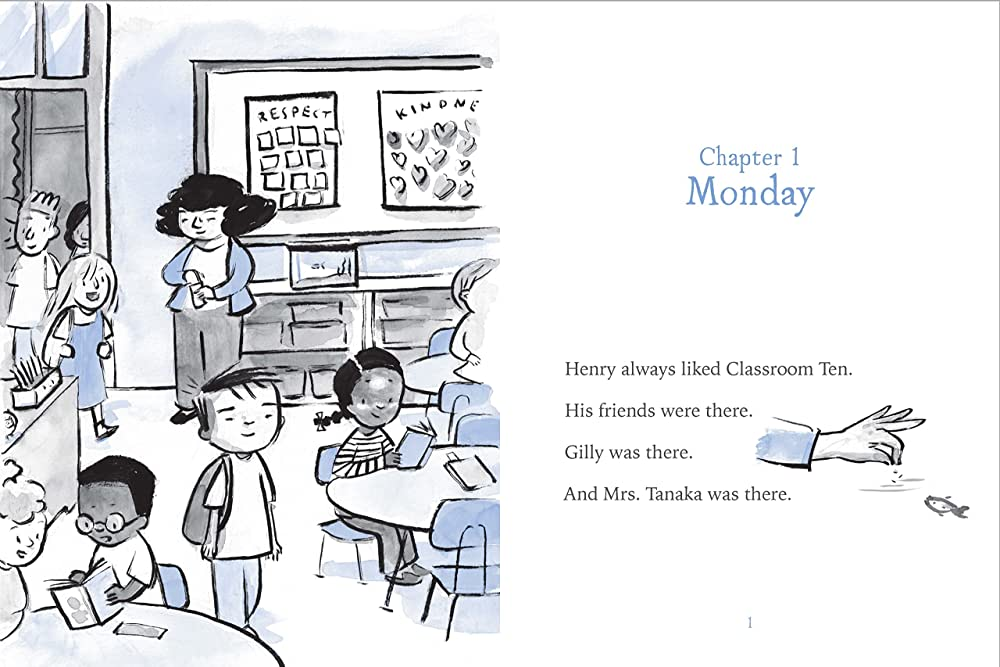
Summary: Henry, featured in the 2019 picture book A Friend for Henry, likes the routine and predictability of his classroom. Mrs. Tanaka has a weekly schedule posted, and Henry feels comfortable when it stays the same. When she announces a parade on Friday, pushing sharing to Thursday, Henry struggles to cope with the change. His feelings of dread grow through the week as the class prepares for the parade. By Friday morning, he needs to give Mrs. Tanaka his Quiet Card, which entitles him to some time alone in the big closet. There he discovers the hat that his classmate Samuel is going to wear to lead the parade. Samuel would rather play the tambourine that Henry has been assigned, and Henry likes the soft pressure of the hat that covers his ears and protects him from some of the noise. A trade is made, and both boys are able to happily participate in the parade. 48 pages; grades 1-3.
Pros: An excellent early chapter book that sympathetically portrays a character who appears to be on the autism spectrum and provides a realistic glimpse into his classroom. Mrs. Tanaka is a kind teacher who accommodates Henry but also expects him to be part of the classroom community. This is billed as book 1, so we can look forward to more books about Henry.
Cons: Henry’s new hat looks like it completely covers his eyes.
Ketanji Brown Jackson: Justice for All by Tami Charles, illustrated by Jemma Skidmore
Published by Simon and Schuster Books for Young Readers
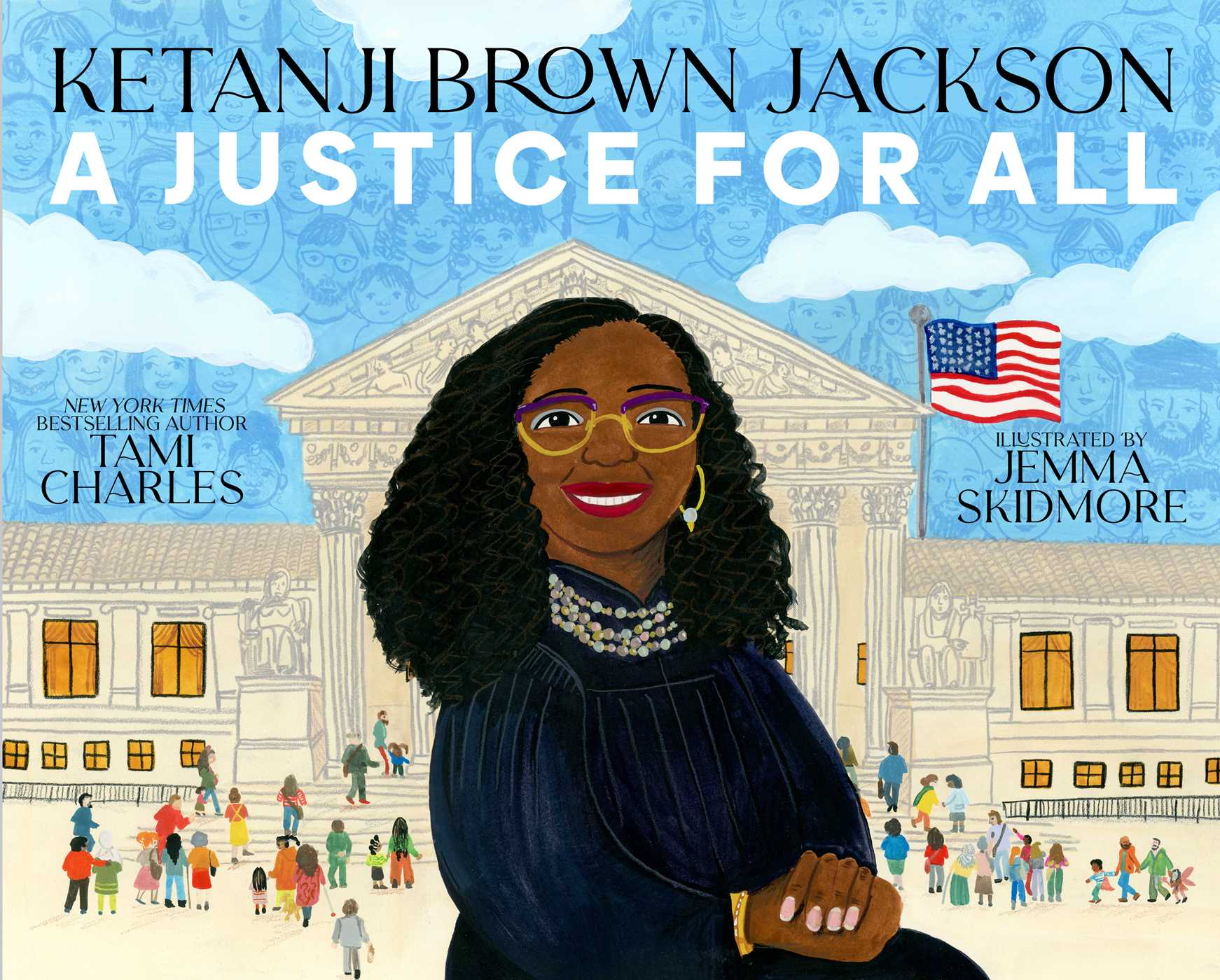
Summary: “Every dream begins with the smallest step.” A young girl visits the Supreme Court Building with her mother, where they see statues of the 115 justices, only six of them women, and none of those women Black…until now. The story of Ketanji Brown Jackson’s life is told, along with the story of the ancestors who lived in Africa, then were enslaved and forced to come to America. There’s also the story of her parents, who attended segregated schools and became the first in their families to graduate from college. Important civil rights cases and other Black female lawyers and judges that helped Ketanji get to the Supreme Court are woven into the narrative. “And now,” says the girl, “because of them, because of her, I know one day I will and certainly can!”. Includes an author’s note with additional information, a list of important dates, and facts about the important people and history shown in the art. 40 pages; grades K-5.
Pros: Like All Rise by Carole Boston Weatherford, this picture book biography of Ketanji Brown Jackson shows not only her own hard work and determination to overcome racist and sexist obstacles, but also the people who came before her that made her rise possible. The poetic text and illustrations convey big ideas but are presented in ways that make them easily understood by younger readers.
Cons: While the author’s note mentions how she was inspired by a photo of Brown’s daughter Leila Jackson looking at her mother with loving pride, the photo is not in the book.
Batcat by Meggie Ramm
Published by Harry N. Abrams
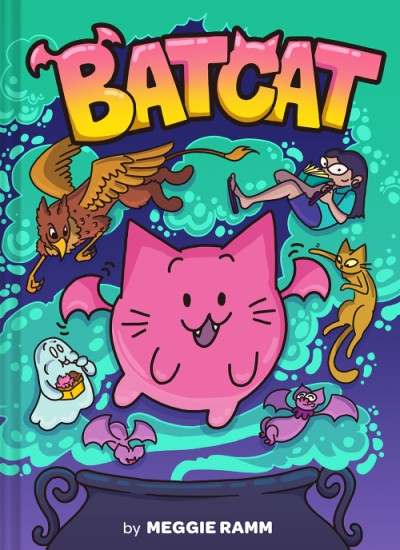
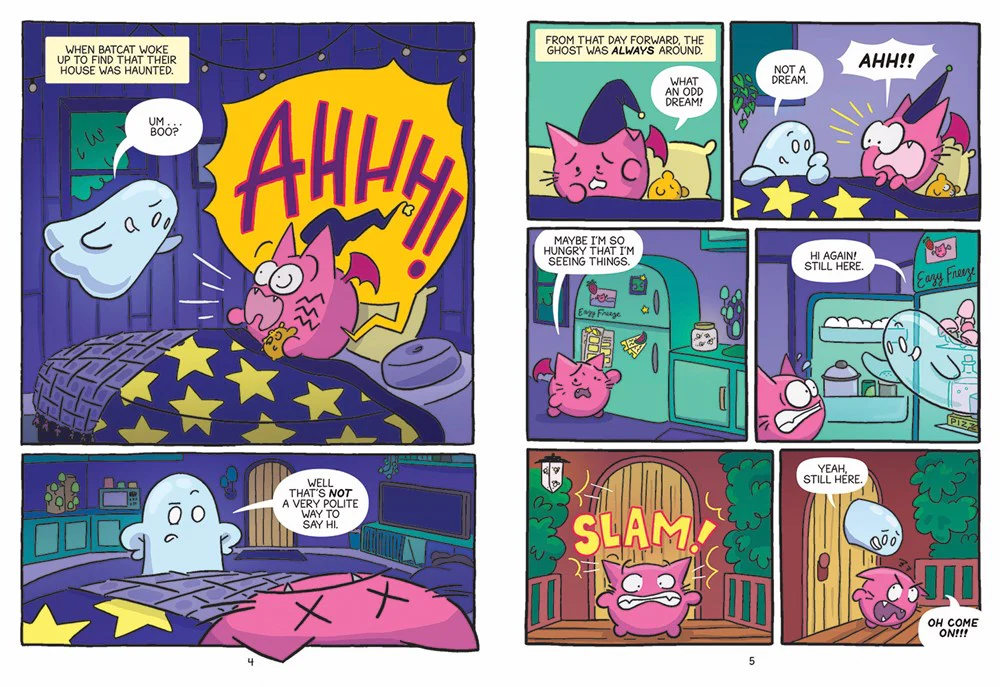
Summary: Batcat is part bat, part cat, and fully annoyed by the ghost that has moved into their treehouse. They consult a witch about how to get rid of the ghostly invader and get sent on a quest to gather the three ingredients needed for the proper spell. Along the way, Batcat meets up with some bats and some cats who assure them that they are lacking some of the bat and cat qualities to be either animal. Batcat gets increasingly despondent about their deficiencies until they meet up with a couple of griffins who assure them that one does not have to be one thing or the other. After embracing their one-of-a-kind identity, Batcat returns to the witch where they slowly realize that maybe the ghost isn’t so bad after all. The witch works her magic, and Batcat and the ghost become friends and roomies. 96 pages; grades 2-4.
Pros: This cute and clever graphic novel has humor, spookiness, and a subtle lesson in self-acceptance that works well with both Batcat’s dual-animal identity and their nonbinary pronouns. I’m happy to see that this is book 1 and look forward to a sequel soon.
Cons: I could have enjoyed some how-to-draw-Batcat pages at the end.
School Trip by Jerry Craft
Published by Quill Tree Books


Summary: Jordan Banks and his friends (and frenemies) from New Kid and Class Act are back for their last hurrah before finishing up at Riverdale Academy Day School (a.k.a. RAD). The whole eighth grade gets to choose from a variety of trips including Yellowstone, Alaska, Mississippi, and, for Jordan, Paris. He’s happy to be in a group with friends like Drew, Liam, and Alexandra, less thrilled with the inclusion of class bully Andy. As the group experiences adventures and mishaps in France, they get to review some of what they’ve learned about friendship, bullying, and other relationship issues during their time in middle school. Jordan has a big decision weighing on him, having gotten into an art school for high school and trying to decide if he wants to transfer or stay at RAD. Back home, he finally figures out what he wants to do (“helped”, as always, by his mother), and it seems as though the story may be continued, or this could be the final installment. 256 pages; grades 4-8.
Pros: Jordan Banks fans will be thrilled with a new book about RAD, and the chance to get off-campus leads to plenty of humor and also many thoughtful conversations on a wide range of relevant topics that will make this a great jumping-off place for class or book club discussions.
Cons: One of my favorite things about New Kid was how deftly Jerry Craft wove discussions of racism and other social justice topics into a funny school story with lots of fun and interesting characters. While I still love the messages being imparted, in this installment, they sometimes felt a bit more heavy-handed.
Woven of the World by Katey Howes, illustrated by Dinara Mirtalipova
Published by Chronicle Books
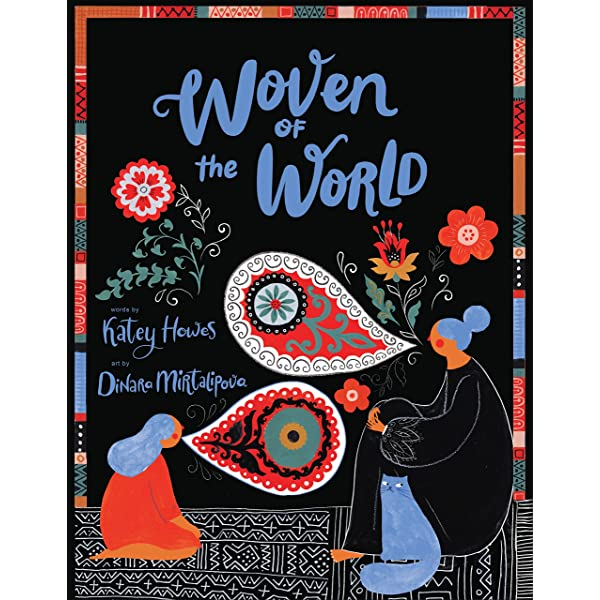

Summary: As a child learns how to weave from a master, the two of them take a tour through history to look at how weaving has played a role in many past cultures. From the “silken threads” of ancient China to the “backstrap loom tied to a tree” of nomadic tribes to the “trail of yarn” of immigrants moving to new countries, there are weaving traditions from all around the world. The final page uses a weaving metaphor for life, with patterns unfolding as the work is done. Includes additional information on weaving tools and the various cultures described, as well as notes from the author and illustrator. 44 pages; grades K-5.
Pros: Anyone with even a passing interest in weaving will appreciate the excellent rhyming text and beautiful patterned illustrations, as well as the history lessons from both the main story and the back matter showing how weaving has been a part of so many people and places in history.
Cons: I had a little trouble figuring out which description in the back matter went with which pages in the main text.
 A Kids Book A Day