How Do You Spell Unfair? MacNolia Cox and the National Spelling Bee by Carole Boston Weatherford, illustrated by Frank Morrison

Published by Candlewick

Summary:  MacNolia Cox loved reading, studying, and spelling, which paid off when she won her eighth-grade spelling bee in 1936.  This victory qualified her for the Akron, Ohio all-city bee, where her correct spelling of “voluble” made her the first African American winner of that contest and sent her to the National Spelling Bee in Washington, D.C.  After weeks of preparation, fundraising, and a bit of celebrity, MacNolia and her mother were on their way to Washington.  As they headed south, they had to move to the Blacks-only car, and in D.C., they stayed with a local doctor, since they were barred from the all-white hotel.  She and another Black girl had to enter the spelling bee stage from the back door and sit at a separate table from the other contestants.  Despite the discrimination, MacNolia succeeded, advancing to the final five before getting out on the word “nemesis” (which was questioned, since it hadn’t been on the official list).  She didn’t win, but MacNolia helped level the playing field for spellers of the future, including Zaila Avant-garde, who in 2021 became the first African American to win the Scripps National Spelling Bee.  Includes an epilogue with additional information about the fight to end racism and discrimination in spelling bees.  40 pages; grades 2-5.

Pros:  A fascinating story about a courageous girl who persevered to follow her dreams.  The text cleverly asks readers to spell words appropriate to the story, and Frank Morrison’s distinctive illustrations portray MacNolia and her family with dignity and grace.

Cons:  I was sorry to read in the epilogue that MacNolia couldn’t afford college and worked as a maid for a doctor.

The Labors of Hercules Beal by Gary D. Schmidt

Published by Clarion Books

Summary:  Hercules Beal is trying to rebuild his life after his parents were killed in a car crash and his older brother has somewhat reluctantly come home to take care of Hercules and run the family nursery.  The last thing he needs is to start seventh grade at a new school and discover that his language arts and social studies teacher is a tough ex-marine who insists that his students call him Lieutenant Colonel Hupfer.  For their mythology unit, Hupfer assigns Hercules the task of reenacting all the labors of the original Hercules, with a 150-word reflection on each.  As Hercules goes through his year, he finds himself in a series of unique and occasionally dangerous situations that bring him closer to his neighbors, classmates, and family.  Slowly, the details of his parents’ accident emerge, and Hercules discovers that, despite his intense grief, he is surrounded by people he can depend upon to help him take on difficult tasks and move forward with his life.  352 pages; grades 4-7.

Pros:  As ever, Gary D. Schmidt has created a memorable cast of characters and a story with equal parts humor and pathos.  The structure of the twelve labors is fun, and it’s delightful to see how Hercules connects events in his life with the myths.  Each chapter concludes with his reflection and Lt. Col. Hupfer’s comment and grades, showing the growing bond between the two.

Cons:  Although this seems to be a contemporary story, there is no mention of a phone (except for occasional calls), video games, or social media in Hercules’ life, making me wonder how much time Gary Schmidt has spent with middle schoolers recently.

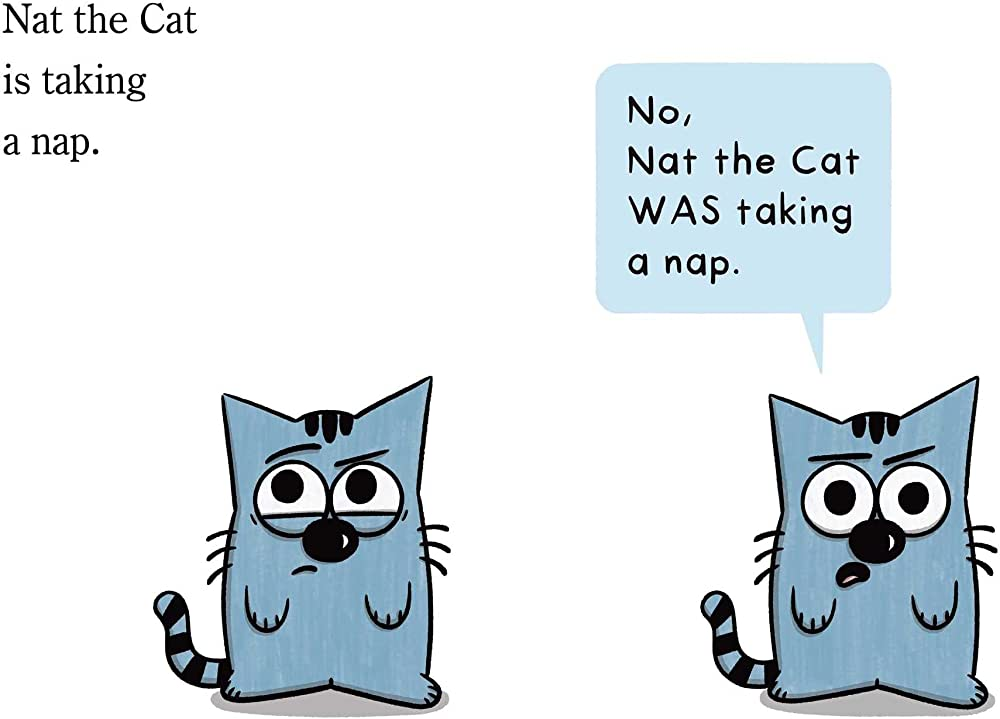
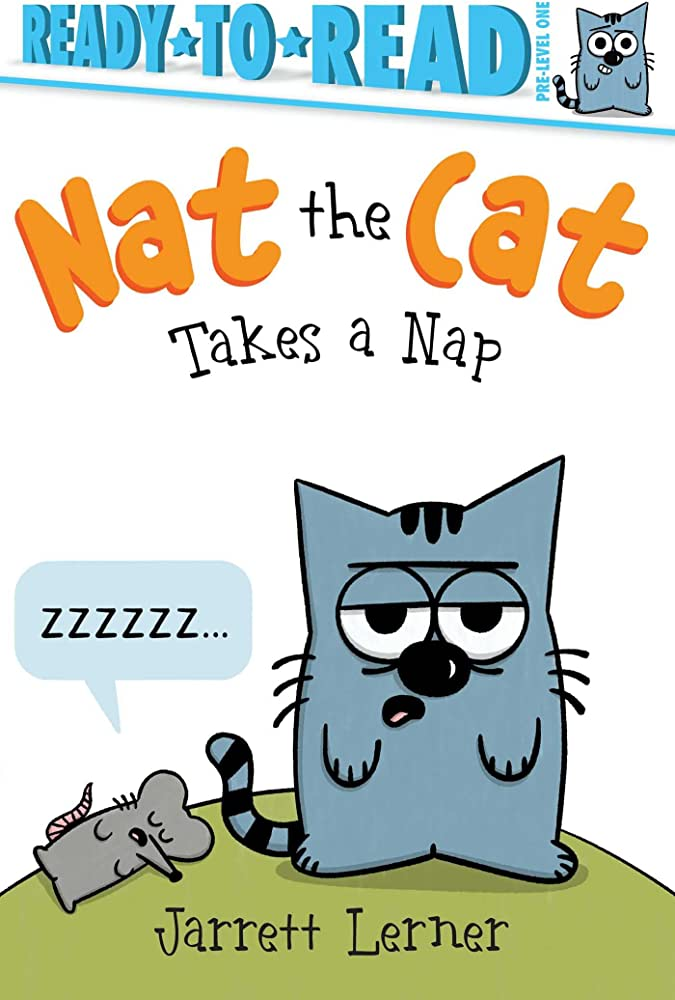
Nat the Cat Takes a Nap by Jarrett Lerner

Published by Simon Spotlight

Summary:  Nat the Cat is TRYING to take a nap, but the narrator of the story keeps waking him…by narrating the story.  “Oh, brother,” says Nat the Cat, and the narrator introduces his brother, Pat the Rat (“That is NOT my brother,” says Nat).  The series of misunderstandings ends, happily, with ZZZ’s for both cat and rat.  32 pages; ages 2-7.

Pros:  This funny early reader with its cartoon-style illustrations and conversation with an omniscient if frustratingly clueless narrator reminds me of one of the most popular early readers in my library, See the Cat: Three Stories About a Dog by David LaRochelle.  That won the Geisel award, so keep any eye on Nat for a similar recognition.

Cons:  Only one story, as opposed to the three in See the Cat.

Hello, Mister Blue by Daria Peoples

Published by Greenwillow Books

Summary:  When the narrator visits her Papa, they enjoy going to breakfast together, sharing a cup of creamy, sweet coffee.  Afterwards, they play their violins together in the park, where she meets Papa’s friend, another musician named Mister Blue.  Mister Blue lives outside, but that doesn’t stop him from making beautiful music, playing a makeshift drum set for people who are protesting in the streets and for those who like to dance.  Papa says he and Mister Blue go way back, and the illustrations shift to black and white, showing the two men in a war together.  The girl has questions about Mister Blue: is he safe? Is he scared? Is he lonely? Is he hungry?  Those questions inspire Papa to go out on a rainy night to find his friend, who is sleeping on a bench, and invite him back to the house. There, the three of them make happy music together.  Includes an author’s note about her father’s stories that inspired this book.  32 pages; ages 4-8.

Pros:  A touching story that humanizes an unhoused person and shows how truly seeing a person can lead to taking action.  

Cons:  Kids may need some help understanding what is going on with the flashback scenes showing Papa’s memories.

Salat in Secret by Jamilah Thompkins-Bigelow, illustrated by Hatem Aly

Published by Random House Studio

Summary:  When Muhammad gets a salat rug for his seventh birthday, he’s determined to pray five times a day like his father does.  It’s easy at home, but more challenging to do dhuhr, the prayer that comes in the middle of the day, when he’s at school.  He tries praying in the bathroom and the coat closet, but neither works out for him, and he ends up missing the midday prayer.  When he joins his father selling ice cream from his truck, he watches as Dad sets up his rug on the sidewalk and begins his prayers.  A woman and some police officers stop and stare, and with shaking hands, Muhammad gets out of the truck and joins his dad.  He notices that Dad is a bit shaky too, but they finish their prayers, and the policemen walk away.  The next day, Muhammad overcomes his fears and tells his teacher that he needs a place to pray.  Includes an author’s note with more information about salat and a glossary.  40 pages; ages 4-8.

Pros:  This empowering story encourages Muslim kids to live their faith and will show any reader how to find the courage to do what feels right.

Cons:  The story ends with the teacher happily agreeing to Muhammad’s request, but I was curious to see what would happen after that.

Champion Chompers, Super Stinkers and Other Poems by Extraordinary Animals by Linda Ashman, illustrated by Aparna Varma

Published by Harry N. Abrams

Summary:  Using mask poems (poems in which the writer speaks in the voice of someone or something else), Linda Ashman has animals give hints as to what they are and what superlatives (fastest, biggest, stinkiest, etc.) they hold in the animal world.  Each poem has an illustration showing part of the animal to give an additional clue.  Turn the page, and the animal is pictured in full, along with a paragraph of information.  Opening and closing poems introduce the contest.  Includes additional information about protecting endangered animals, measurements, and mask poems, as well as a glossary, and lists of websites and books.  48 pages; grades 1-4.

Pros:  I do love a good guessing book to keep kids engaged, and this one lets readers guess both the animals and the records they hold.  The illustrations are cute and offer hints to go with each poem.  Kids can try their hands at mask poems after reading these.

Cons:  It may be a little long for primary kids to get through all of these in one sitting.

Garvey’s Choice: The Graphic Novel by Nikki Grimes, illustrated by Theodore Taylor III

Published by Wordsong

Summary:  Nikki Grimes’s 2016 novel in verse has been turned into a graphic novel that is quite faithful to the original.  Garvey’s interested in chess and astronomy, while his dad wishes he would play sports, leading to ongoing conflict between the two.  When Garvey joins the school chorus, he discovers a talent for singing that eventually leads to a reconciliation with his dad (you can read a more detailed summary in my original review).  Includes additional information about tanka, the poetic form used by Nikki Grimes to write the book.  144 pages; grades 4-7.

Pros:  Turning this into a graphic novel is a stroke of genius, since it will bring a lot more readers to this excellent book.  The original was short enough that it is mostly preserved intact (I’m taking reviewers’ words for this, as I didn’t do a comparison myself), creating a story that many kids will relate to.

Cons:  Although Garvey lost a little bit of weight (one size), he wisely focused on developing healthier habits; however, the illustrations made him look like almost a different person in the last few pages.

Summer Is for Cousins by Rajani LaRocca, illustrated by Abhi Alwar

Published by Harry N. Abrams

Summary:  Every year, Ravi’s extended family rents a house by the ocean and a lake.  He’s the second youngest of seven cousins, with two uncles, two aunties, Mom, and Dad.  The only other boy is his oldest cousin Dhruv, who has grown several inches and gotten a deeper voice since last summer.  Ravi feels shy around him, but Dhruv still enjoys hanging out with Ravi, helping him to learn to paddleboard and to find the courage to jump into the water from the rope swing for the first time ever.  In turn, Ravi enjoys the role of older cousin with baby Leela.  There’s mini golf, biking, shared cooking, and ice cream–lots of ice cream.  One night the cousins cook, and Ravi finds a way to create his favorite ice cream, banana, with help from the rest of the crew.  “Because,” he concludes.  “Summer is for cousins.  And ice cream.”  40 pages; ages 4-8.

Pros:  Just like yesterday’s The Firefly Summer, this lovely picture book perfectly captures the simple joys of a summer spent with extended family. While the illustrations, names, and some of the food prepared indicate that the family is from India (like the author), the experiences of family and summer fun are universal.

Cons:  All the cousins were labeled on the first page, but I wish there had been more of a family tree to show parents and siblings.

The Firefly Summer by Morgan Matson

Published by Simon and Schuster Books for Young Readers

Summary:  When Ryanna gets an invitation from her estranged maternal grandparents to spend the summer at their house on a lake in the Poconos, she’s not sure if she wants to go.  But questions about her late mother motivate her to accept, and what she had imagined as a few quiet months with grandparents turns out to be a fun, busy summer surrounded by aunts, uncles, and cousins.  Partway through her time there, she learns that her grandparents have been forced to sell the camp, and that everything will be bulldozed and developed into condos in the fall.  Ryanna and her cousins discover a treasure hunt her mother created when she was 12 that could lead to the piece of paper her grandparents need to stop the sale of their property.  It’s a race against time as the kids slowly figure out the mystery and Ryanna unravels her own mystery about her mother and the early days of her own childhood.  385 pages; grades 4-7.

Pros:  A perfect summer read with an idyllic setting, lots of interesting characters, some family secrets to discover, and a mystery or two to solve.  Morgan Matson perfectly captures the feel of a tech-free summer spent outdoors with friends, and the pacing will keep readers turning the pages all the way to the end.

Cons:  I know from sad experience that a lot of readers in the intended demographic will be turned off by the page count.     

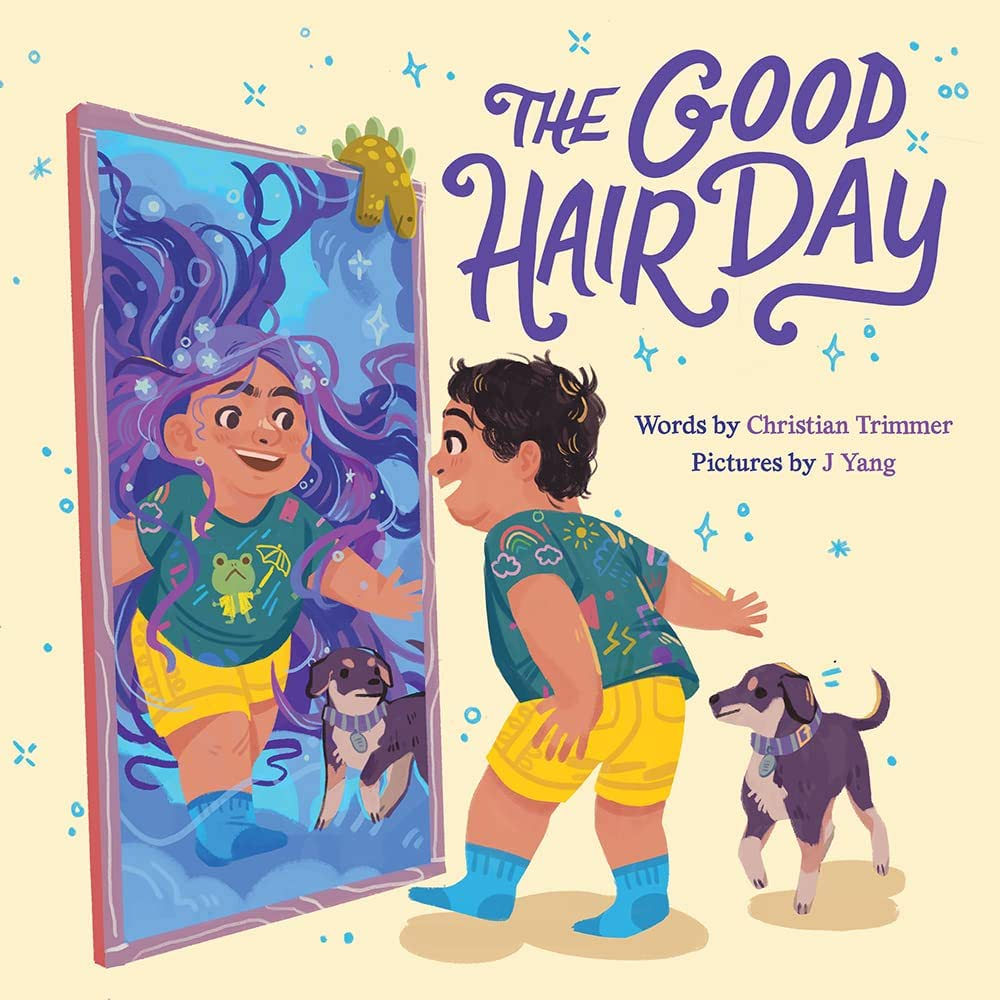
The Good Hair Day by Christian Trimmer, illustrated by J Yang

Published by Harry N. Abrams

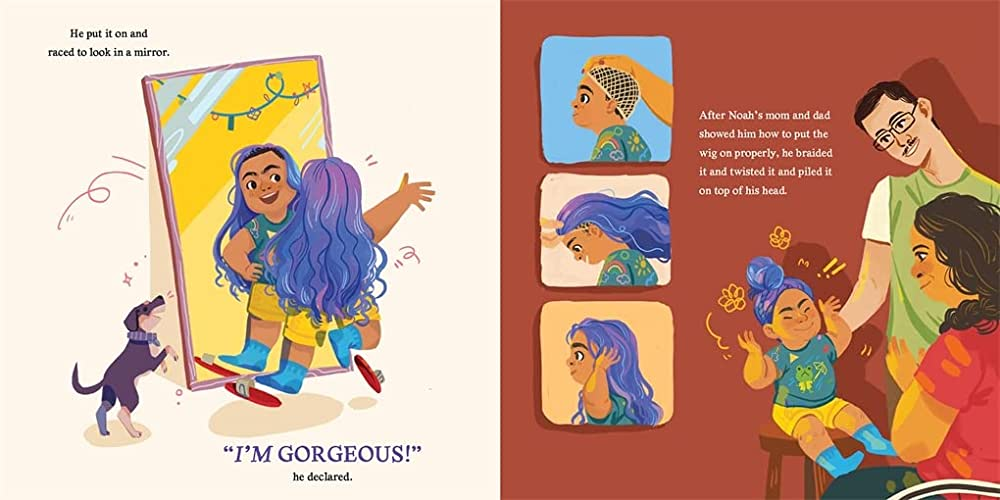
Summary:  Noah is excited about his upcoming birthday, dropping lots of not-too-subtle hints about what he hopes to get.  But he keeps his greatest wish–to grow his hair–to himself, worried that it’s not acceptable for boys to have long hair.  At his pre-birthday haircut, the barber follows Dad’s instructions for “the usual,” causing Noah to burst into tears at the sight of his short hair.  Mom and Dad figure out what’s going on, and on his birthday, Noah’s favorite gift is a long purple wig.  A year later, he’s back at the barber, but now the directions are, “A little off the ends, please,” as Noah is revealed to have shoulder-length hair.  Includes a list of conversation starters about gender, identity, and self-expression.  40 pages; ages 4-8.

Pros:  The author of Teddy’s Favorite Toy has created another fun story with a likable narrator that facilitates discussions around gender norms and expectations and provides some excellent parental role models.

Cons:  I almost missed the list of conversation starters which is printed on the endpapers.