Tee Time on the Moon: How Astronaut Alan Shepard Played Lunar Golf by David A. Kelly, illustrated by Edwin Fotheringham

Published by Calkins Creek
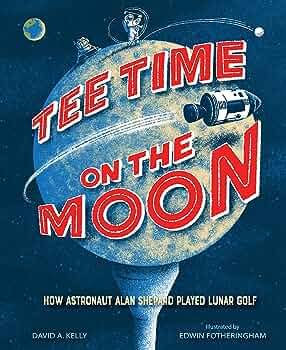
Summary:  When Apollo 14 launched in 1971, astronaut Alan Shepard had a secret stash he was carrying with him.  He revealed what it was after he and fellow astronauts Stuart Roosa and Edgar Mitchell had a successful landing, and he and Mitchell had walked on the moon.  Shepard had a golf club and ball and wanted to see how far he could hit the ball in the low-gravity atmosphere of the moon.  In front of TV cameras, he made a couple of unsuccessful swings before giving the ball a good whack, sending it flying into space.  How far?  It took almost fifty years to find out.  A photographer used software to sharpen the moon images and discovered that the ball had only gone about 120 feet–a far cry from the miles Alan Shepard had claimed.  The stunt made viewers think differently about the moon, though, seeing it as a place where one day everyday events like playing sports could take place.  Includes five pages of additional information, including information about each of the Apollo missions, photos, and a bibliography.  40 pages; grades 2-5.

Pros:  Alan Shepard, Jr.’s golfing stunt provides a great hook to draw readers into a history of the Apollo missions, with information on the history of the program, how the launches worked, and the space suits the astronauts wore, among other things.  The additional information provides a good starting place for learning more.

Cons:  The tiny font of the back matter was hard on my elderly eyes.

What Happened to Rachel Riley? by Claire Swinarski

Published by Quill Tree Books

Summary:  Anna’s new at her Madison, Wisconsin middle school.  She’s a little young for eighth grade and still trying to figure out how the middle school social hierarchy works, so when she notices that a girl named Rachel Riley is shunned by all her classmates, she’s curious to find out why.  Digging deeper into the mystery, Anna discovers that Rachel was one of the popular girls until the end of seventh grade, when a mysterious fire disrupted the end-of-the-year dance and awards ceremony.  A devoted podcast fan, Anna decides to make a podcast to answer the question, what happened to Rachel Riley?  In addition to her own narration, the story is told through texts, emails, letters, interviews, and news reports, which slowly reveal to Anna a tale of bullying and sexual harassment that has been ignored by teachers and administrators and laughed off by students.  As Anna uncovers the truth, she learns the importance of using her own voice to speak up in defense of truth and justice.  352 pages; grades 4-8.

Pros:  It’s not often that I wish I were still running middle school book clubs, but it happened as I read this perfect middle school story.  The format and the mystery elements make it a quick and engaging read, and the story raises important questions about sexual harassment and how it affects both boys and girls.

Cons:  The large cast of characters and story format left me feeling like I didn’t really get to know several of the secondary characters.

Boomi’s Boombox by Shanthi Sekaran

Published by Katherine Tegen Books

Summary:  Boomi is reeling from the death of her father from Covid.  Remote school is isolating, her best friend seems distant, and the final blow comes when she fails an audition at her ballet school.  She receives an old boombox of her father’s under somewhat mysterious conditions, and when she tries to play the mixtape inside, she’s transported back to 1986 England.  There she meets her 12-year-old father, Jeevan, as well as his mysterious older sister, and a younger version of her grandmother, Paati, who lives with Boomi’s family in the present and suffers from dementia.  As Boomi travels back and forth between the present and the past, she learns about the racism that plagues her dad and his family, forcing Asian people to be silent and invisible in their mostly white community.  By helping them speak up, Boomi learns to accept what has happened in her life and to embrace her love of dancing, even if her body is not the size and shape her ballet teacher is looking for.  Working together, Boomi and Jeevan manage to heal the rifts within their families and change their lives for the better.  272 pages; grades 4-7.

Pros:  I wasn’t expecting the time travel twist, which allowed Boomi to get closure around her father’s death and to witness the racism that shaped both her parents’ early years.  Shanthi Sekaran deftly handles so many difficult topics including not only racism, but body image, grief, and the pandemic.

Cons:  I was actually in London in 1987, which doesn’t feel as much like ancient history as this book makes it seem.

What a Map Can Do by Gabrielle Balkan, illustrated by Alberto Lot

Published by Rise x Penguin Workshop

Summary:  An adventurous raccoon narrates its travels by showing kids a series of maps, beginning with its bedroom and continuing to the neighborhood, a museum, a road map, and more (12 altogether).  Each map has questions for kids to answer and introduces concepts like a compass rose and a map key with symbols.  There are maps that show things other than geography, like the stars and the weather.  Includes an index of all the maps with thumbnail drawings, definitions, and the pages where each can be found.  48 pages; grades K-2.

Pros:  Kindergarteners at my school learn about maps, so I have read quite a few picture books on the subject, and this is the best that I have seen.  I love how interactive it is, with the questions the kids can answer using the maps.  It’s lots of fun, but also a pretty thorough introduction to all kinds of maps.

Cons:  It felt a little long to maintain a kindergartener’s attention.  You might want to break it into two or three reading sessions.

Updated book lists

I’ve just completed updates for several of my book lists, including some that may be useful for going back to school:

Back to School

Grief and Loss

Hispanic Heritage

Indigenous Americans

Kindness and Community

People with Physical Disabilities

Persistence and Grit

Pride: Books Featuring LGBTQ+ Characters

I didn’t have new books to add to these lists, but just a reminder of some others that might be useful for the fall:

Fall

Labor Day

September 11

Thanksgiving (focusing on food, family, and gratitude, rather than the traditional Thanksgiving story)

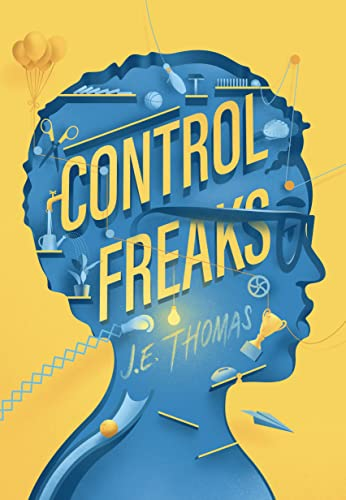
Control Freaks by J. E. Thomas

Published by Levine Querido

Summary:  Frederick Douglass “Doug” Zezzmer is a 12-year-old genius inventor who goes to a middle school for gifted kids in Denver.  When the principal, Dr. Yee, announces a team STEAM competition, most of the kids are less than thrilled.  Doug is determined to win so he can show his dad (who’s just moved back after being absent for most of Doug’s life) that inventing, not sports, is his thing.  His best friend Huey, who suffers from stage fright, proves to be a liability in creating a five-person team, and they end up with a bunch of misfits.  As the competition goes on, though, the group goes from five quirky kids who don’t relate to each other to being a team who supports and cheers for each other.  The final results prove that winning doesn’t always mean finishing first and help Doug to stand up to his dad and show him who he really is.  320 pages; grades 4-7.

Pros:  The humor, middle school setting, and chapters told in different characters’ points of view reminded me of Gordon Korman’s books and should make this book an easy sell to upper elementary and middle school readers.

Cons:  I didn’t entirely understand why the title of this book is Control Freaks.

Mine! by Candace Fleming, illustrated by Eric Rohmann

Published by Anne Schwartz Books

Summary:  A red apple hangs from a tree, ready to drop to the ground.  One by one, animals plan to grab that apple when it falls, each one imagining how delicious it will be, shown with a cartoon bubble and the word “MINE!”  Finally, the wind blows the apple from the tree, and Mouse, Hare, Fox, Deer, and Bear all pounce, resulting in a free-for-all that pushes the apple away.  It lands at the feet of Possum, who eyes it curiously: “Mine?”  A worm pops out, and the two say in unison, “Ours!”  40 pages; ages 3-6.

Pros:  With illustrations reminiscent of Eric Rohmann’s Caldecott book My Friend Rabbit, this story uses catchy rhymes and adorable (if greedy) animals to impart a fun lesson about sharing.

Cons:  Generally, apple trees produce more than one apple at a time, so it seemed like the animals could have just chilled and waited for more apples to fall.

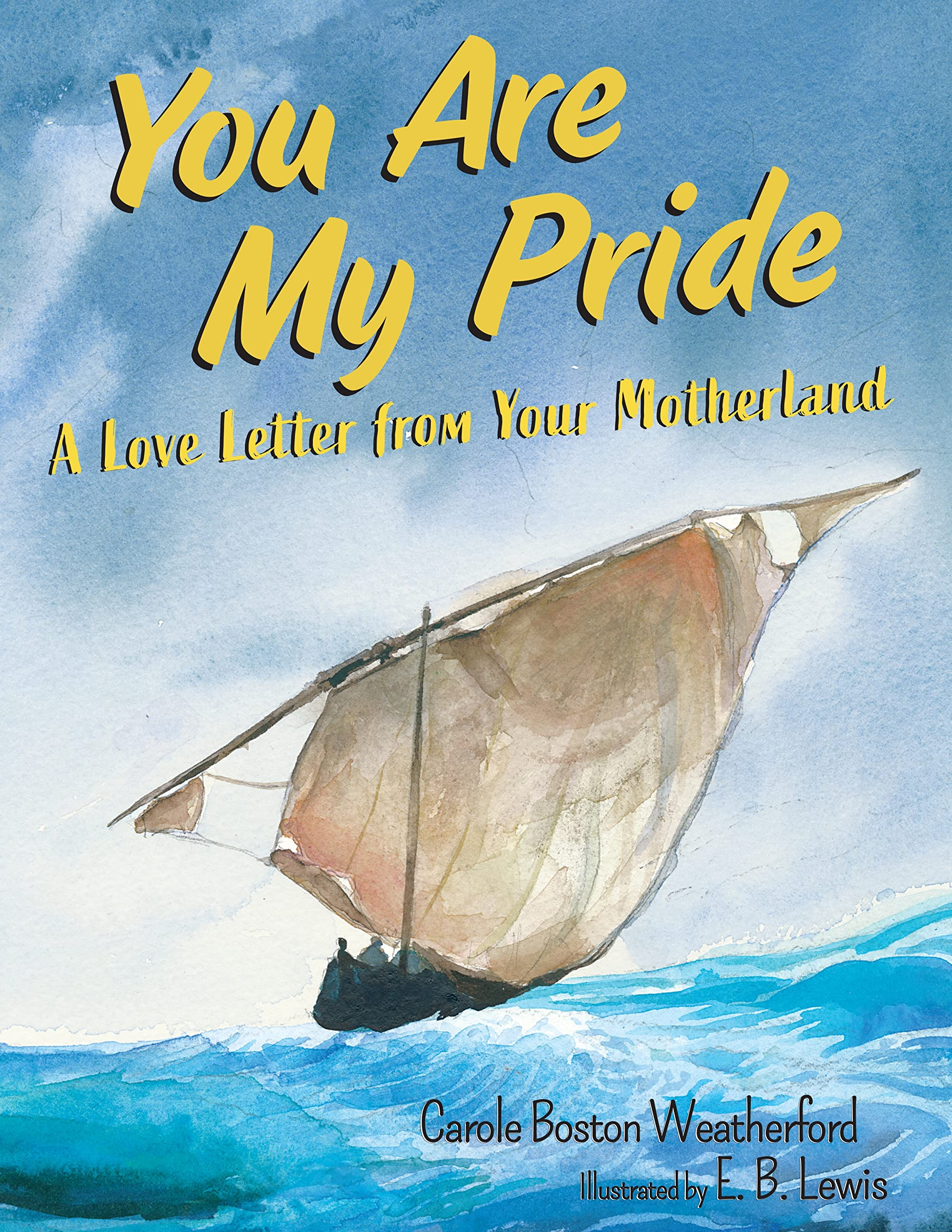
You Are My Pride: A Love Letter from Your Motherland by Carole Boston Weatherford, illustrated by E. B. Lewis

Published by Astra Young Readers

Summary:  “I am the mother of all humanity.  I have a long history and a longer memory,” begins this poem that is addressed to humans from the continent of Africa.  The narrator traces time from the first cells that evolved into the first humans.  “Child, you are mine as much as Mount Kilimanjaro, as much as the Serengiti and the Sahara, as much as the baobab and the bush.”  And although those children are her treasure, she sends them around the globe to let their gifts shine.  Includes additional information about human evolution, specifically in Africa, and a timeline of key species and developments in early human evolution.  40 pages; grades K-5.

Pros:  This loving poem with beautiful illustrations celebrates all of humanity, but especially those with roots in Africa.  The additional information makes it a resource that older kids will find useful as well.

Cons:  No additional resources.

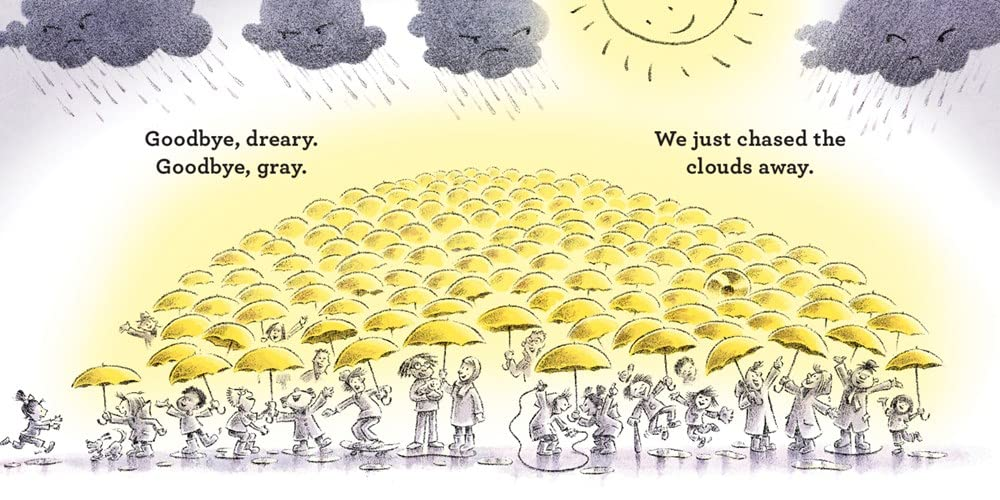
The Umbrella by Beth Ferry, illustrated by Tom Lichtenheld

Published by Clarion Books

Summary:  “Dreary. Weary. Dim. Grim. Drip. Drop. Nonstop.”  From the looks of things on the first pages, the rainy weather has been around for way too long.  But rain or shine, dogs gotta go, and so a girl takes her pup out for a walk in the rain.  When thunder booms, a curio shop provides them with some shelter, and they find a free, albeit tattered, yellow umbrella there.  On the walk home, though, the umbrella disintegrates with a crumble and a tumble, strewing yellow pieces in the grass along the sidewalk.  The rain continues through the night, and when the girl and dog go for another walk, they make a surprising discovery–new yellow umbrellas have sprouted wherever the pieces of the old one fell!  Before long, the whole town is outside celebrating with their sunny new umbrellas despite the rain.  48 pages; ages 4-8.

Pros:  I will definitely be reading this book to some of my preschool and kindergarten classes, maybe pairing it with Stick and Stone by the same author and illustrator.  The umbrella garden was such a fun surprise, complemented by the gray illustrations with their bright spots of yellow.

Cons:  There have been a few weeks this summer that felt like the first few pages of this book.

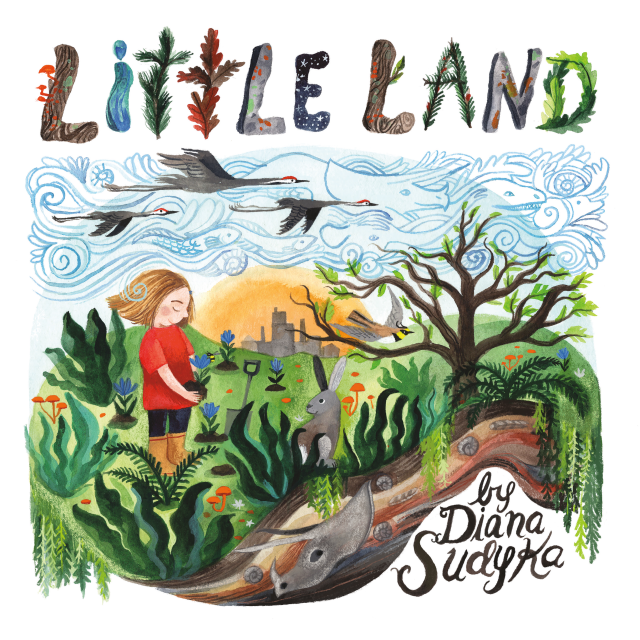
Little Land by Diana Sudyka

Published by Little, Brown Books for Young Readers

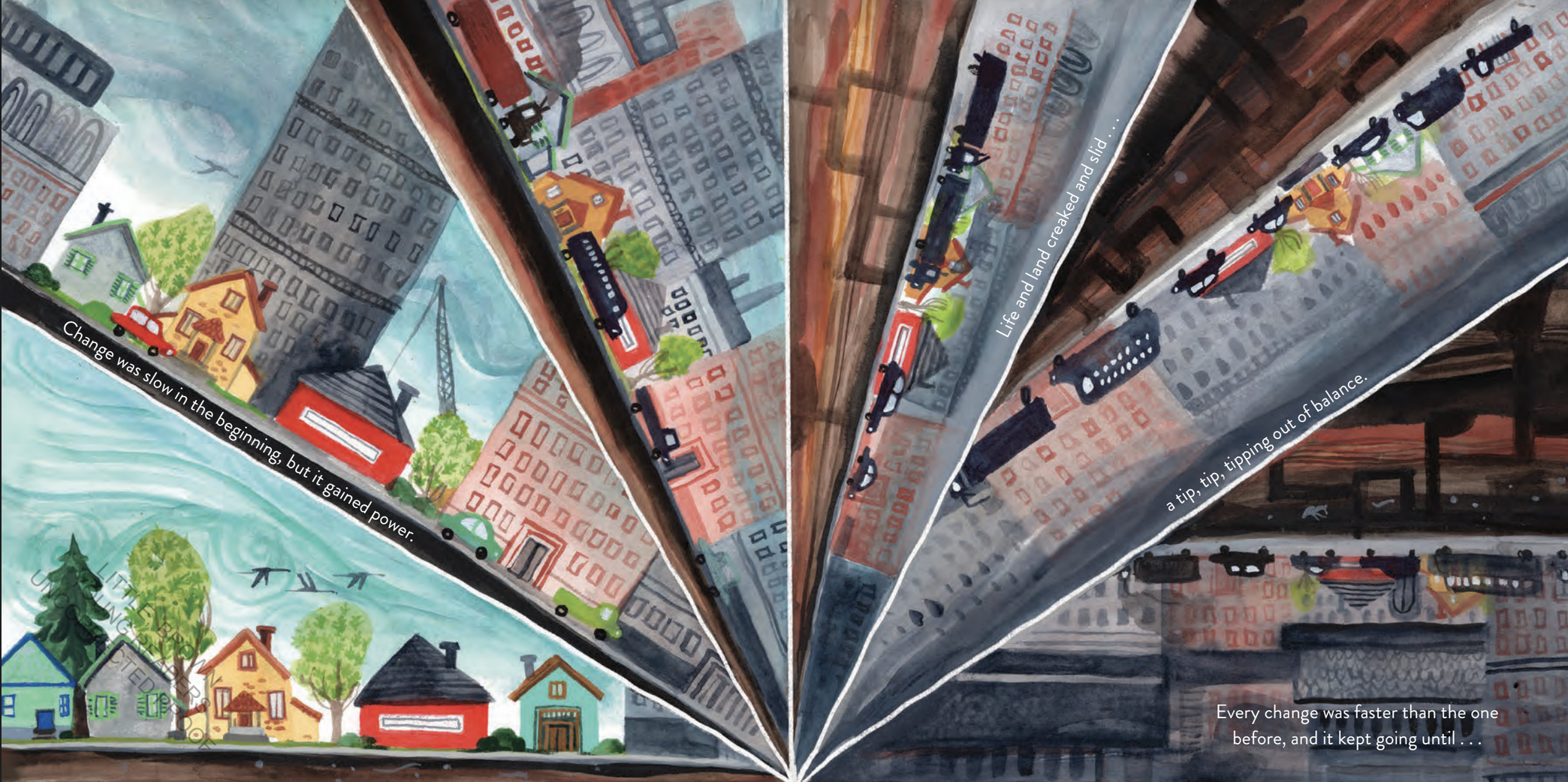
Summary:  The story of a small piece of land began five hundred million years ago, when it was part of the ocean.  Dinosaurs walked on it sixty-seven million years ago, and ice covered it one hundred thousand years ago.  There have been many, many changes, and different forms of life have come and gone.  But the land has always survived…until humans came along.  Starting with a single house, people gradually built more and more on the land, even digging into it to create structures to support them.  The impacts grew and grew until one day “…it seemed unstoppable,” shown with an upside down black and gray illustration.  Kids start to make changes, reclaiming the land with clean-up efforts, flowers, and trees.  Even a small gift to the Earth can reap big rewards.  Includes an author’s note, a list of words that inspired the book, animals and plants in the book, a list of epochs represented, and additional resources.  48 pages; grades K-3.

Pros:  A gorgeous introduction to environmental concerns, covering a surprising amount of information with deceptively simple text and illustrations that reminded me a little bit of Virginia Lee Burton (and should be considered for a Caldecott!).  The last few pages and back matter will empower kids to figure out what they can do to help the planet.

Cons:  My usual discouragement and angst when I read books about the environment.