Stone Age Beasts by Ben Lerwill, illustrated by Grahame Baker-Smith

Published by Candlewick

Summary:  Following a four-page introduction to the Stone Age, the book gets down to business with a series of two-page spreads on some of the large animals of the era.  Each one includes a portrait with a few paragraphs of information and some sidebars, including one with fast facts, a map showing the animal’s range, and a size comparison to a human.  There are old favorites like the woolly mammoth and saber-toothed cat, along with some that may be less familiar, such as the elephant bird and giant short-faced kangaroo.  A final page looks at why the animals disappeared and how we learned about them.  Includes a glossary.  48 pages; grades 2-5.

Pros:  Dinosaur fans will enjoy learning about gigantic beasts from another time period, particularly the ferocious illustrations that dominate each page.  The information is engagingly written and presented.

Cons:  The Stone Age seems scary.

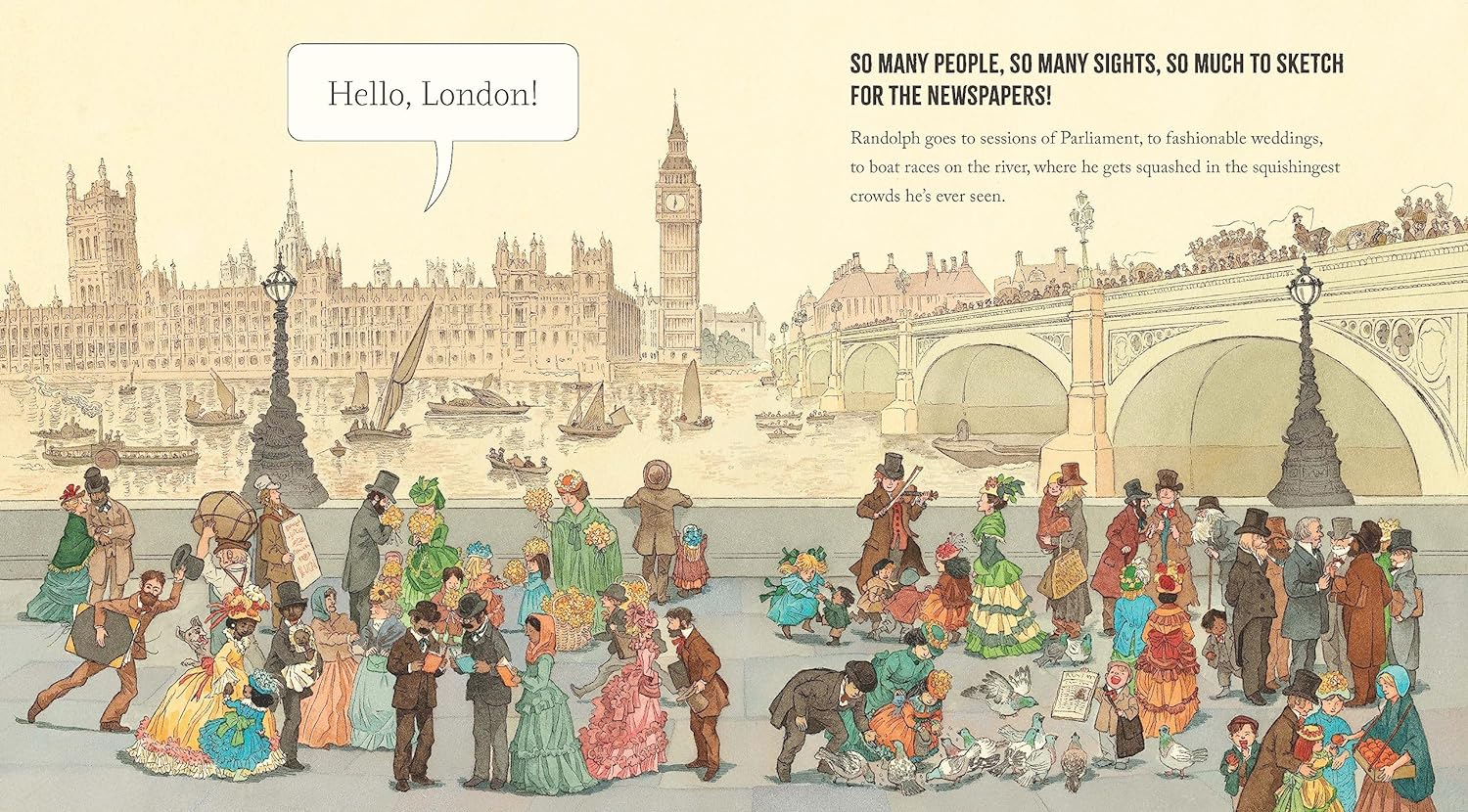
Tomfoolery!: Randolph Caldecott and the Rambunctious Coming-of-Age Children’s Books by Michelle Markel, illustrated by Barbara McClintock

Published by Chronicle Books

Summary:  In this follow-up to Balderdash! John Newbery and the Birth of Children’s Books, Michelle Markel looks at the man who was the namesake for another famous children’s literature award.  Despite a weak heart, Randolph Caldecott loved being outdoors, hanging out with animals, and capturing what he saw on paper.  His father sought to quash his love of art with a career as a banker, but Randolph kept drawing.  When offered a chance to illustrate children’s books, he went against the prevailing fashion of stilted decorations and created art with plenty of action and animals.  Kids and adults loved his work, and Randolph became an international success, his work continuing to influence illustrators 150 years later.  Includes a list of the Caldecott reproductions included in the illustrations; a list of annotations; a picture of the Caldecott medal; additional information about illustrated Victorian periodicals and the big three toy book illustrators (Caldecott, Walter Crane, and Kate Greenaway); and a list of books by Randolph Caldecott.  44 pages; grades K-3.

Pros:  This exuberant book brings Randolph Caldecott to life with beautiful illustrations inspired by his art.  It seems only fitting for this to be considered for a Caldecott medal or honor.

Cons:  There’s a great illustration of several Caldecott medalists reading their own books; I wasn’t able to identify all of them, and I wish the back matter had included a list.

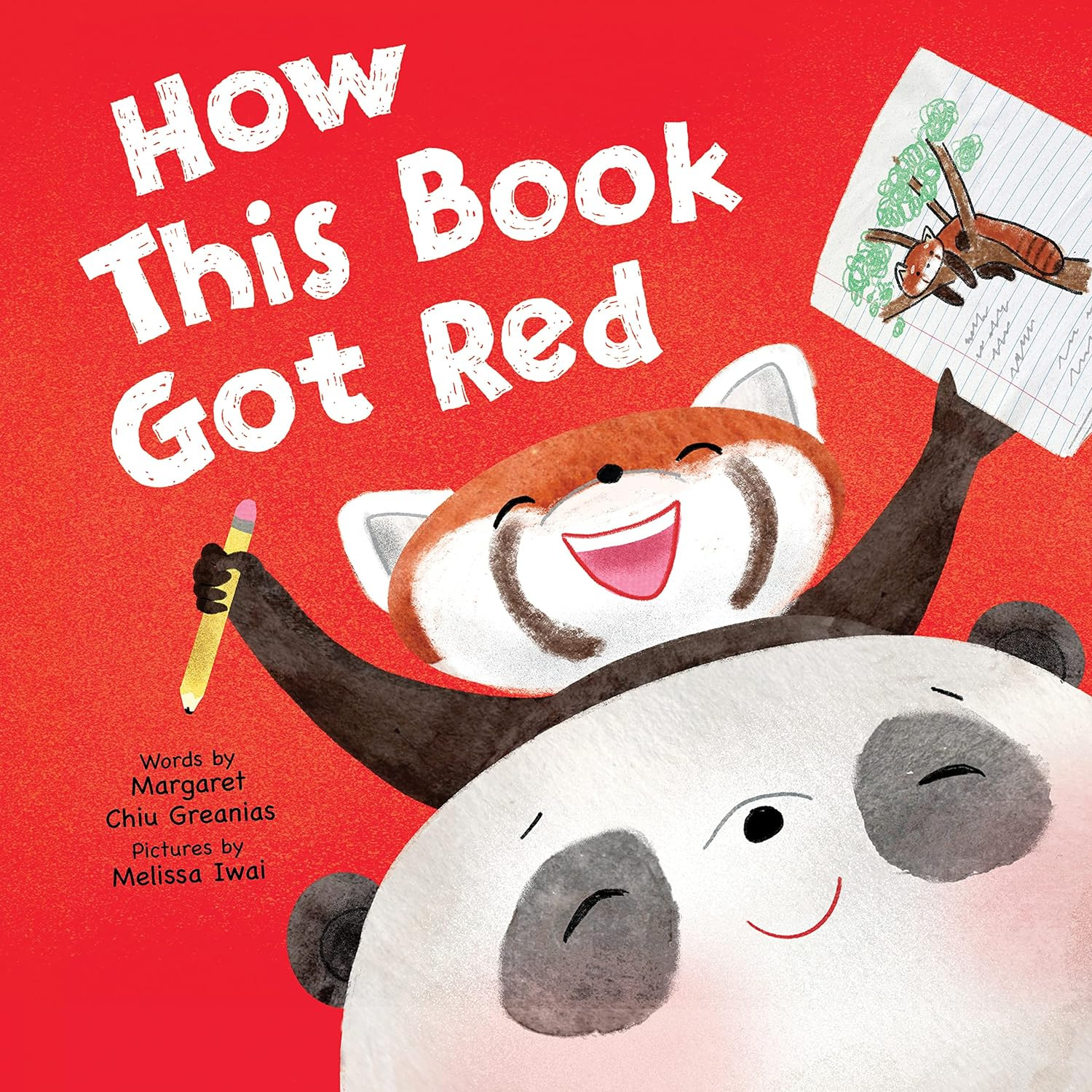
How This Book Got Red by Margaret Chiu Greanias, illustrated by Melissa Iwai

Published by Sourcebooks Jabberwocky

Summary:  Red and Gee are excited to find a book about pandas, but as they read it, Red realizes that it’s all about giant pandas like Gee, with nothing about red pandas like her.  She decides to write her own book, but when she looks at all the books about giant pandas, she concludes that no one will be interested in her story.  Tossing the half-finished manuscript in the trash, she and Gee go off for some bubble tea and forest bathing, but nothing cheers her up.  When they walk by the trash can later, a group of excited red pandas has retrieved her book, and they convince her to finish it.  The last few pages show the future: a bookstore window filled with red panda books, and Red inside signing copies of her book.  40 pages; ages 4-8.

Pros:  A fun way to let readers know that representation matters, with adorable illustrations and some interesting facts about red pandas.

Cons:  The message wasn’t exactly subtle.

Accountable: The True Story of a Racist Social Media Account and the Teenagers Whose Lives It Changed by Dashka Slater

Published by Farrar, Straus and Giroux

Summary:  When Albany (CA) High School junior Charles created a “fake” Instagram account for posting racist memes, he thought it was a way to be funny that his friends would appreciate.  But some of the Black girls he targeted found the account in 2017, and the discovery ripped the school and the community apart.  The school administration tried both traditional methods of discipline (suspension and expulsion) as well as a disastrous restorative justice mediation session to try to bring healing.  A messy combination of lawsuits, school board confrontations, and conversations among the kids themselves eventually allowed them to move on, but the reverberations continue to affect the students, now young adults, and the community.  496 pages; grades 9-12.

Pros:  I don’t usually review young adult books, but I loved Dashka Slater’s The 57 Bus, and a long train ride gave me some extra time to dive into this book.  Like her previous book, this one looks at a hateful incident through the eyes of teenagers, emphasizing the devastating impact on the victims, while digging into the motivations of the perpetrators.  All the kids are presented sympathetically, even the boys, who, with one striking exception, came to see, at least to a certain extent, the harm that they caused.  There are no easy answers, and diving into the complexity of the issues would make this an amazing book discussion choice for high school and possibly older middle school students.

Cons:  It was sadly evident how ill-prepared educational institutions are to deal with cyberbullying and social media in general.

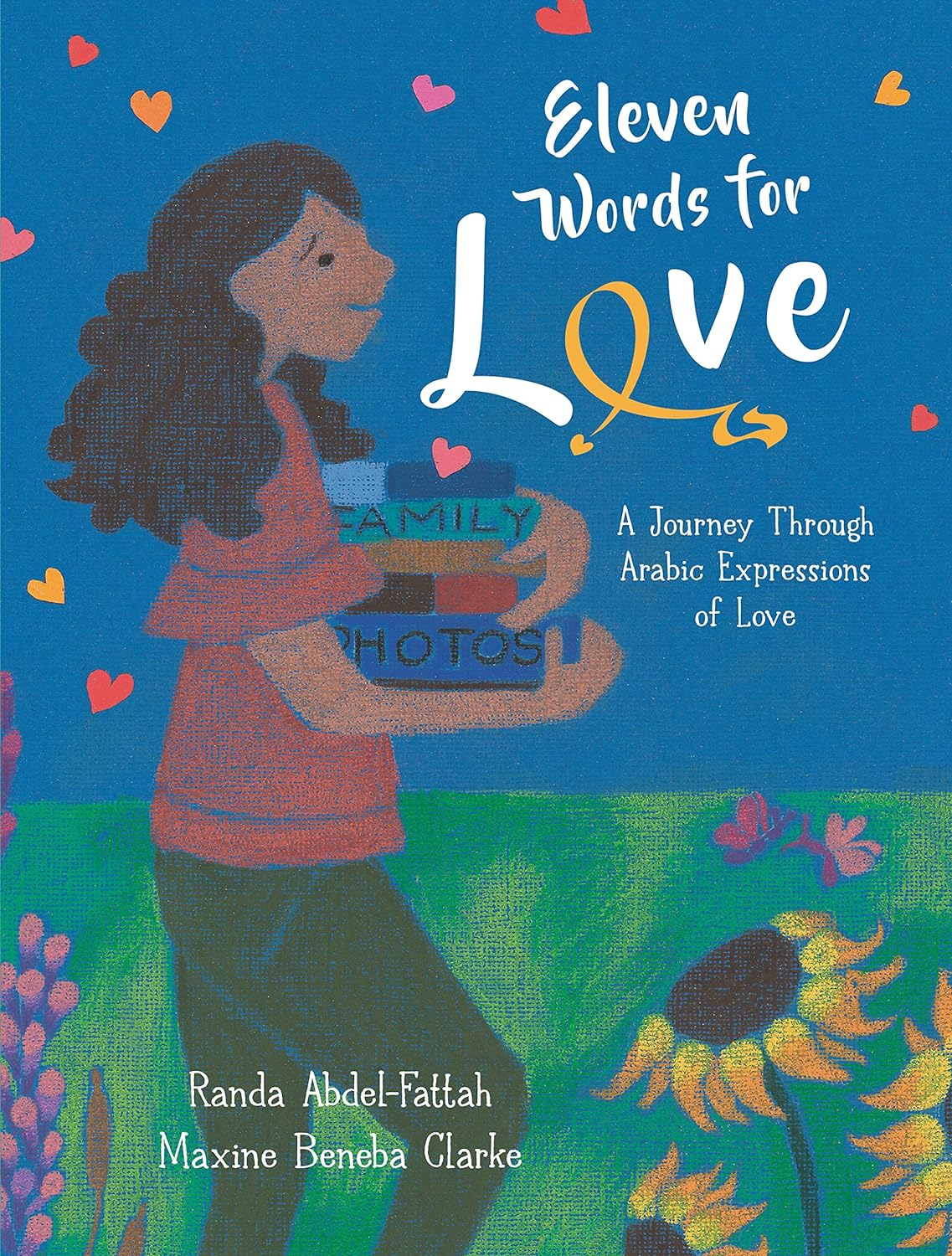
Eleven Words for Love: A Journey Through Arabic Expressions of Love by Randa Abdel-Fattah, illustrated by Maxine Beneba Clarke

Published by Candlewick

Summary:  The first few wordless pages show a family leaving their homeland with rainbow-colored suitcases.  In their new home, the girl opens one of the suitcases and leafs through a photo album.  The pictures depict different types of love, expressed through eleven Arabic words.  Each is described with a rhyming couplet: “There’s sunshine-warm friendship that glows and grows after two people meet (al-Wud)/And love that comes like a sudden breeze, sweeping you off your feet (al-Hawa).”  In between, the refrain is repeated, “There are eleven words for love, and my family knows them all,” with the last page reading, “There are eleven words for love, and I love that my family knows them all.”  40 pages; ages 5-9.

Pros:  Warm, colorful illustrations illuminate this celebration of love in its many forms of a Palestinian family that has fled home to start life in a new place.

Cons:  I wish there had been some context notes either at the beginning or the end.  The only reason I know this is a Palestinian family is from reading reviews.

Remember Us by Jacqueline Woodson

Published by Nancy Paulsen Books

Summary:  Jacqueline Woodson drew on her childhood experiences growing up in the 1970’s Bushwick neighborhood of the Bronx to create the characters of 12-year-old Sage and her friends.  Sage is the best basketball player in the neighborhood, a talent she inherited from her late father, a firefighter who died on the job.  Fire is on the minds of everyone in the community that summer, as buildings are burning down with increasing frequency.  Sage’s mother is working hard to move out of Bushwick and into a safer brick house.  As the summer moves on, Sage has a frightening incident that leaves her questioning herself and temporarily giving up basketball.  Her good friend Freddy helps her get back, making it even harder when she learns that she’s moving at the end of the summer.  The last few pages move forward in time, showing how Sage makes a new life for herself in Queens and how her friendship with Freddy survives into adulthood.  Includes an author’s note about Jacqueline Woodson’s childhood experiences that inspired the book.  192 pages; grades 4-7.

Pros:  A poetic memoir that introduces readers to a close-knit community that’s being ravaged by circumstances beyond their control.  Sage deals with some tough emotional issues but is sustained by the love of family and friends, all of which is subtly expressed through Woodson’s beautiful writing.

Cons:  There was a brief mention near the end that landlords were responsible for the fires.  I was curious to learn more, but there was no mention of that in the author’s note.

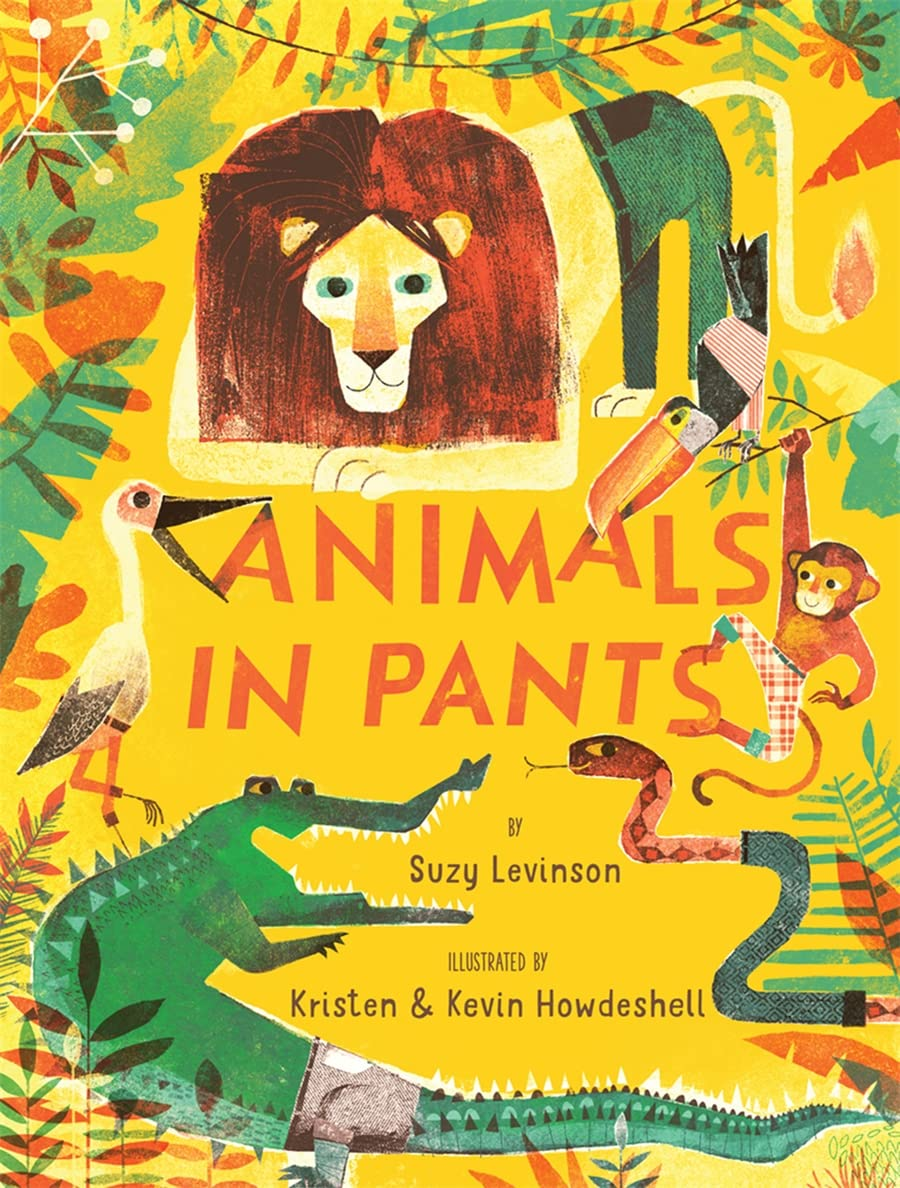
Animals in Pants by Suzy Levinson, illustrated by Kristenand Kevin Howdeshell

Published by Harry N. Abrams

Summary:  “Don’t put a goat in overalls. Really. I mean it. They tend to eat their overalls. Trust me. I’ve seen it.”  Yet the goat and a couple dozen of her friends are rocking their pants, from jeans to lederhosen to slacks (for yaks).  Each poem is just a few lines long, accompanied by humorous illustrations, making this short enough to easily read in a single sitting.  Prepare yourself for the end: “The bad news? The tailor’s incredibly slow. It takes him forever to stitch and to sew. To let out a pant seam, it could be a year. To add a new zipper, the timeline’s unclear. He fusses and frets over each inch of cloth…The good news? He’s fast for a sloth.” 32 pages; ages 4-8.

Pros:  Kids will get a kick out of these animals in their pants with impeccably rhymed poems and fun illustrations.  These took me back to A. A. Milne poems of my early childhood.  A perfect introduction to poetry, and for what it’s worth, this is currently #15 on the Goodreads list of Newbery predictions.

Cons:  I almost missed the child saying, “What? You’ve never seen animals in pants?” on the front endpapers, due to the jacket flap covering up most of her.  The good news is, she’s on the back asking the same question about animals in hats, which bodes well for a sequel.

When Moon Became the Moon by Rob Hodgson

Published by Rise x Penguin Workshop

Summary:  In 11 very short chapters, readers learn about the moon–how it was created, its orbit, craters, phases of the moon, and its relationship to Earth.  Most chapters are just a few sentences, illustrated with colorful anthropomorphized celestial bodies that talk with cartoon bubbles.  Kids will gain a greater appreciation for the moon and its effects on Earth and may be inspired to dream of traveling there some day after reading the final chapter on space exploration.  64 pages; ages 4-8.

Pros:  Fans of Stacy McAnulty’s Our Universe series will enjoy this book with its colorful illustrations and humorous, easy-to-understand information.  

Cons:  No back matter? Lunacy.

Curlfriends: New In Town by Sharee Miller

Published by Little, Brown Ink

Summary:  Charlie’s lived all over the world as a military kid, but now that her dad’s retired, the family’s settled down in her parents’ old hometown.  It’s tough starting middle school three weeks late, but Charlie’s determined to fit in by studying fashion websites and magazines to perfect her clothes and hair.  A catastrophe the first day of school ruins her hairdo but gets her a new group of friends who call themselves Curlfriends after the curly hair they all have.  Although she likes the girls, Charlie’s afraid that they won’t like her if she shows them her real personality.  A series of mishaps finally shows her that being herself is best, and after letting down her guard, the Curlfriends are closer than ever.  288 pages; grades 3-7.

Pros:  Fans of middle school graphic novels will love this family and friendship story that gracefully delivers a be yourself message and shows readers that you can start over any time.  I’m happy to see this billed as book 1 on Amazon, as it has the feeling of a successful series starter.

Cons:  I was starting to lose patience with Charlie.  She’s lucky she has such understanding parents and friends.

Fungi Grow by Maria Gianferrari, illustrated by Diana Sudyka

Published by Beach Lane Books

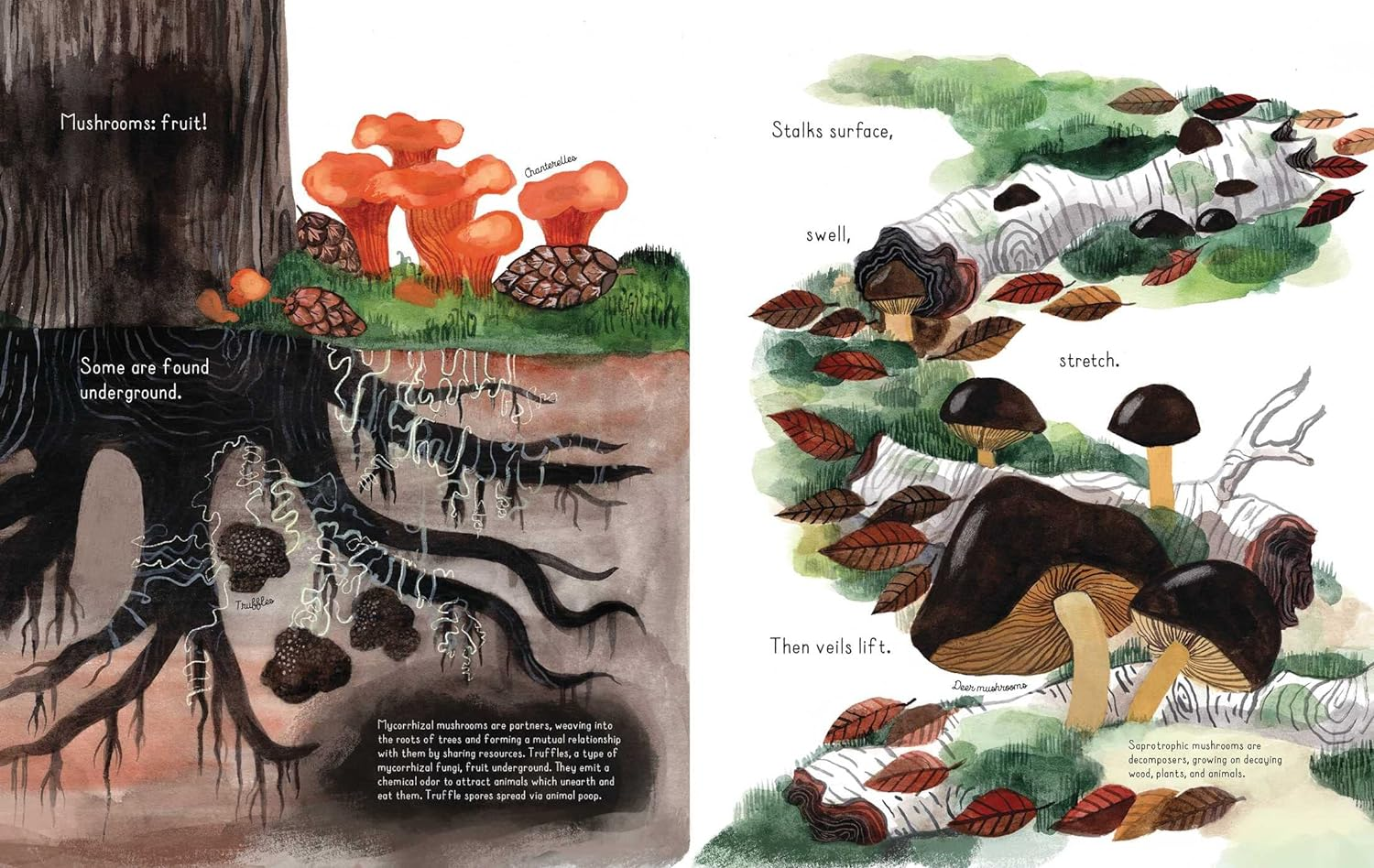
Summary:  There are lots of books about plants’ life cycles, but this one focuses on fungi, which grow from spores, not seeds.  The text begins with how the spores travel and reproduce, then describes all kinds of fungi, showing readers a colorful array that they can see, as well as cutaways that show the underground fungal world.  Specific species are described in greater detail with a smaller font.  Fungi can be poisonous, but they can also help humans in a variety of ways.  Includes additional information and a glossary, list of sources, and additional resources.  48 pages; grades K-4.

Pros:  A fascinating and beautiful look at a wide range of species that many readers may have noticed in passing but will now have reason to examine more closely.  Diana Sudyka is one of my new favorite illustrators this year, illuminating the text with bursts of colorful mushrooms and other fungi.  

Cons:  The zombie ant fungus may give you nightmares.