Two last graphic novels of 2023

Grace Needs Space by Benjamin A. Wilgus and Rii Abrego

Published by Random House Graphic

A Sky of Paper Stars by Susie Yi

Published by Roaring Brook Press

Summary: These graphic novels tell the stories of two very different girls who are both grappling with family issues. Grace lives on a space station with her divorced mom; her other mom, Ba, is a cargo ship captain traveling from one space settlement to the next. Grace is excited to be going on a trip to Titan (Saturn’s moon) with Ba, but she ends up bored and disappointed when Ba is busy with work most of the time. Desperate to see Titan’s sea, Kraken Mare, she sneaks into a group field trip and almost gets herself into serious trouble. When Ba starts having engine trouble on the way back, she has trouble trusting Grace to help her, but Grace (and Mom) manage to save the day, while Ba sees that her own workaholic nature and unwillingness to ask for help have led to some issues with her family. Includes extra artwork showing the development of the characters and the cover. 208 pages; grades 4-7.

In A Sky of Paper Stars, Yuna feels like she’ll never fit in at school. Her parents cling to Korean traditions, while Yuna wants to be more American. After folding 1,000 paper stars the way her grandmother, Halmoni, taught her, she makes a wish to live in Korea, where she feels like she’ll belong. Almost immediately, her mother gets news that Halmoni has passed away, and the family returns to Korea for the funeral. Feeling like she caused her grandmother’s death, Yuna races to fold another 1,000 stars, hoping to bring Halmoni back to life. Includes an author’s note about her experiences that influenced the story and instructions for folding a paper star. 240 pages; grades 4-7.

Pros: Fans of middle school graphic novels will enjoy both of these stories, each featuring a unique setting that emphasizes the commonality of each girl’s emotions and experiences.

Cons: I’m pretty sure I couldn’t fold one paper star, let alone a thousand.

Butt or Face? By Kari Lavelle

Published by Sourcebooks

Summary:  This guessing game style book shows a close-up photo of part of an animal, asking the reader: is it the animal’s butt or face?  Turn the page to find out the answer, see a full photograph of the animal, and learn some interesting facts and where in the world it lives.  The author’s note tells how she was inspired by an article she read about farmers in Botswana who painted eyes on the rear ends of their cattle to scare away predators.  Includes a map showing where each animal lives and a chart telling where each one rests its butt and what food goes in its face.  40 pages; grades K-3.

Pros:  I wasn’t sure how this book would be received by exhausted teachers the week before vacation, but so far, they have enjoyed it as much as the kids–which is a lot.  It’s an amazing introduction to animal adaptations.  Look for book 2 in the spring.

Cons:  The photos are pretty hard to figure out, and many of the animals aren’t well known.

Two books about the immigration experience

Salma Makes a Home by Danny Ramadan, illustrated by Anna Bron

Published by Annick Press

Mina Belongs Here by Sandra Niebuhr-Siebert, illustrated by Lars Baus

Published by Floris Books

Summary: Two girls navigate their new homes after moving from a different country. Readers may know Salma from her picture book, Salma the Syrian Chef. She and her mom have settled into a new apartment in Vancouver, and when the story opens, her dad is on his way to join them. Although she’s thrilled to have Baby back with the family, Salma worries that he won’t like Canada and will go back to Syria. Some heartfelt conversations resolve the issue, and Salma learns that it’s possible to have two homes–the one where you live and the one you remember in your heart. Includes directions for making lanterns like the ones Salma and her mom create in the story. Book 2, Salma Writes a Book, is also available. 120 pages; grades 1-4.

Mina is scared to start kindergarten, even though her mother assures her that she’ll have fun and that the people will be kind. This turns out to be the case, as her teacher warmly greets her the first day, and Mina makes a friend. Each night, she dreams about her experiences, and each day school gets a little easier. The illustrations slowly change from gray to full color, as Mina learns English and becomes a member of the kindergarten community. When a new boy is introduced to the class, Mina is the first to greet him and invite him to play. 40 pages; ages 4-8.

Pros: Both books show resilient main characters who successfully deal with the difficulties of moving to a new country and learning a new language, serving as excellent mirrors for those going through the same challenges and windows for kids who may be welcoming new students to their classes.

Cons: Neither book had quite the light touch of Young Vo’s Gibberish, which is still my favorite on this topic.

Unseen Jungle by Eleanor Spicer Rice, illustrated by Rob Wilson

Published by MIT Kids Press

Summary: After an introduction to different types of microbes, the author looks at different places where these tiny creatures live. There are four parts: house, yard, food, and you, with several section in each. Whether it’s your pet, your bed, or your own body, it’s pretty much impossible to escape the microbes that are everywhere. Fortunately, most are benign or even beneficial to humans, but the ones that take over various creatures, turning their hosts into zombies, are pretty horrifying. In between the descriptions are interviews with scientists whose passion is learning more about the tiny creatures all around us. Includes a few pages at the end with some additional information and resources, as well as directions on how to draw E. coli; also an extensive bibliography. 176 pages; grades 3-6.

Pros: The lighthearted tone and funny illustrations make this a pretty entertaining reading, and kids will no doubt enjoy grossing out their peers, parents, and teachers with the information they learn here. The scientist profiles are a nice addition.

Cons: I may be in the minority here, but I felt like the section on microbes that live on humans was a bit too short. I want to know what I’m up against.

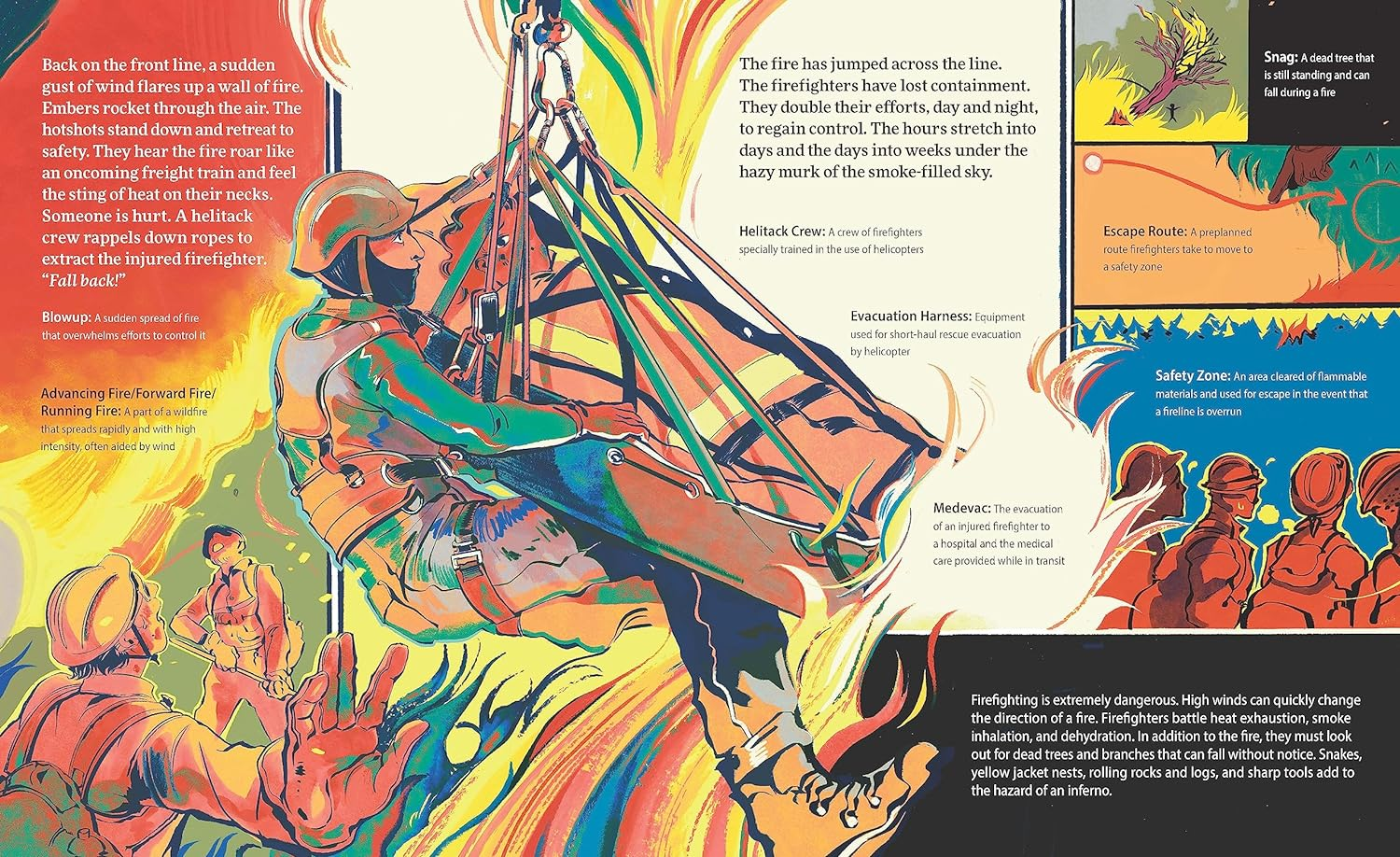
They Hold the Line: Wildfires, Wildlands, and the Firefighters Who Brave Them by Dan Paley, illustrated by Molly Mendoza

Published by Chronicle Books

Summary: When a fire lookout spots smoke coming from the forest following a lightning strike, firefighters spring into action, digging a fireline to try to keep the fire from spreading. When the fire jumps the line, more strategies are needed, including fighting the fire from airplanes and helicopters. As people are evacuated and animals flee, other workers have jobs setting up camps for the evacuees and the firefighters. Even after the fire has been contained there is still work to be done, extinguishing burning material. Finally, the exhausted firefighters get a well-earned rest, but soon they are back on call awaiting the next fire. Includes additional information on fire ecology, describing old and new approaches, and facts about firefighters with labeled diagrams of their protective gear and supplies. 44 pages; grades 2-5.

Pros: This is a fascinating and timely look at many aspects of wildfires and the people who fight them. Each page has several sidebars with definitions of all kinds of terms used by firefighters. The art resembles old WPA posters, an appropriate style for the topic.

Cons: Some additional resources would have been nice.

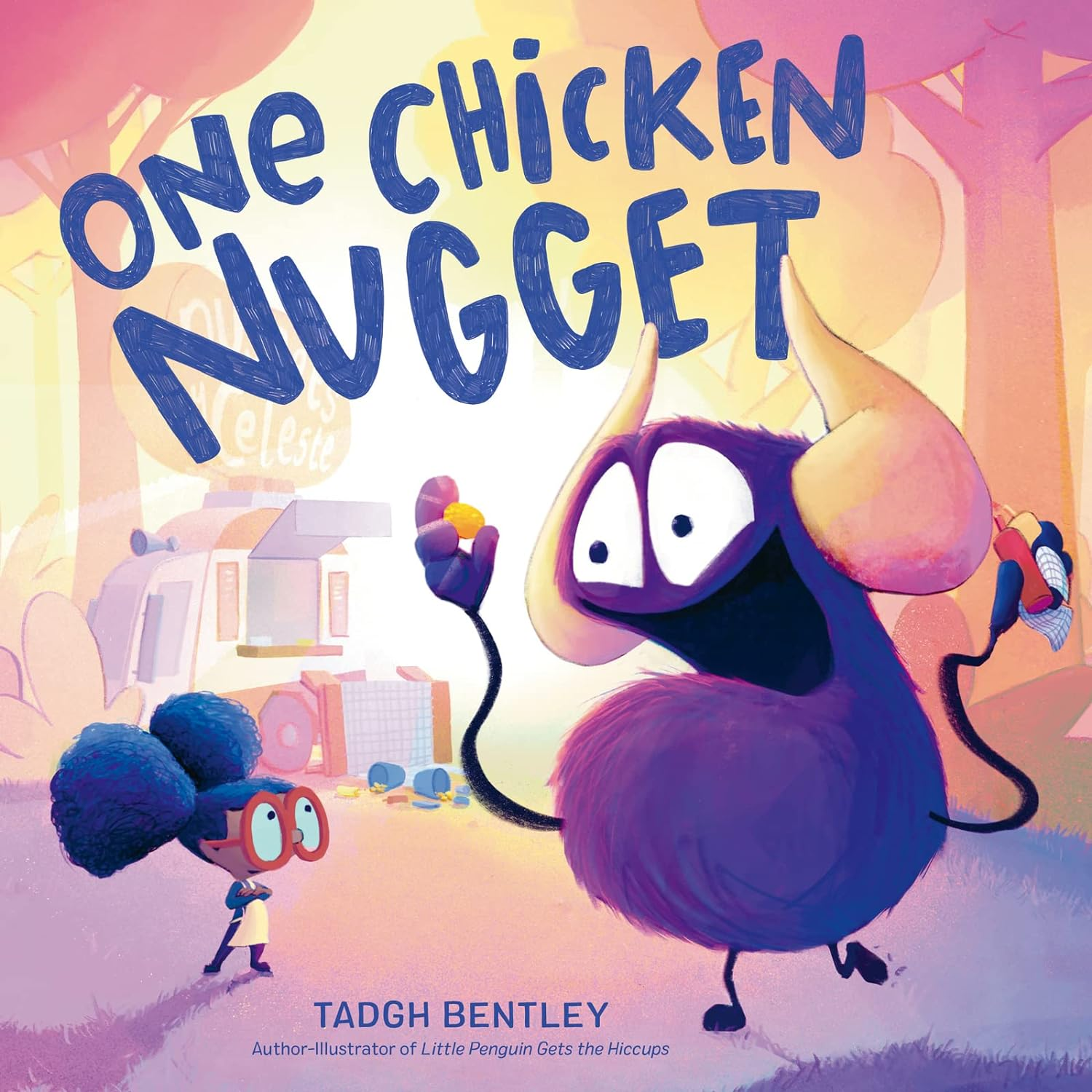
One Chicken Nugget by Tadgh Bentley

Published by Balzer + Bray

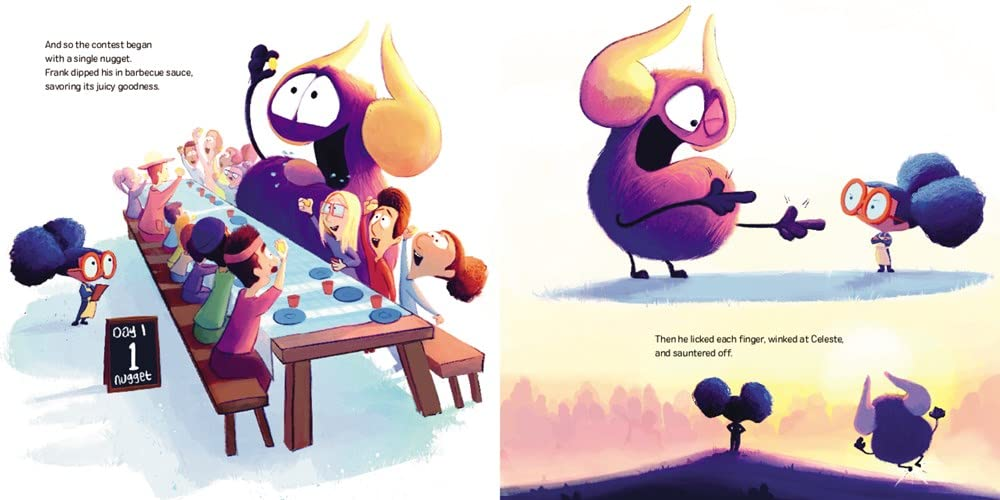
Summary: Frank is a monster with a passion for chicken nuggets, especially the ones Celeste sells on her food truck. Since Frank isn’t exactly an ideal customer (scares away other customers, doesn’t pay, terrible table manners), Celeste is desperate for a way to get rid of him. Some library research gives her an idea: the 30-Day Double Nugget Challenge. Each day the number of nuggets offered will doubled, and anyone who can eat them all wins free chicken nuggets for life. Seems easy enough on the first few days but by day 14 (8,192 nuggets), Frank is the only customer left. On day 30, he starts in on the pile of 536,870,912 nuggets and makes it all the way to the final one, and then…. Includes an author’s note and additional information on exponential growth. 40 pages; grades K-3.

Pros: Similar stories have been told for ages (as the author acknowledges in his note), but this is a particularly fun one with humorous monster illustrations that really bring home the concept of exponential growth.

Cons: The interesting endnotes were printed on the back cover, where the taped-down dust jacket obscured approximately one-sixth of them.

Creep, Leap, Crunch! A Food Chain Story by Jody Jensen Shaffer, illustrated by Christopher Silas Neal

Published by Knopf Books for Young Readers

Summary:  For the first part of this book, the rhyming text builds like The House That Jack Built, with the sun shining down on a cricket munching grass that’s eaten by a mouse, who’s swallowed by a snake, which is scooped up by a hawk, who gets trapped by a fox that gets chased by a bear.  But on some days things are different, and the story takes a twist as each animal escapes its predator, leaving the bear to munch on “flowers and seeds…all that she needs.”  Includes an illustrated glossary that gives more information about each of the animals.  48 pages; ages 4-8.

Pros:  A fun and clever introduction to food chains, with the second version of the story perhaps makes the case for vegetarianism.  

Cons:  Some of the main characters meet a gory end in the first version.

Mehndi Boy by Zain Bandali, illustrated by Jani Balakumar

Published by Annick Press

Summary:  Tehzeeb loves art and fashion, so it seems like a natural fit when he learns how to do mehndi.  He practices on friends and family members and begins to get a reputation for his henna art.  His favorite uncle, Ayaz, is also an artist and has encouraged Tehzeeb’s creativity.  Tehzeeb is crushed when Ayaz Uncle expresses disapproval over his mehndi, telling him that it’s not an appropriate art form for boys.  Reluctantly, Tehzeeb stops doing mehndi until the day before his cousin’s wedding, when he and the bridal party get stuck in traffic.  Tehzeeb ends up saving the day, and Ayaz Uncle has to rethink his gender stereotypes.  Includes a glossary, additional information about mehndi and henna, and directions for drawing a paisley.  100 pages; grades 2-4.

Pros:  Tehzeeb is a great character who learns how to be true to himself, and it was refreshing to see Ayaz Uncle change his ideas and admit to his nephew that he was wrong. The story and the colorful illustrations make this an ideal book for early chapter book readers.

Cons:  I would have liked to know more about the history of this Muslim family with roots in India living in Tanzania.

Virginia Wouldn’t Slow Down: The Unstoppable Dr. Apgar and Her Life-Saving Invention by Carrie A. Pearson, illustrated by Nancy Carpenter

Published by Norton Young Readers

Summary:  Ginny Apgar was an active child, shunning traditional female pursuits and curious about the world around her.  She decided to become a doctor, specializing in the relatively new practice of anesthesiology, and eventually became the second woman to be board certified in the field.  Working in the delivery room, she noticed that doctors and nurses were usually more focused on the mothers than the babies, whose needs for breathing assistance often went unnoticed.  Ginny started paying attention to the babies, using her knowledge as an anesthesiologist to help them.  When a young doctor asked her for signs of health in a newborn, she quickly scribbled down the five markers she checked for.  Ginny’s last name lent itself to the acronym that became a test for newborn health, and today most babies receive an APGAR score within minutes of birth.  Includes an author’s note with additional information, a timeline, and a couple of photos.  48 pages; grades 1-5.

Pros:  I didn’t expect to find this book so engaging, featuring a woman who dealt with career obstacles (she had to give up her dream of becoming a surgeon due to financial constraints) but went on to make a huge contribution to medicine.  She sounds like a real character, and as a New Jersey native who often traveled on the Garden State Parkway before the age of E-ZPass, I particularly appreciated the special gun she had for firing quarters at toll booths so she wouldn’t have to slow down.

Cons:  This may not be a topic kids will be drawn to on their own.

Two picture books set in India

My Bollywood Dream by Avani Dwivedi

Published by Candlewick

The Light Within You by Namita Moolani Mehra, illustrated by Kamala Nair

Published by Two Lions

Summary: Two kids share their experiences in India. In My Bollywood Dream, a girl who dreams of being a filmmaker enjoys an evening at a Mumbai cinema with her family. As they drive to the theater, she imagines turning what she sees in the city streets into Bollywood-style film scenes. Everyone enjoys the movie, and during the final number, the entire audience gets out of their seats to sing and dance. The last page shows the narrator as an adult behind the camera. Includes an author’s note about her own Bollywood experiences.

In The Light Within You, Diya is back in India for a visit from her new home in the United States. She’s excited to see her grandmother, Nani, and to celebrate Diwali, a holiday that the kids in her new school know nothing about. Diya enjoys the festive preparations with Nani, with whom she is able to share some of her struggles with her new life. Nani reminds her that Diwali is about light and encourages Diya to discover her inner light to shine at her new school. The last page shows Diya sharing Indian souvenirs with her new classmates. Includes an author’s note with additional information about Diwali, a glossary, and Diya’s Diwali affirmation, a poem that celebrates the inner light. Both books 40 pages; ages 4-8.

Pros: Both books will make readers want to visit India, with their descriptive text and especially the colorful illustrations that celebrate Bollywood and Diwali. Each one is empowering in its own way, focusing on the protagonist’s gifts and encouraging her to share them with others.

Cons: It felt like Diya might still have some struggles ahead of her.