Birds and dinosaurs

Brave Baby Hummingbird by Sy Montgomery, illustrated by Tiffany Bozic (Simon and Schuster, 48 pages, ages 4-8). A hummingbird tells his story, beginning with his birth when he and his sister hatch from eggs the size of navy beans. They’re fed every twenty minutes until the day their mother doesn’t return to the nest. Fortunately, they’re rescued and taken to a place where a human, known only as the Voice, takes care of them until they are old enough to survive on their own. Woven into the story are facts about hummingbirds’ food, flight, bodies, and migrations, and more information is given at the end, including the author’s experience with a hummingbird rescue and ways that readers can help these birds. This lovely book provides plenty of information about hummingbirds, illuminated with beautiful illustrations of the birds at every stage of their lives and the colorful landscapes they inhabit.

The Iguanadon’s Horn: How Artists and Scientists Put a Dinosaur Back Together Again and Again…and Again! by Sean Rubin (Clarion Books, 48 pages, grades K-4). Ever since humans first realized that dinosaurs once existed, they’ve been trying to imagine what these creatures looked like. Using the dinosaurs’ fossilized remains, artists have painted and sculpted prehistoric depictions…and generally gotten things completely wrong. A case in point is the iguanodon’s horn, which turned out to be (we think) a thumb spike. Sean Rubin goes through the evolution of ideas about the iguanodon, showing how increased scientific knowledge changed perceptions about what the animal looks like. He speculates on what the next ideas may be, emphasizing the fact that, barring time travel, we will never know for sure. The endnotes give additional information about each two-page spread.

Dinosaur fanatics will love this book, both the fascinating story of how science works and the illustrations, which are at once informative and funny (I liked the cartoon bubbles showing the comments of the various wrong iguanodon models: “I DO look pretty terrible here,” “Seriously. This is embarrassing.” I felt a little bogged down reading the repeated wrong guesses, but I suspect a true paleo fan will find them captivating.

Celebrating spring holidays

For those who celebrate Easter (March 31 in 2024): Elijah’s Easter Suit by Brentom Jackson, illustrated by Emmanuel Boateng (Doubleday Books for Young Readers, 32 pages, ages 4-8). Every Easter, Reverend White gives a special “Hallelujah” to the congregant who’s got the most spectacular Easter outfit. Elijah’s determined to win, but the stores around town don’t have anything that looks just right. Feeling defeated, Elijah asks previous winners Mother Green and Deacon Brown for advice. They tell him that Easter’s not about winning a competition, but about new beginnings and remembering their culture. They share how when they were kids, they often wore homemade Easter outfits, not being allowed to shop in local stores. Inspired, Elijah makes an outfit from fabrics that have happy memories for him and wows the crowd on Easter morning with his colorful patchwork suit. Hallelujah!

Verdict: A definite winner with funny illustrations depicting Elijah in a variety of interesting outfits on his shopping spree, but also offering a heartwarming message about community and being true to yourself.

For those who celebrate Eid (on or around April 9 in 2024): The Most Exciting Eid by Zeba Talkhani, illustrated by Abeeha Tariq (Scholastic, 24 pages, ages 4-8). When they spot the new moon, Safa and her family start to get ready for Eid al-Fitr. Safa is excited to wear new clothes, get gifts, and get together with family. In the morning, all her wishes start to come true, and she enjoys her presents, especially a new bike. Her cousin Alissa wants a turn, but Safa doesn’t feel like sharing. Later, Safa’s mother takes her through the neighborhood to distribute gifts, and Safa realizes that sharing is one of the best parts of Eid. After a big dinner at the grandparents’, Safa is ready to go home and ride bikes with Alissa.

Verdict: A cute story that introduces several aspects of Eid, in what appears to be a Pakistani family. It definitely has a Scholastic book club vibe to it, and unfortunately, only seems to be available in paperback.

For those who celebrate Passover (April 22-April 30 in 2024): Afikoman, Where’d You Go? A Passover Hide-and-Seek Adventure by Rebecca Gardyn Levington, illustrated by Noa Kelner (Rocky Pond Books, 40 pages, ages 4-8). Kids at a seder dinner search for the elusive afikoman through every room of the house and yard. Sharp-eyed readers will see the afikoman character hiding on every busy page. He’s finally caught, everyone gets a prize, and dinner continues, but the sneaky afikoman is seen riding away in one of the cars on the last page, wishing everyone, “Happy Pesach!”

Verdict: The bouncy rhyming text and Where’s Waldo style illustrations provide a lot of holiday fun, with details about Passover included in the glossary at the beginning, as well as being woven into the story and pictures. Spell check is telling me that the correct spelling is afikomen, but both the title and the glossary of this book use afikoman.

More graphic novels that made me eat my words

Blue Stars: The Vice Principal Problem by Kekla Magoon and Cynthia Leitich Smith, illustrated by Molly Murakami (Candlewick, 176 pages, grades 3-7). Cousins Maya and Riley are almost polar opposites, but they’re forced to share a room at their grandmother’s house when Maya’s military parents are stationed in Japan and Maya’s family moves away from the Muscogee reservations for opportunities in Urbanopolis.

At the start of sixth grade, outgoing Riley gravitates towards gymnastics and a big group of friends, while Maya prefers her own company and working on robotics. They unite against the villainous vice principal, though, when they learn of his plan to cut all after-school clubs to fund the expansion of his detention space. Working together, they discover each one has talents that lend themselves to the defeat of this plot. They begin to see themselves as superheroes, befriending two boys who become their sidekicks and assistants. The kids manage to save their school activities, but the vice principal is still at the school plotting his evil deeds, making a sequel seem inevitable.

Next Stop by Debbie Fong (Random House Graphic, 272 pages, grades 4-7). Pia’s family has endured an almost unimaginable loss, and they are dealing with it in different ways. Her mother has become withdrawn and depressed, while her dad insists that they move to have a “fresh start.” Pia is caught in the middle, blaming herself and trying to navigate her parents’ emotions. When she’s offered a bus trip to a lake rumored to have magical powers, she jumps at the chance.

The journey proves memorable, with a quirky cast of characters that slowly starts to feel like family as they travel to such sites as the world’s smallest corn maze, the Prickly Park cactus cruise, and a motel shaped like a chicken. The tour guide, a friend of Pia’s father, looks after Pia, who develops a memorable friendship with the guide’s daughter. There’s an older couple desperately seeking a cure for the wife’s illness, and a family with a young daughter with whom Pia bonds. The story of the trip is interspersed with flashback scenes in a more muted palette, slowly showing the reader what has happened to Pia’s family. When the tour finally reaches the lake, a dramatic scene unfolds in which Pia begins to get closure and to forgive herself for what happened. It may not be exactly what she was hoping for, but it helps her family move toward healing when she returns home.

Having just disparaged graphic novels for not being more creative, I am now forced to eat my words after reading these two. They both offer something new, and I found the format and story of Next Stop particularly compelling. The family tragedy and the sadness that pervades the story may make it a bit more appropriate for the older end of the recommended age range. As for Blue Stars, I loved the premise and the contributions to the story by both of the award-winning authors. I wished the book had been a bit longer to develop the plot more fully (the girls went from being enemies to close friends in the space of about a page and a half), but I think kids will love this series opener and will look forward to more to come.

Graphic novels with a touch of deja vu

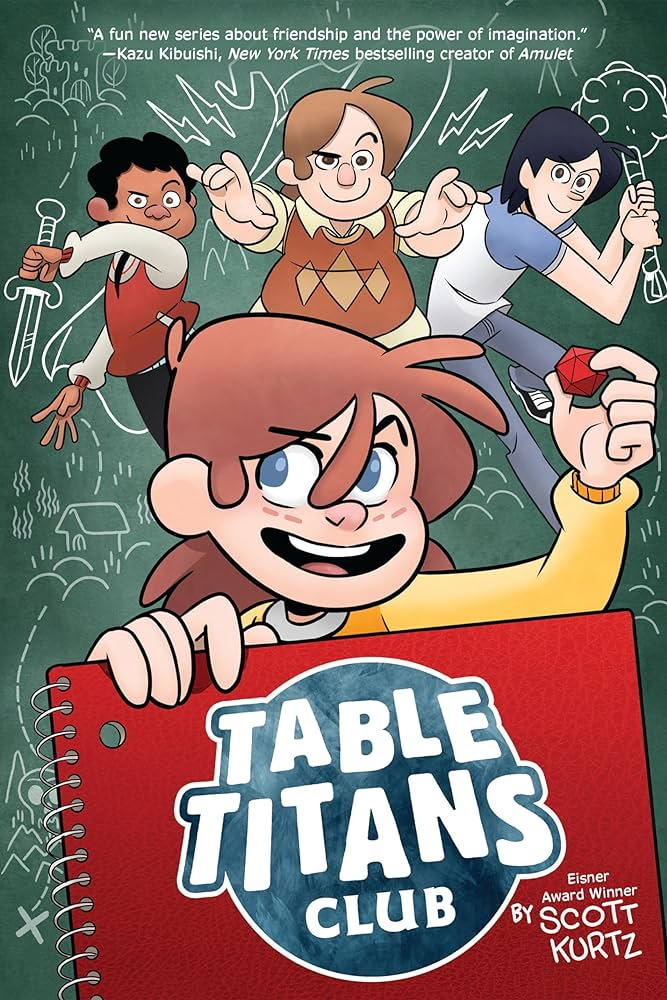
Table Titans Club by Scott Kurtz (Holiday House, 224 pages, grades 3-7). Valeria “Val” Winters is new at school, and her mom’s reminder of a fresh start tips readers off that she may have struggled before. Val’s first day is rough, but she catches the attention of the Table Titans Club, a group of Dungeons and Dragons players. After much debate among the members, one of them invites Val to join their school club. Val’s thrilled, although she’s never played D&D.

Turns out she’s a natural, and all seems to be going well until their teacher sponsor announces that his wife is having a baby, and he has to cut back on his hours. When he tells them that Coach Bitner will be replacing him, the Titans are sure their club is doomed. But Val manages to win Coach Bitner over and secure a spot on the wrestling team. After a number of bumps in the road, Val and the Titans (including another new girl Titan) manage to save the club and secure a wrestling team victory. Val’s announcement about a role-playing fantasy summer camp she’s discovered just about assures a sequel.

Duck and Moose: Duck Moves In! by Kirk Reedstrom (Disney Hyperion, 64 pages, grades 1-3). Moose loves peace and quiet, so when Duck settles in on his antlers, Moose is furious. He tries to convince/trick Duck to find a home in a pond, on a mountaintop, and inside a cave, but Duck is convinced they should be neighbors. Finally, Moose gives up. When Duck realizes how upset Moose is, he sets up a home a short distance away, then invites Moose over for a movie night. They unexpectedly bond over a favorite movie and snacks, and a surprising friendship is born.

These two graphic novels are sure to be big hits, with some funny characters, situations, and artwork as well as heartwarming conclusions. However, I couldn’t help but feel a sense of deja vu: a loveable troublemaker starting middle school is a familiar graphic novel theme and we’ve seen the introvert/extrovert friendship in other early reader series like Narwhal and Jelly, Beak and Ally, and Frank and Bean. Guess I can’t blame publishers for wanting to go with a sure thing, but a few creative risks would be nice to see as well.

Parks for everyone

Cactus Queen: Minerva Hoy Establishes Joshua Tree National Park by Lori Alexander, illustrated by Jenn Ely (Calkins Creek, 40 pages, grades 1-4). Minerva Hoyt grew up in Mississippi, where she loved to play outside and was not afraid to speak her mind. She grew up, got married, and moved to Pasadena, California with her husband. When Minerva needed a break from the city, her favorite place to visit was the Mojave Desert.

Over the years, Minerva watched as people from Los Angeles slowly stripped the Mojave of its cacti, yucca, and Joshua trees to transplant (usually unsuccessfully) to their gardens. To try to preserve this ecosystem, Minerva did something similar, but for a different purpose–she gathered plants from the desert and created an exhibit at the 1928 International Flower Show to raise awareness. Later, she worked to turn some of the Mojave into a national park. There was quite a bit of resistance to this idea from those who thought the desert was a barren wasteland, but Minerva never gave up. In 1936, President Franklin D. Roosevelt signed the law that created Joshua Tree National Monument. Almost 50 years after Minerva’s death in 1945, President Bill Clinton established Joshua Tree National Park. There’s more information about Minerva, Joshua Tree, and national parks, as well as environmental tips and a bibliography in the back.

Tasha’s Voice by Carmen Bogan, illustrated by Floyd Cooper and Daria Peoples (Yosemite Conservancy, 38 pages, grades K-3). In this companion to Carmen Bogan’s Where’s Rodney? a young girl has a transformative experience in nature, just as Rodney does in his story. Tasha is a new girl in Rodney’s class, so shy that she can’t speak when the teacher calls on her or talk to the other kids in the class. When the class takes a field trip to the park, a ranger shows them around, then lets them explore on their own. An encounter with a small turtle helps Tasha to make two new friends and to finally find her own voice.

Be sure to read the last two pages, which include an interview with Daria Peoples who completed the artwork after Floyd Cooper passed away in 2021. There’s also a brief note about parks that includes websites for Outdoor-Afro and Latino Outdoors.

Enjoy these two books for the last part of Women’s History Month! (Although Tasha’s Voice won’t be out until April). They are a celebration of national parks, the healing power of nature, and making outdoor experiences available to groups, like women and people of color, who may not have always felt welcome there.

How to be lucky

Lucky Duck by Greg Pizzoli (Knopf Books for Young Readers, 48 pages, ages 3-8). Susan the duck feels unlucky when the roller skates she ordered online are two sizes too big. But she feels lucky when a wolf shows up at her door to tell her she’s won a free pot. Kitchen light burns out and the pickle jar is empty? Unlucky. Free onions, celery, and carrots from the wolf? Lucky. Finally, just as Susan’s luck seems to have completely run out, the tables are turned, and all the unlucky things turn out to be the best kind of luck.

I’ve been reading this book all week to the K-2 crowd, and it’s been a big hit. I’ve paired it with Mo Willems’ That Is Not a Good Idea, another tale of duck vs. canine (fox), which also has a surprise twist near the end. If you want to dig deeper, you can talk about what’s lucky and what’s unlucky, and how those things are subject to change, sometimes depending on how you look at them.

What’s New, Daniel? by Micha Archer. In the third book about Daniel, he meets his grandpa in the park. “What’s new, Daniel?” Grandpa asks. “Um, I don’t know yet,” Daniel replies. “I’ll go find out.” As he gathers the news from his friends in the park–Rock, Blackbird, Duck, Polliwog, Snake, Squirrel, and Butterfly–Daniel remembers things that are new with him, too. He’s learned to whistle, he has a new tooth, and his legs have grown so he can run faster. Back with Grandpa, Daniel gives updates on everyone, including himself, then asks Grandpa to share what’s new with him.

This is a perfect book for spring, with all the changes taking place, and Caldecott Honor artist Micha Archer has created beautiful collage illustrations that capture the blues and greens of a sunny spring day. Kids will be eager to share what’s new with them. What’s lucky? Daniel and Grandpa getting to share this perfect day together and clearly enjoying spending time with each other.

The Book That Can Read Your Mind by Marianna Coppo. (Chronicle Books, 48 pages, ages 4-8). You may remember the trick this book employs from childhood magic sets, one that has apparently been around for hundreds of years. Marianna Coppo introduces a bunny magician (who pulls a man out of a hat) to read your mind. 36 different creatures, sitting in six rows of six, are introduced. You choose one without telling the reader, then tell the reader which row its in. Different rows go to different pages, where the same 36 characters are rearranged. Point out the row again, and you’ll be directed to another page that should reveal which character you picked. There’s an afterword that gives more information about the history of this trick.

The illustrations are adorable, and I’m sure kids will love doing the trick, then showing it to others. However, it is just that, a trick, and once the novelty has worn off, I imagine this book is not one that will enjoy multiple readings. But you’ll be lucky enough to have your mind read by a bunny magician, and then be able to turn around and become a magician yourself.

World War II in fact and fiction

Max in the House of Spies: A Tale of World War II by Adam Gidwitz (Dutton Books for Young Readers, 336 pages, grades 4-7). “Once there was a boy who had two immortal creatures living on his shoulders. This was the fourth most interesting thing about him.” The other things about Max are that he’s a genius, particularly in the mechanical realm, that his parents send him from Berlin to England as part of the Kindertransport in 1939, and that he falls in with some spies, even though he’s only 11. The immortal creatures, a kobold named Berg and a dybbuk named Stein are invisible and inaudible to everyone but Max, which proves both huge help and a terrific nuisance.

Max wants nothing more than to return home and save his parents. Much to his surprise, he ends up living with a Jewish family in London, giving him the chance to observe British antisemitism up close. It’s this family that brings him into contact with the spies, allowing Max to use his genius to get them to agree to send him back to Berlin as a British spy. First there’s an intense training, where it takes every bit of Max’s brains, as well as help from Berg and Stein, to pass to the next level. Finally, Max is ready to go, assigned to be carried in by a paratrooper in the dead of night. That’s as much as I can tell you now, except to assure you that the cliffhanger ending will have you praying that Adam Gidwitz is a speedy writer who can produce book 2 ASAP.

The Enigma Girls: How Ten Teenagers Broke Ciphers, Kept Secrets, and Helped Win World War II by Candace Fleming (Scholastic Focus, 384 pages, grades 5-9). If you’ve seen The Imitation Game, you’re familiar with Bletchley Park, the top-secret British facility where thousands of men and women worked day and night to crack German codes. This book focuses on ten of the young women, many still in their teens, who came to work in various jobs there. Each one had a very specialized task, whether it was translating, indexing, or keeping machines running. The work was absolutely grueling, with rotating eight-hour shifts to keep a 24-hour schedule, and it was top, top secret. Workers couldn’t even discuss what they were doing with those in a different department.

All were motivated by a desire to save lives and win the war, although at one point, one of the women reflects on the fact that saving British lives meant losing German lives. They all put their lives on hold, some for years, to do their important work. When the war ended, the girls went their separate ways, never telling anyone, including spouses and family members, what they had done. It wasn’t until the late 1970’s that some of the secrecy was lifted and stories started to be told. In the 1990’s, what was left of Bletchley Park was restored and opened as a museum. An author’s note and extensive source notes and index are a testament to the research done by Candace Fleming.

Reading these two books caused me to reflect on how World War II is still being mined for stories for all ages, more than any other time period I can think of. It seems like an era that easily lends itself to unambiguous tales of good versus evil. I appreciate how Adam Gidwitz subtly points out the racism and antisemitism that was prevalent in Britain, as well as making a point of England’s centuries of colonialism and empire building that preceded the war, with little concern for indigenous people in the conquered lands. The Enigma Girls is a more straightforward war story, with an interesting emphasis on the importance of women’s work that is often missing (e.g., Christopher Nolan’s Oppenheimer). Ten enigma girls were a lot for me to keep track of, especially since their stories were all woven together, and, although I would have liked to have known each one better, it did emphasize the diversity of backgrounds of those who ended up at Bletchley Park. It’s also unfortunate, although understandable, that not many photos exist of the facility, and Candace Fleming made the decision not to include any of the women’s photos, since she couldn’t find pictures of all of them.

The art of science and the science of art

The Observologist by Giselle Clarkson (Gecko Press, 120 pages; grades 3-7). Giselle Clarkson defines observology as the study of looking and encourages kids to become observologists, closely examining the world around them. Following the introductory chapter, there are four sections, each focusing on a specific place to observe: a damp corner, pavement, a weedy patch, and behind the curtains. Each of these has several subsections that look at topics as diverse as how to relocate a spider, droppings and eggs, and things to spot at night.

Kids are encouraged to draw what they see, and the whole book has the look of a naturalist’s notebook, with lots of sketches and labels. The text and illustrations are both humorous and informative. It may take a dedicated naturalist to read this book from cover to cover, but it’s an easy one to browse. I could also see it being used as a textbook for a fun and fascinating observology class. The book concludes with a very complete index, in a font so small that this observologist was compelled to break out her magnifying glass to read it.

This Book Will Make You an Artist by Ruth Millington, illustrated by Ellen Surrey (Nosy Crow, 64 pages, grades 2-5). The title’s bold claim is supported by profiles of 25 different artists, with step-by-step instructions to make art projects based on each person’s work. It’s a diverse group of artists, starting with cave painters, and continuing through time to include famous artists like Leonardo da Vinci, Pablo Picasso, and Frida Kahlo, and those who may not be as well-known, such as Judith Scott, Liu Bolin, and Esther Mahlangu. There’s plenty of diversity in the art as well, allowing kids to create paintings, mosaics, collages, sculptures, and more. The introduction shows readers how to set up their own art studio, and the glossary will help with unfamiliar words that they may encounter throughout the book.

Just like The Observologist, this is a book that’s unlikely to be read from start to finish but could be used to teach a pretty awesome class combining art history and hands-on art. The projects all look like fun and are broken down into 4-6 easy-to-follow steps with illustrations. The pages felt kind of crowded, with information and illustrations about the artist taking up about 2/3 of each spread, and the directions crammed into the remaining portion of one page. The plus side of this is that each spread is chock full of information, ideas, and inspiration, and readers are likely to come away with some artwork they will feel proud of.

One of these things is not like the other

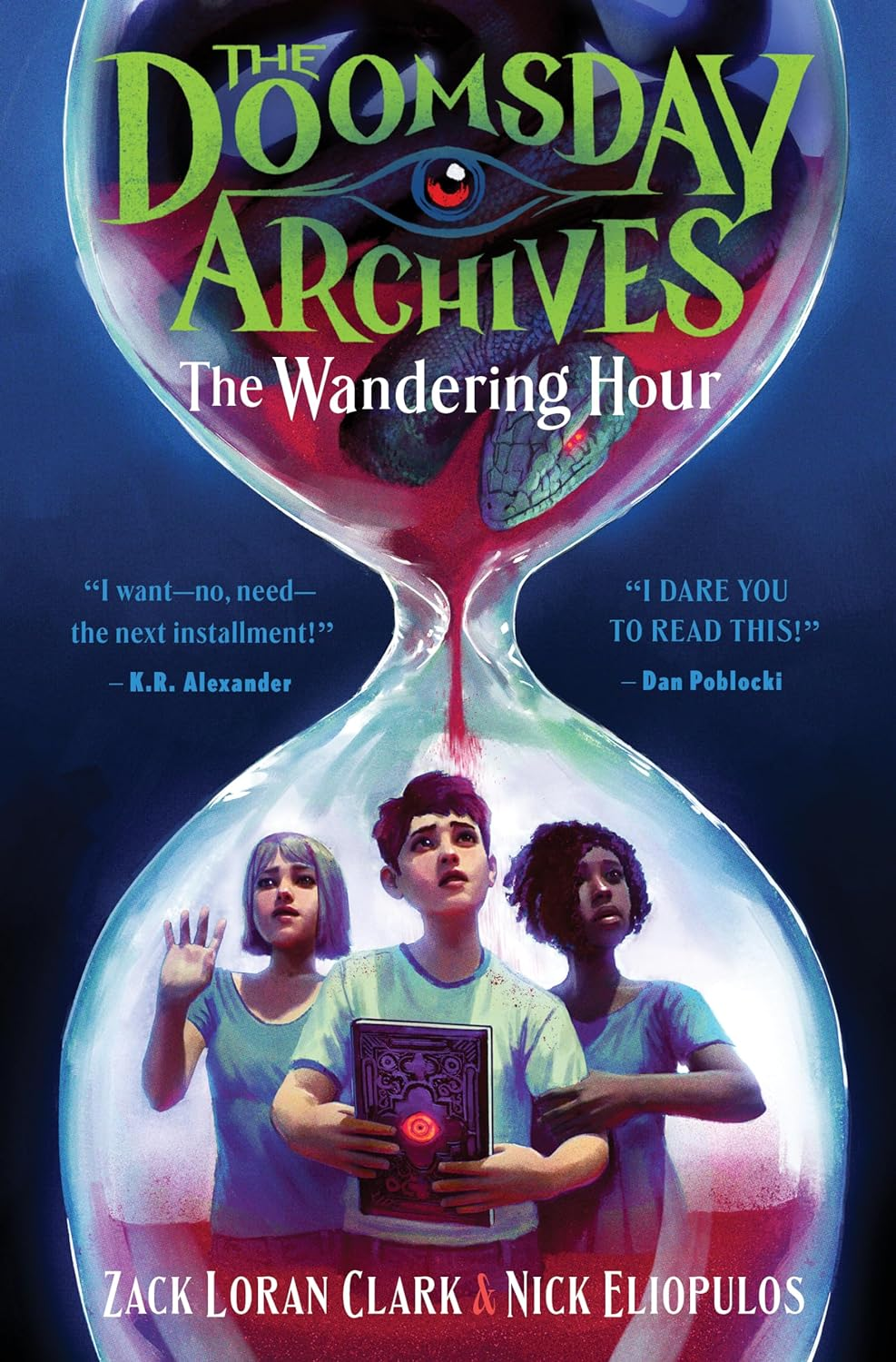
The Wandering Hour (Doomsday Archives, book 1) by Zach Loran Clark and Nick Eliopulos (Zando Young Readers, 224 pages, grades 4-7). Even though Emrys is relatively new to the town of New Rotterdam, he’s gotten pretty obsessed with the town’s spooky history. He and his new friend Hazel enjoy reading and updating the Doomsday Archives page of the New Rotterdam Wiki Project, which documents various urban legends and unexplained disappearances.

One stormy night, the two friends, plus Hazel’s friend Serena, make an unsettling discovery and receive an invitation to join the Order of the Azure Eye–an invitation accepted by Emrys and Hazel, but rejected by Serena, who is more creeped out than fascinated by the supernatural. Membership in the Order leads Emrys and Hazel, and eventually, a reluctant Serena, to discoveries that explain many of the town’s mysterious disappearances. A showdown with an evil force helps the kids set things right in New Rotterdam…at least for the time being.

Not only does this book provide a good spooky story, but the wiki pages and illustrations add lots of scary tales and urban legends that horror fans will love. Given the number of children disappearing on a regular basis, I think any parent moving to this town should trigger some sort of investigation, but readers will be glad Emrys and his family made the move. I wished that Hazel’s character had been more fleshed out, but maybe that will happen in book 2.

My original plan was to review two horror books in this post, but when I started to read Dread Detention by Jennifer Killick (Delacorte Press, 208 pages, grades 4-7) it kind of felt like…well, a dread detention. Described on Amazon as “The Breakfast Club meets Stranger Things, this is the story of four seventh graders whose Saturday detention goes very wrong when gigantic spiders drag away the teacher left in charge. It sounds like it’s both scary and funny, it’s gotten good reviews, and I’ve never worked in a school library where the kids weren’t clamoring for scary stories, so check it out.

So what did I read instead? Swimming Into Trouble (Julia on the Go! book 1) by Angela Ahn, illustrated by Julie Kim (Tundra Books, 176 pages, grades 2-5), which is about as far from horror as one can get–unless you are horrified by a treatable ear infection. That’s the diagnosis for Julia, whose passion for swimming has earned her a spot on the local team, the youngest member at nine years old. Everyone’s excited for Personal Best Day, but no one more than Julia, who knows she’s made big improvements this season. But the ear infection means no swimming for ten days, one of which is PBD. Julia comes up with all sorts of schemes to get around the rule, but in the end, she accepts her fate and finds a way to support her team from the sidelines.

For such a slight plot, I found this book to be a compelling read, and I’m always a fan of “real” middle grade books that feature nine-year-olds, unfortunately few and far between. Julia’s immigrant parents, despite working hard to make their sushi restaurant profitable, are supportive and have a good sense of humor. I look forward to more stories about Julia and her family.

A train station, a cooking vocation, and news for a new nation

A Grand Idea: How William J. Wilgus Created Grand Central Terminal by Megan Hoyt, illustrated by Dav Szalay (Quill Tree Books, 48 pages, grades 1-5). At the turn of the (previous) century, Manhattan was filled with the smoke of trains, not to mention the snarl of traffic they caused, at one point resulting in a crash that killed 15 people and injured dozens more. Chief engineer William J. Wilgus struggled to find a solution, finally proposing the revolutionary idea of moving the trains underground, electrifying them, and building a bigger station.

Another country might have invested some government funding, but in the U.S., the project was taken on by robber baron Cornelius Vanderbilt. Although the winning design was submitted by architectural firm Reed and Stern, Vanderbilt’s cousin owned another company that he insisted be part of the design process. This resulted in 18 months of feuding, but the new design finally emerged. The rest of the book traces the magnificent station, with its amenities that over the years included a movie theater, a hospital, and a ski slope. As planes replaced trains, Grand Central Station was used less. Demolition was on the table, until a group of citizens led by Jacqueline Kennedy Onassis campaigned to save and restore it to its present glory. Includes additional information about Wingus and Grand Central Station, along with a timeline and a list of sources.

A Plate of Hope: The Inspiring Story of José Andrés by Erin Frankel, illustrated by Paola Escobar (Random House Studio, 48 pages, grades 1-5). As a child, José Andrés loved to help his parents cook for big gatherings at their home in Spain. Cooking school, a stint on a Navy ship, and a job at a Spanish restaurant prepared him for a move to the U.S., where he quickly rose to become a star chef. But he wanted his cooking to be for everyone, not just for those who could afford to eat in his restaurants.

When he was invited to help after the 2010 earthquake in Haiti, José learned to prepare large quantities of local cuisine for people who desperately needed food. This experience gave birth to World Central Kitchen, an organization that travels around the world offering humanitarian food aid. When Huracán María hit Puerto Rico in 2017, José and World Central Kitchen spent three months serving almost four million meals all around the island. They continue to travel around the world, as described in the author’s note at the end, doing work that earned José a Nobel Peace Prize nomination in 2019. There’s also a bibliography.

Amazing Abe: How Abraham Cahan’s Newspaper Gave a Voice to Jewish Immigrants by Norman H. Finkelstein, illustrated by Vesper Stamper (Holiday House, 40 pages, grades 1-5). Growing up in Lithuania, Abraham Cahan loved languages, learning Hebrew, Russian, and Yiddish. He became a teacher and political activist, which eventually forced him to flee to the United States. He added English to the list of languages he spoke, and gradually became fluent enough to begin writing about the experience of Jewish immigrants for American newspapers.

His first love was Yiddish, though, and in 1897, Abe founded Forverts, a Yiddish newspaper which grew to become the largest foreign-language newspaper in the country. In addition to news, the paper helped immigrants adjust to their new home, providing them with detailed instructions about baseball, how Americans set a table, and explanations of democracy and the importance of voting. The author’s note describes how the paper evolved over time, continuing as an online publication to this day. There’s also additional information about Abe and the Yiddish language, as well as a timeline and a bibliography.

I know, I know, March is Women’s History Month! But these three picture book biographies all landed on the library hold shelf for me at approximately the same time, all of them telling inspiring stories about men I knew nothing about who made significant contributions to their communities that continue to this day. All three have excellent illustrations; I particularly liked the endpapers of Amazing Abe that show laundry day in a busy NYC tenement, and the full-circle beginning and ending illustrations of A Plate of Hope that portray José Andrés as a child and an adult cooking large meals over an open fire. Readers will find plenty of additional resources in all three books to continue their research about these men.