Summer reading

Samira’s Worst Best Summer by Nina Hamza (Quill Tree Books, 336 pages, grades 4-7). Sammy’s hoping for some down time over summer vacation to recover from a rough seventh grade year. Painfully shy and insecure, her best times are when she’s behind a camera observing and taking pictures. When her house is toilet papered on the last day of school, she’s sure her ex-best friend Kiera is behind it, part of a campaign of cruelty that has gone on all year. Sammy’s grandmother, Umma, arrives from India to look after Sammy and her younger brother Imran, while their parents and older sister travel to India for a family wedding. Umma is loving, supporting, and also extremely outgoing, and she slowly draws Sammy out of her shell, helping her to connect with some of the neighbors, especially Alice, a new girl on the street. As Sammy and Alice work together to solve the mystery of the TP’ing and another mean prank, Sammy slowly learns to speak up for herself and to claim a new identity for herself as Samira.

Summer Vamp by Violet Chan Karim (Random House Graphic, 240 pages, grades 3-7). Maya’s another one recovering from a difficult school year, her only refuge being the kitchen where she enjoys whipping up delicious masterpieces. She’s not sure how she feels when her dad and his girlfriend, Charlotte, announce on the last day of school that Charlotte is moving in, but the blow is softened when she learns that Charlotte has offered to send her to culinary camp. A mix-up at the bus station lands Maya at Camp Dracula, where the other campers have fangs, drink blood boxes instead of juice boxes, and don’t have reflections. Horrified at first, she slowly begins to bond with the other campers and finds them friendlier and more accepting than the humans she’s been around recently. By the time she gets the opportunity to switch to culinary camp, Maya realizes that Camp Dracula is where she belongs.

Although these books have many differences, they are remarkably similar with introverted protagonists who have endured a grueling middle school year, and who find supportive friends and family to help them embrace their strengths and come into their own during summer vacation. I found both of them extremely engaging stories that would make for some great beach reading. Of all the vampires I’ve been forced to read about over the years, Maya’s friends may be my favorites.
A picture book potpourri

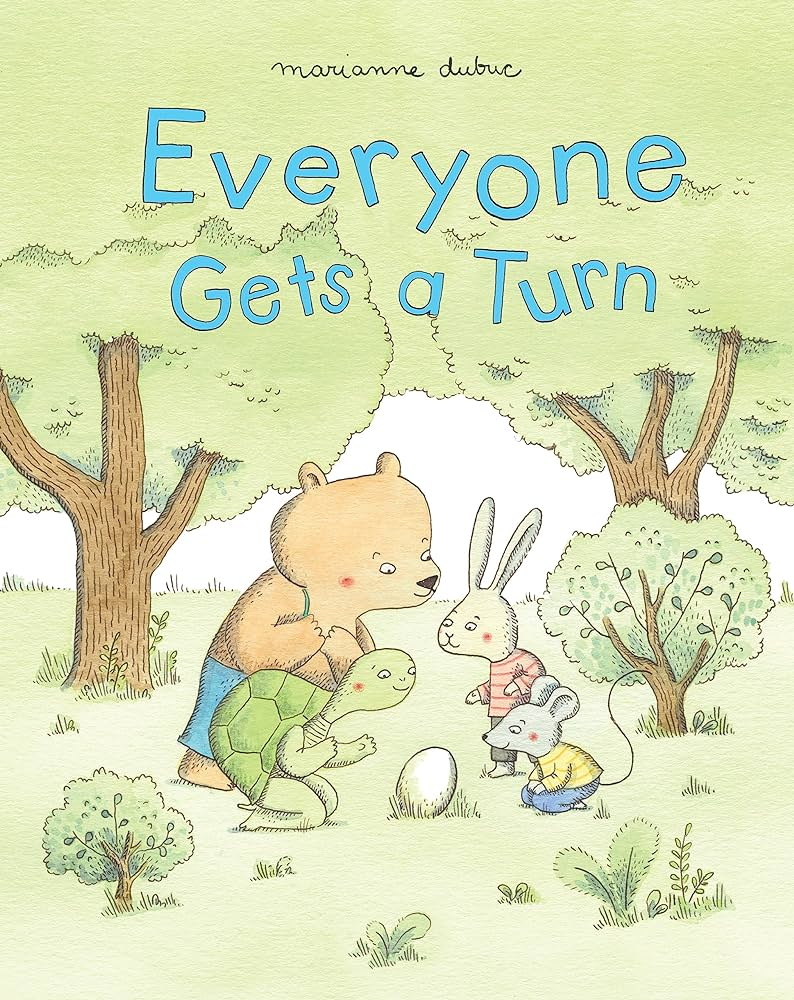
Everyone Gets a Turn by Marianne Dubuc (Princeton Architectural Press, 60 pages, ages 4-9). When friends Bear, Mouse, Turtle, and Hare discover an egg, each one wants to take it home. The egg provides the answer: “Everyone gets a turn!” Mouse found the egg, so he brings it home first, getting to know the egg and learning how to keep it comfortable. Next is Bear, who gets a surprise: the egg hatches, and Little Bird arrives. Hare and Turtle figure out how to feed and care for a young bird, and by the time the visit with Turtle ends, Little Bird has built her own home and is ready to take care of herself. There’s a housewarming party, at which time Little Bird declares she will henceforth be known as Clara, and the five friends and neighbors “continue to grow, each in their own way.” The story could hardly be any cozier or more heartwarming, and the longer page count and graphic novel format will make it appealing to older readers as well as younger kids. I’d love to know the story of how this came to be published by the Princeton Architectural Press.

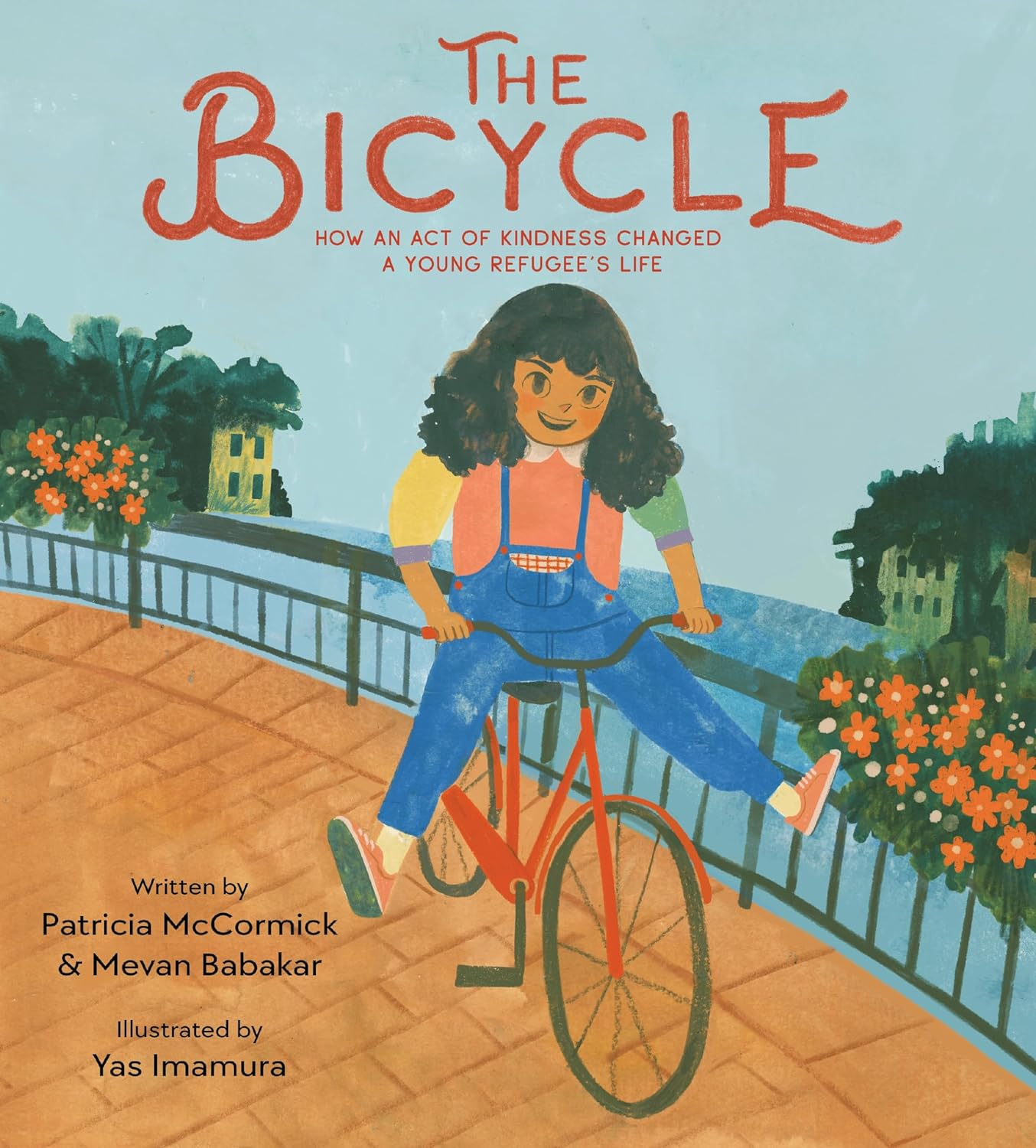
The Bicycle: How an Act of Kindness Changed a Young Refugee’s Life by Patricia McCormick and Mevan Babakar, illustrated by Yas Imamura (Balzer + Bray, 40 pages, grades 1-4). Mevan tells the story of her childhood, beginning with idyllic early years surrounded by family in Kurdistan. When the Iraqi government begins persecuting the Kurdish people, Mevan and her family are forced to flee, first to Turkey, then to Russia, and finally to the Netherlands. Mevan learns to make herself as invisible as she can. In the Netherlands, she watches people outside her window riding bicycles, but she rarely leaves the apartment herself. It feels like no one sees her, but it turns out that Egbert, the building’s handyman, has noticed her, and one day he brings her a red bicycle. His gift makes Mevan feel “a hundred feet tall,” and before long, she’s outside riding with the rest of her neighbors. An epilogue describes the miraculous reunion she had with Egbert as an adult, including a photo of the two of them, and an author’s note describes her life as a refugee, how it has made her feel like an outsider, and the miraculous power of kindness. This is a touching if bittersweet memoir with an emphasis on the power of one person’s kindness to make a difference. I like how the epilogue ends, describing the ripple effect of her story of finding Egbert: “In a world where there are many people running from war, from hunger, from hatred, people everywhere, of every age, asked themselves: What’s one kind thing I can do?”

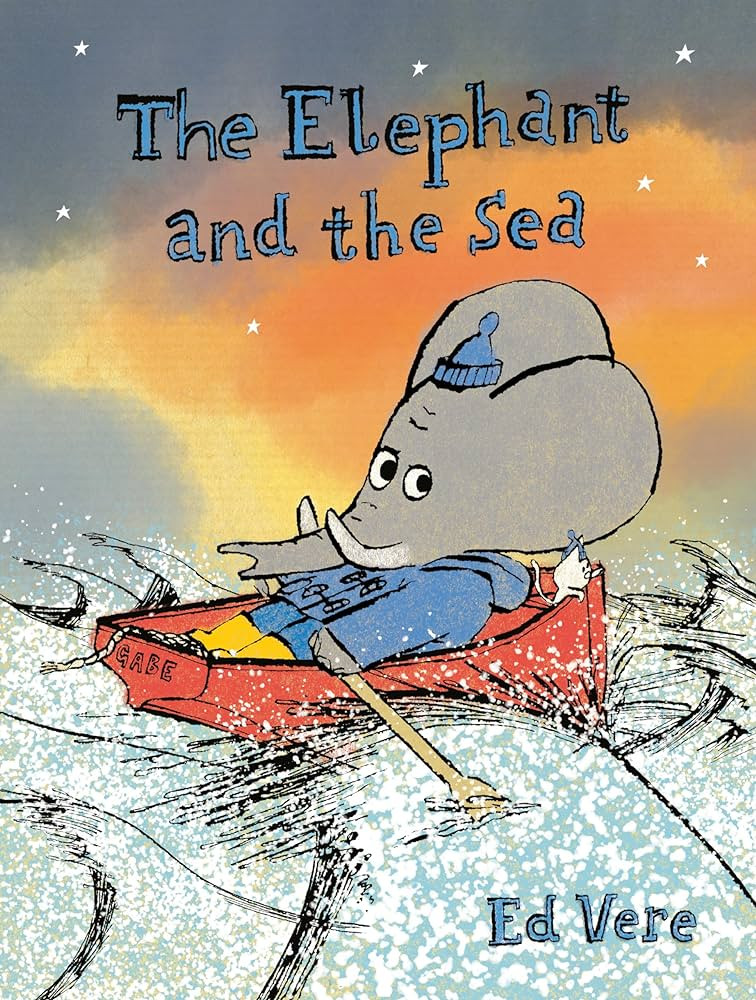
The Elephant and the Sea by Ed Vere (Doubleday Books for Young Readers, 32 pages, ages 4-8). Gabriel is an old elephant when we meet him on the first page, sitting in the harbor and remembering his younger days. Back then, he loved to visit the lifeboat crew and dreamed of helping sailors at sea, singing “Heave away, haul away, heave-HO!” But then Gabriel grows…and grows, and the other animals say he’s too big for the lifeboat. He refuses to give up his dream, though, and spends his days collecting driftwood and building. When a storm hits that’s too strong for the lifeboat crew, Gabriel is ready with his own boat that he uses to haul in the entire fleet. “Brave Gabriel, our hero!” the animals hail him. “Can we join you?” “Of course,” Gabriel replies. “But we might need a bigger boat.” And Gabriel enjoys a career of lifesaving, bringing us back to the old elephant remembering. It’s a cute story with a nice theme of perseverance and determination, with a fun “Heave away” repeating refrain. This would make a nice companion to read with Swashby and the Sea.