Bare feet and cowboy boots

Cesaria Feels the Beat by Denise Rosario Adusei, illustrated by Priscila Soares (Roaring Brook Press, 40 pages, ages 4-8). Cesaria is a little girl who loves to dance, and she’s excited to be part of a group that’s dancing for Carnival. She dons her tutu and beautiful peacock feathers, but she doesn’t want to wear the shoes the director tells her to put on. “Peacocks don’t wear shoes,” she signs, but he is insistent. Finally, Cesaria relents and joins the rest of the troupe on stage, her tail feather drooping. But when the music begins, she kicks off her shoes so that she can feel the beat in her feet. “Take off your shoes,” she signs to the other dancers. “Feel!” They join her in a lively dance that brings cheers from the audience and a sign of “Thank you!” from Cesaria, before she rushes off the stage, leaving her shoes behind. Includes notes from the author, who drew inspiration from watching a Deaf cousin appreciate music by putting her hand on the speaker (which was initially discouraged by family members), and the illustrator, who was diagnosed with hearing loss as a teenager but didn’t get help for it until her son was born deaf.

Beautiful illustrations of Carnival use brilliant colors to portray the crowds and Cesaria’s peacock-themed dance troupe. The story of a courageous Deaf girl showing others how she dances is sure to resonate with readers, and possibly educate them as well. Kids will need to use some inferencing skills to figure out from Cesaria’s signing what is going on in the story.
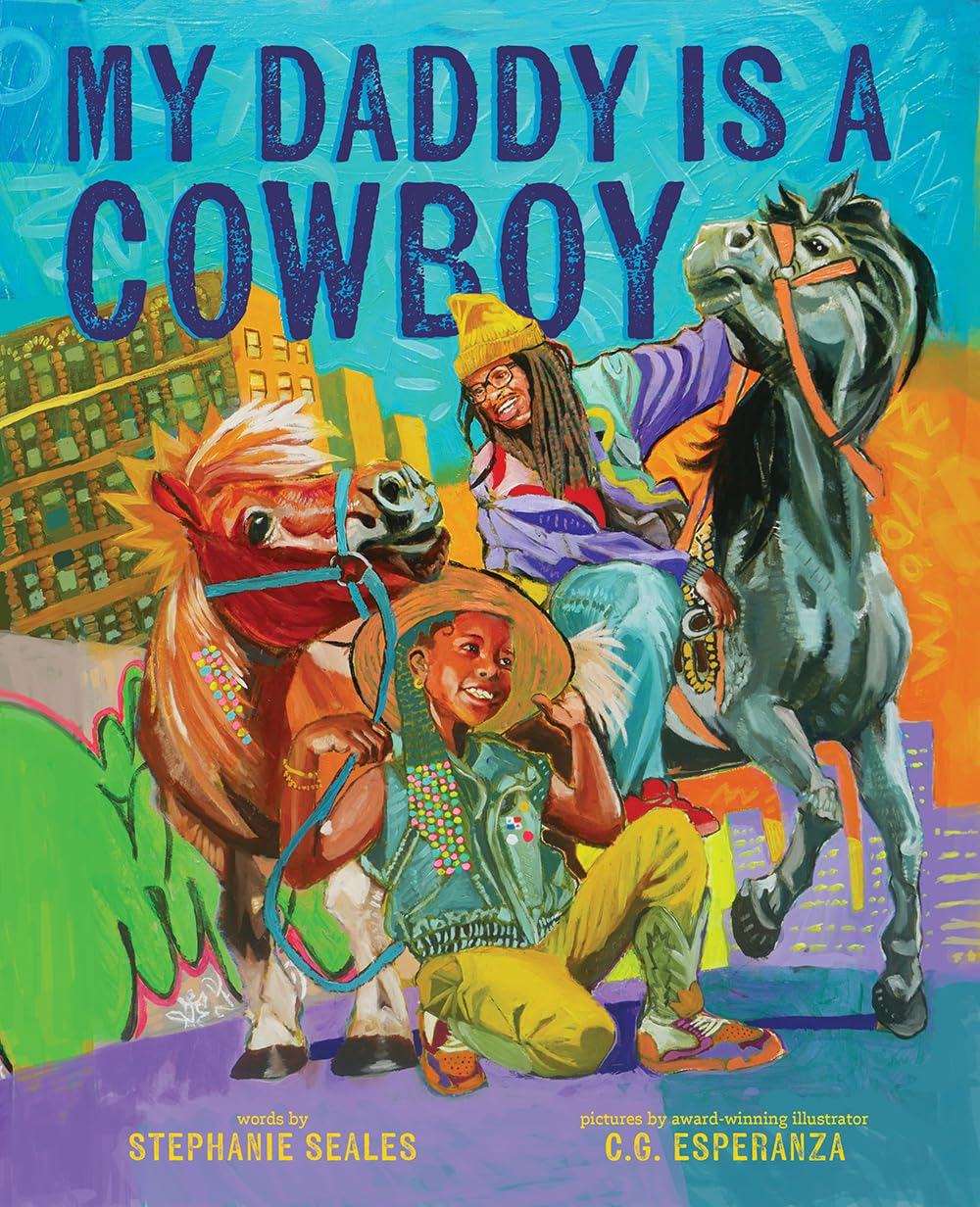
My Daddy Is a Cowboy by Stephanie Seales, illustrated by C. G. Esperanza (Harry N. Abrams, 48 pages, ages 4-8). A girl and her father rise before dawn to take his motorcycle out to the ranch where the girl takes riding lessons, and where Daddy rode as a child with a group of friends who call themselves cowboys. Together, they saddle up the horses and set out through the dark silent streets of their city, returning when the sun comes up. Some of the cowboys are there to greet them, and Daddy takes his daughter home before heading back to the ranch to ride with his friends. When he asks her what her favorite part of the morning was, she considers the horses and the beautiful morning before responding, “Just us time!”

This is a sweet book that I wish I had seen in time for Father’s Day. It’s another one with vibrant illustrations, the colors popping off the pages, and I hope it will be considered for a Caldecott, Coretta Scott King, and/or Belpré award. The family’s Panamanian heritage is woven into both the text and the illustrations. I would have loved to find out the inspiration for the book and was disappointed that there was no back matter.

If you like Junie B. Jones…

Rachel Friedman Breaks the Rules by Sarah Kapit (Henry Holt Books for Young Readers, grades 1-4). Eight-year-old Rachel has plenty of energy and sometimes doesn’t understand the reason for having so many rules in her life–at home, at school, at the temple when she and her dad and brother attend Shabbat services. But when Rachel wants to meet famous gymnast Holly Luna when she comes to town, her dad makes a deal: if Rachel can follow all the rules for a week, he’ll let her go with her best friend Maya to see Holly. Rachel makes it through six days, but then a situation arises where she feels that she must break a rule. She and her dad don’t see eye to eye, and when Rachel stages a rebellion at a Shabbat service, Dad puts his foot down. But a conversation with the rabbi leads to a greater understanding and a compromise that satisfies everyone.

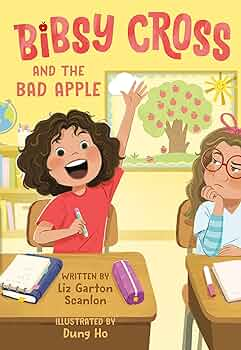
Bibsy Cross and the Bad Apple by Liz Garton Scanlon, illustrated by Dung Ho (Knopf Books for Young Readers, 128 pages, grades 1-4). Bibsy is another eight-year-old who has always loved school and her teachers until she hits third grade. Mrs. Stumper doesn’t seem to like Bibsy, especially the many contributions to class discussions Bibsy loves to make. A bulletin board features each student’s name on an apple that hangs from a tree, but which gets moved to the ground for behavior issues. Bibsy’s apple frequently falls to the ground, but things come to a head one day when Bibsy, defending what she’s sure will be a championship science fair project, goes too far and gets a worm hole punched in her apple. She has to bring the apple home to show her parents, which leads to a good conversation about how to handle her situation. Mrs. Stumper will probably never be Bibsy’s favorite teacher, but they come to an understanding, and Bibsy and her best friend Natia enjoy science fair success.

Both of these series openers feature spunky girls who have strong opinions and are not afraid to share them. Rachel’s book is a conventional chapter book with illustrations, while Bibsy’s is written almost like a book in verse, making it perhaps a more manageable choice for those just transitioning to chapter books. Both feature black and white illustrations, with highlights of apple-red in Bisby’s. While no new ground is broken–there are plenty of early chapter books featuring spunky girls–these are both sure to find an audience among the newly independent reader crowd who enjoy relatable protagonists and situations with plenty of humor.

Back to school books

I know July 1 is a little premature for this post, but I like to have a good book to read aloud for the first week of school. The hunt has begun.

The First Week of School by Drew Beckmeyer (Atheneum Books for Young Readers, 48 pages, grades K-3). Get ready for an extra exciting first week of school, looking at what happens in a classroom each day of that week. At first things seem pretty ordinary: students include a talented artist who lacks self-confidence, an inventor who brings a creation to share on the first day, and the sports kings who like to be either playing or discussing sports. There’s also a teacher and a bearded dragon named Pat, who’s the class pet. Things start to get weird when the inventor’s satellite makes extraterrestrial contact, and a creature named Nobody shows up. Everyone thinks Nobody is the new kid who was expected to start a few days late, so they don’t pay much attention to him, allowing him to bond with (a somewhat reluctant) Pat and to find a way to showcase the shy artist’s talents. Nobody’s last act before heading back home is to get some plutonium for the inventor’s time machine, which seems to work, since the last page is the same as the first, showing the kids arriving for the first day of school.

This book is cute and a lot of fun, with the alien providing an unexpected twist to ordinary events like recess, lunch, and STEM class. The illustrations look like they could have been created by the student artist with her crayons or colored pencils and move between close-ups of different parts of the classroom and aerial views. Would I use it as a read-aloud? I’m not sure. The text is mostly lots of small captions about what’s going on in different parts of the pictures, and it may be hard for younger kids to follow. I would want to project the pages to allow them to see everything that’s going on.

The Yellow Bus by Loren Long (Roaring Brook Press, 48 pages, ages 4-9). A school bus has a busy and happy life transporting kids to and from school. Time passes, and the bus gets a new job: carrying senior citizens around town. When the bus no longer runs, it seems like it’s been abandoned, until unhoused people come and find a place to rest inside the bus. Later, it’s towed to a farm, where goats climb all over it. Finally, the bus is washed away by the river, and comes to rest under the water, where fish, frogs, and turtles find a home. With each group shown, the repeating line, “And they filled her with joy,” makes this a celebration of all the eras in the bus’s life. A two page note at the end tells how Loren Long got the idea from a real-life abandoned school bus and gives a fascinating look at how he created the art using models that he built.

This book is really a masterpiece, and one that I hope will be considered for a Caldecott. The bus and her inhabitants are brightly colored against a black and white background. I’m so glad Loren Long included information on how he created the art, which made me even more appreciative of the work that went into this. Having said all that, I don’t think I will be using this for my back-to-school classes. It’s more of a meditation on life, and I found it a bit too melancholy for the first day of school.