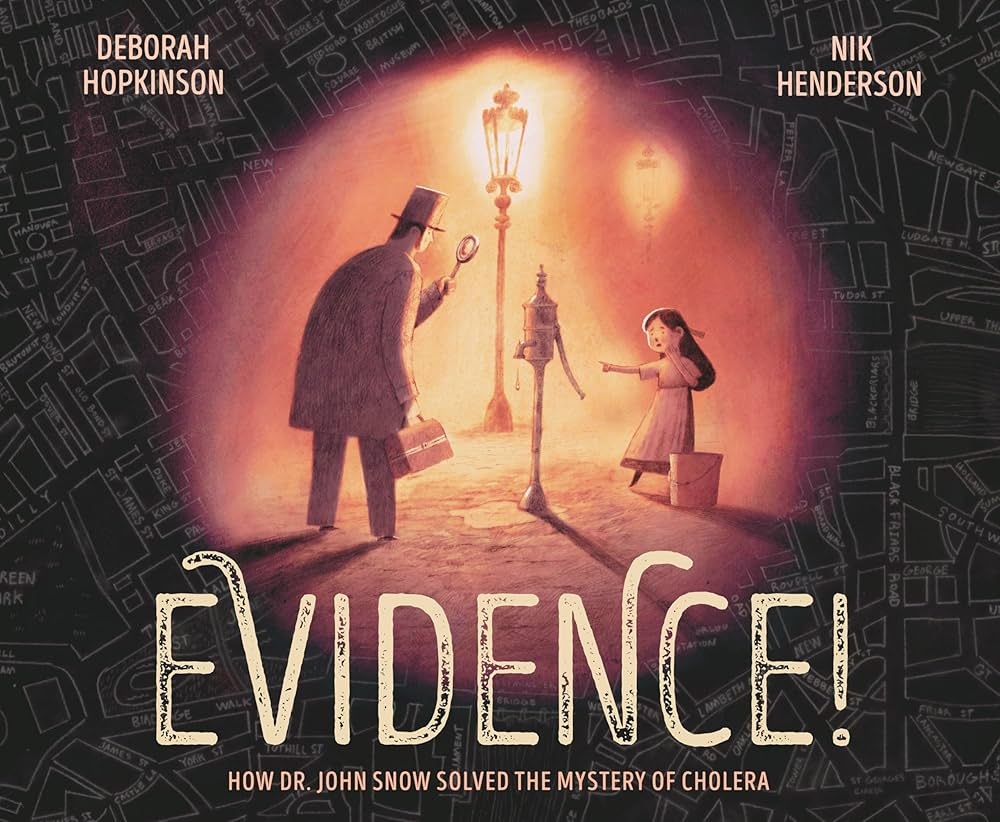
Evidence! How Dr. John Snow Solved the Mystery of Cholera by Deborah Hopkinson, illustrated by Nik Henderson (Knopf Books for Young Readers, 40 pages, grades 2+). When an 1854 cholera outbreak hit Broad Street in “stinky old London”, most people accepted the prevailing theory that it was caused by bad air. With human waste and garbage filling the streets, there was no shortage of that, but Dr. John Snow believed there was a different cause. He’d been gathering clues for years, working as a medical detective to solve the mystery of cholera. When he heard of the Broad Street outbreak, he hurried over to interview families of victims. Their answers led him to hypothesize that the water used by the neighborhood was a possible cause. But old beliefs are hard to change, and Dr. Snow had to keep gathering evidence to persuade the local neighborhood board to remove the pump handle. The back matter gives more information about this particular cholera outbreak as well as Dr. John Snow’s impressive career and contributions to modern medicine.
I’d love to see this exciting medical mystery considered for a Sibert award. The pacing is perfect, as Deborah Hopkinson tells the story of Dr. Snow’s race against time to gather evidence before the upcoming board meeting, skillfully incorporating details about cholera and London at that time. The sepia-toned illustrations convey both the time period and the wretched conditions many people were living in. The reviews I saw recommended this book for kids as young as 4 or 5 (making me wonder if these reviewers know any actual 4- or 5-year-olds), but I think upper elementary as well as middle school or even high school science students would find it interesting. Incidentally, I did learn via Google that a fever is rarely a symptom or cholera, but the rhyme was just too good, so I took poetic license with this blog post title.
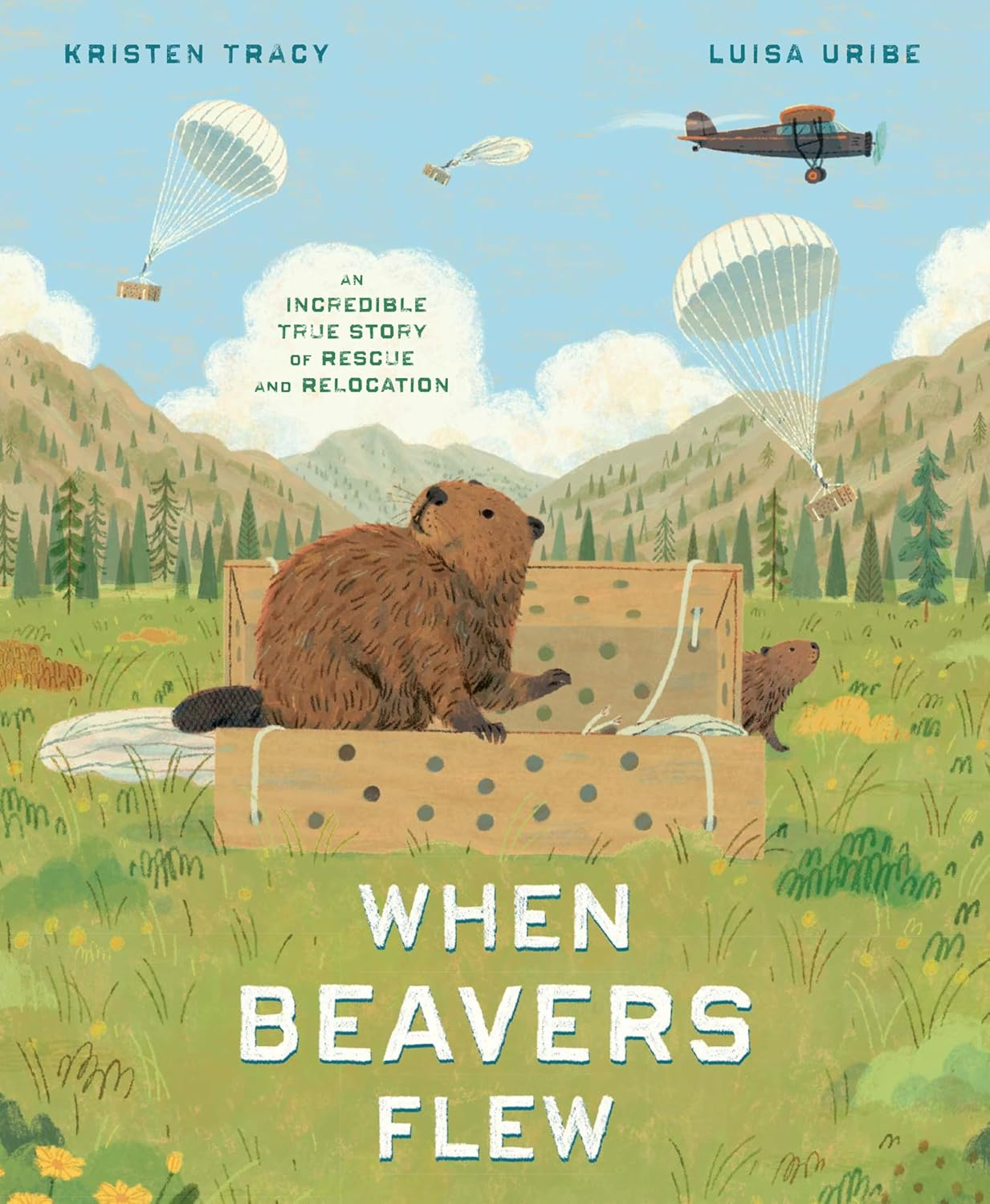
When Beavers Flew: An Incredible True Story of Rescue and Relocation by Kristen Tracy, illustrated by Luisa Uribe (Random House Studio, 40 pages, grades K-3). In 1948, the town of McCall, Idaho was booming, and the beavers that lived there were becoming a nuisance. Fish and Game warden Elmo Heter thought it would be best for both the beavers and the humans if the animals could be transported to a wilderness area called Chamberlain Basin. The problem was, the basin was surrounded by mountains that were almost impassable. Elmo tried strapping beavers in their traps onto pack horses, but this didn’t work well for the beavers, the horses, or the human riders. His next idea was to attach the beavers to surplus World War II parachutes and drop them into their new home. After experimenting with a variety of boxes, he finally found one that seemed like it would work. When he tried it out with a beaver named Geronimo, the animal landed safely and got out of the box. So Elmo boxed up 75 beavers and dropped them from a plane. When he checked on them a year later, he found that they were thriving, as was the wetland environment they helped create, and the beaver population continues in Chamberlain Basin to this day. Includes an author’s note with additional information, a couple for photos, and a list of sources.
Sometimes I find myself writing a sentence like, “So Elmo boxed up 75 beavers and dropped them from a plane,” and wonder how we got here. But I’m sure kids will find this story fascinating as well as surprising, and Elmo demonstrates some tenacious and creative problem-solving skills. Although the ending is reassuring, dropping beavers out of a plane seems like kind of an ethically gray area, and I’m glad the author’s note discusses the problems that can be associated with moving species out of their natural habitat.
 A Kids Book A Day
One thought on “Fighting fevers and moving beavers”