Hair-raising stories

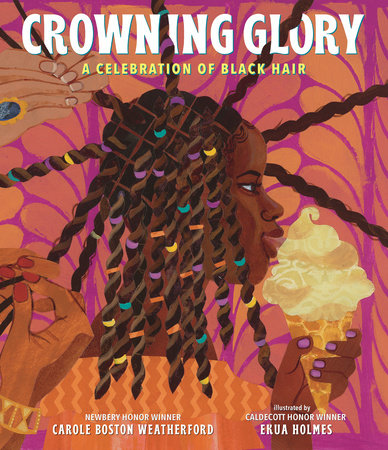
Crowning Glory: A Celebration of Black Hair by Carole Boston Weatherford, illustrated by Ekua Holmes (Candlewick, 32 pages, ages 4-8). Starting with “five queens” (five Black women, who, in 2019, won the titles of Miss America, Miss USA, Miss World, Miss Universe, and Miss Teen USA ), the rhyming text and vibrant illustrations celebrate Black hair. Cornrows, ‘fros, locs, puffs, ponytails, and more–all get their moment to shine. “To heed beliefs or cheer gray days,” women cover their hair with hijabs, geles, headwraps, and hats. “A ritual of hand and heart,/each stunning head a work of art./Each royal coil coaxed by kin./Each strand a story without end.” Includes a glossary.

I hope this beautiful book will be considered for both Coretta Scott King and Caldecott awards. I always love Ekua Holmes collage illustrations, and these are gorgeous. The focus is on female hair, so this could make a good companion to read with Crown: An Ode to the Fresh Cut by Derrick Barnes, which features a barbershop.
My Hair Is a Book by Maisha Oso, illustrated by London Ladd (HarperCollins, 32 pages, ages 4-8). This book looks similar to Crowning Glory, and it has gotten at least two starred reviews. I’ve had it on hold at the library for weeks now, but I haven’t been able to get a copy. Now that I’m finally giving up, it will probably be on its way to me tomorrow!
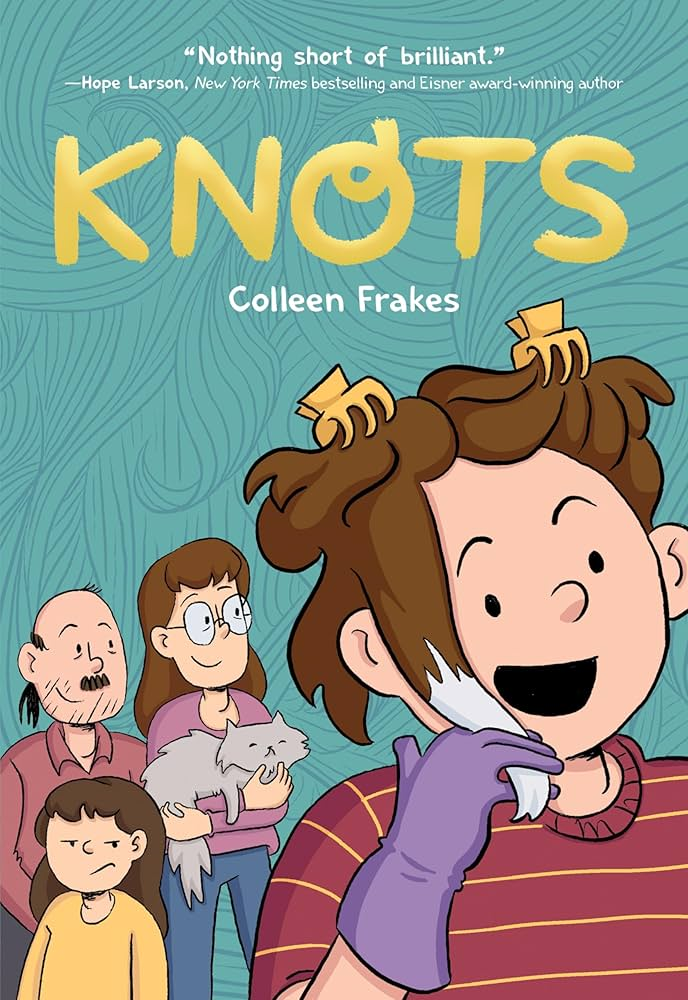
Knots by Colleen Frakes (HarperAlley, 240 pages, grades 4-7). Nervous about starting at a new school, Norah tries to give herself a new look by first bleaching her hair, then dyeing it blue. It turns out surprisingly well, and school gets off to a good start. But a few weeks in, a boy shares with the class that he is mostly responsible for his two younger sisters because his parents aren’t home much. Norah and some of the other kids get pulled out of class by the police as witnesses, and the boy and his sisters end up getting sent to live at their grandparents’ house. When Norah’s mom and younger sister move across the state for a new job, Norah finds herself feeling neglected by both parents and worries that something similar will happen in her family. Another attempt to change her hair turns out to be disastrous, and her disheveled appearance makes a caring teacher start questioning Norah’s home life. When the family is reunited for the holidays, they finally start communicating about what’s going on, and, while things are still far from perfect, some changes are made that help get them back on track. Includes an author’s note about incidents from her own life that inspired the story and the evolution of the book.

Raina Telgemeier fans will enjoy this fictionalized graphic novel memoir that explores family issues, as well as school and friendship concerns. The hair dyeing is somewhat symbolic of the changes Norah and her family are going through, but also includes a reassuring message that with hair and life, there are always chances for a do-over. The scene with the police pulling the kids out of class as witnesses was kind of jarring; yes, teachers are mandated reporters, but hopefully such methods are not used to find out what’s going on at kids’ homes.

A ballplayer who dared, a poet who cared, and a sanitation worker who repaired

Call Me Roberto! Roberto Clemente Goes to Bat for Latinos by Nathalie Alonso, illustrated by Rudy Gutierrez (Calkins Creek, 40 pages, grades 2-5). Roberto Clemente loved playing baseball as a boy in Puerto Rico and was thrilled to be scouted by the MLB. After a disappointing season in Montreal, he joined the Pittsburgh Pirates, where he became an All-Star and helped lead his team to the World Series in 1960 and 1971. He won twelve Gold Gloves, was the 1966 National League MVP, and the 1971 World Series MVP. Despite his success, Roberto often faced racism and discrimination. He corrected those who tried to call him Bob and spoke out against the segregation he endured during spring training in Florida. On September 30, 1972, Roberto became the 11th MLB player and the first Latino one to reach 3,000 hits. Includes notes from the author and illustrator, glossary, photos, bibliography, and timeline that tells about Roberto’s death in a plane crash on his way to deliver humanitarian aid to Nicaragua in December of 1972.

I’m ashamed to say that I thought Roberto Clemente was Dominican and that the only thing I knew about him was his death in a plane crash. This biography emphasizes his greatness in baseball, making clear the discrimination he faced and how he fought for justice for himself and other Black and Latino players. The illustrations by Caldecott honoree Rudy Gutierrez are beautiful and deserve a look from this year’s Caldecott committee. The author’s note adds a personal story, since she is a Cuban American sportswriter who has faced some of the same issues Roberto Clemente did.

The Soldier’s Friend: Walt Whitman’s Extraordinary Service in the American Civil War by Gary Golio, illustrated by E. B. Lewis (Calkins Creek, 40 pages, grades 2-5). A look at a lesser-known part of Walt Whitman’s life, when he served as a volunteer nurse in the Civil War. After his brother was wounded, Walt traveled from New York to Virginia to visit him in the hospital. He was so moved by the soldiers he saw that he decided to move to Washington, DC to devote himself to caring for them. Most of what he did was simple: bringing treats, helping men write letters, talking with them, or just listening. Although he was a fervent supporter of the Union cause, he cared equally for soldiers from both sides. Lines from Whitman’s “Leaves of Grass” are woven into the story. Includes photos and additional information about Walt Whitman and his Civil War experiences, along with a list of resources.

This touching story of Walt Whitman’s kindness and caring seems particularly relevant in today’s world when it’s easy to feel like it’s necessary to take sides or that one person can’t make a difference. The author notes at the end that Whitman may have visited as many as 25,000 soldiers, and while he couldn’t influence the outcome of the war, he found a way to express caring and kindness. Except for the lines from “Leaves of Grass,” there’s almost no mention of Walt Whitman’s poetry; it would have been nice to acknowledge his literary contributions in the story or back matter.

Gifts from the Garbage Truck: A True Story About the Things We (Don’t) Throw Away by Andrew Larsen, foreword by Nelson Molina, illustrated by Oriol Vidal (Sourcebooks Explorer, 40 pages, grades 1-4). Nelson Molina was always a collector. His mostly Puerto Rican neighborhood in East Harlem yielded all kinds of treasures. His mom showed him how to turn scrap wood into birdhouses, and Nelson enjoyed fixing up cast-off toys for his younger siblings. As an adult, Nelson became a New York City Sanitation Worker, where he continued to find and fix up things that he found in the trash. He started displaying them in the locker room of the sanitation garage, eventually expanding into other parts of the building. Since retirement, Nelson has opened a museum where he can display his treasures, showing the huge amount of stuff that we put into the trash. Includes tips for reducing, reusing, recycling, and rethinking, as well as photos of Nelson with some of the exhibits from his museum.

Kids will be inspired to look at trash differently, maybe thinking twice before they throw something away. I loved the scene at Christmas where young Nelson happily gives his siblings the toys he’s fixed up for them. Being something of a minimalist, though, the photos of his cluttered museum convinced me that his way of life is not for me.

Read at your own risk!

The Secret Dead Club by Karen Strong (Simon and Schuster Books for Young Readers, 240 pages, grades 4-7). Wednesday has always been able to see ghosts, a power she inherited from her mother, grandmother, and great-grandmother. When an encounter with a wicked ghost almost kills her, Wednesday and her mother end their extended RV trip and return to her great-grandmother’s house in Georgia. There, Wednesday finds herself drawn to two girls who have formed a secret Dead Club for those who can either see ghosts or believe that they exist. A third girl has left the club under somewhat mysterious circumstances, and a fourth member died the previous year and starts appearing to Wednesday as a ghost. Most of the women in her family have lost their ability to see ghosts when they hit puberty, so Wednesday isn’t sure how much longer she’ll hold onto her powers. When the girls in the club need her help to resolve a potentially dangerous ghostly mystery, Wednesday has to decide how much she is willing to trust them, herself, and the ghosts to try to set things right.

Full disclosure: this is the only book in this post that I actually read from start to finish. Although there was some creepy ghost stuff–including a prologue in which a grieving father becomes possessed by an evil spirit and kills his two children–a lot of the focus is on the changing nature of middle school friendships and the emotions that accompany those transitions. I saw a review that called this book the Baby-Sitters Club meets Stranger Things, and I feel like that is an apt description.

Give Me Something Good to Eat by D. W. Gillespie (Delacorte Press, 272 pages, grades 4-7). Every year, the town of Pearl, North Carolina celebrates Halloween with a big blowout, but before the night is over, a child disappears, and all the residents’ memories of that kid are wiped clear. All of them, that is, except for seventh grader Mason, who still recalls the time five years ago that his best friend Marcus vanished, and even his own mother forgot that he had ever existed. When Mason’s younger sister Meg goes missing, it’s up to him and his three friends, Serge, Becca, and Mari, to discover the town’s dark underside and rescue Meg. UnderPearl is filled with monsters, giant spiders, and a horrifying witch who controls everything and has no intention of letting Meg escape.

I started reading this book just before bed, and after two nights of bad dreams, I finally decided it was not for me. Horror fans will undoubtedly love the monsters and frightening situations the kids find themselves in, but be warned that this is a genuinely scary book that may not be for everyone.

Once They See You: 13 Stories to Shiver and Shock by Josh Allen, illustrations by Sarah Coleman (Holiday House, 192 pages, grades 4-7). Holiday House sent me a copy of this book recently. I was delighted, since Josh Allen’s other other short story collections, Only if You Dare and Out to Get You are extremely popular in my library. Fans of Alvin Schwartz’s classic Scary Stories collections will also enjoy these.

Election Day, part two

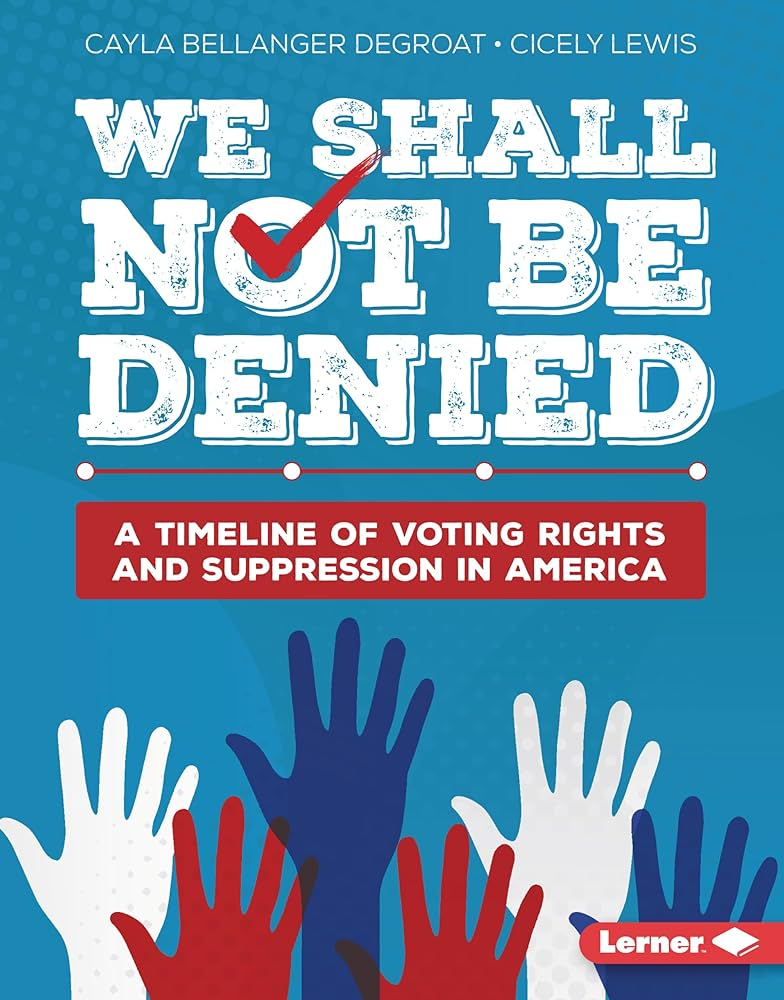
We Shall Not Be Denied: A Timeline of Voting Rights and Suppression in America by Cayla Bellanger DeGroat and Cicely Lewis (Lerner Publications, 48 pages, grades 4-8). Beginning with a present-day example of laws being passed to limit voting by mail, the authors trace the history of groups of Americans whose right to vote has been suppressed. A timeline at the bottom of each page keeps track of important years in voting rights history, while the text and illustrations give more details about those events. Although there have been backwards steps, the trajectory has slowly inched forward to give women, Indigenous people, Asian Americans, and Black citizens voting rights, and voting has become more accessible through absentee ballots and the repeal of poll taxes and other discriminatory practices. There is still work to do, and the final pages suggest actions readers can take, as well as offering reflection questions, a glossary, and index, and a reading list.

Readers will learn that voting, which should be a right, has too often been a privilege reserved for certain groups based on race, gender, and class. Although it contains a fairly brief, straightforward narrative, the book offers a lot of food for thought and discussion and would make an excellent resource to begin an investigation into the history of voting rights and the state of those rights today.

With Election Day just weeks away, teachers and librarians will undoubtedly be looking for resources to share with students. Here’s an Election Day and voting rights book list to help you out.

Indigenous history

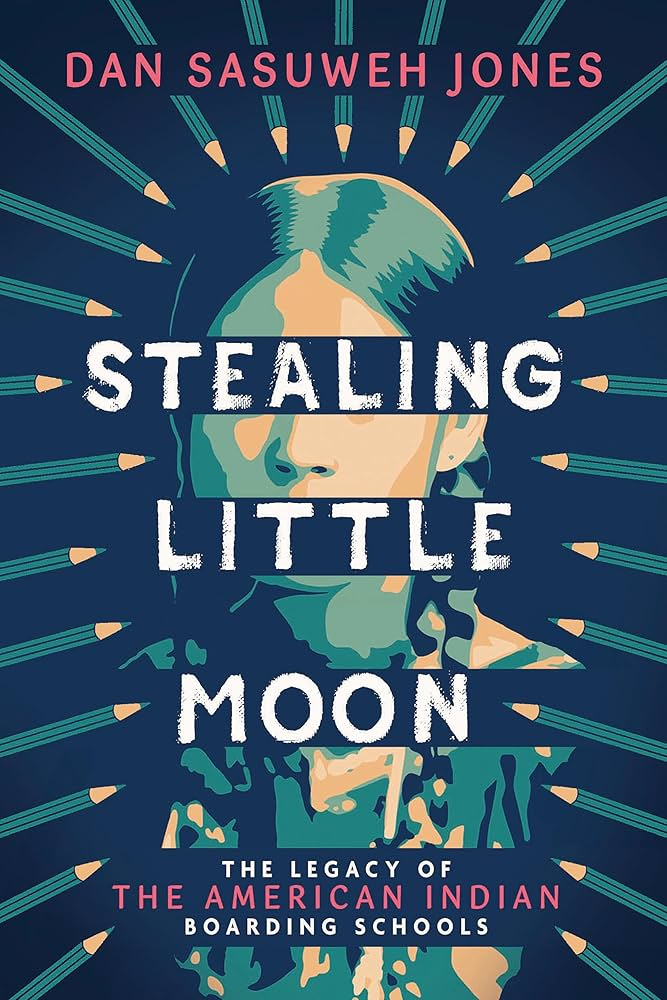
Stealing Little Moon: The Legacy of the American Indian Boarding Schools by Dan SaSuWeh Jones (Scholastic Focus, 304 Pages, grades 5-8). Dan SaSuWeh Jones tells the story of his family’s history with the Chilocco Indian Agricultural (boarding) School, beginning with the forcible capture of his grandmother Little Moon There Are No Stars from the Ponca reservation in 1885 at the age of four. The Chilocco school, run by Quakers, did not condone the physical abuse found at other Indian boarding schools, but it did use strict, military-inspired practices to force the students to assimilate to white culture. Little Moon There Are No Stars, renamed Elizabeth, stayed on for several years after her graduation to work as a school matron, and sent her own daughter there as well. By the time the author’s sister attended the school in the 1950’s, there had been many changes, becoming a vocational school that provided a positive experience for many (although certainly not all) of the students. The 1960’s and 1970’s saw political movements that helped the school and its students embrace their various cultures and languages. While the author didn’t attend the school, he worked there after it closed in 1985 as part of a maintenance crew trying to preserve the buildings and grounds. In his final chapter, he writes of the appropriateness that those buildings have crumbled, leaving the land to its natural state, a metaphor for the enduring nature of Indigenous cultures that have survived so much trauma yet still continue to live on. Includes an introduction by Denise K. Lajimodiere (Turtle Mountain Band, Chippewa), photos throughout the text, and a long list of additional resources.

Reading this book caused me to reflect on how much this blog has educated me and changed my views on American history. I’m not sure I knew anything about Indian boarding schools ten years ago, but I’ve learned from children’s books over the years, and this one added a lot to that knowledge. It’s masterfully written, weaving together a personal family memoir and the history of boarding schools in North America. The author writes unflinchingly about a multitude of abuses and deaths of children at many different schools, while at the same time acknowledging that some students had positive experiences and learned to embrace their heritage, particularly in the later years of the schools’ histories. The final chapters give hope that some of the many, many crimes and trauma committed against indigenous people are finally being at least brought to light and possibly, in some cases, addressed and healed. There are some horrific descriptions of child abuse, so be aware of that element when sharing this book with kids. I hope this book will be considered for awards, especially by the Sibert committee.

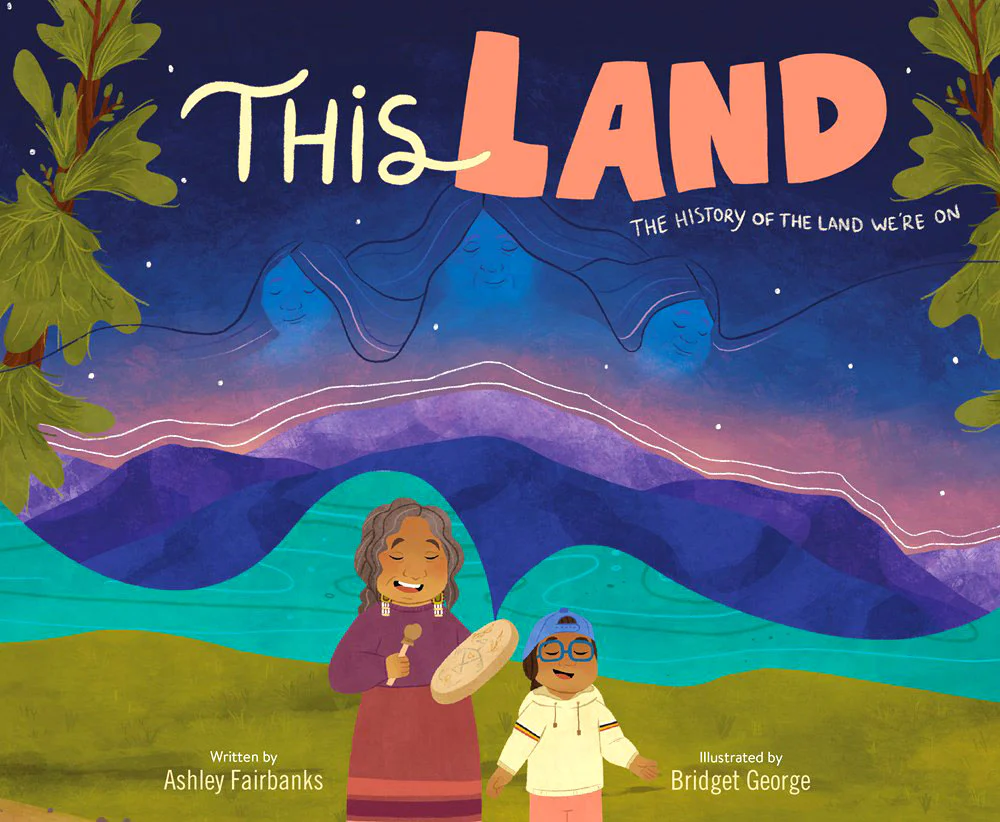
This Land: A History of the Land We’re On by Ashley Fairbanks, illustrated by Bridget George (Crown Books for Young Readers, 40 pages, ages 4-8). “This is my house. I live here with my family,” the narrator begins. “Before us, another family lived here.” Other families lived there, too, but further back in time, a whole community lived on the land before they were forced off by Europeans, something that happened all across the country. The narrator has a friend who is Anishinaabe (like the author and illustrator), and he and his grandma remind the boy of the Indigenous people who once lived there: their food, their songs, and mostly, the way they considered the land to be sacred. Now, as he travels around the U.S. with his family, the boy learns about different Indigenous groups who lived in those places and remembers how they once honored the land they were on. Includes additional information about land acknowledgement, discussion questions, and ideas for learning more about local Native people.

This straightforward story reminds readers to learn about the history of the land they now call home and recall that it once belonged to people who were forced to leave their homes. I really liked how the book acknowledges those who lived on the land of well-known sites like Mount Rushmore and New York City. I read in a review that the title calls to mind the controversy around the song “This Land Is Your Land,” a song that is considered problematic by many Indigenous people. I wasn’t aware of this and was reminded once again of how much I have learned from reading books for this blog.

Picture books to share

Mr. Fox’s Game of “No!” by David LaRochelle, illustrated by Mike Wohnoutka (Candlewick, 40 pages, ages 4-8). Here’s how Mr. Fox’s game works: every time he asks a question, you have to say “no,” or you will be sent back to the beginning of the book. Ready to play? Better not say yes! Do you want a taste of Mr. Fox’s scrumptious-looking sundae? A free trip to Hawaii with a million billion dollars thrown in? If you’re still in the game, how about this: are you stronger than a baby? Are you wearing underwear? What do the letters Y-E-S spell? If you make it all the way to the end of the book, there’s a final question: have you ever read a funnier, better written, more beautifully illustrated book than this one?

I’ve just been delighting first graders by reading them David LaRochelle and Mike Wohnoutka’s book, See the Cat: Three Stories About a Dog, and I look forward to trying this one out on them. It’s such a clever idea, and just the right humor for kids. I’m not sure about going back to the beginning of the book if they make a mistake…I might just make it a game where Mr. Fox gets points for the wrong answer.

First Day, Hooray! A Book of School Day Feelings by June Sobel, illustrated by Nabila Adani (Clarion Books, 40 pages, ages 4-8). Kids run into school on their first day with “backpacks filled with school supplies, but something else hides in disguise.” What’s hiding? Big feelings, shown with colored fonts in the text and colorful creatures surrounding different kids. Whether you’re feeling happy, scared, angry, or brave, it helps to name the feeling and to take a deep breath when needed. At the end of the day, kids pack up their backpacks–and their feelings–and head home with one more emotion: hooray! Includes a note from Yale early childhood professor Craig S. Bailey about ways to use this book to help kids explore their emotions.

I’m taking this book to school with me on Monday to share with our school counselors. It’s a simple but effective exploration of different emotions children (and adults) may experience, helping them to handle them better by identifying them. The illustrations of a diverse student body and fun magical creatures associated with the different feelings will appeal to kids as well.

War

A Star Shines Through by Anna Desnitskaya (Eerdmans Books for Young Readers, 40 pages, grades 1-5). “We used to live in a big city,” the narrator begins. Her family kept a star-shaped lamp in their apartment window, which would welcome her home at night. But then war came, and she and her mother (the father disappears without explanation) flee to another country. Everything is new: the language, the food, the apartment, even her mom and her. One night, Mom brings home a package with cardboard, scissors, and glue, and together they make a cardboard star with a light inside. Putting the lamp in the window marks a turning point, and soon their new country is feeling more like home. Includes an author’s note telling how a one-week family vacation in Cyprus turned into a refugee situation when Russia invaded Ukraine.

The author packs a big punch with just a few words on the beautifully illustrated pages of this book. It felt a little optimistic that making a lamp would turn things around so quickly, especially with the loss of the father, whether he was killed or had to stay behind. But the story offers hope to kids forced to move due to wars and other difficulties that make them and their families refugees.

The Night War by Kimberly Brubaker Bradley (Dial Books, 288 pages, grades 4-7). When there’s a roundup of Jews living in Paris, Miriam (Miri) is captured and separated from her parents. A neighbor helps her escape, on the condition the Miri take the woman’s two-year-old daughter Nora with her. Helped by a nun, Miri and Nora are sent to a town near Tours, where an old castle stands on the border of occupied France and Vichy France. En route to the town, Miriam falls asleep and awakens to find that Nora has been taken away and sent to live with another family. Miri is placed in a convent school, joining the nuns and a few students who have stayed for the summer, and is renamed Marie to hide her Jewish identity. While there, she gets involved in a secret operation to help escaping Jews cross the border, aided by a mysterious old woman who turns out to be the ghost of former castle owner Catherine de Medici. Miriam/Marie’s last mission is to save herself and Nora, which she is able to do with the help of the friends she has made at the convent, in an exciting and daring escape. Includes a lengthy author’s note with additional historical information.

I’m on a mission to read some of the Newbery contenders, so I finally got around to this one, written by the author of some of my favorite World War II historical fiction books, The War That Saved My Life and its sequel. While it’s currently at number 3 on the Goodreads Newbery list, I confess I did not much care for it. I’m sure the circumstances of 1942 France made kids grow up fast, but Miri and her friend Beatrice were way too wise beyond their years. Their other friend Jacqueline seemed to exist mostly to show how oblivious many French people were to the suffering of their Jewish neighbors. I had kind of mixed feelings about the ghost plot twist; it was cool in some ways and made for an interesting subplot, but also felt somewhat jarring. Finally, the epilogue wrapped things up WAY too neatly for a book about the Holocaust. This book has gotten glowing reviews, though, and the history is super interesting, so take a look for yourself!

Dealing with middle school

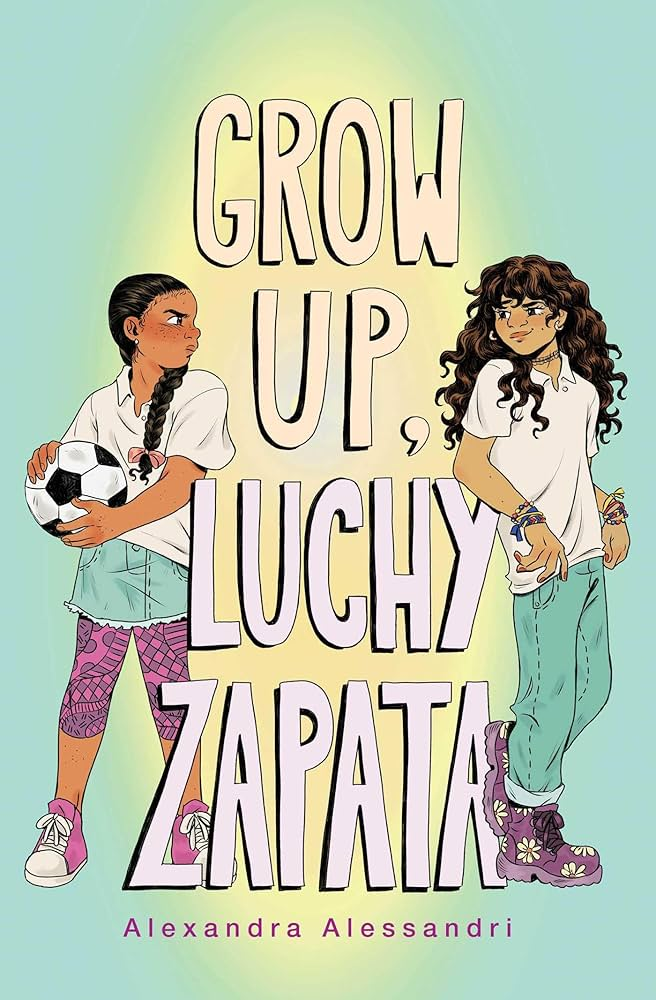
Grow Up, Luchy Zapata by Alexandra Alessandri (Atheneum Books for Young Readers, 256 pages, grades 4-7). Luchy’s excited to be starting middle school, joined by her two best friends, Mateo and Cami. Cami and Luchy are both Colombian American, and they’ve been friends since their moms met years before, but they’ve never gone to the same school. Middle school brings changes, though, and Cami, who spent the summer in Colombia, starts acting cool toward Luchy and Mateo. Luchy attempts to figure out what’s happening, first by making Cami a fancy scrapbook to remind her of their long friendship, and, when that doesn’t work, declaring war on Cami and her new friend Melissa. One act of revenge leads to another until Luchy finally does something that jeopardizes her place on the soccer team, something she’s worked hard for all fall. Even though Mateo and Luchy’s parents keep encouraging her to try talking to Cami, it takes a near catastrophe for the two girls to finally sit down and communicate about what’s been going on.

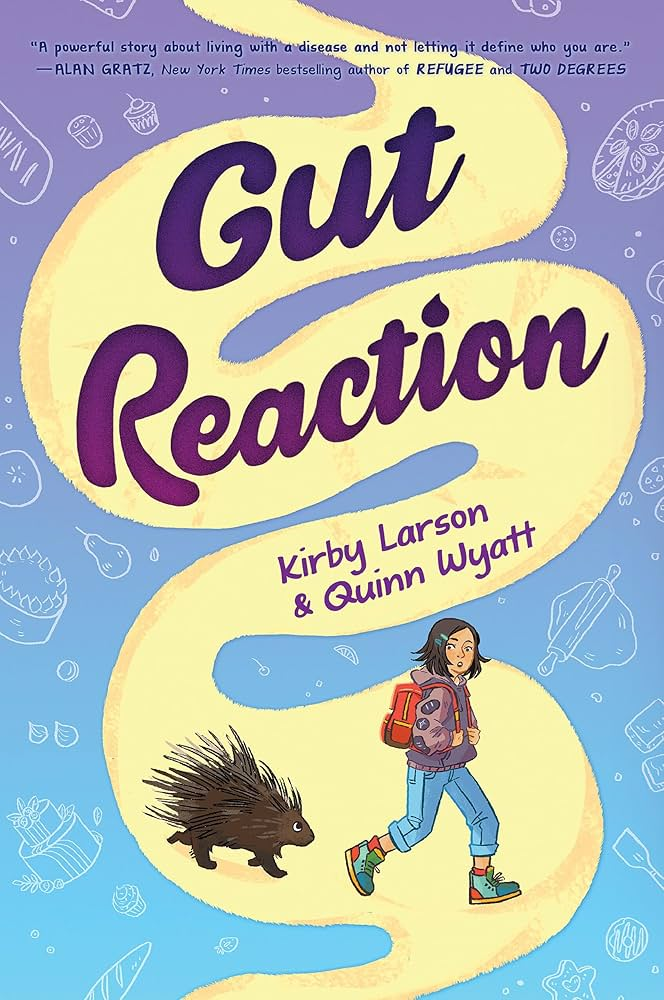
Gut Reaction by Kirby Larson and Quinn Wyatt (Scholastic Press, 272 pages, grades 4-7). Tess is starting eighth grade at a new middle school, where, after a bit of a rocky start, she finds some good friends. They support her dream of competing in the Jubilee Flour Junior Baker contest, something Tess knows her late father, a baker who taught her everything she knows, would also support. But Tess is experiencing increasingly debilitating stomach issues, and a painful episode at school lands her in the hospital. She’s devastated to get a diagnosis of Crohn’s disease and to learn that the symptoms can only be managed, not cured. Her friends help her get back on track, and she’s able to compete in the baking contest, where an unfortunate turn of events forces Tess to have to make a difficult decision.

Both of these realistic middle school books feature engaging protagonists and realistic issues. Gut Reaction is written by a mother-daughter team who drew on their real-life experience with Crohn’s disease to write sympathetically about Tess’s symptoms, diagnosis, and gradual acceptance of her illness. Grow Up, Luchy Zapata has many elements of middle school angst: changing friendships, a possible crush, academic and athletic struggles, and embarrassing parents. There are also some issues facing second-generation American immigrants Luchy, Camila, and Mateo (who is Chilean-American). Both books used plots that felt a little timeworn: the cooking/baking prodigy who competes in some kind of contest or reality show, and the friend who goes away the summer before middle school and comes back different and trying to fit in with the cool kids.

Election Day

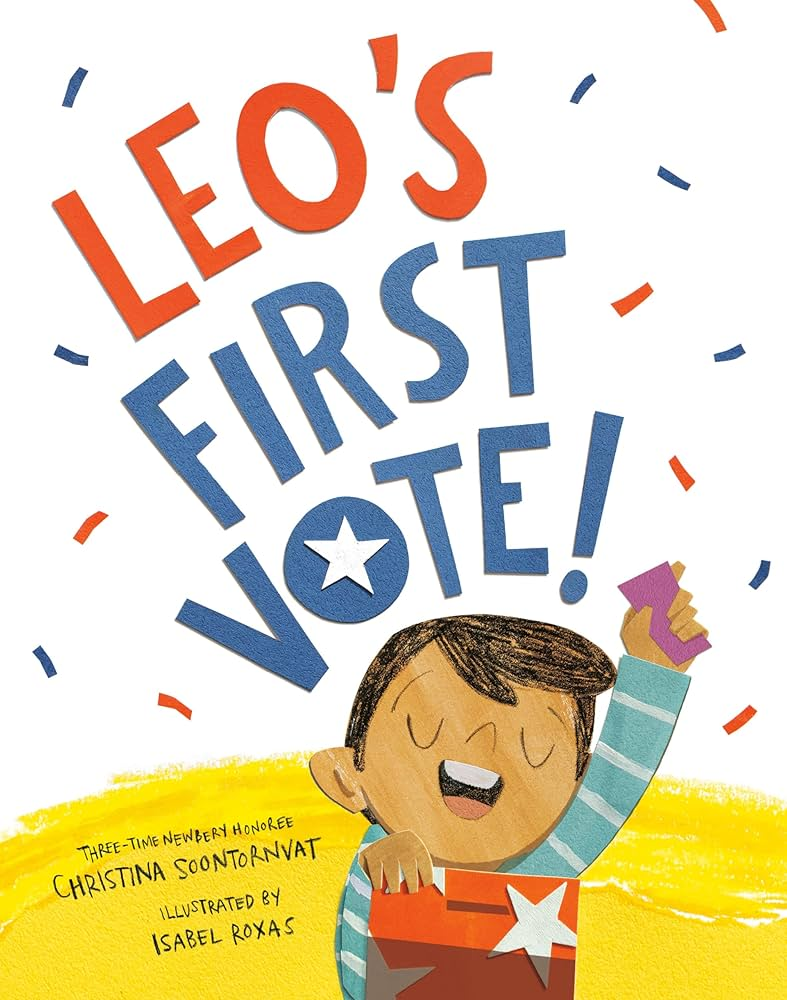
Leo’s First Vote by Christina Soontornvat, illustrated by Isabel Roxas (Knopf Books for Young Readers, 48 pages, ages 4-8). Leo’s excited that his dad has recently become a naturalized U.S. citizen, which means Dad gets to vote in the upcoming presidential election. Leo plans to go with him to the polls, but in the meantime, his class is having a mock presidential election. The kids learn about elections, and at home, Leo watches conventions and debates with his family. Everyone’s talking about the upcoming election, and when Leo hears a cousin say he’s not going to vote (“What’s the point?”), he feels deflated. But when his class’s mock election is determined by one vote, Leo finds his enthusiasm again. The last page shows Dad reading a newspaper with a headline declaring, “Historic turnout!” Also available in a Spanish language edition, ¡El primer voto de Leo!

Lots of facts about elections are woven into Leo’s story, and the excitement around voting will have kids eagerly anticipating Election Day. Personally, I am feeling so jaded about the day (Leo’s cousin really spoke to me) that I almost didn’t write this review, but good for Leo and his dad (and Christina Soontornvat) for having such enthusiasm about it.

Presidential Elections and Other Cool Facts: Understanding How Our Country Picks Its President by Syl Sobel, J.D. (Sourcebooks Explore, 5th edition, 48 pages, grades 2-5). This straightforward introduction to the presidency tells how elections work, as well as giving interesting facts about campaigns, the electoral college, First Ladies, and the order of succession should the President die or become disabled. There’s a list of all the U.S. Presidents, along with the years of their terms, and party affiliations. Includes a glossary, index, and lists of resources.

Rumor has it there’s an updated version of this book, but interlibrary loan has only been able to send me older ones, so I got to travel back to a time when Barack Obama was President, and Ronald Reagan was the oldest person to have been elected President at age 73. It’s a good introduction to the presidency and the election process, and although the writing and illustrations aren’t particularly exciting, it includes the kinds of facts and trivia kids (and adults) enjoy learning.

Ghostly graphic novels

Welcome to Scare School (Scare School Diaries, book 1) by Jarrett Lerner (Aladdin, 144 pages, grades 1-4). Bash is one nervous ghost about starting Scare School, an institution that caters to monsters. His classmates are vampires, spiders, werewolves, and even a snot monster, a creature that scares Bash more than any of the others. He’s happily surprised to find a friend in Itsy, a spider who winds up as his roommate. Classes are tough, though, and the hardest one is his Creature Intensive with grouchy Mr. Crane, where Bash has to learn the skills specific to ghosts. If he’s not proficient by the end of the first two weeks, he’ll get sent home. With the help of Itsy and some other surprising supporters, Bash finds a way to get through it all and is ready to take on whatever else might come his way at Scare School.

Written in a diary format with lots of illustrations, this very unscary book will appeal to kids moving into longer chapter books. Despite being a ghost with some pretty unconventional classmates, Bash has experiences at school that kids will relate to. I’m happy this is billed as book 1, and I hope we won’t have long to wait for a sequel. Scare factor: Too small to detect.

The Night Librarian by Christopher Lincoln (Dial Books, 256 pages, grades 4-8). Twins Page and Turner Reed are alone a lot, with parents who travel all over the world and a nanny who likes to take a lot of time off. With not much better to do, they decide to go to the New York Public Library one day to find out how much their father’s rare copy of Dracula is worth. When the book goes missing at the library, they’re plunged into a wild series of adventures, guided by Night Librarian Ms. Literati, who shows them how fictional characters can be released from their books. Aided by Wonderland’s Alice, Jim Hawkins, Jack of beanstalk fame, and Tinkerbell, the team sets off on a mission to rescue the library from some of the evil characters who have managed to escape from their books. The final scene results in chaos and the destruction of the library…until H. G. Wells’s time machine turns things back again.

While not exactly scary, the black and purple palette of the nighttime library conjures up spookiness, offset by the fun adventures and opportunities to meet literary characters. Younger readers might need a little help straightening out who’s who, but the nonstop action, humor, and fun characters will appeal to kids right through middle school. Oldsters like myself will be inspired to learn that author Christopher Lincoln is publishing his debut graphic novel at the age of 71. Scare factor: Pretty low, mostly just a spooky atmosphere.

Read At Your Own Risk by Remy Lai (Henry Holt and Co., 160 pages, grades 3-6. Hannah recounts in a journal the story of how she has been cursed. It started when she and her friends went up to the school’s attic and played a Ouija board-like game to try to summon up spirits. Hannah tried to trick them, and as a result, it seems as though she’s been cursed. At first, there are small signs, like being pushed by invisible hands and skinning her knees, but soon things get more gory: a gash in her forehead, a tooth that mysteriously falls out, silverfish crawling through her gums and coming out of the gash. School rumor has it that she has eight days to break the curse–or else. By day eight, it seems as though everything is in a downward spiral, but there may be one last hope….

Wow, Remy Lai sure has changed since she created the cute and charming Pawcasso! Although there’s some humor and maybe even a little macabre charm, this story is a genuine horror tale. It’s a pretty quick read, thank goodness, because you won’t want to put it down! Kids who are looking for scary stories will be flocking to this one, for sure. Scare factor: Considerable.