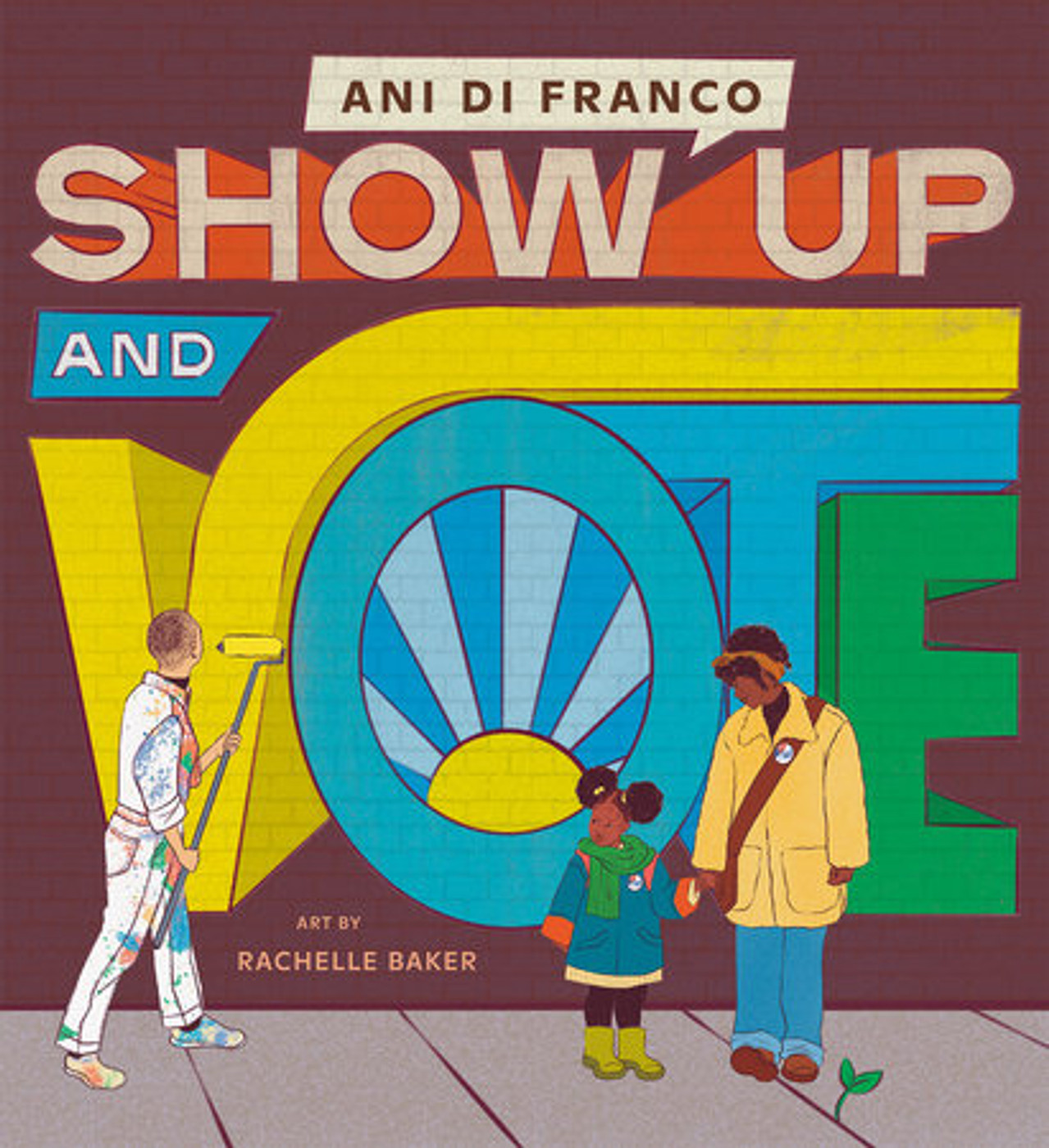
Show Up and Vote by Ani DiFranco, illustrated by Rachelle Baker (Rise x Penguin Workshop, 48 pages, ages 4-8). A young girl looks back at the end of Election Day, recalling how she was reluctant to go out on a rainy November morning, but her mother told her that they were on a mission. At the polling station, the girl recognizes friends and neighbors, realizing that voting is a community event. In the voting booth, she watches her mom make her selections, and as they finish, the two of them imagine people across the country doing the same thing. Proudly wearing their “I voted” stickers, they walk home, and the girl sees her neighborhood with new eyes, as a place where people work together to create a community, and “showing up to vote is how it all starts.”
Singer and songwriter Ani DiFranco has created an accessible introduction to voting and Election Day with rhyming text (and no capital letters) that reads kind of like a folk song and colorful illustrations that resemble retro posters. Readers will learn a bit about voting and be empowered to get involved in their communities.
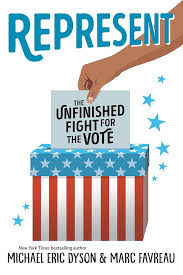
Represent: The Unfinished Fight for the Vote by Michael Eric Dyson and Marc Favreau (Little, Brown Books for Young Readers, 256 pages, ages 12 and up). Dyson and Favreau continue their exploration of American history that they began in Unequal with this story of voting rights from the founding of the United States to the present. There are inspiring narratives about Black, female, Latinx, and Native activists who worked to get the vote for their communities, alongside less inspiring ones such as how white women largely refused to help Black and Native women once they had secured their own right to vote. And there are downright depressing ones that continue to this day like the Citizens United Supreme Court decision that has encouraged huge amounts of spending across the political spectrum and the gerrymandering of districts for political gain. The list of “People-Power Ideas” at the end (get rid of the electoral college, expand the House of Representatives, introduce ranked-choice voting, among others) seem commonsensical yet depressingly unlikely to happen. There are also ideas for student activism, a voting rights timeline, additional resources, and an index.
I found this book both extremely depressing and surprisingly hopeful, seeing that our current threats to democracy are actually part of a centuries-long plot to keep voting and power concentrated in the hands of a few. The struggles that have ensued to give more people the right to vote have resulted in torture, imprisonment, and murder, yet ordinary people have persevered and often ultimately met with success. Seeing ourselves as part of this long history rather than poised at some do-or-die moment gives me a glimmer of hope to continue the struggle.
Reminder: I have an Election Day and Voting Rights book list if you’re looking for more. I haven’t had a chance to add these two books yet!







 A Kids Book A Day