
The Table by Winsome Bingham and Wiley Blevins, illustrated by Jason Griffin (Neal Porter Books, 56 pages, ages 4-8). A child tells the story of their family as they gather around the table to eat, dye eggs, and sew a dress. The narrator reads to Meemaw, who can’t read but is an excellent cook. When Papa loses his job in the mines, the family is forced to move to a place that’s too small to fit the table. Left by the side of the road, the table gets a new home when another family drives by. Daddy is a carpenter, so he’s able to fix it up. As they sit down to dinner, the narrator tries to imagine the stories that their new-old table could tell.
A poignant story about two families–one White and one Black–who share the mundane but loving details of their lives. It would make a good book to share around Thanksgiving, with its emphasis on food and family. I loved the illustrations, which only portray the hands of the characters as they gather around the table, but readers may need some inferencing skills to understand what is going on.
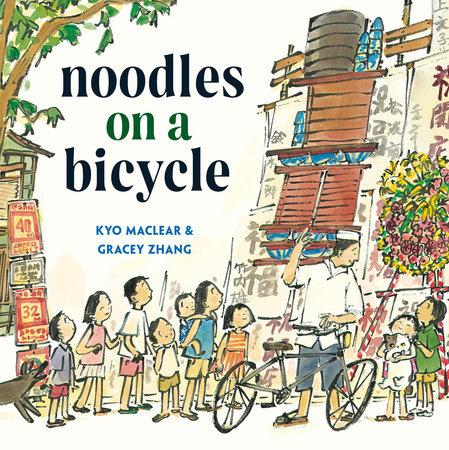
Noodles on a Bicycle by Kyo Maclear, illustrated by Gracey Zhang (Random House Studio, 40 pages, ages 4-8). The team that brought us The Big Bath House has created another story from Japan, this time about kids watching the amazing deliverymen who work for the noodle shops, carrying trays stacked high with china bowls full of steaming noodles. Zipping through traffic, they never lose their balance, setting up friendly rivals between deliverymen from different shops. The kids try to emulate them, stacking trays with bowls full of water, but inevitably suffer spills. At the end of the day, Mama calls the noodle shop, and a few minutes later the doorbell rings–Papa! Turns out he is one of the deliverymen, and he’s ready for a soak in a hot tub before wearily tucking in the kids and heading for bed. Includes an author’s note and photos on the front and back endpapers of Tokyo deliverymen in 1937 and 1959.
This slice-of-life story from the mid-twentieth century celebrates the workers who adroitly performed the hot, hard work of delivering noodles to the hungry residents of Tokyo. I’m glad they included two photos to help readers really appreciate the skill involved. The author’s note captures it perfectly when she says, “Of course, there are practices worth improving, but there are also things worth remembering and celebrating.”
 A Kids Book A Day