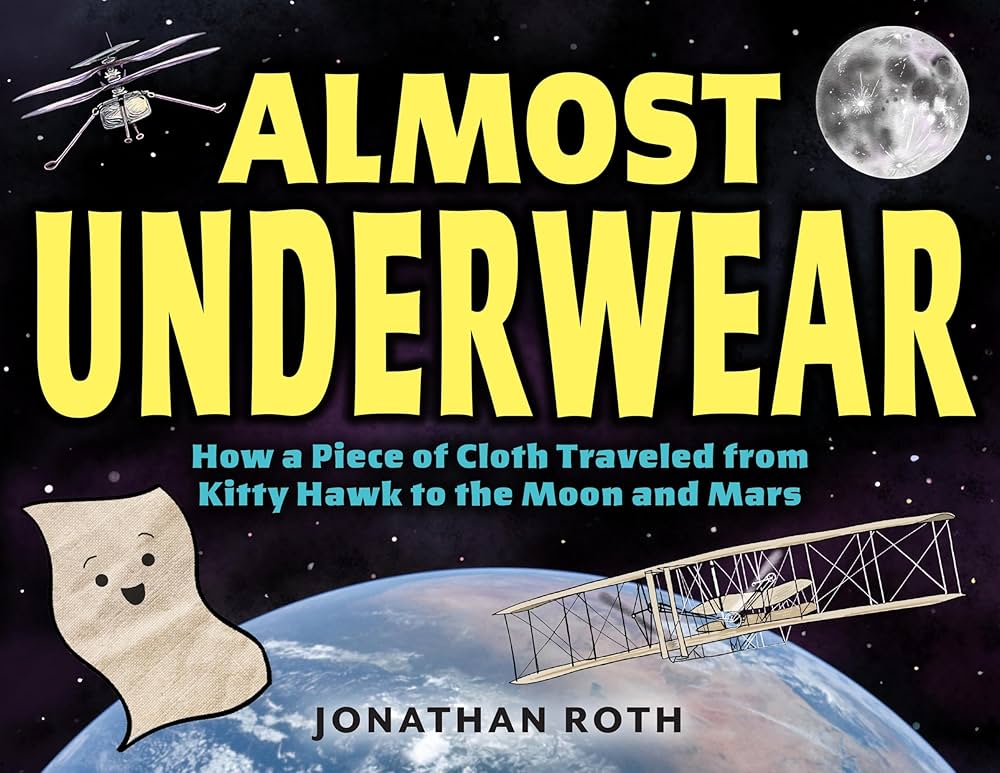
Almost Underwear: How a Piece of Cloth Traveled from Kitty Hawk to the Moon and Mars by Jonathan Roth (Christy Ottaviano Books, 40 pages, grades 1-5). Back in 1903, unbleached muslin was most commonly used to make ladies’ underwear. But one bolt of fabric was purchased by Wilbur and Orville Wright and used for a completely different purpose: to help make the wings of their new flying machine. Although they succeeded, and the muslin went airborne, the machine ultimately was wrecked and went into storage for many years. Shortly before his death, Orville donated swatches of fabric to the new Carillon Historical Park museum in Dayton, Ohio, where it stayed until 1969, when Neil Armstrong carried a piece of it into space. The cloth made it all the way to the Moon, where Armstrong carried it on his moonwalk. The cloth’s final adventures took place in 2020, when it traveled all the way to Mars on board the rover Perseverance. Not only that, but the cloth was attached to Ingenuity, a four-pound helicopter that became the first machine to fly on a different planet. Not bad…for something that could have been some underwear. Includes an author’s note, a glossary of the Perseverance instruments, and a bibliography.
The title reveals the clever hook used to look at three different milestones in air and space travel history, illustrated with combinations of historical photographs and cartoons, including a fun cartoon rendering of the happy piece of cloth. The author does a great job of making STEM history accessible to elementary readers. Pro tip: be very specific when doing a Google images search for Almost Underwear.
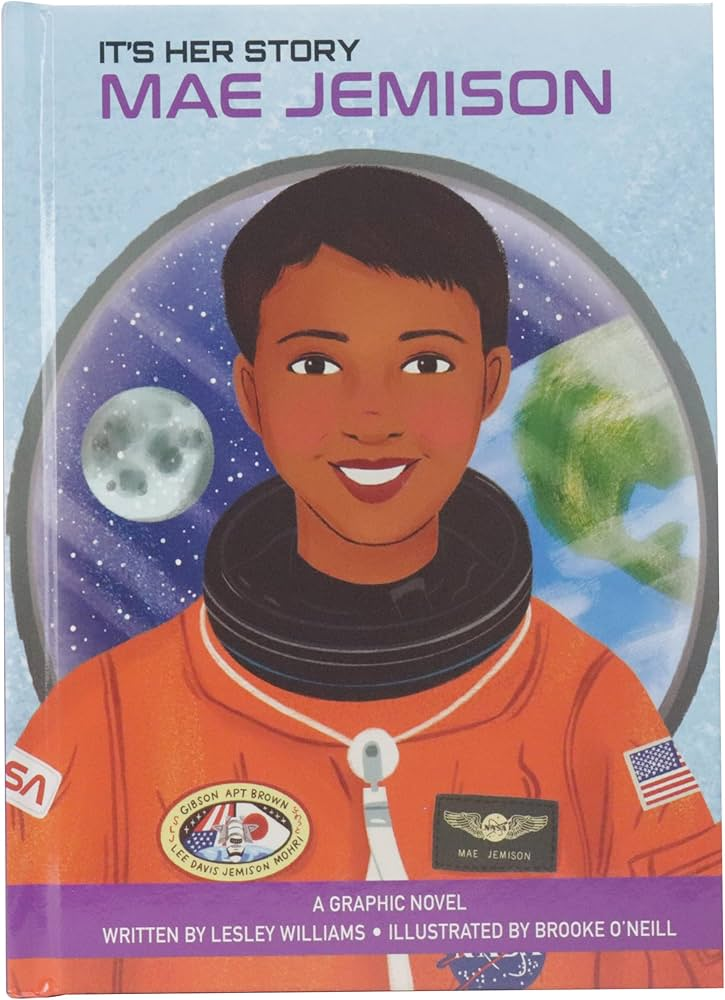
Mae Jemison: A Graphic Novel (It’s Her Story) by Lesley Williams, illustrated by Brooke O’Neill (Sunbird Books, 48 pages, grades 2-5). This short graphic biography tells the amazing life of Mae Jemison, who graduated from high school at age 16, attended Stanford, became an M.D., then transitioned to a career as an astronaut, becoming the first Black woman to go into space. She also loved music and was an accomplished dancer, as well as working for civil rights as a college student and advocating for STEM education as an adult. The last page invites readers to share their dreams, remembering that Mae’s hard work and persistence made hers come true.
This is the first volume of this series I’ve seen, but it looks like there are several others about famous women. The short page count and graphic format will make it appealing to many different types of readers, and it brings Mae Jemison to life in a way that kids will relate to, showing her as a child who had many interests in addition to science. Some additional resources at the end would have been a nice addition.
 A Kids Book A Day