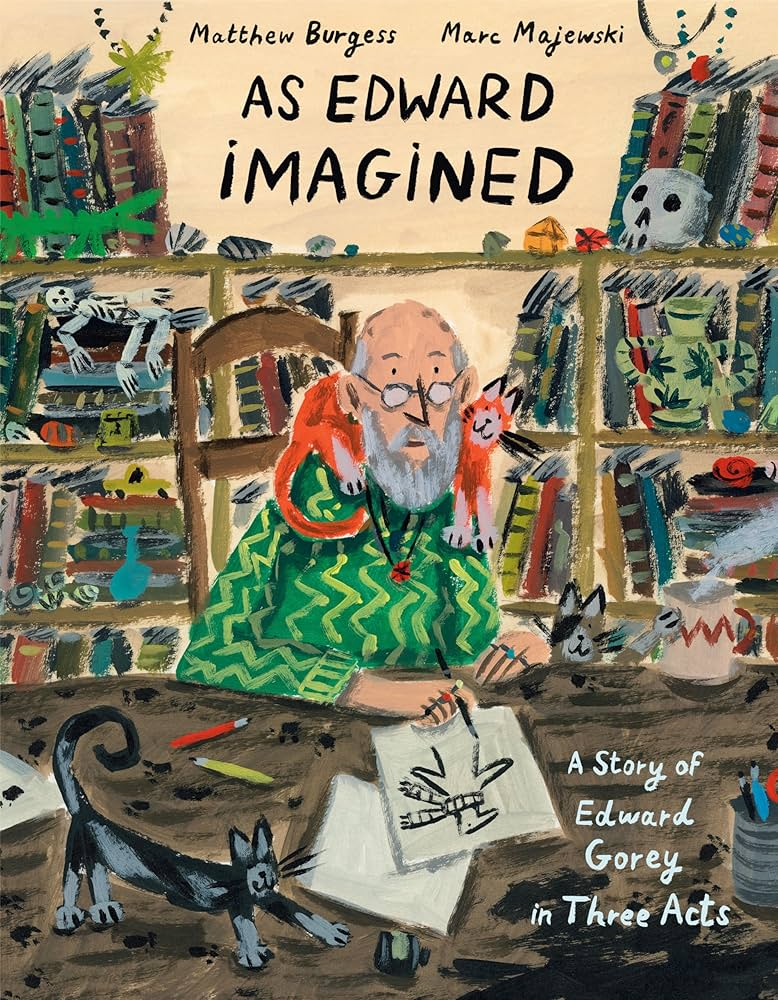
As Edward Imagined: A Story of Edward Gorey in Three Acts by Matthew Burgess, illustrated by Marc Majewski (Knopf Books for Young Readers, 48 pages, grades 2-5). In Act 1, we meet a young Edward Gorey, who learned to read when he was 3 and devoured books, including Dracula at the age of six. This led him to create his own spooky stories, something that he continued to do when he moved to New York City as an adult (Act 2). Not only did he write his own stories, but he illustrated other writers’ books and gained his greatest fame designing the sets for the Broadway adaptation of Dracula and creating introductions to PBS’s Mystery! series. With money earned from those projects, Gorey headed to Act 3, purchasing a house on Cape Cod where he continued to write, draw, and work with local theaters. Edward always led life on his own terms, whether that was wearing green toenail polish as a child, attending nearly every performance of the NYC Ballet for twenty years, or keeping six cats at Elephant House on the Cape. Includes an author’s note, additional resources, and chronology.
Kids may need to be introduced to Edward Gorey’s work, but they will undoubtedly embrace his spooky illustrations and books, and perhaps be inspired to live life to the beat of their own drummer, as Edward Gorey most definitely did. I first learned of Gorey through John Bellairs’ books, which were only briefly mentioned both in this book and when I visited the Edward Gorey Museum on the Cape; this seems like an unfortunate oversight.
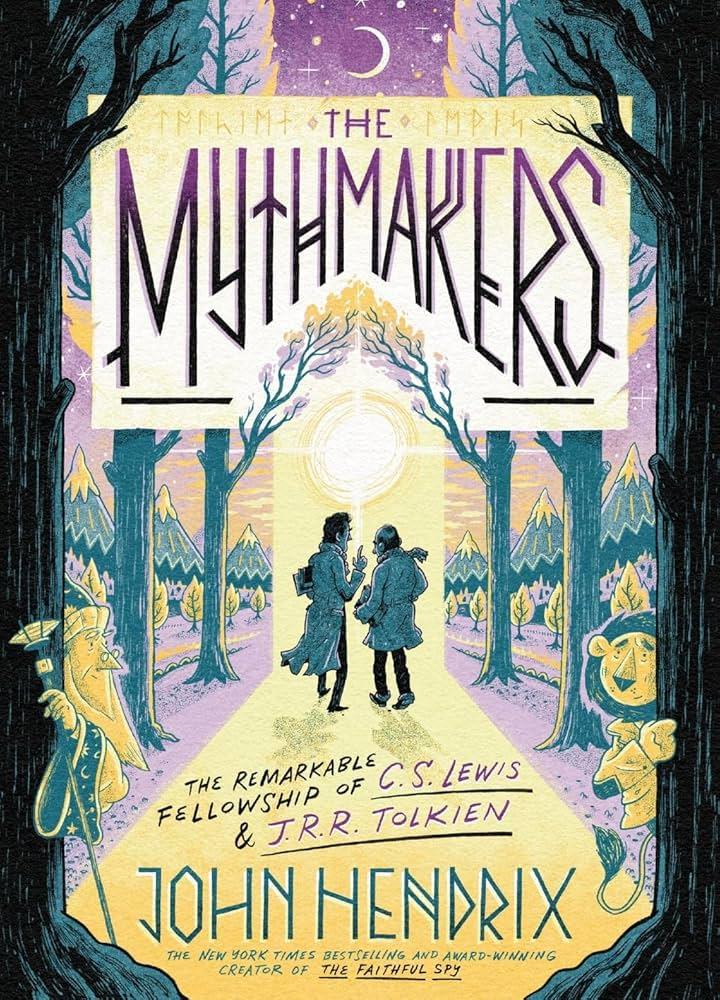
The Mythmakers: The Remarkable Fellowship of C.S. Lewis and J.R.R. Tolkien by John Hendrix (Harry N. Abrams, 224 pages, grades 7-12). C.S. Lewis and J.R.R. Tolkien both suffered early childhood losses but also had mystical experiences of joy as children, often associated with reading myths and fairy tales. After horrific experiences fighting in the trenches of World War I, they both became Oxford dons, where they developed a delightful friendship based on their mutual love of myths and interest in religion. A lifelong Catholic, Tolkien encouraged the agnostic Lewis to follow his spiritual longings, eventually leading Lewis to a dramatic conversion to Christianity. Each supported the other in his writing, and it’s pretty clear that neither the Chronicles of Narnia and especially The Lord of the Rings would have existed without the influence of their friendship and the literary group The Inklings which grew out of that relationship. The main chapters are interspersed with comics featuring a lion and a wizard traveling through the landscapes of Tolkien’s and Lewis’s life, and a poignant final chapter imagines the two men, who sadly had a falling out in the last decades of their lives, reuniting for one last conversation before moving into the great beyond. Includes extensive additional information about mythology, as well as an author’s note about his research, notes, a bibliography, and an index.
As someone who is both a John Hendrix fan and was an obsessive enough fan of C.S. Lewis to actually write a biography of him, I was excited to see this new book. Although it bills itself as a graphic novel, the amount of information far exceeds most of that genre. The lion and wizard segments are in comic format, while the rest of the book is more like an illustrated text. The emphasis is on the friendship between the two men and how their common love of mythology influenced their literary masterpieces. I was a bit disappointed that Lewis’s relationship with Janie Moore, which lasted for decades and had a huge impact on his life, was pretty much left out of the story. Additionally, some of the information about mythology got a bit too dense for me, and I imagine many young adults will have the same experience. Nevertheless, this is a rich story of an extraordinary friendship between two men who changed the landscape of fantasy literature and left behind books that are still beloved today.
 A Kids Book A Day
These are both books I would have enjoyed as a child!
LikeLike