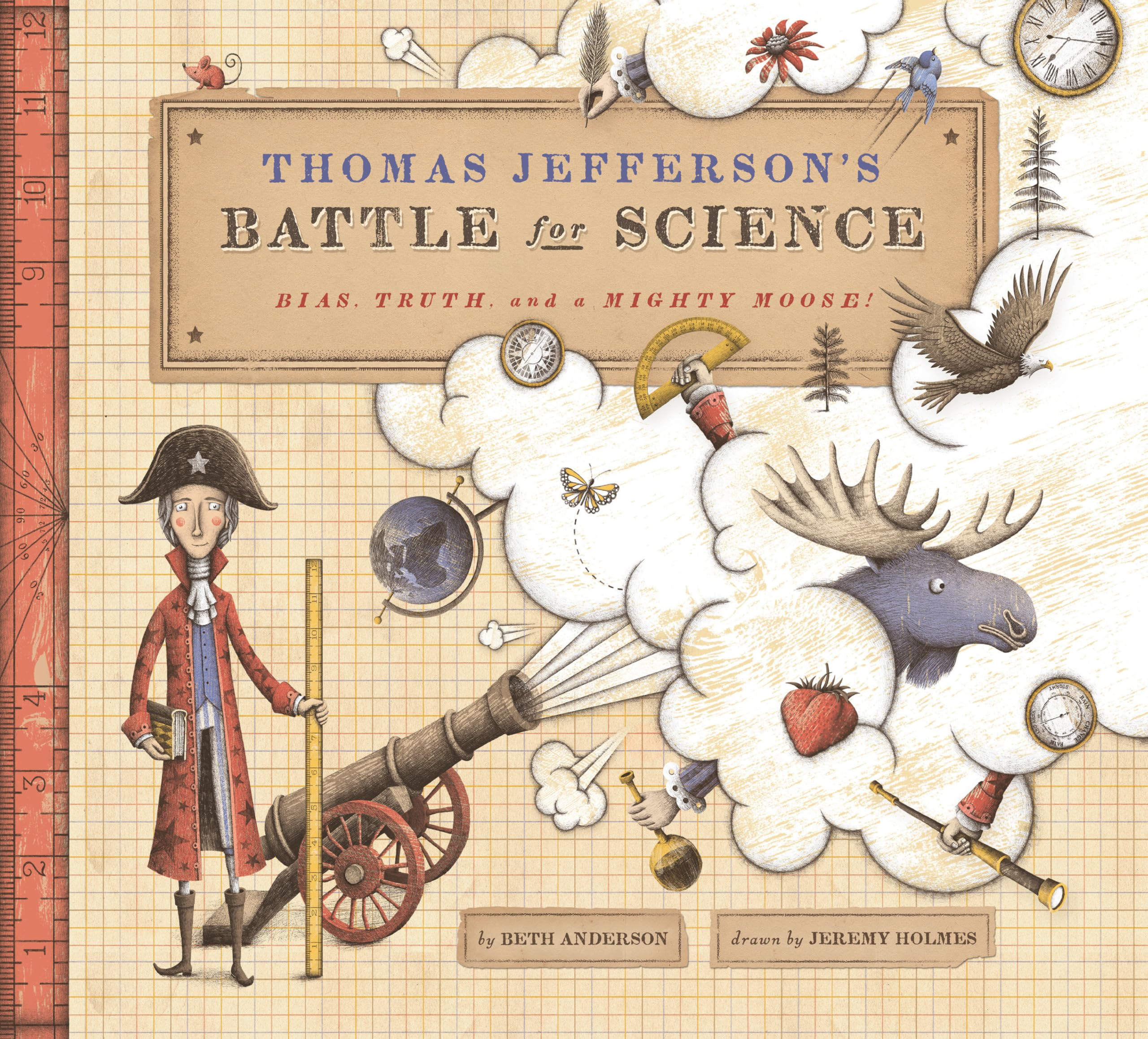
Thomas Jefferson’s Battle for Science: Bias, Truth, and a Mighty Moose! by Beth Anderson, illustrated by Jeremy Holmes (Calkins Creek, 48 pages, grades 2-5). Thomas Jefferson loved science, and one of his favorite books was Count Georges-Louis Leclerc de Buffon’s encyclopedia of the natural world. But he was incensed by Buffon’s descriptions of American wildlife, comparing it unfavorably to the animals found in Europe. Thomas decided to measure as many American animals as he could, and recruited friends from different parts of the country to assist him, eventually putting together his own book that he showed Buffon when he became minister to France. So committed to the truth about American fauna was Jefferson, that he actually had friends hunt a moose and ship it to France (you can read more about that here). When Buffon saw (and smelled) the enormous moose, he promised to revise his book, but unfortunately passed away a few months later. Jefferson’s book became well-known, and people started sending him information and artifacts to add to it, helping him to promote the idea that the New World was not inferior to the old one…just measurably different. Includes an author’s note, a list of five steps to use for a scientific inquiry process, a timeline of Jefferson’s life, and a bibliography.
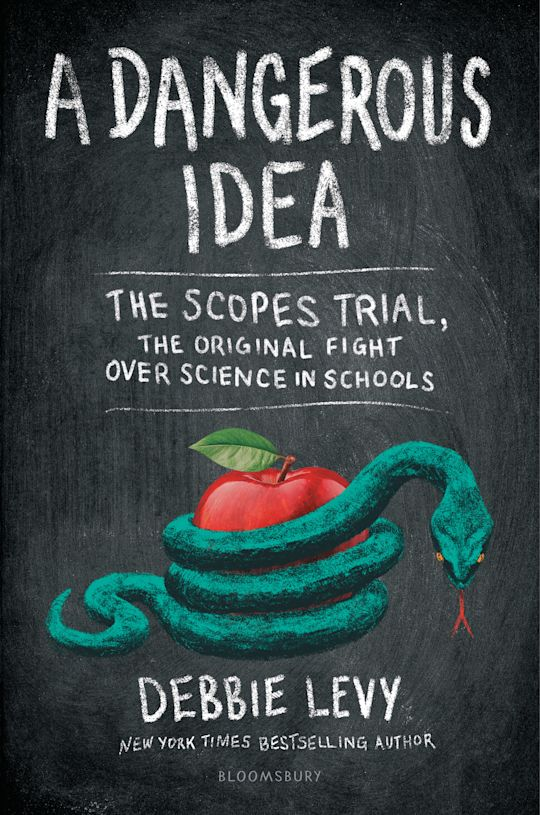
A Dangerous Idea: The Scopes Trial, the Original Fight Over Science in Schools by Debbie Levy (Bloomsbury Children’s Books, 288 pages, grades 6 and up). This account of the 1925 trial of John Scopes, a young high school teacher accused of teaching evolution, gives background information on evolution, the law that banned teaching it in Tennessee, and the two great orators, Clarence Darrow and William Jennings Bryan, who served as prosecuting and defense attorneys. The trial itself is described in detail, capturing both the serious debates about religion and the circus-like atmosphere. The story concludes with information about Susan Epperson, a biology teacher who challenged a similar law in Arkansas, leading to a 1968 Supreme Court ruling striking down the law and allowing evolution to be taught in high schools. There’s also information about the play and movie Inherit the Wind, which took some pretty big liberties with the truth about the Scopes trial. Includes an epilogue tying the case to current events, a detailed timeline from 1831-2005, and an extensive bibliography, index, and list of sources notes.
These books could not be more timely with their reminders that attacking science is a tale as old as time. Both are told with a lighthearted, humorous tone, but the back matter shows how extensively researched they are. I enjoyed the Jefferson illustrations that resemble a naturalist’s notebook, with lots of cartoon bubbles and captions. The authors’ notes will give readers plenty to think about, and I thought Debbie Levy did an especially good job of connecting the events of the Scopes trial to current news stories. Beth Anderson delves into the scientific method and explains how Jefferson made mistakes, too, lest any of us think we have any sort of monopoly on the truth.
 A Kids Book A Day
One thought on “Blinded with science”