Creating community

No More Chairs by Dan Gill, illustrated by Susan Gal (Little, Brown Books for Young Readers, 40 pages, grades K-3). On the first day of school, Mr. Gill’s students ask him why there’s an extra chair at the front of the room. He tells a story of when he was a kid, and he went to a birthday party with his best friend Archie. At the door, the host’s mother stared at Dan, who was white, and Archie, who was Black. “You can come in,” she told Dan, “but your friend cannot, because there are no more chairs.” At first Dan doesn’t understand, although Archie seems to, and he offers to bring a chair from home or sit on the floor. But when the mom is adamant, Dan finally realizes what’s going on. “Give these presents to Steve,” he says. “We’re going back to my house, where there are always enough chairs.” On the way home, Archie tells Dan he will speak up for him if Dan ever feels like he can’t speak for himself, and the two friends share a big bowl of ice cream. And that’s why, Mr. Gill explains, he always keeps an extra chair in the classroom, to make sure that everyone knows that there are always enough chairs, and everyone is welcome. Includes an author’s note of how he always told this true story from his childhood to his classes on Dr. Martin Luther King, Jr.’s birthday to help them understand the meaning of the day.

Use this short but powerful tale to either kick off the school year with a message of inclusion or to begin a conversation about the civil rights movement. It’s a story that will resonate with kids of all ages, as well as with adults, and points to the importance of people with privilege speaking up for those who are being marginalized.

Sunnyside School: A Community Helpers Book by Lindsay Ward (HarperCollins, 40 pages, grades K-3). Welcome to Sunnyside School! The first two pages show 39 different jobs that people have at the school. Then the story begins, with siblings Ali and Matty starting second grade and kindergarten, getting walked into the school by their mom. As the two go through their day, they meet all kinds of people: front office staff, classroom teachers, specialists, cafeteria staff, and more. Sidebars give additional information about their jobs, while questions are sprinkled throughout the text to keep kids engaged, and characters talk to each other via cartoon bubbles. Ali’s best friend has just moved away, and Matty’s going to school for the first time; each of them is successful and finding a new friend. At the end of the day, both kids meet their mom and report an excellent first day. Includes a search and find activity for kids to go back and find things like pencils and backpacks in the book, as well as a glossary.

This is an outstanding introduction to all the people who work in a school woven into a first day of school story that kids will relate to. I thought about reading this to kids at the beginning of school, but there’s so much information packed into it that it almost felt overwhelming to read it all in one sitting. it would be a great book to revisit a few times during the first week or two of school, as well as a good one to share with kids at home before their first day.
Two picture books made for sharing

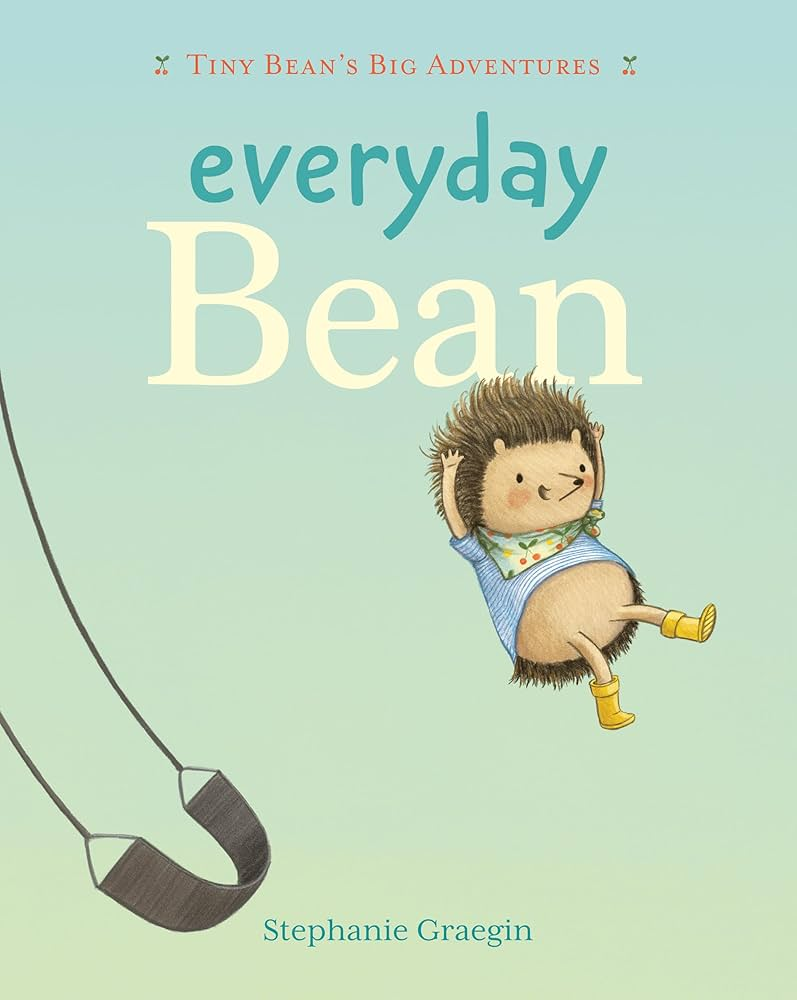
Everyday Bean (Tiny Bean’s Big Adventures) by Stephanie Graegin (Tundra Books, 56 pages, ages 3-7). “Bean wants to tell a story about tiny ghosts. And Grandma wants to tell a story about giant strawberries. They can’t decide which story to tell you. So they’ve asked me to tell some stories instead.” Ten stories follow about Bean and Grandma, each one only a few sentences long, with adorable illustrations of a young hedgehog and her grandmother. There are tales about everyday events, like swinging at the park, making different things from a cardboard box, and picking out a cactus at Mr. Green’s plant store (“This plant reminds Bean of Grandma. And it reminds Grandma of Bean.”). The last story, “Bean Burrito,” shows Grandma tucking Bean into bed, and both of them nodding off as she reads a bedtime story.

This feels like a book with great potential to become a well-loved favorite over time, with gentle humor, familiar situations, and adorable characters. Listeners who are paying attention will notice that they get to hear stories about both giant strawberries and tiny ghosts.

More or Less by Alison Hughes, illustrated by Oge Mora (Little, Brown Books for Young Readers, 40 pages, ages 3-7). The entire text of this book consists almost entirely of the words “more”, “less”, and “plenty”. Oge Mora’s colorful collage illustrations give readers a lot to consider about what those words mean. A family has plenty, but one of the kids has a room with more…and more (with two pictures side by side that kids can compare to see what’s been added). Less in the room can lead to more donations and community building. Less going into the trash results in more recycling and creative repurposing of unwanted items. The last page shows the family hugging one another with the word “Plenty.”

Take your time going through this deceptively simple book. There’s a lot to see, and many interesting ideas about what we want more or less of in our lives, as well as the meaning of the word plenty. I’m looking forward to projecting this on a screen and sharing it with kids, who I know will see all kinds of things in the illustrations that I missed.

Ghostly graphic novels

Ghost Town by Eric Colossal (Harry N. Abrams, 256 pages, grades 4-7). Lily’s been accepted to a prestigious science academy, which means a move to another town, but she’s sure she doesn’t want her life to change. After purposely failing her science final in an attempt to lose her scholarship, she’s grounded and assigned to volunteer at the library every morning, but that doesn’t stop her from sneaking out to play baseball with her friends. When their ball goes through the window of an old mansion, the kids stumble upon a ghost and a trap for catching other ghosts. As they go through town, cleaning up ghosts and restoring the power that those ghosts have been sucking up, they slowly unravel a mystery involving an old family from town, and one member in particular, who, like Lily, didn’t want anything to change. As she begins to see the destruction his resistance has caused, Lily realizes that change is inevitable, and it’s okay for her to embrace the new things in her life.

This is a fun tween ghostbusters story with the whole gang taking on the task of trapping ghosts and finding out about their past lives, which they accidentally discover can be done by swallowing the ghost and initiating a flashback of its past life. There’s lots of humor, like when some of the ghosts turn out to be animals, but there’s also a pretty serious message conveyed in the big final showdown.

Free Piano (Not Haunted) by Whitney Gardner (Simon and Schuster Books for Young Readers, 256 pages, grades 5-8). Margot loves playing the ukulele and writing songs, but everyone around her seems more concerned with getting likes and follows on social media. Her dad goes off to L.A. to pursue his musical dreams and his goal of 10,000 followers, while her two best friends are getting more action on their channel smashing things from a tree house than Margot gets with her music. When she finds an old synthesizer keyboard with a sign reading “Free Piano (Not Haunted),” she thinks it may be just the thing to help her connect with her dad. Instead, it starts making weird sounds, even when it’s not plugged in, and eventually the ghost of ’80’s pop star Vision appears. Vision encourages Margot to embrace her own talents, and together, the two of them exorcise an evil spirit from Vision’s past who’s been haunting the keyboard. The ghost eventually has to move on, but its clear that her influence has changed the way Margot sees herself and her talents. Includes additional information about the Prophet-5 keyboard featured in the story.

This is sure to be a popular choice for middle school kids struggling with their own identities and parental issues, and it never hurts to throw a ghost or two into the mix. The brilliantly colored artwork conjures up Vision’s 1980’s vibe, with the portrayals of ghosts and the haunted keyboard especially effective.

Two books for LGBTQ+ collections

Trans History: A Graphic Novel: From Ancient Times to the Present Day by Alex L. Combs and Andrew Eakett (Candlewick, 384 pages, grades 8 and up). The title gives a pretty good idea of what this book is: a graphic novel of trans history, starting in ancient times and going to the present, with an emphasis on western cultures. Much of the history is told through the stories of individuals, from ancient Egyptian pharaoh Maatkare Hatshepsut, “a person who was raised to be a queen but instead became a king” to Adelaide/Alexina/Camille/Herculine Barbin, a French intersex woman from the 19th century to trans activists of the twentieth century like Marsha P. Johnson and Sylvia Rivera. Their stories give some idea about beliefs and treatments of trans people were like at that time. The final chapter profiles present-day activists, each of which is written in their own voice. Includes many pages of source notes and a lengthy index.

I often reflect on how much I’ve learned from the thousands of books I’ve read for this blog, and nowhere is this more apparent than in my greater understanding of trans people. Authors like Alex Gino and Kyle Lukoff have helped me understand what it’s like to be a trans kid, and now Alex Combs and Andrew Eakett have added a whole new level of understanding with this outstanding graphic history. Focusing on individuals makes for a fascinating read, and the interviews with contemporary activists are compelling. It’s a huge amount of information, occasionally a bit overwhelming, but definitely an important book to educate readers in such an engaging format.

Athlete Is Agender: True Stories of LGBTQ+ People in Sports edited by Katherine Locke and Nicole Melleby (Christy Ottaviano Books, 224 pages, grades 5-8). In 22 essays, LGBTQ+ people tell the stories of their athletic experiences. Most of the narratives lift up supportive teammates, but there are also examples of bullying and prejudice encountered in sports. Interspersed with personal essays are brief biographies of successful LGBTQ+ athletes like tennis player Billie Jean King, WNBA players (and married couple) Courtney Vandersloot and Allie Quigley, and Olympic gold medalist rugby player and trans activist Ellia Green. The sports are varied: sled dog racing, water fitness, longboarding, and sailing, among others, and each athlete’s experience is equally unique. Introductory material includes a note on pronouns and the history of Title IX, and in the back you’ll find profiles and photos of all the contributors, information on how to be a good teammate and ally, steps to take to form a Queer Athletics Alliance or Gender and Sexuality Alliance at your school, and source notes.

I loved this positive presentation of sports, an area that has been particularly fraught for LGBTQ+ participants, especially trans athletes. The writers are honest about their experiences, and the way gender divisions in sports often made them feel uncomfortable. Each essay could stand on its own as a powerful argument for inclusion in sports, but taken all together that argument becomes all the more compelling.

Life lessons from animal friends

Axolotl and Axolittle by Jess Hitchman, illustrated by Sarah Rebar (Sourcebooks Jabberwocky, 40 pages, ages 3-8). Siblings Axolotl and Axolittle are very different–big sis Axolotl lives life to the max while younger brother Axolittle is quieter and more studious–but they’re still the best of friends. When Axolotl’s boisterous play ends up destroying Axolittle’s painting, though, an axo-squabble ensues. Finally, Axo-dad-l comes in to calm things down, and after a bit of a break, family harmony is restored.

Axolotls seem to be having a moment, due to Minecraft, I guess? Whatever the reason, this book will definitely catch the eye of many a young reader, and they won’t be disappointed by the lively rhymes, clever axolotl (and axolittle) plays on words, and relatable family situations. This would make a great sibling gift for the older child in a family with a new baby.

Don’t Trust Fish by Neil Sharpson, illustrated by Dan Santat (Dial Books, 40 pages, ages 4-8). After an introduction to mammals, reptiles, and birds, the narrator gets to fish: DON”T TRUST FISH! There are so many reasons, and those reasons grow more preposterous as the book goes on. Some have gills and some have lungs. Some live in salt water, some in fresh water. Very shifty. They live underwater where you can’t see them. They may be in your home, spying from that aquarium, and reporting back to the king fish! And they like to eat poor, innocent, kind crabs…which readers will learn on the last page is the animal responsible for all the information in this book.

I’ll admit I didn’t love this book the first time I tried reading it, and I only looked at the first few pages. But the four starred reviews and inclusion on possible Caldecott lists led me to take another look, and I’m happy to say that now I get it! It would be a fun story to read aloud and have kids try to guess who the narrator is. Dan Santat’s illustrations, of course, add immeasurably to the fun. It could also be a great introduction to a discussion with older kids about considering sources of information in the news and on social media.

You and Me, Anemone by Rachel Vail, illustrated by Chris Raschka (Greenwillow Books, 32 pages, ages 4-8). Using clever rhyming text, an anemone makes a plea to readers not to BOOP it, then goes on to encourage kids who prefer not to be booped to assertively make their wishes known. The anemone explains that it likes living harmoniously in community with other anemones, and that not being touched doesn’t mean that it doesn’t enjoy the company of others, “to live side by side in our own kind of unity! Resplendent, independently, extending as far as eye can see.” Includes an author’s note about how she learned recently not to touch anemones and giving kids tips for communicating their own preferences as well as noticing those of others.

This is an ingenious book, combining interesting information about anemones with ideas for kids on how to notice what they may or may not want and expressing that. The illustrations are made to look like applique on burlap, with lots of textures and colors.

Which witch?

This Year, a Witch! by Zoey Abbott (Atheneum/Caitlyn Dlouhy Books, 40 pages, ages 4-8). The narrator has had enough of her cute costumes of years past. No more bunny or mouse…this year, she is going to be a witch! She’s been planning this for quite a while, growing her hair, practicing spells, and enlisting her dad to make her a witch costume. On Halloween night, she dresses up, only to scare herself when she looks in the mirror. Dad helps her to take a break, and before long they’re out trick-or-treating, the girl in her witch costume, and her dad dressed up like a cat.

Jazzy the Witch in Broom Doom by Jessixa Bagley (Simon and Schuster Books for Young Readers, 232 pages, grades 3-7). Although Jazzy’s moms and grandmother run a successful broom business, Jazzy’s never had any interest in flying. She’s not too surprised when she’s the only kid at school not to get off the ground during her first flying lessons, trying not to feel jealous when her best friend Aggie is a soaring success. When Jazzy sees a cycling race on TV, she’s sure that she’s found her passion, and using parts from the junkyard and a little magic, she and Aggie create a bike for her. Jazzy discovers she loves biking, but she’s afraid to tell her family. With a supermoon in the forecast, the witches all get ready for a flying parade, and Jazzy is finally forced to confess her shortcomings. She learns that her moms both had their share of youthful struggles, and that everyone is proud of her just the way she is, leading her to come up with an innovative broom design with a comfortable bike saddle that not only allows her to finally learn to fly, but helps other witches as well. Includes an author’s note and a preview of Jazzy’s next adventure.

Evelyn Witch Gets a Pet by Beth Ferry, illustrated by Charles Santoso (Roaring Brook Press, 32 pages, ages 4-8). When Evelyn Witch wakes up with a feeling that something is missing from her life, she can’t quite put her finger on it until she spies the pet shop. Bats, rats, and cats are all beyond her budget, and the only thing she can afford is a box marked “Mystery Pet.” Inside is an egg, which Evelyn is most impatient to have hatch. After a series of outlandish plans to make this happen, she finally realizes that all she can do is be patient, take good care of the egg, and focus on other areas of her life. Her patience is finally rewarded with an appropriate pet for a witch.

Kids will love these three witchy heroines who learn lessons in courage, patience, and being true to themselves in two picture books and a graphic novel. Each one has distinctive artwork that creates a magical world of witches and other fantastic creatures. Halloween may still be three months away, but there’s no reason to wait to read and share these magical books.

We can never have too many middle school graphic novels

Reel Life by Kane Lynch (Graphix, 240 pages, grades 4-7). Galen’s upset when his friend Kyle pulls away from him, but their mutual friend Luna explains that Kyle’s going through a tough divorce and a custody battle with his parents. Galen doesn’t really get it until his own dad announces that he’s leaving Galen’s mom and has a new girlfriend, Jasmine. Galen and Luna use their movie making skills to try to understand not only what’s going on with Galen’s family, but also Luna’s constantly bickering parents. As the kids navigate these difficult relationships, they learn the importance of love, support, and communication. As they wrap up their movie, Galen declares, “It’s OUR story. We get to choose how it ends.”

There’s a lot to love about this graphic novel, including the artwork that resembles an animated film, but especially the underlying upbeat tone that shows kids’ resilience in the face of changing families and friendships. Galen is a kind kid who doesn’t shy away from difficult emotions, is willing to give the new people in his life a chance, but is still–for the most part–able to figure out how to take care of himself.

On Guard!: a Marshall Middle School graphic novel by Cassidy Wasserman (Random House Graphic, 256 pages, grades 4-7). Grace isn’t excited about starting seventh grade after her best friend Ava dumped her at the end of sixth grade and her parents got divorced over the summer. Due to a custody agreement, she’s forced to spend every other week with her self-absorbed mother who makes no effort to understand her daughter. When Grace sneaks into the gym at lunchtime to avoid the cafeteria, she discovers the fencing team practicing there. Although she’s fascinated, she’s sure she’s too much of a klutz to try it. After trying and failing at several other clubs, she finally reluctantly signs up for fencing. To her surprise, she finds out that she has a talent for it and that the team is a surprisingly good source of friendship and support. Using the lessons she learns through fencing, Grace slowly begins to learn how to stand up to her mother and advocate for herself with both of her parents.

I’m hoping the subtitle of this book indicates that there will be other Marshall Middle School graphic novels, as this is sure to be popular with fans of authors like Raina Telgemeier, Kayla Miller, and Maria Scrivan, as well as a good choice for those who enjoyed another fencing graphic novel, Duel. Grace’s struggles with her mother are heartbreaking but ring true, and I like how fencing subtly teachers her skills that she can use in her real life.

Christmas (and Halloween) in July

Scary Shark: A Jaw-Some Halloween by Mike Lowery (Orchard Books, 32 pages, ages 4-8). Edgar the shark is too scared of everything having to do with Halloween to want to go trick-or-treating, so his friend Lotta the crab eases him into it. They start by carving pumpkins (Lotta uses claws, Edgar uses teeth), then move on to decorating, and finally costumes. After deciding to be Count Sharkula, Edgar freaks out a little when he sees monsters outside his window, but Lotta shows him they’re just friends in costumes. Finally, Edgar’s ready to join the fun, and the two swim out the door and into a spooky underwater town just right for trick-or-treating.

I’m familiar with Mike Lowery’s Gingerbread Man books, but I didn’t know about his shark series, which includes Pizza Shark and Santa Shark. They’re sure to be popular with their comic-style artwork, lots of cartoon bubbles, and puns galore. One can never have too many Halloween books, and this one will be a big hit.

The Gift of Words by Peter H. Reynolds (Orchard Books, available October 7, 40 pages, ages 4-8). In this follow-up to Reynolds’s The Word Collector, Jerome is looking for some good holiday words to add to his collection and to give as gifts to his family and friends. In town, he sees words like, “Sale!”, “Cheap stuff!”, and “Violators will be towed”, none of which seem right for the holidays. The newsstand is even worse, with its headlines about war, poverty, and climate change. Jerome tries listening to the words around him, but they turn out to be complaints or angry commands (“Hurry up!”). He goes back home, where he pulls a selection of the right words from his collection, then heads to the park to decorate a tree. He invites others to add their own words, and before long, the tree is covered with words such as listen, hope, and epiphany, as well as phrases like peace on earth and savor each moment.

Like many Peter H. Reynolds books, the message isn’t exactly subtle (in case you missed it, the last page says “‘Share your positive words. May they inspire peace on Earth.’ – Peter H. Reynolds”), but this is a lovely book for the winter season that spreads a positive message without specifying a particular holiday. The ending practically begs for a bulletin board featuring a tree that kids can decorate with their own words.

Thanks to Scholastic for providing me with review copies of both of these books!

Two brave girls

The Freedom Seeker by Ruchira Gupta (Scholastic Press, released August 5, 320 pages, grades 4-8). Simi has a happy life in Northern India, where she’s surrounded by friends and family who celebrate her accomplishments at school and on the hockey field. But when a right-wing group comes to power, her Sikh father and Muslim mother become targets. After her father is badly beaten, he’s able to illegally immigrate to the United States, where he’s granted asylum and starts working as a taxi driver in New York. By the time he’s saved enough to send for Simi and her mother, though, immigration policies have changed in the US. The two of them have to make a dangerous desert crossing in Mexico, and they wind up getting separated. Simi makes it to a detention center but has to endure weeks of crowded, prison-like conditions and the agony of not knowing what has happened to her mother. Drawing on her experience as a leader in school and in sports, Simi finds ways to help herself. She’s eventually able to connect with her father, and the two of them work together to find her mom. Simi’s courage and kindness to others helps her to survive and finally bring her family together again.

This book puts a face on the phrase “illegal immigrant,” showing how families must make the difficult decision to leave their homelands, friends, and extended families to escape violence, and the incredibly harsh conditions that they endure in their quest to find a place where they can live in safety. Simi’s voice is compelling, as are the stories of others she meets on the journey, and once I got to about page 100, I had to keep going until I knew she and her family were going to make it. While advanced fourth and fifth grade readers would enjoy this, I think middle school kids would perhaps get more from the story. Thanks to Scholastic for providing me with an advance copy.

The Burning Season by Caroline Starr Rose (Nancy Paulsen Books, 256 pages, grades 4-7). On Opal’s twelfth birthday, she starts her training with Gran, continuing the tradition of women in her family who have served as fire lookouts deep in New Mexico’s Gila National Forest. Although Opal loves her life with Gran and Mom and their small home in a lookout tower, she yearns to move to town and go to middle school like other kids. She also guards a deep secret–she’s afraid of fire, which killed her dad and almost took the rest of the family during a huge wildfire a few years back. When her mom gets stranded in town after a fierce storm and Gran gets injured in the woods, Opal comes face to face with a fire that threatens Gran and their home. Despite her own injuries, she must overcome her fears and fight the fire alone. Opal discovers that sometimes bravery means doing the very thing you’re afraid of and that protecting those you love can give you courage. Includes a seven-page author’s note with additional information about wildfires and the history of fire management.

This novel-in-verse kept me riveted from the first page with its unusual setting and strong characters living a happy if somewhat bare bones life in the middle of the wilderness. The action really picks up when Mom leaves for supplies and they don’t hear from her for several days, then continues when Opal accidentally breaks their only pair of binoculars and Gran gets hurt. Opal’s favorite books are Gary Paulsen’s Brian series, and this story is an homage to their combination of nail-biting survival story and wilderness setting.

Protest and Resistance

If you’re looking for a way through these difficult times, I’ve put together a book list of true stories about protests and resistance movements in the United States. Read them yourself for inspiration, or share them with your students to empower the next generation.