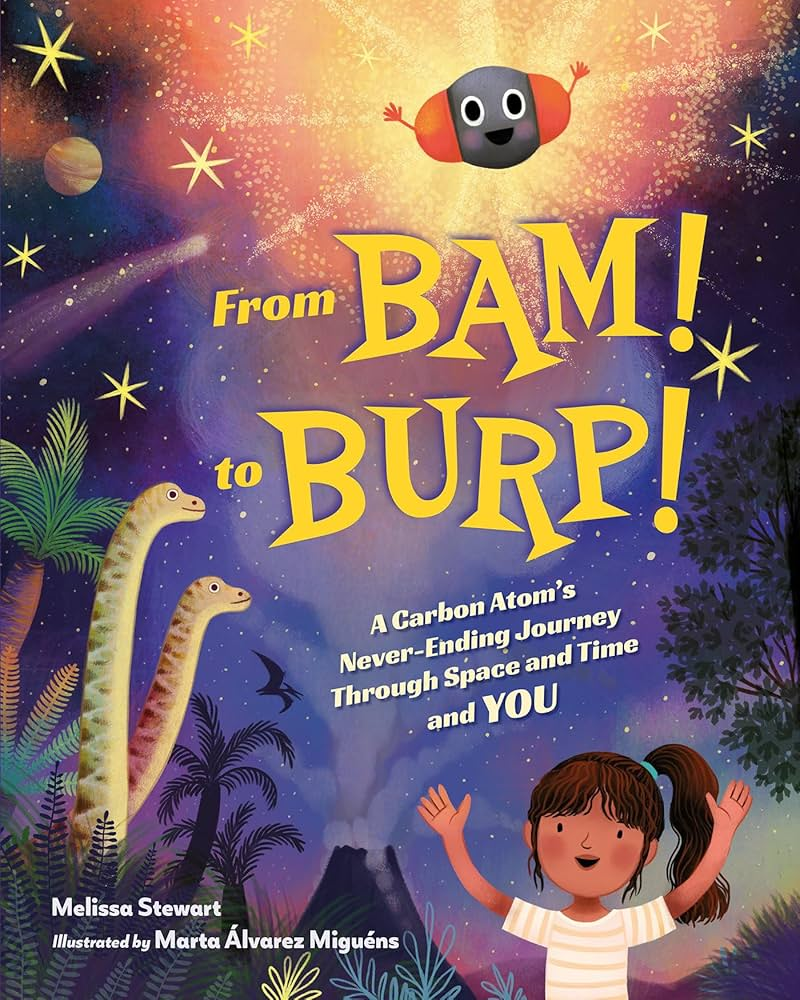
From Bam! to Burp!: A Carbon Atom’s Never-Ending Journey Through Space and Time and You! by Melissa Stewart, illustrated by Marta Alvarez Miguens (Charlesbridge, 40 pages, grades 1-4). The story begins with a planet called Theia, which 4.5 billion years ago smashed into Earth (the bam! of the title) and broke into pieces, some of which eventually became the moon, and some of which were buried deep into the Earth’s core, including carbon atoms. The carbon atom featured in this story combined with oxygen to become carbon dioxide, which was later released from the Earth’s core following a volcanic eruption. The molecule wanders the Earth until it’s pulled apart by a plant that uses it to make sugar. The journey continues through a dinosaur, a rotting pumpkin, even toilet paper, until the carbon winds up in maple syrup, entering the body of a present-day kid who eats it on pancakes, and later burps it out into the world once again. Includes a wonder wall with questions and answers about carbon and related topics, additional facts about carbon, fossil fuels, and the climate crisis, as well as notes from the author and illustrator about the evolution of this book.
Seems like finding a fun picture about chemistry is about as likely as a carbon atom becoming a diamond, but budding scientists will enjoy this one and learn all sorts of information about carbon in the process. The presentation, both text and illustrations, really bring this potentially dry topic to life. I also appreciated the notes from the author and illustrator that emphasized the need for many drafts and much hard work to produce the final book.
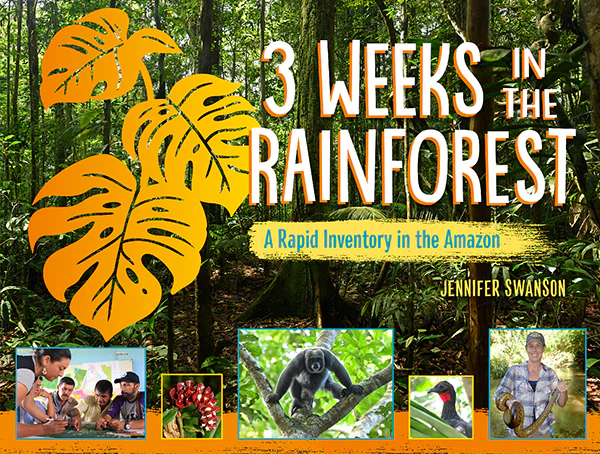
3 Weeks in the Rainforest: A Rapid Inventory in the Amazon by Jennifer Swanson (Charlesbridge, 80 pages, grades 3-7). To measure the health of Colombia’s rainforest, a rapid inventory team from Chicago’s Field Museum spends three weeks observing and recording plants, birds, fish, mammals, and reptiles. They also work with the indigenous people there to learn what they need to live sustainably on the land. The narrative follows different teams of scientists as they travel to this remote area, set up camp, and tirelessly work round the clock in all kinds of weather to inventory as many species of plants and animals as they can in three weeks. After leaving the rainforest, the team compiles its findings into a report to the Colombian government with their recommendations for preserving this ecosystem. Includes a note from the rapid inventory team, an author’s note that recounts how an exhibit at the Field Museum inspired her to write this book, a list of those who were on the team, and an index.
This engagingly written science book offers readers an intriguing look at scientists in the field, with plenty of photos and sidebars to keep things interesting. It was refreshing to read a book about the rainforest that was pretty upbeat in its reports on the health of this particular portion of it, and the descriptions of the fascinating work being done to preserve it will no doubt inspire future generations of scientists.
 A Kids Book A Day