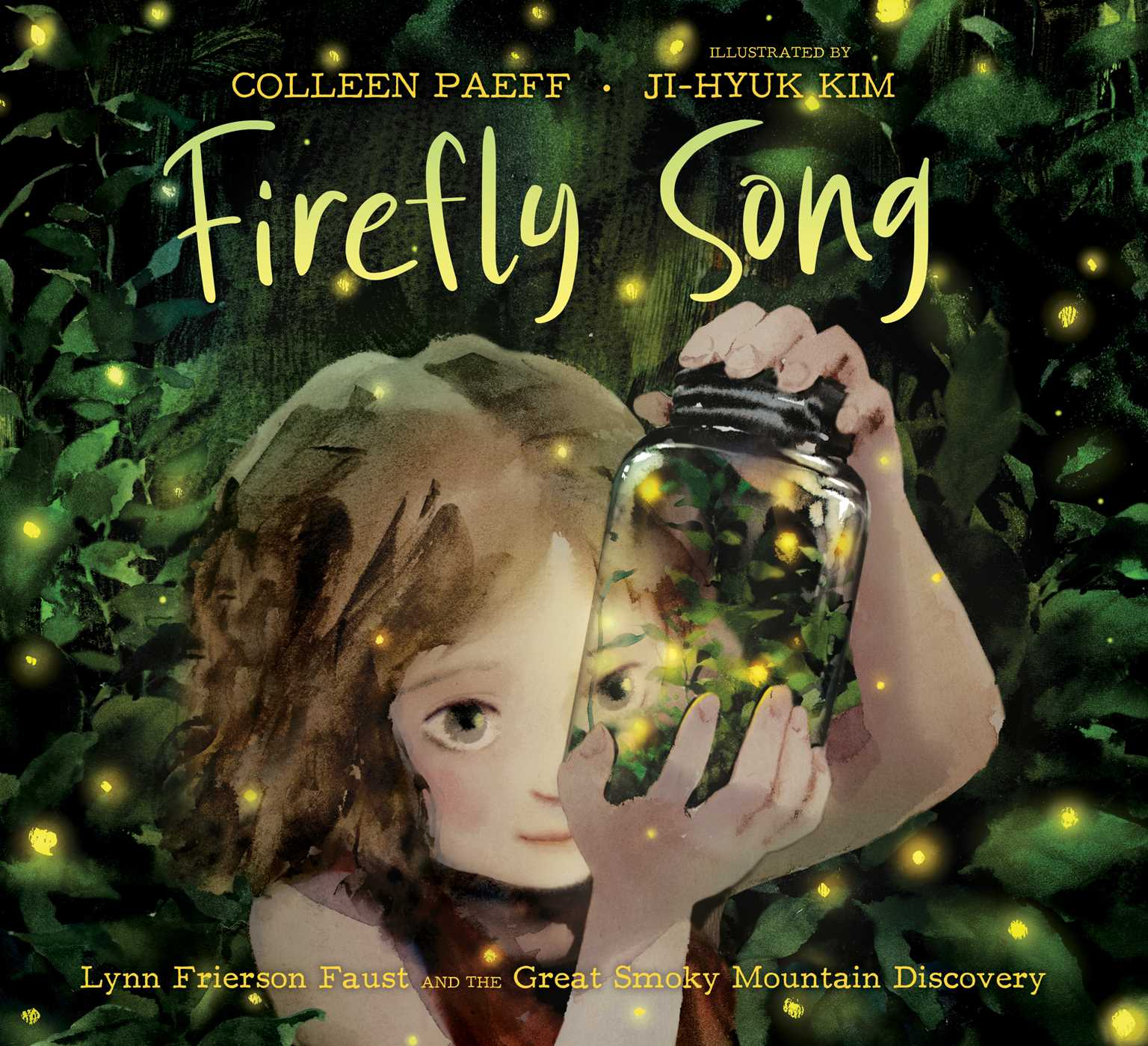
Firefly Song: Lynn Frierson Faust and the Great Smoky Mountain Discovery by Colleen Paeff, illustrated by Ji-Hyuk Kim (Margaret K. McElderry Books, 40 pages, grades 1-5). As a child spending summers in the Great Smoky Mountains, Lynn Frierson Faust was fascinated by fireflies who would flash their lights and go dark in unison. Years later, her family’s summer cabin and the land it was on became part of the national park, but Lynn never forgot those fireflies. When she read that synchronous fireflies didn’t exist in North America, she was determined to prove that they did. Working with other scientists, Lynn’s perseverance over many years finally paid off when she helped a biologist and his team observe the synchronous phenomenon. Although her scientific training is self-taught, Lynn is known globally for her firefly expertise. Includes tips for observing fireflies, firefly facts, a bibliography, and an author’s note.
Lynn’s story is a fascinating one and may inspire readers to become citizen scientists, or at least to be persistent in pursuing their passions. The illustrations are gorgeous, with backgrounds that look like slightly blurry photos, making the fireflies’ lights even more striking. I think the illustrator lives in South Korea, so unfortunately not eligible for a Caldecott, but this would be a good choice for another Sibert award for Colleen Paeff.
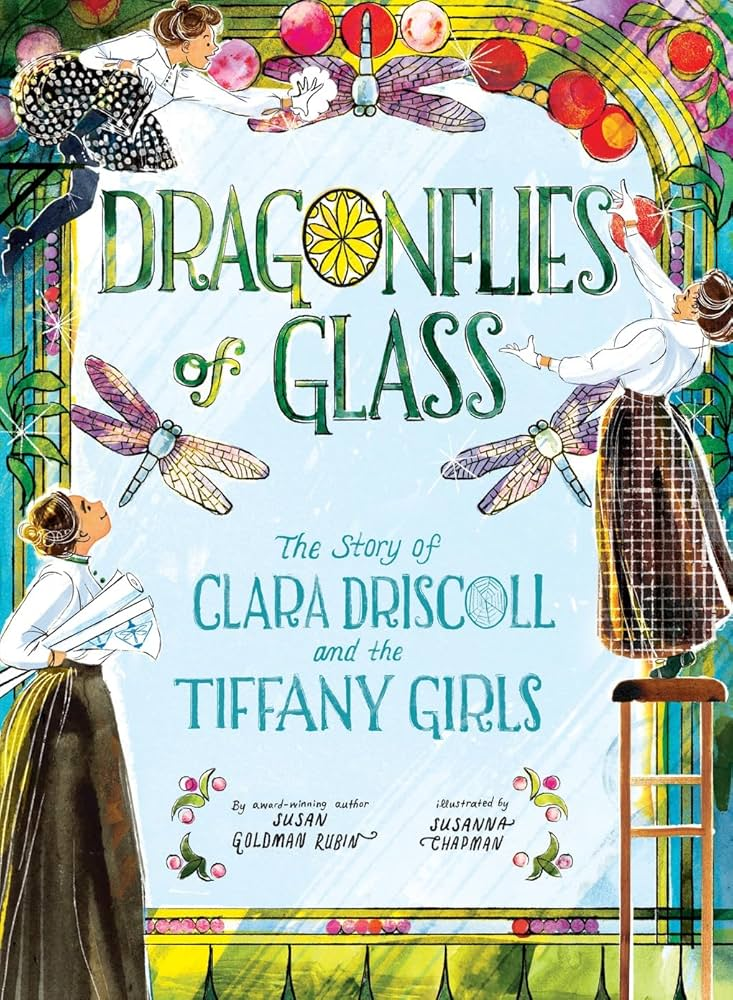
Dragonflies of Glass: the Story of Clara Driscoll and the Tiffany Girls by Susan Goldman Rubin, illustrated by Susanna Chapman (Harry N. Abrams, 40 pages, grades 1-5). Clara Driscoll grew up on a farm in Ohio, where she loved drawing the flowers and animals she observed around her. Her father died when she was 12, but her mother encouraged Clara and her sisters to become self-sufficient. In 1888, Clara and her sister Josephine moved to New York City to study at the Metropolitan Museum of Art School. Clara was hired by Louis Comfort Tiffany, son of the famous jeweler, to work in his studio making stained glass. She was part of the women’s division there, where she learned to cut glass and turn it into designs. Drawing on her memories of the Ohio farm, she was soon creating her own designs incorporating dragonflies, butterflies, and flowers, including the wisteria that was part of Tiffany’s most famous lamp. Includes notes from the author and artist, a list of places to see Clara’s work, and a bibliography.
Another story of an amazing woman who built a full artistic life at a time when sexism was a big obstacle. While Louis Comfort Tiffany sounds pretty progressive (he defended the women’s division when the men threatened to strike if he didn’t get rid of it), the author’s note reveals that Clara was forced to quit working there after she got married. The illustrations are gorgeous, especially the depictions of the Tiffany lamps. Clara’s story came to light thanks to round robin letters that she, her mother, and sisters wrote, and the story of those letters arriving at the farm is shown in small illustrations running along the bottom of each page.
 A Kids Book A Day