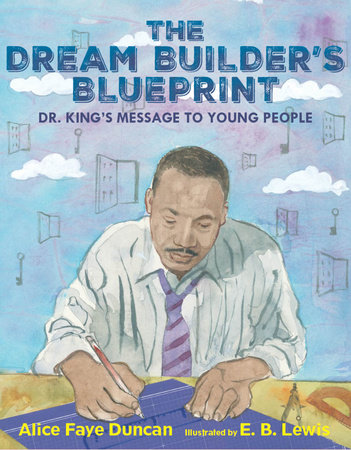
The Dream Builder’s Blueprint: Dr. King’s Message to Young People by Alice Faye Duncan, illustrated by E. B. Lewis (Calkins Creek, 32 pages, grades 2-8). In the foreword, Alice Faye Duncan explains that the text of this book is an erasure poem, a form of found poetry, in which she took a 1,765-word speech delivered by Dr. Martin Luther King, Jr. to a Philadelphia junior high school in 1967 and distilled it to 277 words. This brief text captures the essence of the speech, in which Dr. King encouraged his audience to build a blueprint for their lives: believing in themselves, choosing a life’s purpose, working for peace and justice, and practicing nonviolence. Words in the poem are capitalized and printed in large, colorful fonts for emphasis, while the illustrations show the hope and hard word needed to build such a blueprint. Includes additional history about this speech with a link to a YouTube video of it, a list of the historical figures mentioned in the speech with the dates of their lives and a sentence about their achievements, victories from the American Civil Rights Movement, directions for writing your own erasure poem, and a bibliography.
There’s so much more to this book than meets the eye, and readers will learn about this inspiring speech that Dr. King made to kids (something he seldom did), as well as receiving instruction and encouragement for creating their own erasure poetry. Although the announcement of 2027 awards is almost a year away, I hope this will be considered, especially for Coretta Scott King recognition.
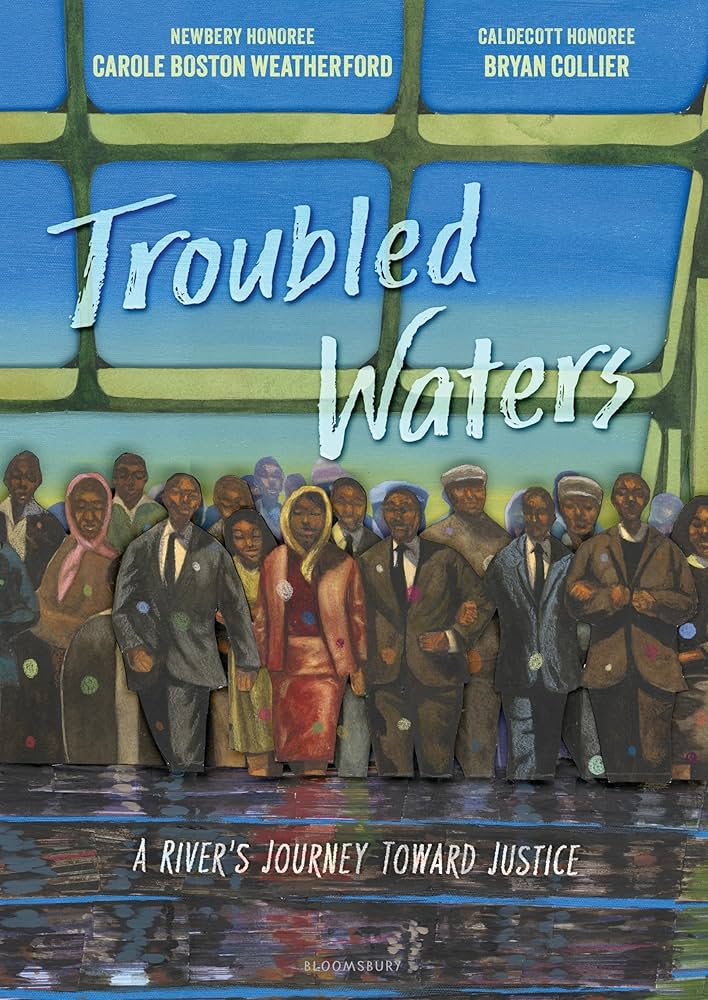
Troubled Waters: A River’s Journey Toward Justice by Carole Boston Weatherford, illustrated by Bryan Collier (Bloomsbury Children’s Books, 40 pages, grades 2-5). The Alabama River tells its story, briefly recounting the millions of years it has flowed from Montgomery to Mobile, witnessing the arrival of the Choctaw, who gave it its name that means “Thicket Clearers,” and later, the Europeans, who brought with them ships carrying enslaved Africans. It witnessed the Trail of Tears, the rise of the Black Belt and its cotton plantations, and battles of the Civil War. A bridge was built over it, and eventually, that bridge became the site of two marches in 1965 that brought the violence against civil rights protesters to the nation’s attention. Those marches led to an even bigger one, from Selma to Montgomery, and to the passage of the Voting Rights Act less than five months later. Includes a timeline of the Alabama River from circa 10,000 BCE to August, 1965 and a note from the illustrator.
This powerful book focuses on the Alabama civil rights marches in 1965 that led to the Voting Rights Act in August of that year, told in the unique perspective of the Alabama River. The text is poetic, with lines from spirituals woven in, and the illustrations are gorgeous, always keeping the river at the center of the story. Definitely another awards contender.
 A Kids Book A Day