Indigenous history

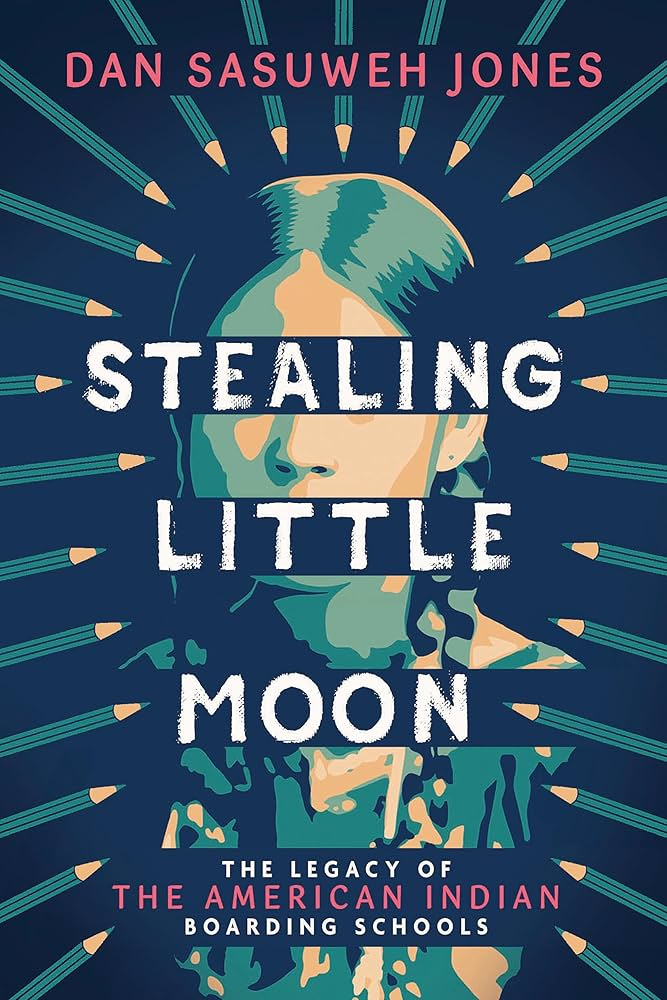
Stealing Little Moon: The Legacy of the American Indian Boarding Schools by Dan SaSuWeh Jones (Scholastic Focus, 304 Pages, grades 5-8). Dan SaSuWeh Jones tells the story of his family’s history with the Chilocco Indian Agricultural (boarding) School, beginning with the forcible capture of his grandmother Little Moon There Are No Stars from the Ponca reservation in 1885 at the age of four. The Chilocco school, run by Quakers, did not condone the physical abuse found at other Indian boarding schools, but it did use strict, military-inspired practices to force the students to assimilate to white culture. Little Moon There Are No Stars, renamed Elizabeth, stayed on for several years after her graduation to work as a school matron, and sent her own daughter there as well. By the time the author’s sister attended the school in the 1950’s, there had been many changes, becoming a vocational school that provided a positive experience for many (although certainly not all) of the students. The 1960’s and 1970’s saw political movements that helped the school and its students embrace their various cultures and languages. While the author didn’t attend the school, he worked there after it closed in 1985 as part of a maintenance crew trying to preserve the buildings and grounds. In his final chapter, he writes of the appropriateness that those buildings have crumbled, leaving the land to its natural state, a metaphor for the enduring nature of Indigenous cultures that have survived so much trauma yet still continue to live on. Includes an introduction by Denise K. Lajimodiere (Turtle Mountain Band, Chippewa), photos throughout the text, and a long list of additional resources.

Reading this book caused me to reflect on how much this blog has educated me and changed my views on American history. I’m not sure I knew anything about Indian boarding schools ten years ago, but I’ve learned from children’s books over the years, and this one added a lot to that knowledge. It’s masterfully written, weaving together a personal family memoir and the history of boarding schools in North America. The author writes unflinchingly about a multitude of abuses and deaths of children at many different schools, while at the same time acknowledging that some students had positive experiences and learned to embrace their heritage, particularly in the later years of the schools’ histories. The final chapters give hope that some of the many, many crimes and trauma committed against indigenous people are finally being at least brought to light and possibly, in some cases, addressed and healed. There are some horrific descriptions of child abuse, so be aware of that element when sharing this book with kids. I hope this book will be considered for awards, especially by the Sibert committee.
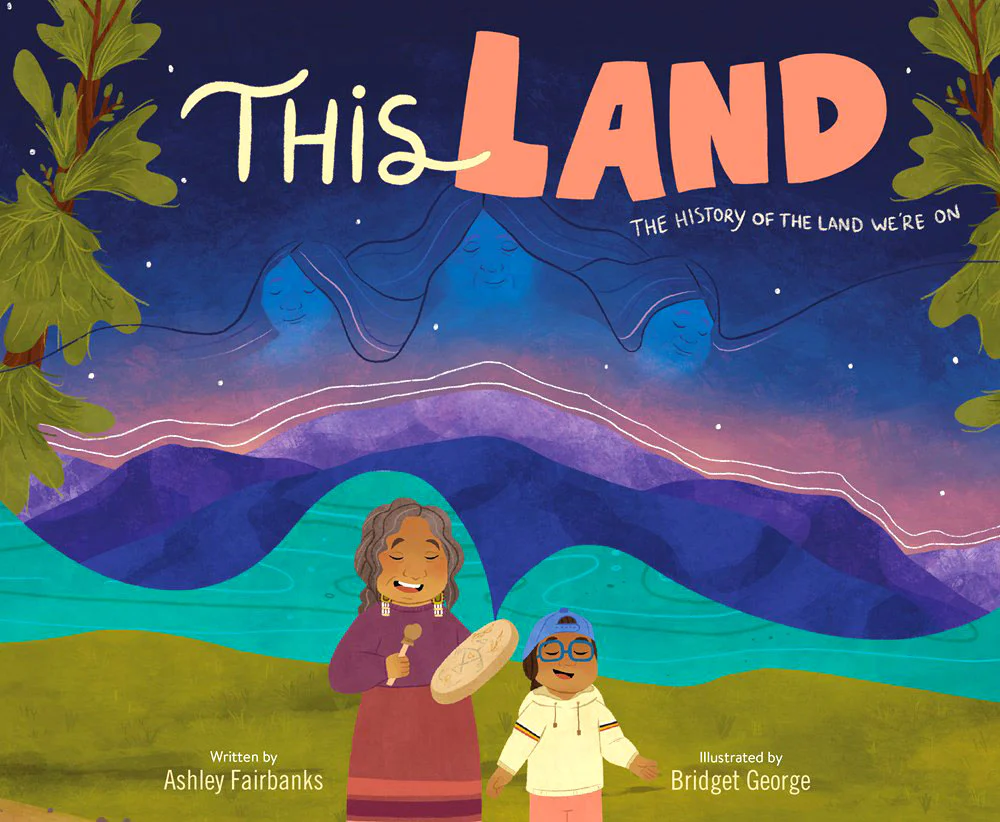
This Land: A History of the Land We’re On by Ashley Fairbanks, illustrated by Bridget George (Crown Books for Young Readers, 40 pages, ages 4-8). “This is my house. I live here with my family,” the narrator begins. “Before us, another family lived here.” Other families lived there, too, but further back in time, a whole community lived on the land before they were forced off by Europeans, something that happened all across the country. The narrator has a friend who is Anishinaabe (like the author and illustrator), and he and his grandma remind the boy of the Indigenous people who once lived there: their food, their songs, and mostly, the way they considered the land to be sacred. Now, as he travels around the U.S. with his family, the boy learns about different Indigenous groups who lived in those places and remembers how they once honored the land they were on. Includes additional information about land acknowledgement, discussion questions, and ideas for learning more about local Native people.

This straightforward story reminds readers to learn about the history of the land they now call home and recall that it once belonged to people who were forced to leave their homes. I really liked how the book acknowledges those who lived on the land of well-known sites like Mount Rushmore and New York City. I read in a review that the title calls to mind the controversy around the song “This Land Is Your Land,” a song that is considered problematic by many Indigenous people. I wasn’t aware of this and was reminded once again of how much I have learned from reading books for this blog.

Picture books to share

Mr. Fox’s Game of “No!” by David LaRochelle, illustrated by Mike Wohnoutka (Candlewick, 40 pages, ages 4-8). Here’s how Mr. Fox’s game works: every time he asks a question, you have to say “no,” or you will be sent back to the beginning of the book. Ready to play? Better not say yes! Do you want a taste of Mr. Fox’s scrumptious-looking sundae? A free trip to Hawaii with a million billion dollars thrown in? If you’re still in the game, how about this: are you stronger than a baby? Are you wearing underwear? What do the letters Y-E-S spell? If you make it all the way to the end of the book, there’s a final question: have you ever read a funnier, better written, more beautifully illustrated book than this one?

I’ve just been delighting first graders by reading them David LaRochelle and Mike Wohnoutka’s book, See the Cat: Three Stories About a Dog, and I look forward to trying this one out on them. It’s such a clever idea, and just the right humor for kids. I’m not sure about going back to the beginning of the book if they make a mistake…I might just make it a game where Mr. Fox gets points for the wrong answer.

First Day, Hooray! A Book of School Day Feelings by June Sobel, illustrated by Nabila Adani (Clarion Books, 40 pages, ages 4-8). Kids run into school on their first day with “backpacks filled with school supplies, but something else hides in disguise.” What’s hiding? Big feelings, shown with colored fonts in the text and colorful creatures surrounding different kids. Whether you’re feeling happy, scared, angry, or brave, it helps to name the feeling and to take a deep breath when needed. At the end of the day, kids pack up their backpacks–and their feelings–and head home with one more emotion: hooray! Includes a note from Yale early childhood professor Craig S. Bailey about ways to use this book to help kids explore their emotions.

I’m taking this book to school with me on Monday to share with our school counselors. It’s a simple but effective exploration of different emotions children (and adults) may experience, helping them to handle them better by identifying them. The illustrations of a diverse student body and fun magical creatures associated with the different feelings will appeal to kids as well.

War

A Star Shines Through by Anna Desnitskaya (Eerdmans Books for Young Readers, 40 pages, grades 1-5). “We used to live in a big city,” the narrator begins. Her family kept a star-shaped lamp in their apartment window, which would welcome her home at night. But then war came, and she and her mother (the father disappears without explanation) flee to another country. Everything is new: the language, the food, the apartment, even her mom and her. One night, Mom brings home a package with cardboard, scissors, and glue, and together they make a cardboard star with a light inside. Putting the lamp in the window marks a turning point, and soon their new country is feeling more like home. Includes an author’s note telling how a one-week family vacation in Cyprus turned into a refugee situation when Russia invaded Ukraine.

The author packs a big punch with just a few words on the beautifully illustrated pages of this book. It felt a little optimistic that making a lamp would turn things around so quickly, especially with the loss of the father, whether he was killed or had to stay behind. But the story offers hope to kids forced to move due to wars and other difficulties that make them and their families refugees.

The Night War by Kimberly Brubaker Bradley (Dial Books, 288 pages, grades 4-7). When there’s a roundup of Jews living in Paris, Miriam (Miri) is captured and separated from her parents. A neighbor helps her escape, on the condition the Miri take the woman’s two-year-old daughter Nora with her. Helped by a nun, Miri and Nora are sent to a town near Tours, where an old castle stands on the border of occupied France and Vichy France. En route to the town, Miriam falls asleep and awakens to find that Nora has been taken away and sent to live with another family. Miri is placed in a convent school, joining the nuns and a few students who have stayed for the summer, and is renamed Marie to hide her Jewish identity. While there, she gets involved in a secret operation to help escaping Jews cross the border, aided by a mysterious old woman who turns out to be the ghost of former castle owner Catherine de Medici. Miriam/Marie’s last mission is to save herself and Nora, which she is able to do with the help of the friends she has made at the convent, in an exciting and daring escape. Includes a lengthy author’s note with additional historical information.

I’m on a mission to read some of the Newbery contenders, so I finally got around to this one, written by the author of some of my favorite World War II historical fiction books, The War That Saved My Life and its sequel. While it’s currently at number 3 on the Goodreads Newbery list, I confess I did not much care for it. I’m sure the circumstances of 1942 France made kids grow up fast, but Miri and her friend Beatrice were way too wise beyond their years. Their other friend Jacqueline seemed to exist mostly to show how oblivious many French people were to the suffering of their Jewish neighbors. I had kind of mixed feelings about the ghost plot twist; it was cool in some ways and made for an interesting subplot, but also felt somewhat jarring. Finally, the epilogue wrapped things up WAY too neatly for a book about the Holocaust. This book has gotten glowing reviews, though, and the history is super interesting, so take a look for yourself!

Dealing with middle school

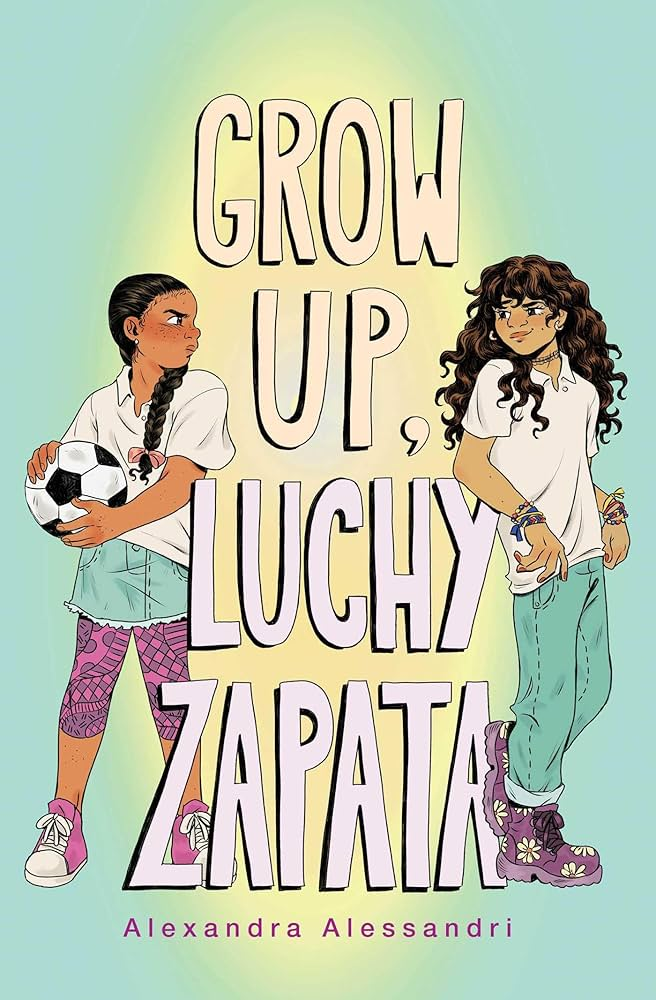
Grow Up, Luchy Zapata by Alexandra Alessandri (Atheneum Books for Young Readers, 256 pages, grades 4-7). Luchy’s excited to be starting middle school, joined by her two best friends, Mateo and Cami. Cami and Luchy are both Colombian American, and they’ve been friends since their moms met years before, but they’ve never gone to the same school. Middle school brings changes, though, and Cami, who spent the summer in Colombia, starts acting cool toward Luchy and Mateo. Luchy attempts to figure out what’s happening, first by making Cami a fancy scrapbook to remind her of their long friendship, and, when that doesn’t work, declaring war on Cami and her new friend Melissa. One act of revenge leads to another until Luchy finally does something that jeopardizes her place on the soccer team, something she’s worked hard for all fall. Even though Mateo and Luchy’s parents keep encouraging her to try talking to Cami, it takes a near catastrophe for the two girls to finally sit down and communicate about what’s been going on.

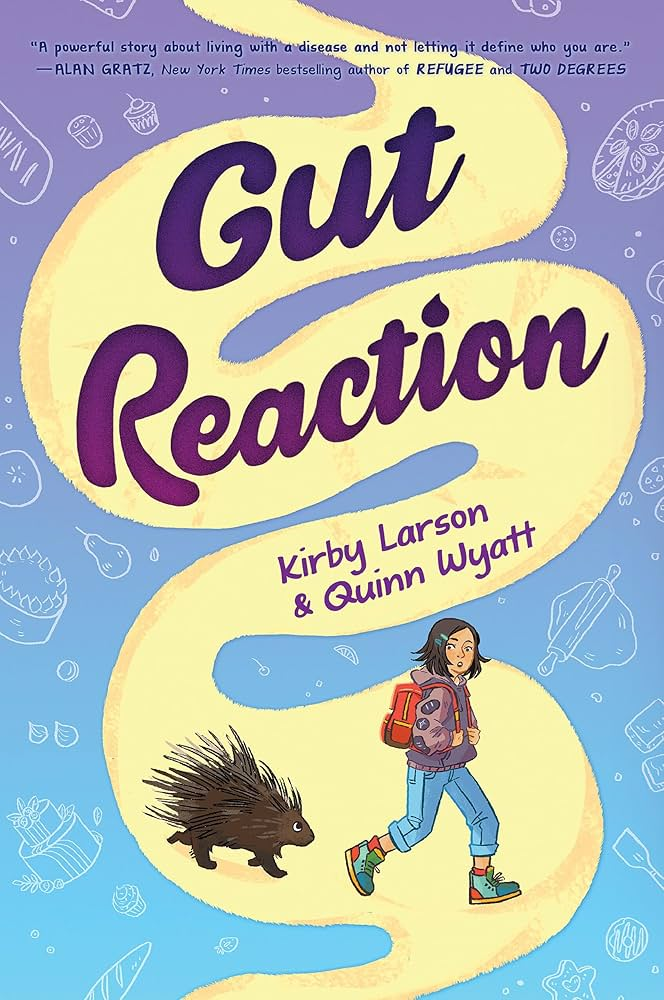
Gut Reaction by Kirby Larson and Quinn Wyatt (Scholastic Press, 272 pages, grades 4-7). Tess is starting eighth grade at a new middle school, where, after a bit of a rocky start, she finds some good friends. They support her dream of competing in the Jubilee Flour Junior Baker contest, something Tess knows her late father, a baker who taught her everything she knows, would also support. But Tess is experiencing increasingly debilitating stomach issues, and a painful episode at school lands her in the hospital. She’s devastated to get a diagnosis of Crohn’s disease and to learn that the symptoms can only be managed, not cured. Her friends help her get back on track, and she’s able to compete in the baking contest, where an unfortunate turn of events forces Tess to have to make a difficult decision.

Both of these realistic middle school books feature engaging protagonists and realistic issues. Gut Reaction is written by a mother-daughter team who drew on their real-life experience with Crohn’s disease to write sympathetically about Tess’s symptoms, diagnosis, and gradual acceptance of her illness. Grow Up, Luchy Zapata has many elements of middle school angst: changing friendships, a possible crush, academic and athletic struggles, and embarrassing parents. There are also some issues facing second-generation American immigrants Luchy, Camila, and Mateo (who is Chilean-American). Both books used plots that felt a little timeworn: the cooking/baking prodigy who competes in some kind of contest or reality show, and the friend who goes away the summer before middle school and comes back different and trying to fit in with the cool kids.

Election Day

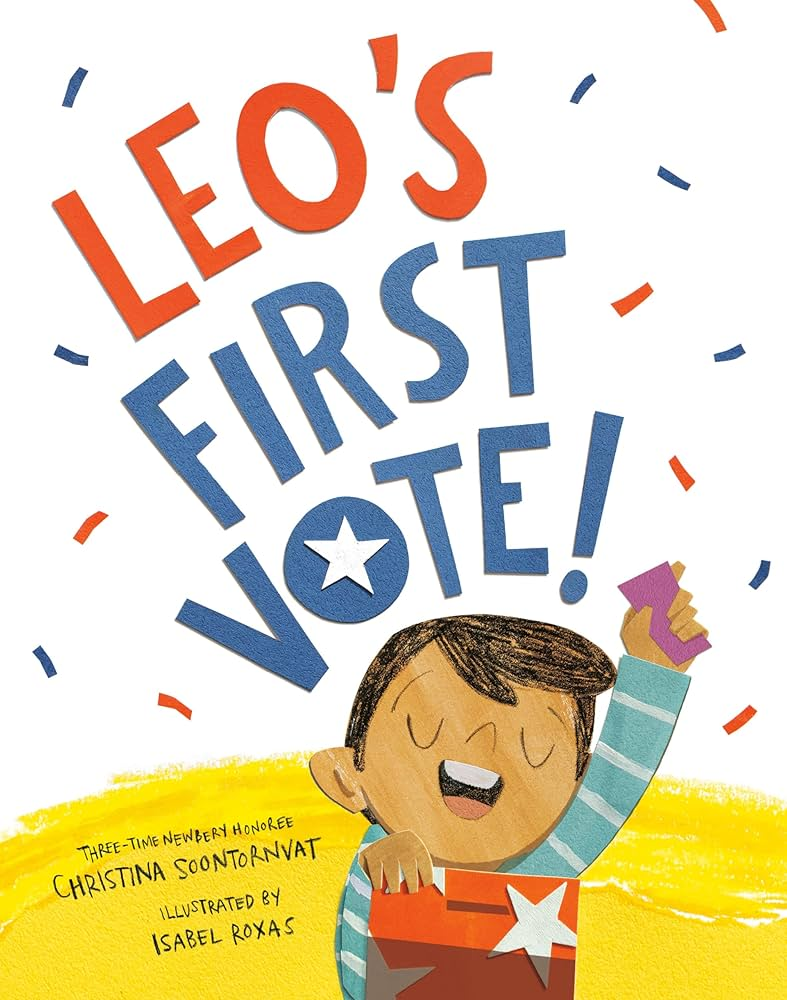
Leo’s First Vote by Christina Soontornvat, illustrated by Isabel Roxas (Knopf Books for Young Readers, 48 pages, ages 4-8). Leo’s excited that his dad has recently become a naturalized U.S. citizen, which means Dad gets to vote in the upcoming presidential election. Leo plans to go with him to the polls, but in the meantime, his class is having a mock presidential election. The kids learn about elections, and at home, Leo watches conventions and debates with his family. Everyone’s talking about the upcoming election, and when Leo hears a cousin say he’s not going to vote (“What’s the point?”), he feels deflated. But when his class’s mock election is determined by one vote, Leo finds his enthusiasm again. The last page shows Dad reading a newspaper with a headline declaring, “Historic turnout!” Also available in a Spanish language edition, ¡El primer voto de Leo!

Lots of facts about elections are woven into Leo’s story, and the excitement around voting will have kids eagerly anticipating Election Day. Personally, I am feeling so jaded about the day (Leo’s cousin really spoke to me) that I almost didn’t write this review, but good for Leo and his dad (and Christina Soontornvat) for having such enthusiasm about it.

Presidential Elections and Other Cool Facts: Understanding How Our Country Picks Its President by Syl Sobel, J.D. (Sourcebooks Explore, 5th edition, 48 pages, grades 2-5). This straightforward introduction to the presidency tells how elections work, as well as giving interesting facts about campaigns, the electoral college, First Ladies, and the order of succession should the President die or become disabled. There’s a list of all the U.S. Presidents, along with the years of their terms, and party affiliations. Includes a glossary, index, and lists of resources.

Rumor has it there’s an updated version of this book, but interlibrary loan has only been able to send me older ones, so I got to travel back to a time when Barack Obama was President, and Ronald Reagan was the oldest person to have been elected President at age 73. It’s a good introduction to the presidency and the election process, and although the writing and illustrations aren’t particularly exciting, it includes the kinds of facts and trivia kids (and adults) enjoy learning.

Ghostly graphic novels

Welcome to Scare School (Scare School Diaries, book 1) by Jarrett Lerner (Aladdin, 144 pages, grades 1-4). Bash is one nervous ghost about starting Scare School, an institution that caters to monsters. His classmates are vampires, spiders, werewolves, and even a snot monster, a creature that scares Bash more than any of the others. He’s happily surprised to find a friend in Itsy, a spider who winds up as his roommate. Classes are tough, though, and the hardest one is his Creature Intensive with grouchy Mr. Crane, where Bash has to learn the skills specific to ghosts. If he’s not proficient by the end of the first two weeks, he’ll get sent home. With the help of Itsy and some other surprising supporters, Bash finds a way to get through it all and is ready to take on whatever else might come his way at Scare School.

Written in a diary format with lots of illustrations, this very unscary book will appeal to kids moving into longer chapter books. Despite being a ghost with some pretty unconventional classmates, Bash has experiences at school that kids will relate to. I’m happy this is billed as book 1, and I hope we won’t have long to wait for a sequel. Scare factor: Too small to detect.

The Night Librarian by Christopher Lincoln (Dial Books, 256 pages, grades 4-8). Twins Page and Turner Reed are alone a lot, with parents who travel all over the world and a nanny who likes to take a lot of time off. With not much better to do, they decide to go to the New York Public Library one day to find out how much their father’s rare copy of Dracula is worth. When the book goes missing at the library, they’re plunged into a wild series of adventures, guided by Night Librarian Ms. Literati, who shows them how fictional characters can be released from their books. Aided by Wonderland’s Alice, Jim Hawkins, Jack of beanstalk fame, and Tinkerbell, the team sets off on a mission to rescue the library from some of the evil characters who have managed to escape from their books. The final scene results in chaos and the destruction of the library…until H. G. Wells’s time machine turns things back again.

While not exactly scary, the black and purple palette of the nighttime library conjures up spookiness, offset by the fun adventures and opportunities to meet literary characters. Younger readers might need a little help straightening out who’s who, but the nonstop action, humor, and fun characters will appeal to kids right through middle school. Oldsters like myself will be inspired to learn that author Christopher Lincoln is publishing his debut graphic novel at the age of 71. Scare factor: Pretty low, mostly just a spooky atmosphere.

Read At Your Own Risk by Remy Lai (Henry Holt and Co., 160 pages, grades 3-6. Hannah recounts in a journal the story of how she has been cursed. It started when she and her friends went up to the school’s attic and played a Ouija board-like game to try to summon up spirits. Hannah tried to trick them, and as a result, it seems as though she’s been cursed. At first, there are small signs, like being pushed by invisible hands and skinning her knees, but soon things get more gory: a gash in her forehead, a tooth that mysteriously falls out, silverfish crawling through her gums and coming out of the gash. School rumor has it that she has eight days to break the curse–or else. By day eight, it seems as though everything is in a downward spiral, but there may be one last hope….

Wow, Remy Lai sure has changed since she created the cute and charming Pawcasso! Although there’s some humor and maybe even a little macabre charm, this story is a genuine horror tale. It’s a pretty quick read, thank goodness, because you won’t want to put it down! Kids who are looking for scary stories will be flocking to this one, for sure. Scare factor: Considerable.

Women’s history book list

Statue from the Women’s Rights National Historic Park

I took a final weekend trip this summer to Seneca Falls, New York, where I visited the National Women’s Hall of Fame and the Women’s Rights National Historic Park. I thought about heading up to Rochester to visit the Susan B. Anthony Museum, but I was kind of running out of steam from all my driving this summer, and I didn’t make it, although I did stop at the Susan B. Anthony Birthplace in Pittsfield, Massachusetts on my way to New York.

Recent inductees at the Women’s Hall of fame

Seneca Falls is an excellent fall trip to make this election season to learn about the struggle women went through for the right to vote. It’s amazing to contemplate the fact that it took 72 years from the 1848 Seneca Falls Convention that kicked off the women’s suffrage movement to the passage of the 19th amendment that finally gave (white) U.S. women the right to vote. I guess this could be seen as discouraging or a lesson in persistent activism.

To commemorate this trip, I’ve put together a women’s history book list. You can click on the link, or find it on my blog under Book Lists.

Some suggestions for the first weeks of school

Sometimes We Fall by Randall de Sève, illustrated by Kate Gardiner (Random House Studio, 40 pages, ages 3-8). A young bear looks worriedly at his mother enjoying plums up in a tree. “What if I try and I miss?” asks the cub as he contemplates leaping. “Sometimes we try and we miss. It’s okay,” his mother reassures him. This pattern repeats as the cub starts climbing the tree, voicing his anxieties, which are soothed by his mother. Finally, he crawls out onto a branch for the plum, the branch breaks, and the worst happens: he falls. But it really is okay, because the plum falls too, and one taste is enough to motivate the cub to try again. An excellent lesson for preschoolers or kindergarteners about persevering. The mother is a good model for letting her child try and fail and try again, and as a bonus, both bears are adorable.

We Are Definitely Human by X. Fang (Tundra Books, 48 pages, ages 4-8). When something crashes outside Mr. and Mrs. Li’s house one night, Mr. Li investigates and finds three strange creatures. “We are DEFINITELY human,” they tell him, despite evidence to the contrary. Mr. Li is a kind human, and he gives the creatures a place to sleep and a promise that he’ll help them repair their vehicle in the morning. When morning comes, the Lis take the visitors into town, where other kind humans help them get what they need. Before long, there’s a party at the Lis’ house, and Mr. and Mrs. Li explain about food and dancing to the creatures. Finally, the “car” is fixed, and the creatures head off to space. “But wherever they went, they would remember kind humans and do what kind humans do–offer help to those in need.” A fun way to start classroom discussions about kindness and community while keeping things light. For an out-of-this-world theme, you could follow up with reading Dalmartian and/or The First Week of School.

Round and Round the Year We Go by Carter Higgins (Neal Porter Books, 48 pages, ages 4-8). Rhyming text and collage illustrations take readers month by month through the year. Pages inserted after February, May, August, and November introduce the change of seasons (with the name of the season in a bold font) with a simple rhyme, “rainy waiting/shady spring/round and round the year we swing.” A final two page spread summarizes the year: “some things change/and some do not/let’s play with all the time we’ve got/summer, spring, and winter, fall/round and round for one and all.” Reminiscent of an Eric Carle book, but with catchier text, using collage illustrations to introduce a concept. Although it’s the calendar year and not the school year, this would be a nice book to share with kindergarteners or first graders in the early days of school.

I’m Sorry You Got Mad by Kyle Lukoff, illustrated by Julie Kwon (Dial Books, 32 pages, ages 4-8). The title of the book is also Jack’s first attempt at a note apologizing to Zoe for knocking over her block castle. Made up entirely of the drafts Jack writes with his teacher’s coaching, the story traces Jack’s gradual movement from an angry “I’m sorry,” to a more nuanced explanation of his behavior (a couple of other boys told him castles were for girls, so he didn’t get to help Zoe build hers). A few pages from the end, Jack finally gets his apology right and hands the note to Zoe. Zoe responds with one of her own, and by the last page, the two friends are working on a new castle together. Perfect for starting discussions about what makes a real apology, the letters and illustrations also capture the kids’ emotions and show how a teacher can make a difference in helping them sort out and express their feelings.

Graphic novels that root for the underdogs

We Are Big Time by Hena Khan, illustrated by Safiya Zerrougui (Knopf Books for Young Readers, 240 pages, grades 3-7). Aliya’s not happy that her family is moving from Tampa to Milwaukee just as she’s about to start high school. Although it’s nice to be close to her grandparents, she misses the Florida weather and her basketball friends. Her new Islamic school has a girls’ basketball team, but they’re not very good. A new coach arrives at the school at the same time Aliya does, and before long the girls are working harder than ever on their conditioning and teamwork. Slowly, huge losses turn into smaller losses, then wins. As the team improves, they start attracting some media attention, which more often than not focuses more on their clothing and religion than on their basketball playing. The girls learn to navigate all kinds of new situations as they slowly build a winning season and make their way to the big end-of-the-year tournament. When the season finally comes to an end, the team and their families have plenty to celebrate. Include’s an author’s note about the real-life team that inspired this book and a behind-the-scenes look at the development of some of the artwork.

This is sure to be a big hit with fans of Raina Telgemeier-inspired graphic novels. The story reminded me a little bit of Hoops, with its team of scrappy underdogs breaking barriers for girls’ sports. Their turnaround from huge losses to wins seemed to happen very quickly, reminding me of the storytelling limitations of graphic novels.

Lion Dancers by Cai Tse (Simon and Schuster Books for Young Readers, 304 pages, grades 4-7). Wei is trying to find his place in middle school, but despite academic success, he hasn’t found a place where he feels he belongs. When he literally runs into a teenager wearing a lion dance t-shirt, Wei begs him for a chance to join his team. Wei’s late father was a championship lion dancer, and Wei danced a few years back, but he quit when he had some conflicts with another boy named Hung. Hung is part of the new team as well, and Wei struggles to work with him. When Lunar New Year comes around, the team is booked solid with performances all over the city, and everyone has to pitch in to make things work. When Wei and Hung’s rivalry gets in the way of one of their dances, it threatens everything the team has worked for. Wei has to decide if he’s going to work through his problems to continue with the dance form he loves or once again walk away from it.

I struggled a little at the beginning trying to keep the various characters straight and get up to speed with lion dancing, but once I figured things out, I very much enjoyed learning more about the dance and seeing how all the interpersonal drama played out. After reading this and Lunar New Year Love Story, I am ready to attend my first lion dance performance.

A pair of award contenders

Barrio Rising: The Protest That Built Chicano Park by María Dolores Águila, illustrated by Magdalena Mora (Dial Books, 40 pages, grades 1-4). The narrator lives in a neighborhood called Barrio Logan, one of San Diego’s oldest Chicano neighborhoods, where residents have been looking forward to finally getting the park they’ve been promised for years. When they find out that the new construction being done is for a police station, they’ve had enough. Neighbors band together to take over the land and protest, despite orders from the police to disperse. For twelve days, the crowd grows, drawing protesters from nearby barrios. Finally, the city council holds a meeting, led by Leon Williams, San Diego’s first Black councilman, and announces they’ve changed the plan from a police station to a park. Everyone celebrates and pitches in to create Chicano Park. Includes additional information about the park, which is now a National Historic Landmark. Also available in a Spanish language edition, El barrio se levanta: La protesta que construyó el Parque Chicano.

Keep this book in mind when Hispanic Heritage kicks off on September 15. The story about this 1970 event is inspiring, and the illustrations juxtapose birds, butterflies, and purple flowers with the gritty urban setting. I’d love to see it get some Belpré Award recognition for either the story or the illustrations.

Before the Ships: The Birth of Black Excellence by Maisha Oso, illustrated by Candice Bradley (Orchard Books, 40 pages, grades K-5). Instead of starting with the slave trade, as is often the case with Black history in America, this book begins “before the ships” when civilizations flourished across Africa. There were kings and queens, doctors, scribes, artisans, and merchants. Impressive buildings were created, as were stories and music, while scientists and mathematicians studied the world. A wordless page showing a slave ship sailing through the darkness divides the book between the past and the present, “after the ships.” The descendants of those Africans now live different lives, but they are still warriors, scholars, and leaders, or, as the final page says, “We are the light.” Includes an author’s note telling how her time in Africa showed her the cultures of Ethiopia, South Africa, Kenya, and Nigeria.

I’ll be surprised if this doesn’t get a Coretta Scott King award or honor. I love the focus, all too rare, on the civilizations that existed before African people were captured and sold into slavery, and I will definitely be sharing this book with teachers at my school. I would have enjoyed even more back matter, including a map or two.