When the Stars Came Home by Brittany Luby, illustrated by Natasha Donovan

Published by Little, Brown Books for Young Readers

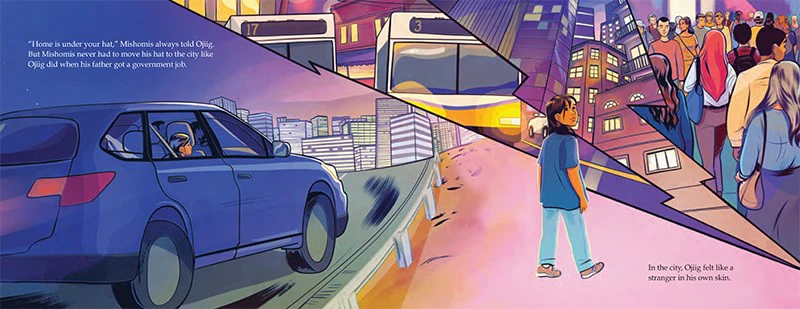
Summary: When Ojiig’s father gets a government job, the family moves to the city. Ojiig misses fishing and picking blueberries, having friendly neighbors, his grandparents Mishomis and Kookum, and seeing the stars at night. His parents buy him glow-in-the-dark stars for his ceiling and a star nightlight, but it’s not the same. One day, Ojiig wakes up to discover that his mother is making him a quilt. With each piece she sews, she tells him a story of one of his ancestors. Finally, she’s done, and Ojiig realizes that the quilt has a giant star design. He’s happily wrapping it around himself when Mishomis and Kookum knock on the door. As he joyfully greets them, he realizes that “Home is where you learn who came before you. Home is where you discover who you are. Home is where you imagine who you might become.” Includes additional information about the author’s Anishinaabeg heritage and quilt making, and a pronunciation guide. 40 pages; ages 4-8. 

Pros: A touching story about discovering what makes home, with indigenous stories and history woven into the contemporary text.

Cons: The back matter was printed on the endpapers.

Facing the Mountain: A True Story of Japanese American Heroes in World War II by Daniel James Brown (adapted for young readers)

Published by Viking Books for Young Readers

Summary:  Even before the Japanese bombed Pearl Harbor, Japanese Americans faced daily racism, but afterward, things got much worse, as families were rounded up and sent to concentration camps.  This story profiles four young Nisei (those with Japanese ancestry born in America) who fought back in different ways.  Rudy Tokiwa, Fred Shiosaki, and Kata Miho volunteered for the 442nd, a regiment made up entirely of Japanese American men, while Gordon Hirabayashi, a Quaker and conscientious objector, served jail time for refusing to be deported to an internment camp.  The story follows the four young men from December 7, 1941 until shortly after the bombings of Hiroshima and Nagasaki and the end of World War II.  Includes additional resources, notes, a bibliography, and an index.  240 pages; grades 6-9.

Pros:  A fascinating history that shows the courage of so many Japanese Americans during World War II, particularly the young men who were determined to show their loyalty to the United States, even after losing their homes and being sent to internment camps. The 442nd became known as one of the toughest, bravest regiments to fight in Europe. 

Cons:  I loved Gordon Hirabayashi’s story and was disappointed that it kind of fizzled out once the battle action began about halfway through the book.

Two last graphic novels of 2023

Grace Needs Space by Benjamin A. Wilgus and Rii Abrego

Published by Random House Graphic

A Sky of Paper Stars by Susie Yi

Published by Roaring Brook Press

Summary: These graphic novels tell the stories of two very different girls who are both grappling with family issues. Grace lives on a space station with her divorced mom; her other mom, Ba, is a cargo ship captain traveling from one space settlement to the next. Grace is excited to be going on a trip to Titan (Saturn’s moon) with Ba, but she ends up bored and disappointed when Ba is busy with work most of the time. Desperate to see Titan’s sea, Kraken Mare, she sneaks into a group field trip and almost gets herself into serious trouble. When Ba starts having engine trouble on the way back, she has trouble trusting Grace to help her, but Grace (and Mom) manage to save the day, while Ba sees that her own workaholic nature and unwillingness to ask for help have led to some issues with her family. Includes extra artwork showing the development of the characters and the cover. 208 pages; grades 4-7.

In A Sky of Paper Stars, Yuna feels like she’ll never fit in at school. Her parents cling to Korean traditions, while Yuna wants to be more American. After folding 1,000 paper stars the way her grandmother, Halmoni, taught her, she makes a wish to live in Korea, where she feels like she’ll belong. Almost immediately, her mother gets news that Halmoni has passed away, and the family returns to Korea for the funeral. Feeling like she caused her grandmother’s death, Yuna races to fold another 1,000 stars, hoping to bring Halmoni back to life. Includes an author’s note about her experiences that influenced the story and instructions for folding a paper star. 240 pages; grades 4-7.

Pros: Fans of middle school graphic novels will enjoy both of these stories, each featuring a unique setting that emphasizes the commonality of each girl’s emotions and experiences.

Cons: I’m pretty sure I couldn’t fold one paper star, let alone a thousand.

Butt or Face? By Kari Lavelle

Published by Sourcebooks

Summary:  This guessing game style book shows a close-up photo of part of an animal, asking the reader: is it the animal’s butt or face?  Turn the page to find out the answer, see a full photograph of the animal, and learn some interesting facts and where in the world it lives.  The author’s note tells how she was inspired by an article she read about farmers in Botswana who painted eyes on the rear ends of their cattle to scare away predators.  Includes a map showing where each animal lives and a chart telling where each one rests its butt and what food goes in its face.  40 pages; grades K-3.

Pros:  I wasn’t sure how this book would be received by exhausted teachers the week before vacation, but so far, they have enjoyed it as much as the kids–which is a lot.  It’s an amazing introduction to animal adaptations.  Look for book 2 in the spring.

Cons:  The photos are pretty hard to figure out, and many of the animals aren’t well known.

Two books about the immigration experience

Salma Makes a Home by Danny Ramadan, illustrated by Anna Bron

Published by Annick Press

Mina Belongs Here by Sandra Niebuhr-Siebert, illustrated by Lars Baus

Published by Floris Books

Summary: Two girls navigate their new homes after moving from a different country. Readers may know Salma from her picture book, Salma the Syrian Chef. She and her mom have settled into a new apartment in Vancouver, and when the story opens, her dad is on his way to join them. Although she’s thrilled to have Baby back with the family, Salma worries that he won’t like Canada and will go back to Syria. Some heartfelt conversations resolve the issue, and Salma learns that it’s possible to have two homes–the one where you live and the one you remember in your heart. Includes directions for making lanterns like the ones Salma and her mom create in the story. Book 2, Salma Writes a Book, is also available. 120 pages; grades 1-4.

Mina is scared to start kindergarten, even though her mother assures her that she’ll have fun and that the people will be kind. This turns out to be the case, as her teacher warmly greets her the first day, and Mina makes a friend. Each night, she dreams about her experiences, and each day school gets a little easier. The illustrations slowly change from gray to full color, as Mina learns English and becomes a member of the kindergarten community. When a new boy is introduced to the class, Mina is the first to greet him and invite him to play. 40 pages; ages 4-8.

Pros: Both books show resilient main characters who successfully deal with the difficulties of moving to a new country and learning a new language, serving as excellent mirrors for those going through the same challenges and windows for kids who may be welcoming new students to their classes.

Cons: Neither book had quite the light touch of Young Vo’s Gibberish, which is still my favorite on this topic.

Unseen Jungle by Eleanor Spicer Rice, illustrated by Rob Wilson

Published by MIT Kids Press

Summary: After an introduction to different types of microbes, the author looks at different places where these tiny creatures live. There are four parts: house, yard, food, and you, with several section in each. Whether it’s your pet, your bed, or your own body, it’s pretty much impossible to escape the microbes that are everywhere. Fortunately, most are benign or even beneficial to humans, but the ones that take over various creatures, turning their hosts into zombies, are pretty horrifying. In between the descriptions are interviews with scientists whose passion is learning more about the tiny creatures all around us. Includes a few pages at the end with some additional information and resources, as well as directions on how to draw E. coli; also an extensive bibliography. 176 pages; grades 3-6.

Pros: The lighthearted tone and funny illustrations make this a pretty entertaining reading, and kids will no doubt enjoy grossing out their peers, parents, and teachers with the information they learn here. The scientist profiles are a nice addition.

Cons: I may be in the minority here, but I felt like the section on microbes that live on humans was a bit too short. I want to know what I’m up against.

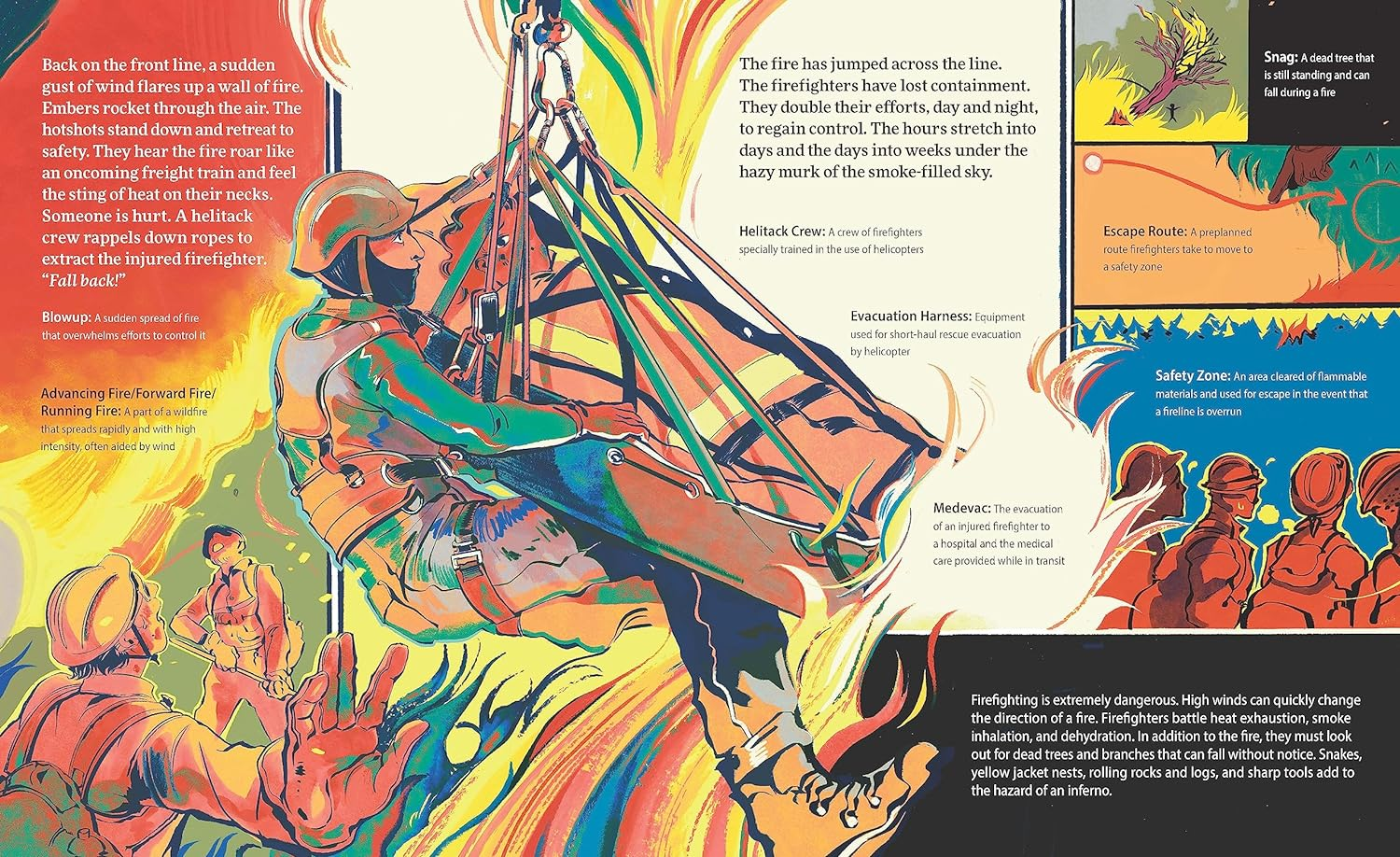
They Hold the Line: Wildfires, Wildlands, and the Firefighters Who Brave Them by Dan Paley, illustrated by Molly Mendoza

Published by Chronicle Books

Summary: When a fire lookout spots smoke coming from the forest following a lightning strike, firefighters spring into action, digging a fireline to try to keep the fire from spreading. When the fire jumps the line, more strategies are needed, including fighting the fire from airplanes and helicopters. As people are evacuated and animals flee, other workers have jobs setting up camps for the evacuees and the firefighters. Even after the fire has been contained there is still work to be done, extinguishing burning material. Finally, the exhausted firefighters get a well-earned rest, but soon they are back on call awaiting the next fire. Includes additional information on fire ecology, describing old and new approaches, and facts about firefighters with labeled diagrams of their protective gear and supplies. 44 pages; grades 2-5.

Pros: This is a fascinating and timely look at many aspects of wildfires and the people who fight them. Each page has several sidebars with definitions of all kinds of terms used by firefighters. The art resembles old WPA posters, an appropriate style for the topic.

Cons: Some additional resources would have been nice.

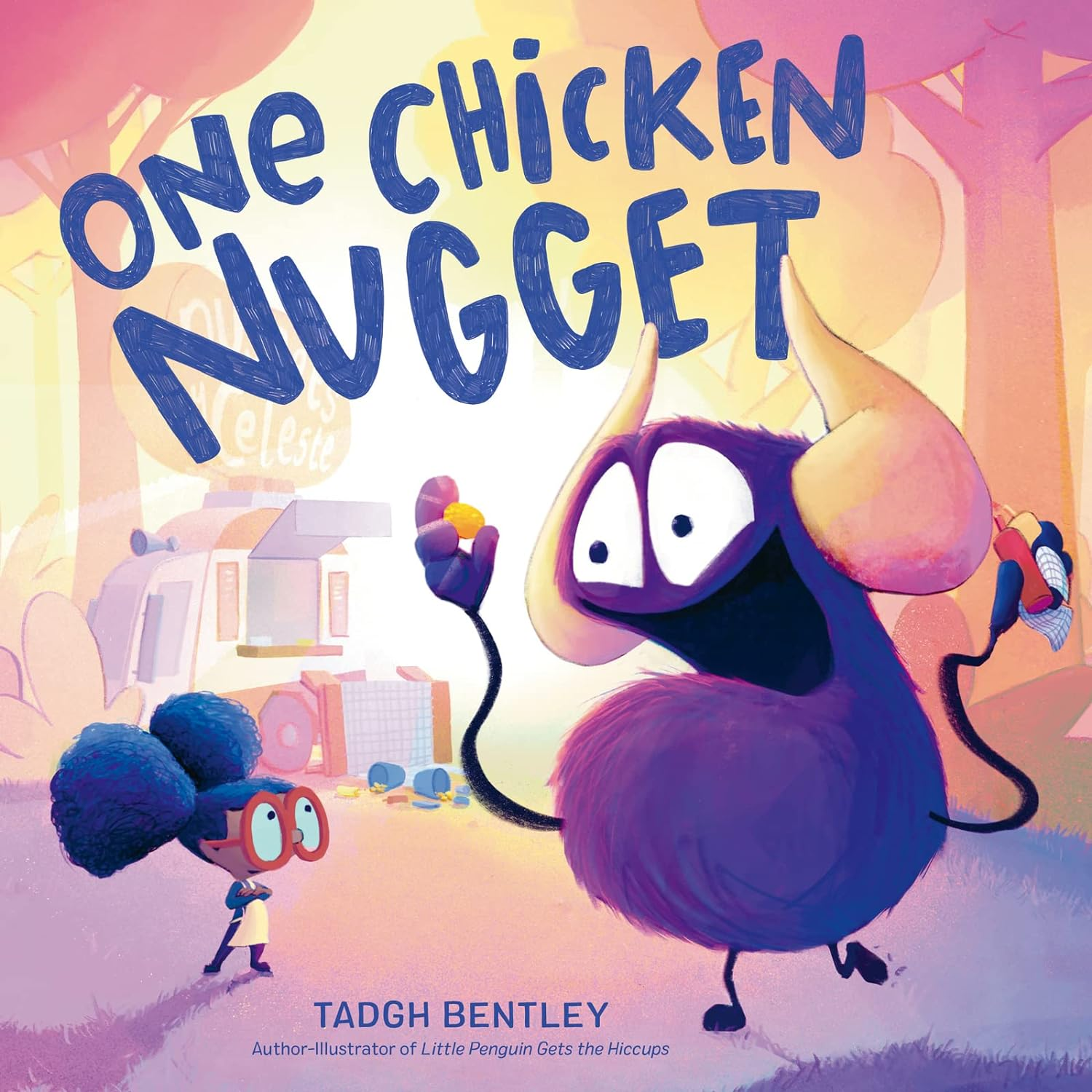
One Chicken Nugget by Tadgh Bentley

Published by Balzer + Bray

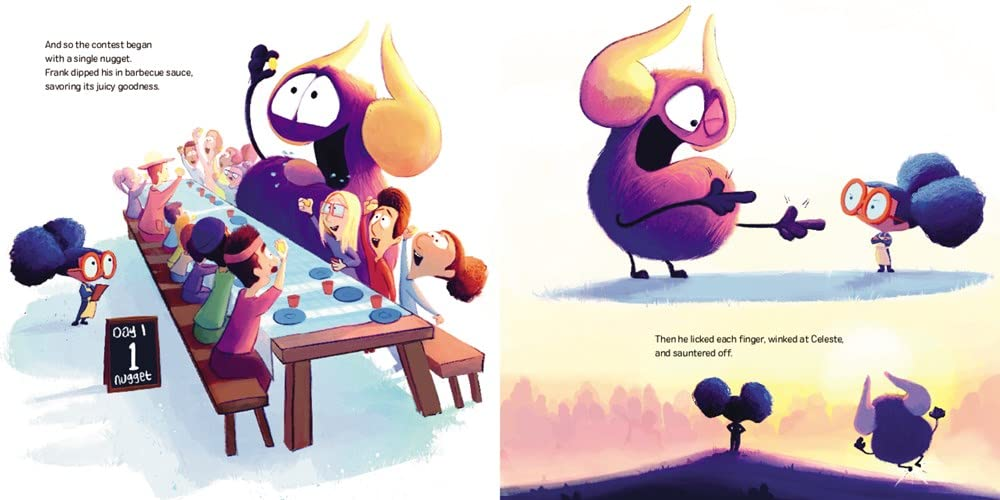
Summary: Frank is a monster with a passion for chicken nuggets, especially the ones Celeste sells on her food truck. Since Frank isn’t exactly an ideal customer (scares away other customers, doesn’t pay, terrible table manners), Celeste is desperate for a way to get rid of him. Some library research gives her an idea: the 30-Day Double Nugget Challenge. Each day the number of nuggets offered will doubled, and anyone who can eat them all wins free chicken nuggets for life. Seems easy enough on the first few days but by day 14 (8,192 nuggets), Frank is the only customer left. On day 30, he starts in on the pile of 536,870,912 nuggets and makes it all the way to the final one, and then…. Includes an author’s note and additional information on exponential growth. 40 pages; grades K-3.

Pros: Similar stories have been told for ages (as the author acknowledges in his note), but this is a particularly fun one with humorous monster illustrations that really bring home the concept of exponential growth.

Cons: The interesting endnotes were printed on the back cover, where the taped-down dust jacket obscured approximately one-sixth of them.

Creep, Leap, Crunch! A Food Chain Story by Jody Jensen Shaffer, illustrated by Christopher Silas Neal

Published by Knopf Books for Young Readers

Summary:  For the first part of this book, the rhyming text builds like The House That Jack Built, with the sun shining down on a cricket munching grass that’s eaten by a mouse, who’s swallowed by a snake, which is scooped up by a hawk, who gets trapped by a fox that gets chased by a bear.  But on some days things are different, and the story takes a twist as each animal escapes its predator, leaving the bear to munch on “flowers and seeds…all that she needs.”  Includes an illustrated glossary that gives more information about each of the animals.  48 pages; ages 4-8.

Pros:  A fun and clever introduction to food chains, with the second version of the story perhaps makes the case for vegetarianism.  

Cons:  Some of the main characters meet a gory end in the first version.

Mehndi Boy by Zain Bandali, illustrated by Jani Balakumar

Published by Annick Press

Summary:  Tehzeeb loves art and fashion, so it seems like a natural fit when he learns how to do mehndi.  He practices on friends and family members and begins to get a reputation for his henna art.  His favorite uncle, Ayaz, is also an artist and has encouraged Tehzeeb’s creativity.  Tehzeeb is crushed when Ayaz Uncle expresses disapproval over his mehndi, telling him that it’s not an appropriate art form for boys.  Reluctantly, Tehzeeb stops doing mehndi until the day before his cousin’s wedding, when he and the bridal party get stuck in traffic.  Tehzeeb ends up saving the day, and Ayaz Uncle has to rethink his gender stereotypes.  Includes a glossary, additional information about mehndi and henna, and directions for drawing a paisley.  100 pages; grades 2-4.

Pros:  Tehzeeb is a great character who learns how to be true to himself, and it was refreshing to see Ayaz Uncle change his ideas and admit to his nephew that he was wrong. The story and the colorful illustrations make this an ideal book for early chapter book readers.

Cons:  I would have liked to know more about the history of this Muslim family with roots in India living in Tanzania.