Nadia: The Girl Who Couldn’t Sit Still by Karlin Gray, illustrated by Christine Davenier

Published by Houghton Mifflin Harcourt


Summary: Readers of a certain age will remember Romanian gymnast Nadia Comaneci,  one of the stars of the 1976 Summer Olympics. This picture book looks at Nadia’s life leading up to those Olympic performances. From an early age, Nadia was a daredevil, and her high energy level led her parents to enroll her in gymnastics. She was spotted by now-legendary coach Bela Karolyi who recruited Nadia to join the new gymnastics school he had opened with his wife Marta. Motivated by a disappointing performance at her first National Junior Championship, Nadia worked hard for many hours a day to make it to the Montreal Olympics when she was only 14. There she became the first female gymnast to earn a perfect 10…and went on to earn six more! The book ends there, but an afterword and timeline give more information about Nadia’s performance in the 1980 Olympics and her defection from Romania in 1989. 40 pages; Grades K-4.

Pros: An inspiring story of an amazing athlete, perfect for summer reading during this year’s Olympics. Nadia always seemed to me to be more serious than her predecessor Olga Korbut, but she comes across as ebullient and energetic in the illustrations here.

Cons: Because of the brevity of the story, making it to the Olympics comes across as about as difficult as snagging a spot on the high school gymnastics team.

The Hole Story of the Doughnut by Pat Miller, illustrated by Vincent X. Kirsch

Published by Houghton Mifflin Harcourt 

Summary:  Hanson Gregory left his family’s farm for a life at sea in 1844 at the age of 13.  He quickly rose from cook’s assistant to become captain of a clipper ship.  By all accounts, he became an excellent commander, even receiving a medal for heroism from the queen of Spain after rescuing seven Spanish sailors.  But what Hanson Gregory is remembered for today is inventing the doughnut.  As cook’s assistant, he was charged with making breakfast cakes of fried dough.  Because the centers of these cakes remained raw and heavy, they were called sinkers.  One day Gregory had the brilliant idea to cut out the centers with the top of the pepper shaker.  The rest is baking history.  Over the years, legends arose about the genesis of the doughnut, and others even claimed to have invented it, but this book lays these rumors to rest once and for all.  An author’s note gives a bit more information about Gregory.  A timeline and bibliography are also included.  32 pages; grades K-3.

Pros:  An excellent introduction to the invention of ordinary items, told with plenty of humor in both the text and the illustrations.

Cons:  Does not really address the question, Dunkin’ or Krispy Kreme?


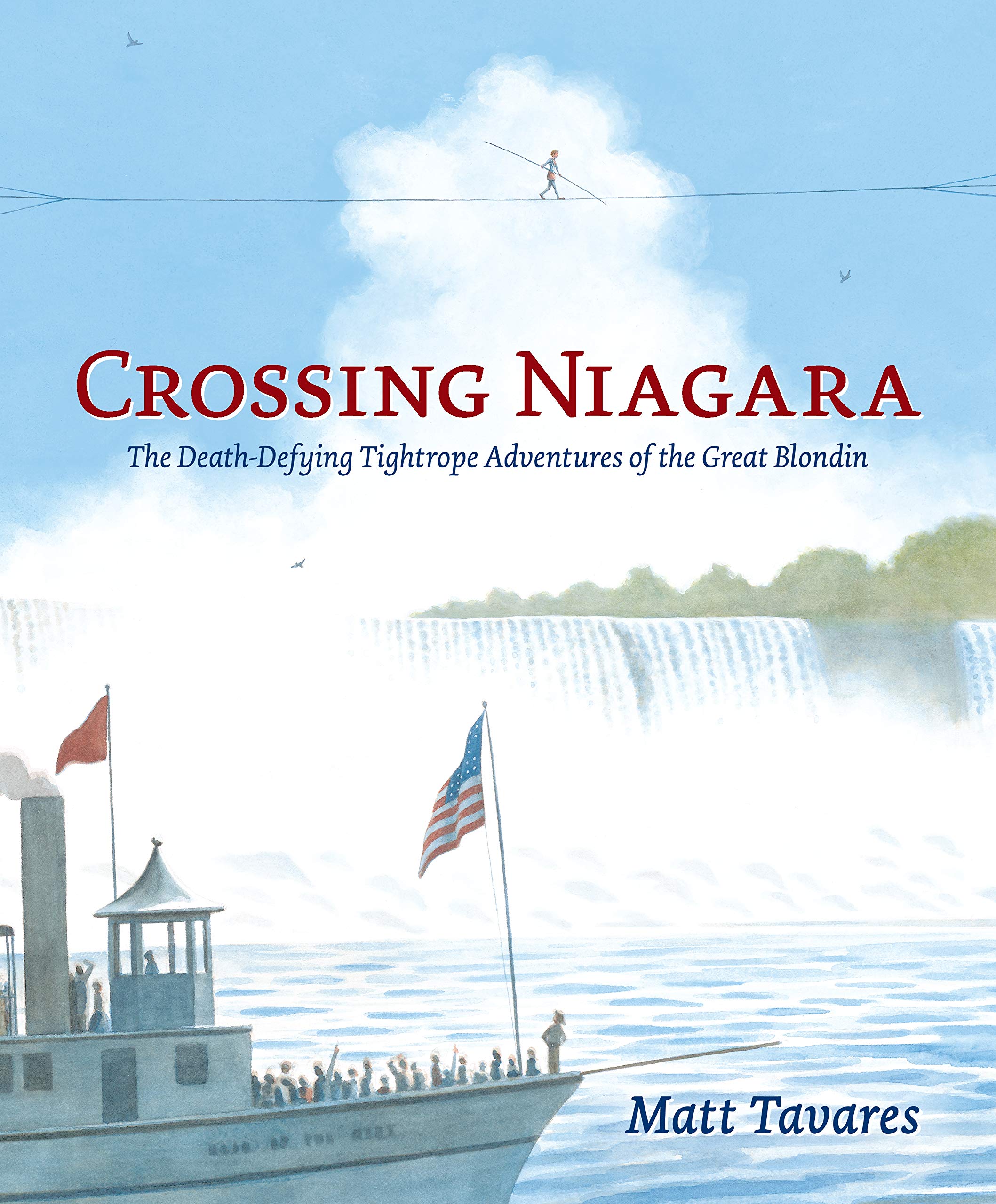
Crossing Niagara: The Death-Defying Tightrope Adventures of the Great Blondin by Matt Tavares

Published by Candlewick Press

Crossing Niagara: The Death-Defying Tightrope Adventures of the Great  Blondin: Tavares, Matt, Tavares, Matt: 9780763668235: Amazon.com: Books

Summary:  Jean Francois Gravelet, a.k.a. The Great Blondin was just five years old when he first performed on the tightrope.  Although he loved his circus career, he longed to do something even more daring.  When he first laid eyes on Niagara Falls, he knew what he wanted to do.  He set up a rope, contacted the newspapers, and on June 30, 1859, he made his first successful crossing, stopping along the way to perform a few tricks, including retrieving a bottle from the Maid of the Mist below and toasting the crowd.  He promised to return on July 4, and this time, he crossed the falls blindfolded.  Over the next two summers, he made many crossings, trying all kinds of stunts.  His ultimate challenge was carrying his manager across on his back (a trick his manager wasn’t terribly enthusiastic about).  When the crowds began to thin, The Great Blondin moved on, but he was forever remembered for his Niagara Falls crossings.  End matter includes a brief author’s note and a bibliography.  36 pages; grades 1-5.

Pros:  The storytelling and large, detailed illustrations combine to make a pulse-pounding tale of daring.

Cons:  I could have enjoyed a little more biographical detail about The Great Blondin.

Cloth Lullaby: The Woven Life of Louise Bourgeois by Amy Novesky, pictures by Isabelle Aresenault

Published by Abrams Books for Young Readers 

Summary:  Louise Bourgeois (1911-2010) spent her childhood along the banks of a river in France.  Her mother repaired tapestries, and Louise learned the art of weaving from her.  Although she studied math at the Sorbonne, Louise ultimately became an artist.  After her mother died, she made a giant sculpture of a spider, famous for its weaving, and spiders appeared in a lot of her other works.  Later in life, she gathered fabric from many different people and places in her past and created works of art with the different textiles.  She continued to create art right up until the time of her death at age 98.  End matter includes additional biographical information.  40 pages; grades 2-6.

Pros:  The illustrations are exquisite and really capture Louise’s life and art.  The text is almost poetic.

Cons:  This is not a straightforward biography, and kids may find some of the text difficult to understand.  The biographical information at the end is helpful; it may be useful to present it before reading the story.

Anything But Ordinary Addie: The True Story of Adelaide Herrmann Queen of Magic written by Mara Rockliff, illustrated by Iacopo Bruno

Published by Candlewick

Summary: Adele Scarsez never wanted to be ordinary. As a young woman she tried dancing and acrobatics, but they didn’t quite satisfy her desire to entertain and thrill audiences. Traveling to America, she met a young magician named Alexander Herrmann and asked him to marry her. He agreed, and Addie found her true calling as Adelaide Herrmann, magician. She performed as his assistant for many years. When he died, she knew she needed a way to keep the show going. Addie decided to learn the bullet-catching trick, a bit of magic so dangerous that magicians had been killed performing it. However, Addie succeeded, and her show continued for many years. An author’s note at the end tells a bit more about Addie, as well as how Mara Rockliff uncovered her story. 48 pages; grades 1-4.

Pros: The team that produced last year’s Mesmerized returns with another tour de force. The story is fascinating, and the illustrations and overall design of the book, with text in a variety of fonts woven in among the pictures, make this a visual feast.

Cons: I would have liked to have understood the bullet-catching trick while reading the story instead of having to go to the website given on the last page to get a description of what it was.

Clean Sweep! Frank Zamboni’s Ice Machine by Monica Kulling, illustrated by Renne Benoit

Published by Tundra Books


Summary:  Anyone who’s ever gone ice skating, or watched a sports event that took place on ice, has observed the giant Zamboni machine that drives around the rink and quickly resurfaces the ice.  But 70 years ago, there was no machine, and it took several men 90 minutes or more for that ice treatment.  And for Frank Zamboni, owner of the Iceland rink in California, that was too many man hours.  Fortunately, Frank was a tinkerer who knew a lot about machinery.  He had come up with an innovative way to design Iceland that resulted in smoother ice than other rinks.  Nine years passed, as Frank got busy raising a family and was shut down from working on his machine during World War II.  Many people said what he was trying to do was impossible, but he persevered.  In 1949, his machine took to the ice, and did in minutes what had previously taken over an hour.  Frank named his new machine after himself, which is good, because it’s so much fun to say “Zamboni”.  Today, Zamboni machines are on every continent…except the ice-covered continent of Antarctica.  32 pages; grades K-4.

Pros:  The story of an ordinary man who saw a problem, persevered, and succeeded in solving it.  This would be a great book to include in a unit on inventors and inventions.

Cons:  The poem at the beginning about ice skating is cute but seems sort of unnecessary.

Fearless Flyer: Ruth Law and Her Flying Machine by Heather Lang, illustrated by Raul Colon

Published by Calkins Creek


Summary:  Ruth Law loved to entertain crowds with her daredevil flying, but after four years of shows, she was ready for a new challenge.  In 1916, she decided to fly from Chicago to New York City, which would set a new American record for nonstop flight.  Although she had never flown more than 25 miles, Ruth was a mechanical whiz, and set about modifying her plane to get it ready for the journey.  She also cut a map into strips and put it on a roller.  She had to have both hands on the controls at all times, but managed to maneuver one control with her knee when she had to turn the roller and find her way.  (Kind of like those drivers who talk on their phones with one hand and hold their Slurpees in the other)  Flying in a 50-mile-per-hour late November wind, she made it as far as Haskell, NY before she ran out of gas.  That was enough for a new record, though, and the next day she landed in New York City, gliding past the Statue of Liberty before landing in the midst of a cheering crowd.  Grades 1-4.

Pros:  Heather Lang tells a fascinating story of an early aviation pioneer, with relevant quotes from Law interspersed throughout the text.  The illustrations capture the feel of flying in a primitive airplane, low enough to the ground to be able to navigate with a map.

Cons:  This is mostly the story of a single flight, not a complete biography of Ruth Law.

Miss Mary Reporting: The True Story of Sportswriter Mary Garber by Sue Macy, illustrated by C. F. Payne

Published by Simon and Schuster


Summary:  Mary Garber was considered a bit of a tomboy growing up in North Carolina.  She played tackle football on the boys’ team and loved going to football games with her father.  After college, she knew she wanted to be a reporter, but her first job on the society page didn’t exactly suit her.  During World War II, most sports writers went to war, so Mary got to fill in, a job she continued for the next forty years.  Not only did she blaze trails for women sportswriters, but she was among the first to report on African American teams and players, most famously Jackie Robinson.  If a kid tried hard, Miss Mary would report his or her achievements in a positive way, resulting in adults who sometimes thanked her for her coverage many years later.  As the author notes at the end, “Mary Garber didn’t set out to change the world, but change it she did.”  End matter includes author’s note, a timeline, and additional resources.  40 pages; grades 1-4.

Pros:  A lively biography of a little-known woman who followed her passion and opened doors for others as she went.  The slightly goofy illustrations lend a light-hearted feel to the text.

Cons:  Mary looks pretty much exactly the same in the illustrations from childhood through retirement.

Beatrix Potter & the Unfortunate Tale of a Borrowed Guinea Pig by Deborah Hopkinson, illustrated by Charlotte Voake

Published by Schwartz & Wade Books


Summary:  Told as a story letter (“My Dear Reader”) in a style similar to one Beatrix Potter used to use, this tale features a young Beatrix.  Not surprisingly, she enjoyed keeping numerous pets, and even borrowing others’ pets, mostly for the purpose of drawing and painting them.  She could be careless, though, and on one occasion, she forgot about a borrowed guinea pig, who proceeded to eat up most of her art supplies.  Unfortunately, these proved fatal for the cute little animal, and Beatrix was forced to go confess her mistake.  In an attempt at compensation, Miss Potter offered a watercolor drawing of the guinea pig, which was not received too graciously.  Although the story is about a young girl, the author’s note reveals that this incident happened when Beatrix Potter was 26 years old.

Pros:  This humorous tale includes quite a bit of historical information about Beatrix Potter’s life and how she got her start writing and illustrating her famous books.  The watercolor illustrations are clearly inspired by the Potter books.

Cons:  The whole killing the guinea pig thing is a little less of a chuckle when one finds out it was committed by a 26-year-old woman.


Nice Work, Franklin! by Suzanne Tripp Jurmain, illustrations by Larry Day

 Published by Dial Books for Young Readers 

Summary:  Some presidents have faced personal challenges, some have faced national challenges, and some, as the author describes on the first page, have faced both.  She then goes on to a light-hearted introduction to Franklin Roosevelt, and how he aspired to be like his famous cousin Theodore.  He got off to a good start—young Franklin was rich, smart, and determined.  He soon was making a name for himself in the New York legislature and as Assistant Secretary of the Navy.  But shortly after his 39th birthday, he was struck with polio and paralyzed from the waist down.  Although he never recovered use of his legs, he learned to stand with braces and went on to become NY governor, then President of the United States.  And there he was faced with a national challenge, the Great Depression.  Using the same determination that helped him overcome polio, he worked hard to improve Americans’ lives.  The book ends with Roosevelt’s second term inauguration.  An author’s note gives more information about Roosevelt’s life and some of the programs he started during the Great Depression.  32 pages; ages 6-10.

Pros: This is the third book of U.S. history by this author-illustrator team (George Did It and The Worst of Friends are their other two).  Although the subject matter is serious, both the text and the illustrations are upbeat and humorous.  While Franklin Roosevelt comes off in a positive light, there is some balance in describing why some Americans didn’t like him as President.

Cons:  The book begins when Roosevelt is a young man and ends in early 1937, so this is not a complete biography.