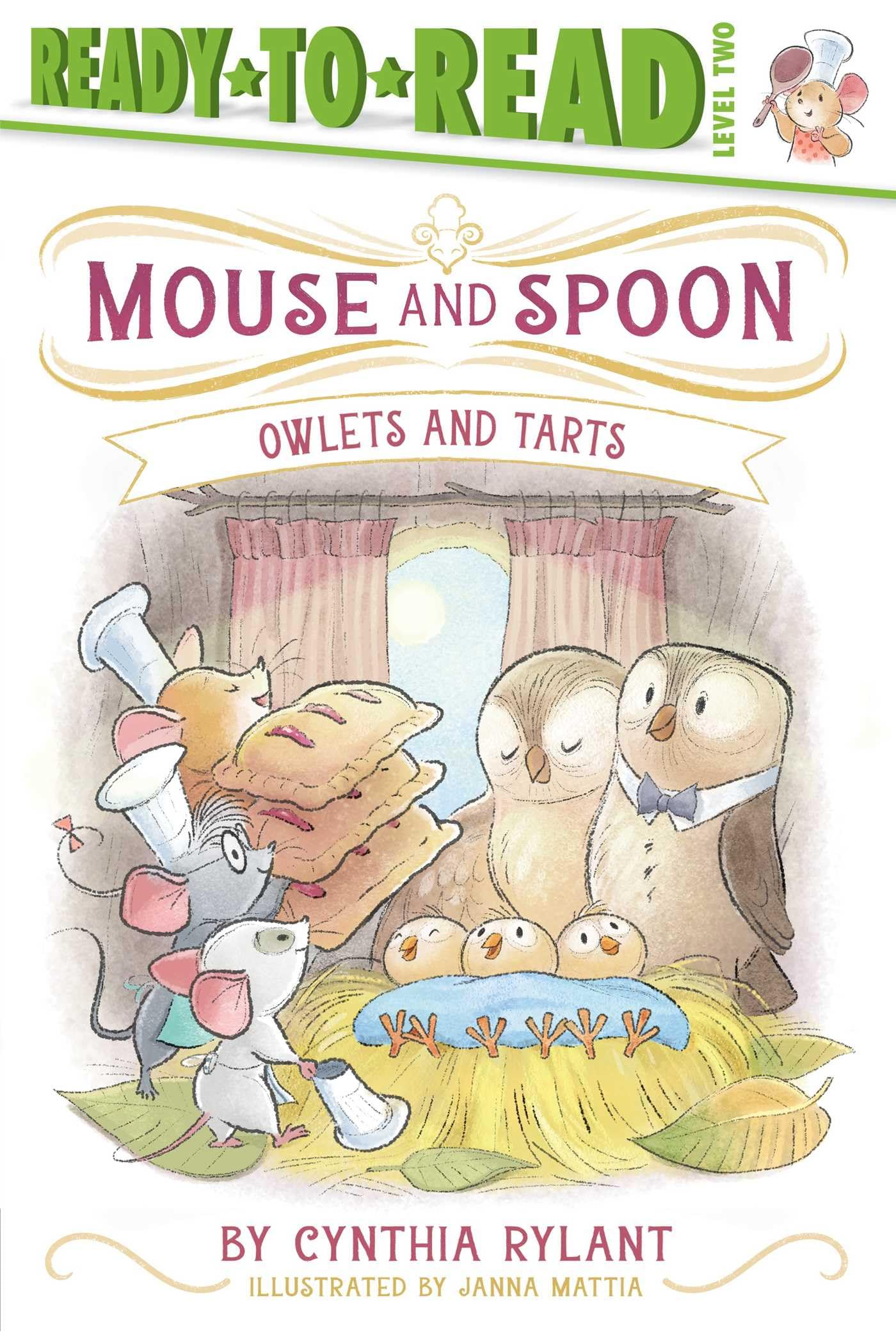
Owlets and Tarts (Mouse and Spoon) by Cynthia Rylant (Simon Spotlight, 32 pages, ages 4-8). Ginger, Piper, and Tom are three mice who run the Mouse and Spoon Bakery. When a sleepy owl dad shows up requesting Pillow Tarts for his three offspring who refuse to sleep, the mice are on it. By 4:00, they’ve made three extra-fluffy tarts, as well as Half-Moon Buns for the parents. Everything is delivered to the owls, and three three owlets are asleep before their little heads hit the tarts. The mice have saved the day (and night), making it a happy ending for all.
Cynthia Rylant has yet another enchanting early reader series that would also make a great read-aloud. I think this is actually book two, although it was released at the same time as book 1, The Elephant’s Birthday. Give this to fans of Henry and Mudge and Poppleton, and don’t get caught up in the dark thoughts I had about owls luring mice to their home.
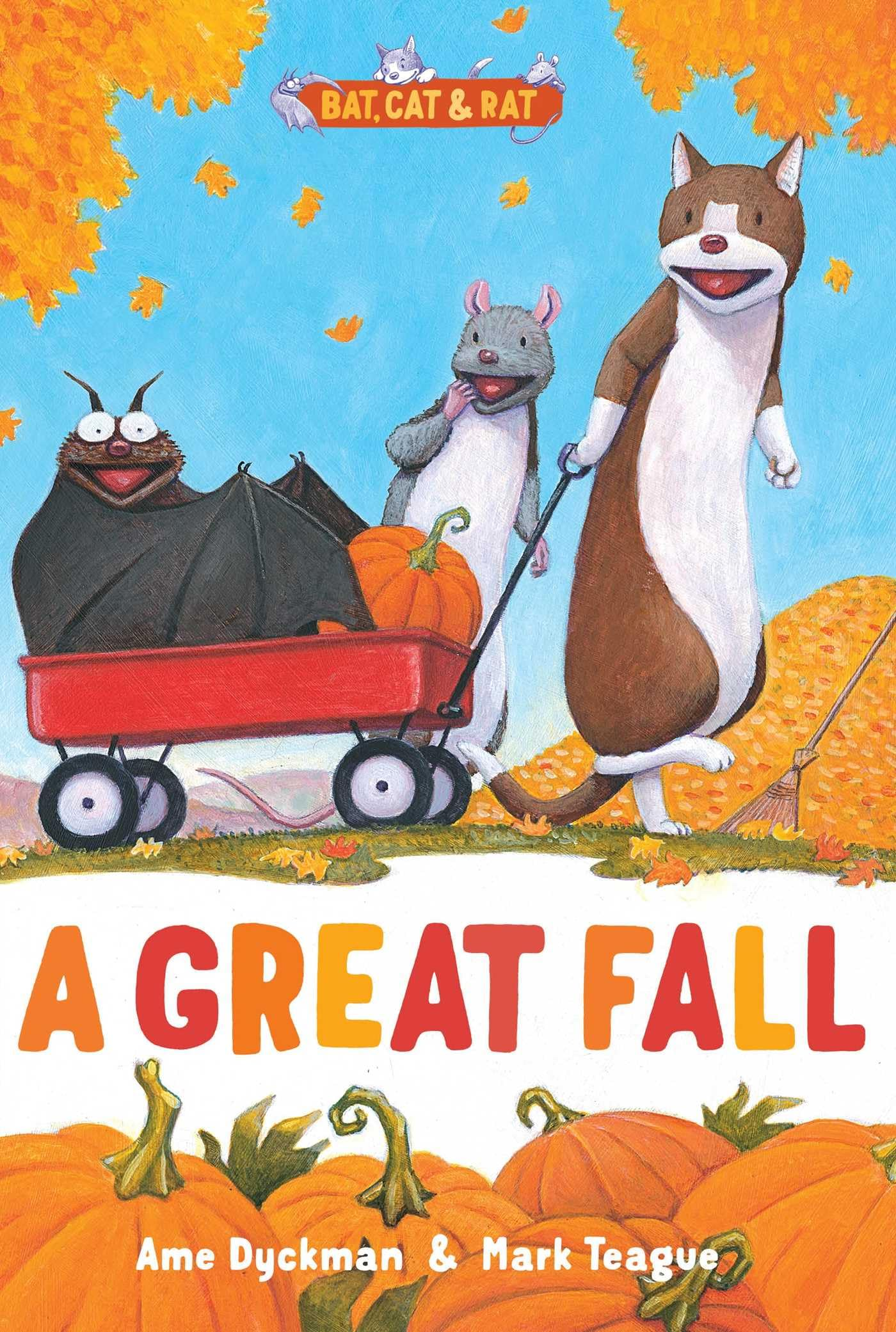
A Great Fall (Bat, Cat, and Rat) by Amy Dyckman, illustrated by Mark Teague (Beach Lane Books, 48 pages, ages 4-8). Friends and housemates Bat, Cat, and Rat enjoy some typical fall adventures: raking leaves, picking pumpkins, and making costumes. In the final half a story, they trade treats on Halloween night so that each one gets what they like best.
This is actually book 4 in a series whose debut I missed last year (#2 won the Theodor Geisel award). Each book has three and a half stories with fairly simple, repetitive text and adorable illustrations of the three friends. Beginning readers will feel a sense of accomplishment reading a chapter book, and now they can enjoy a book for each season.
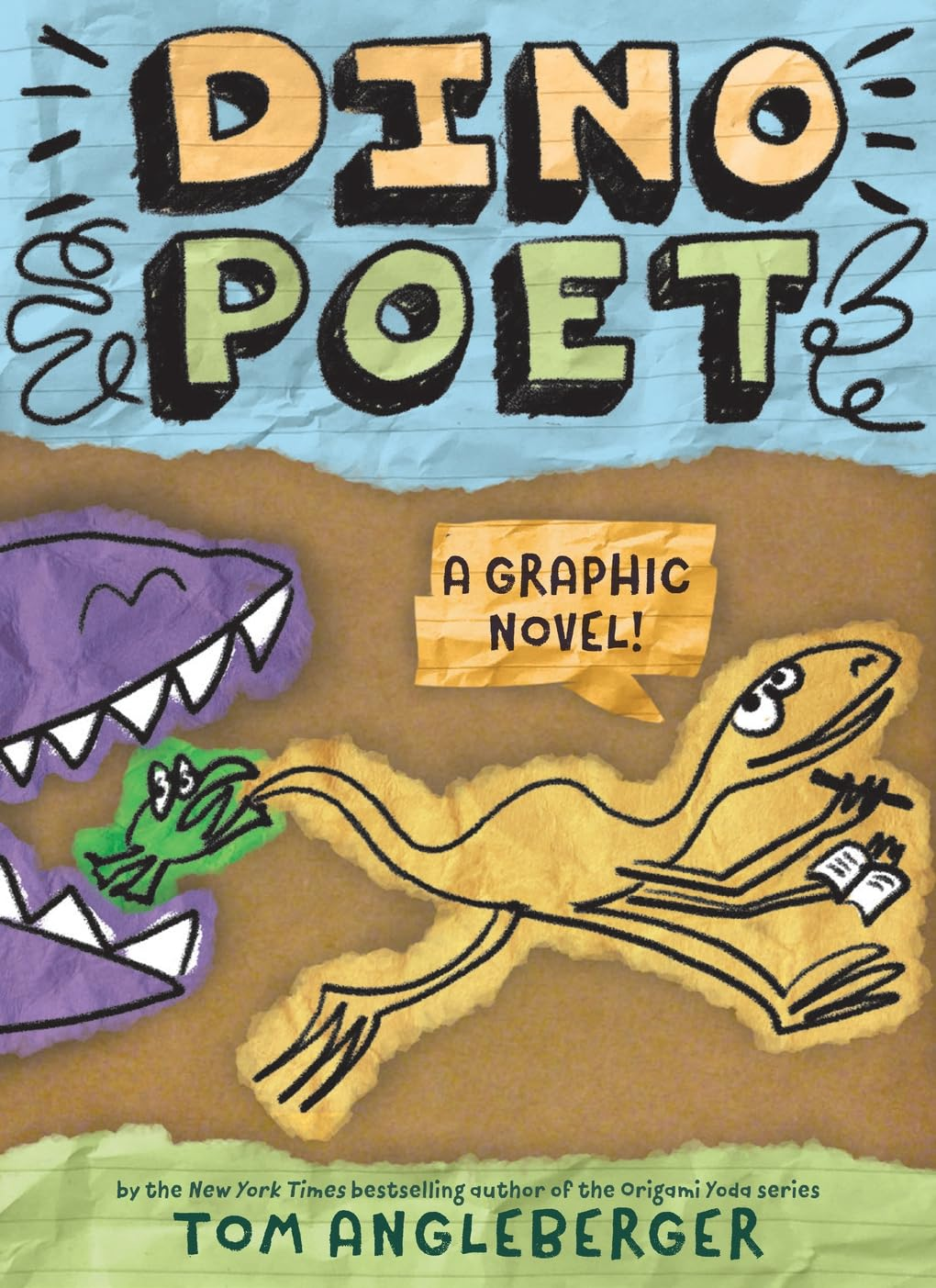
Dino Poet: a graphic novel by Tom Angleberger (Harry N. Abrams, 96 pages, grades 1-4). When a Coelophysis takes a break from writing poetry to have a froggy snack, the frog in question tells him that he hates his poem. The frog then proceeds to give the dinosaur poetry pointers, like how to express his emotions and use his senses to perceive the world. Desperate not to be eaten, the frog introduces different forms of poetry like limericks and speed haiku, while both creatures keep a sharp lookout for larger dinosaurs who may want to consume them both. The frog is so successful that by the end, the Coelophysis calls him a friend, refuses to eat him, and gets him his own notebook and pen so that they can write together.
Always expect the unexpected with Tom Angleberger, as evidenced by this book which is short for a graphic novel, long for a picture book, and has the unlikely premise of two animals from different eras becoming friends and writing poetry together. I love the way it introduces poetry and gently (and humorously) encourages kids to try their own. The simple collage art and the photo of art supplies at the beginning may also inspire readers in their artistic endeavors.
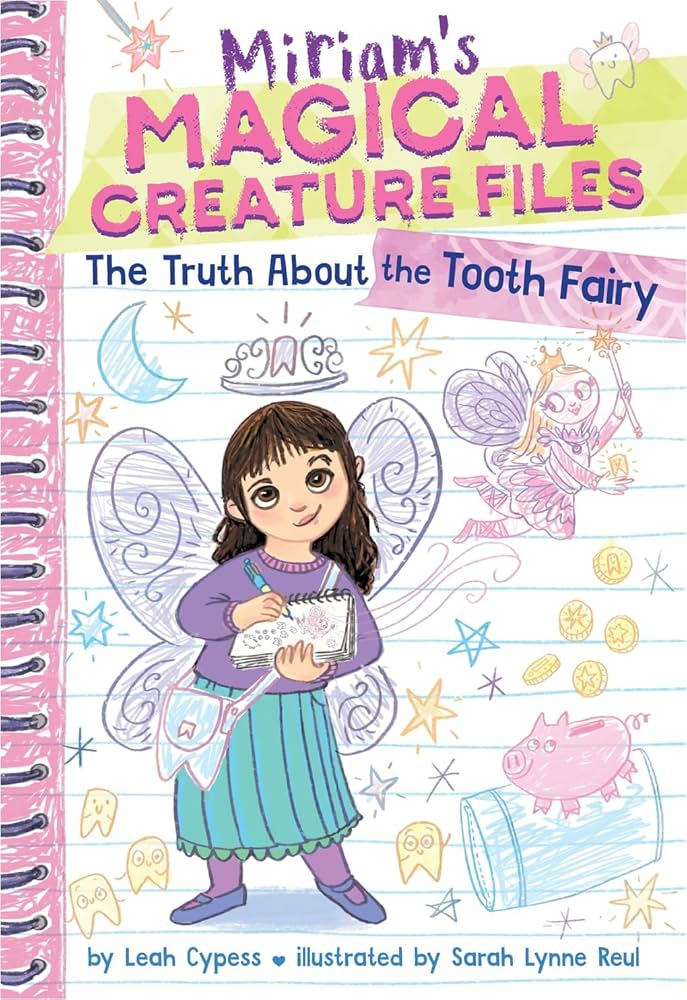
The Truth About the Tooth Fairy (Miriam’s Magical Creature Files book 1) by Leah Cypess, illustrated by Sarah Lynne Reul (Harry N. Abrams, 112 pages, grades 1-3). 6-year-old Miriam is the youngest of three siblings, slightly jaded about things her family tells her, and a firm believer in testing them out to find out if they’re true or not. For instance, after being told, “Sugar makes you hyper,” she eats a lot of it at a birthday party and feels fine. So when she realizes she has her first loose tooth, Miriam is ready to find out if the tooth fairy is real. Her methodology involves staying up and catching her parents in the act. Does she succeed? Readers will have to draw their own conclusions, but whatever they decide, they can look forward to book 2, The Discovery of Dragons, coming in August.
Miriam is a spunky and smart protagonist, part of an Orthodox Jewish family whose traditions are woven into the story and illustrations. The book resembles a scrapbook, with Miriam’s lists, charts, notes, and drawings on what looks like paper torn from a notebook. Fans of Junie B. Jones and other feisty early elementary narrators will enjoy this beginning chapter book.
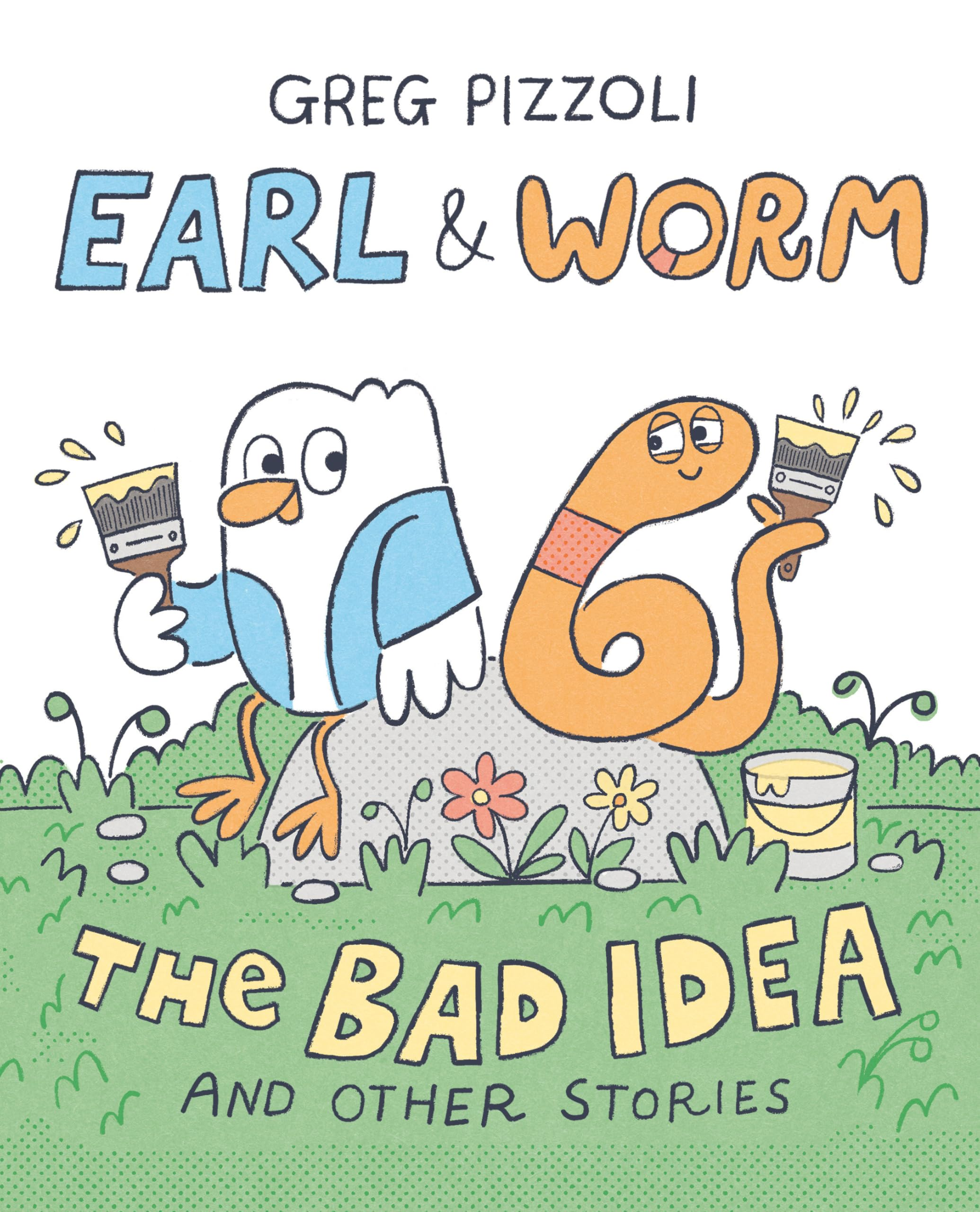
The Bad Idea and Other Stories (Earl and Worm book 1) by Greg Pizzoli (Knopf Books for Young Readers, 72 pages, ages 4-8). In the classic style of such literary friendships as Elephant and Piggie, Frog and Toad, Frank and Bean, Beak and Ally, etc., Worm is a grumpy introvert who initially is annoyed by early bird Earl who gives friendly greetings and plays music for his plants first thing in the morning. The second chapter sees Worm getting increasingly annoyed by what she perceives as Earl’s copying her good ideas about home decor. When she tries to trick Earl by telling him about an outlandish plan to paint the outside of her house, Earl surprises her by painting it for her, leaving her with a house she doesn’t like and the realization that the whole thing was a bad idea. Earl’s persistent cheerfulness slowly wins over Worm, and by the third chapter, Worm is committed enough to their friendship to write a poem that celebrates it.
I’m a pretty big Greg Pizzoli fan, and, while I personally feel this whole introvert/extrovert friendship theme in early readers is a little tired, Pizzoli does an excellent job of creating two fun characters and three funny stories, particularly the one about the bad idea. I love the illustrations, especially the way Worm is portrayed doing all sorts of tasks without any limbs. Try this out on fans of some of the series mentioned above.
As the year winds down, I’ll be reviewing two final 2024 books in several categories (middle grade fiction, nonfiction, early chapter books, and picture books). During the week between Christmas and New Year’s, I’ll post my lists of favorites, then take a break for the first few weeks of January.
Words Are Magic! by Zaila Avang-garde, illustrated by Felicia Whaley. (Random House Books for Young Readers, 32 pages, ages 4-6). “Words are magic! Have you heard? Pick a letter. Make a word!” The enthusiastic narrator shows readers all the things that can be done with words: sing them, shout them, draw them, paint them, and more. She goes through her day finding different ways to use words, and concludes “I love words!” As well she might, being the 2021 winner of the Scripps National Spelling Bee (the author that is). This is a fun, high-energy introduction to the power of words and reading, written in a format that beginning readers will soon be able to read themselves.
No Cats in the Library by Lauren Emmons (Simon and Schuster/Paula Wiseman Books, 32 pages, ages 4-8). Clarisse is a stray cat who loves books. Peering over a child’s shoulder from her perch in a tree, she can’t understand the dark squiggly lines, but she loves the pictures. When she discovers a library, she tries to get inside, but the librarian keeps taking her out again. Finally, Clarisse discovers the book drop, and uses a catlike leap to get inside. A child struggling to learn to read finds Clarisse the perfect read-aloud partner, and Clarisse is happy to oblige. Witnessing the power of a read-aloud cat, the librarian is convinced to change her mind, and Clarisse finds a new home. This lovely story made me want to get a cat for my library, even though I am allergic. Maybe a stuffed one? Kids and librarians alike will love Clarisse, and if a library has a read-aloud program with a dog (I’ve never seen one with a cat, but who knows?), this book will make a perfect introduction.
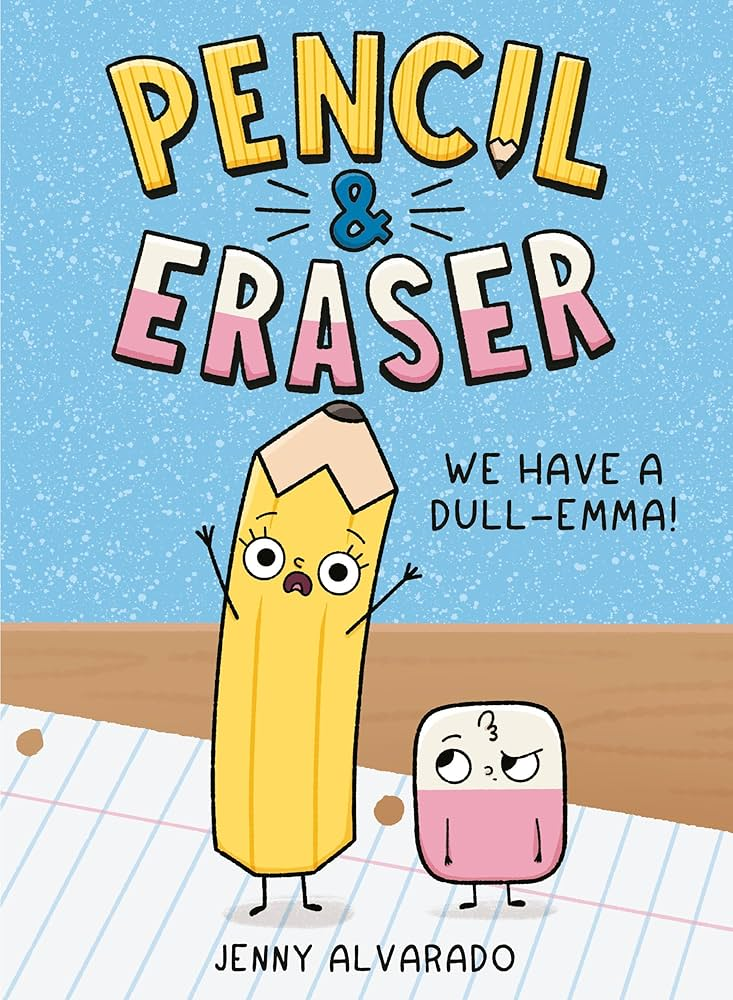
Pencil & Eraser: We Have a Dull-Emma by Jenny Alvarado (G. P. Putnam’s Sons, 67 pages, grades K-2). When Penciil discovers she’s lost her point, she’s ready to go on an adventure to find a sharpener. Eraser serves as both sidekick and voice of reality, keeping Pencil’s wild schemes in check. When they find out the classroom sharpener is broken, they’re forced to venture down the hall to another class. The pressure’s on to get back before recess is over, but they make it just in time…only to have Eraser discover there was a small sharpener in their pencil case all along. Includes step-by-step instructions for drawing Pencil and Eraser.
Fans of Pizza and Taco will enjoy this silly graphic novel, and the large font and short amount of text on each page makes it a good choice for those ready to take the next step from Elephant and Piggie.
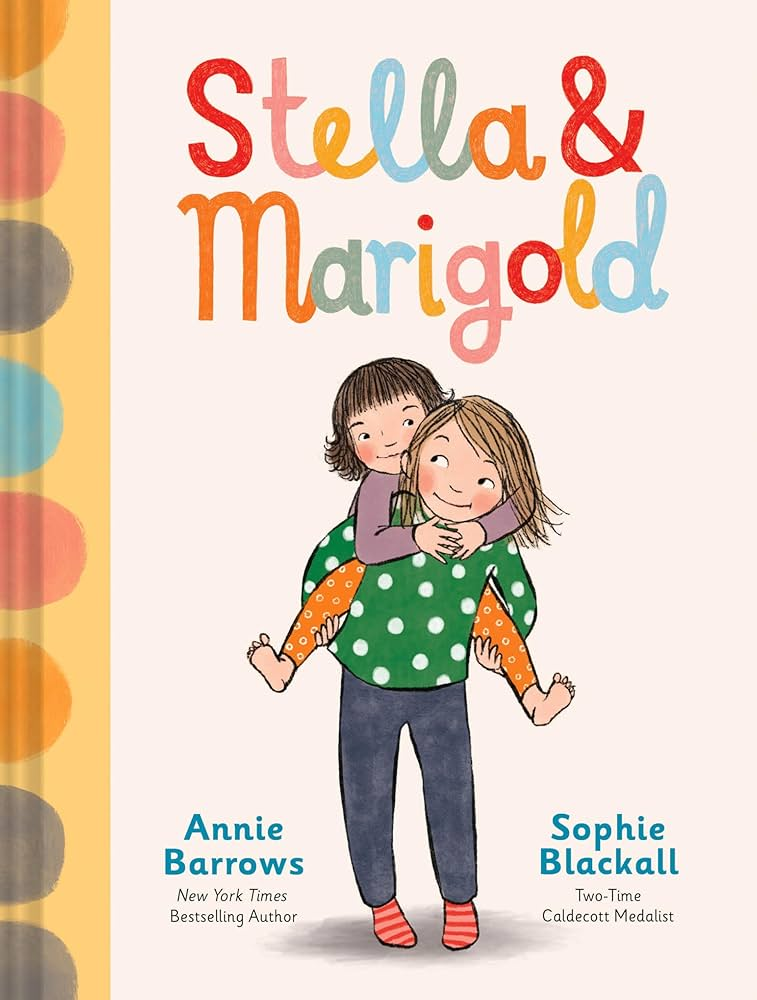
Stella & Marigold by Annie Barrows, illustrated by Sophie Blackall (Chronicle Books, 101 pages, ages 6-9). Stella and Marigold are sisters, ages 7 and 4, who have been close friends ever since the day Marigold came home from the hospital. Their story is told in seven chapters, each of which could be read on its own. Marigold has a mind of her own and can’t always understand why adults don’t get why she drops her hairclip down the drain or gets lost in the meerkat tunnel at the zoo. Stella serves as a sort of go-between, interpreting the world for Marigold and helping the grown-ups understand the perspective of a four-year-old. But it’s Marigold who uses her cuteness and her fearlessness to help Stella when a second-grade best friend makes a new friend. The last chapter is a funny homage to the Laura Ingalls Wilder books and shows both girls using their active imaginations at full power.
This new book from the Ivy and Bean author and illustrator will undoubtedly be a series starter. The reading level is a bit high for a book about characters under the age of eight, and that combined with the stand-alone nature of each chapter and the adorable full-color illustrations make it feel more like a read-aloud than a book for early independent reading. It’s sure to be a holiday gift this year from many parents and grandparents.
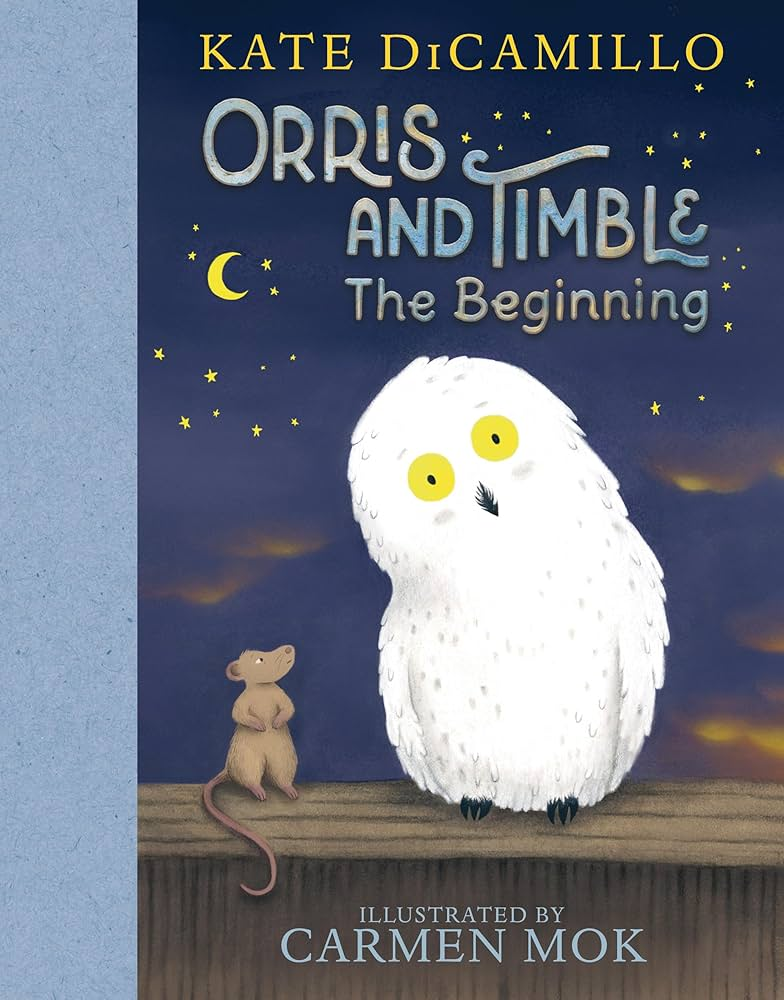
Orris and Timble: The Beginning by Kate DiCamillo (Candlewick, 76 pages, grades K-3). Orris the rat lives in a comfortable nest inside the old wall of an abandoned barn. One night he hears a snap and discovers an owl named Timble has gotten his foot caught in an old mouse trap. After wrestling with his conscience, Orris helps free Timble, sharing the story of the lion and the mouse to try to discourage Timble from eating him. Timble, who seems to have missed the memo that owls are supposed to be wise, brings Orris a butterscotch candy and asks for more stories. By the end of the book, Orris is willing to admit that the two have become friends.
As I’ve mentioned previously, I’m not a big Kate DiCamillo fan and have pretty much given up reading her books. This one was donated to my library, so I decided to make an exception. It’s a cute story with beautiful illustrations, supposedly the first in a planned trilogy (book 2 is slated for April of next year), and would make a good side-by-side read-aloud with Jerry Pinkney’s The Lion and the Mouse. It lacks the humor and cast of quirky characters of the Mercy Watson series, but more introverted, introspective early readers will appreciate the quiet nature of this book.
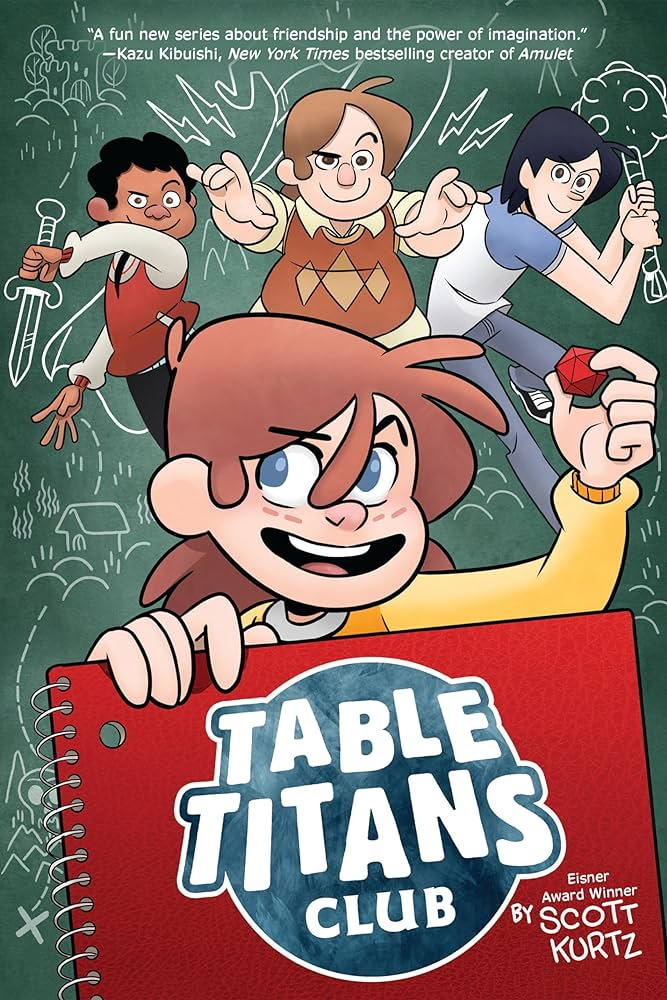
Table Titans Club by Scott Kurtz (Holiday House, 224 pages, grades 3-7). Valeria “Val” Winters is new at school, and her mom’s reminder of a fresh start tips readers off that she may have struggled before. Val’s first day is rough, but she catches the attention of the Table Titans Club, a group of Dungeons and Dragons players. After much debate among the members, one of them invites Val to join their school club. Val’s thrilled, although she’s never played D&D.
Turns out she’s a natural, and all seems to be going well until their teacher sponsor announces that his wife is having a baby, and he has to cut back on his hours. When he tells them that Coach Bitner will be replacing him, the Titans are sure their club is doomed. But Val manages to win Coach Bitner over and secure a spot on the wrestling team. After a number of bumps in the road, Val and the Titans (including another new girl Titan) manage to save the club and secure a wrestling team victory. Val’s announcement about a role-playing fantasy summer camp she’s discovered just about assures a sequel.
Duck and Moose: Duck Moves In! by Kirk Reedstrom (Disney Hyperion, 64 pages, grades 1-3). Moose loves peace and quiet, so when Duck settles in on his antlers, Moose is furious. He tries to convince/trick Duck to find a home in a pond, on a mountaintop, and inside a cave, but Duck is convinced they should be neighbors. Finally, Moose gives up. When Duck realizes how upset Moose is, he sets up a home a short distance away, then invites Moose over for a movie night. They unexpectedly bond over a favorite movie and snacks, and a surprising friendship is born.
These two graphic novels are sure to be big hits, with some funny characters, situations, and artwork as well as heartwarming conclusions. However, I couldn’t help but feel a sense of deja vu: a loveable troublemaker starting middle school is a familiar graphic novel theme and we’ve seen the introvert/extrovert friendship in other early reader series like Narwhal and Jelly, Beak and Ally, and Frank and Bean. Guess I can’t blame publishers for wanting to go with a sure thing, but a few creative risks would be nice to see as well.
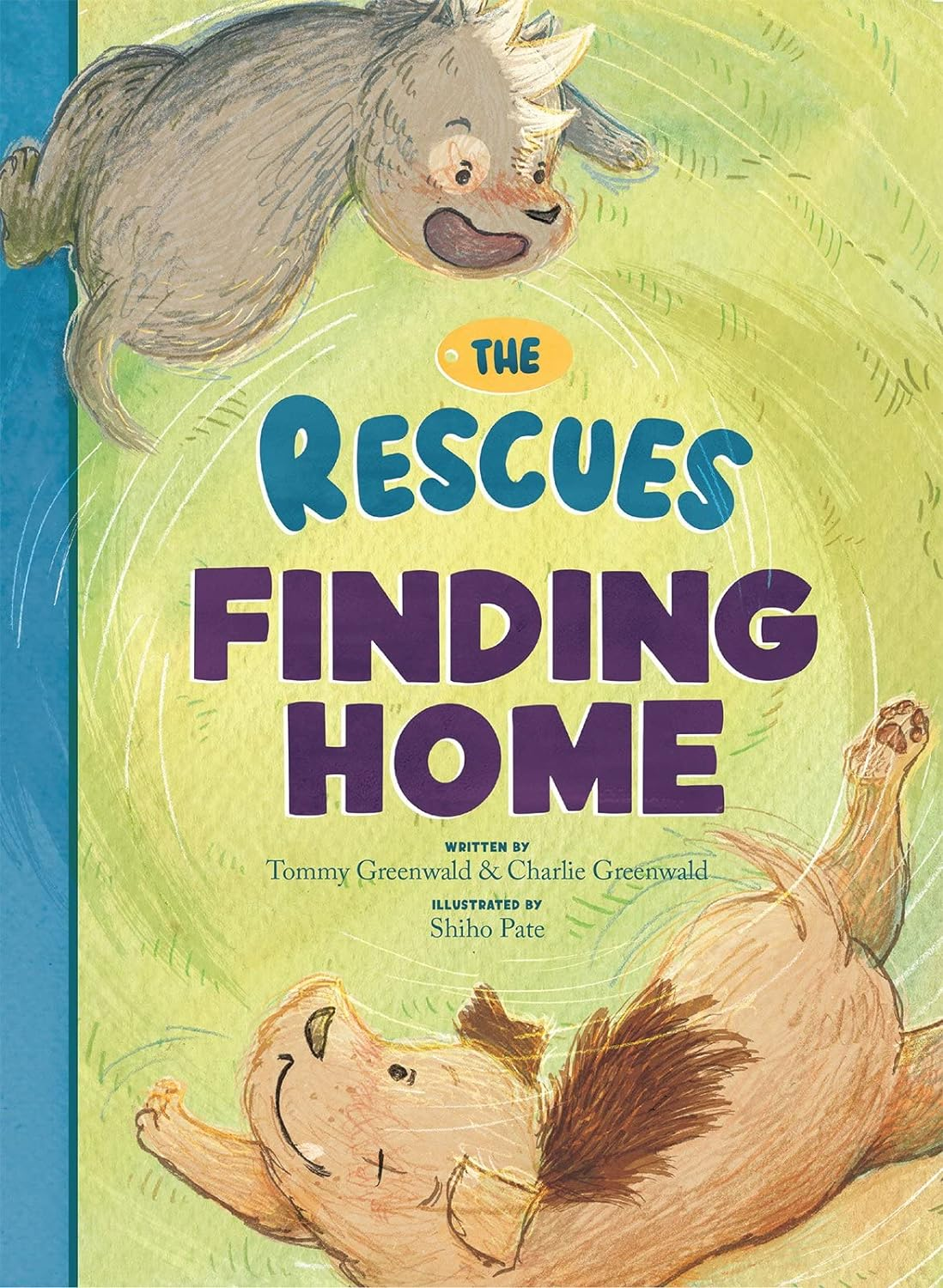
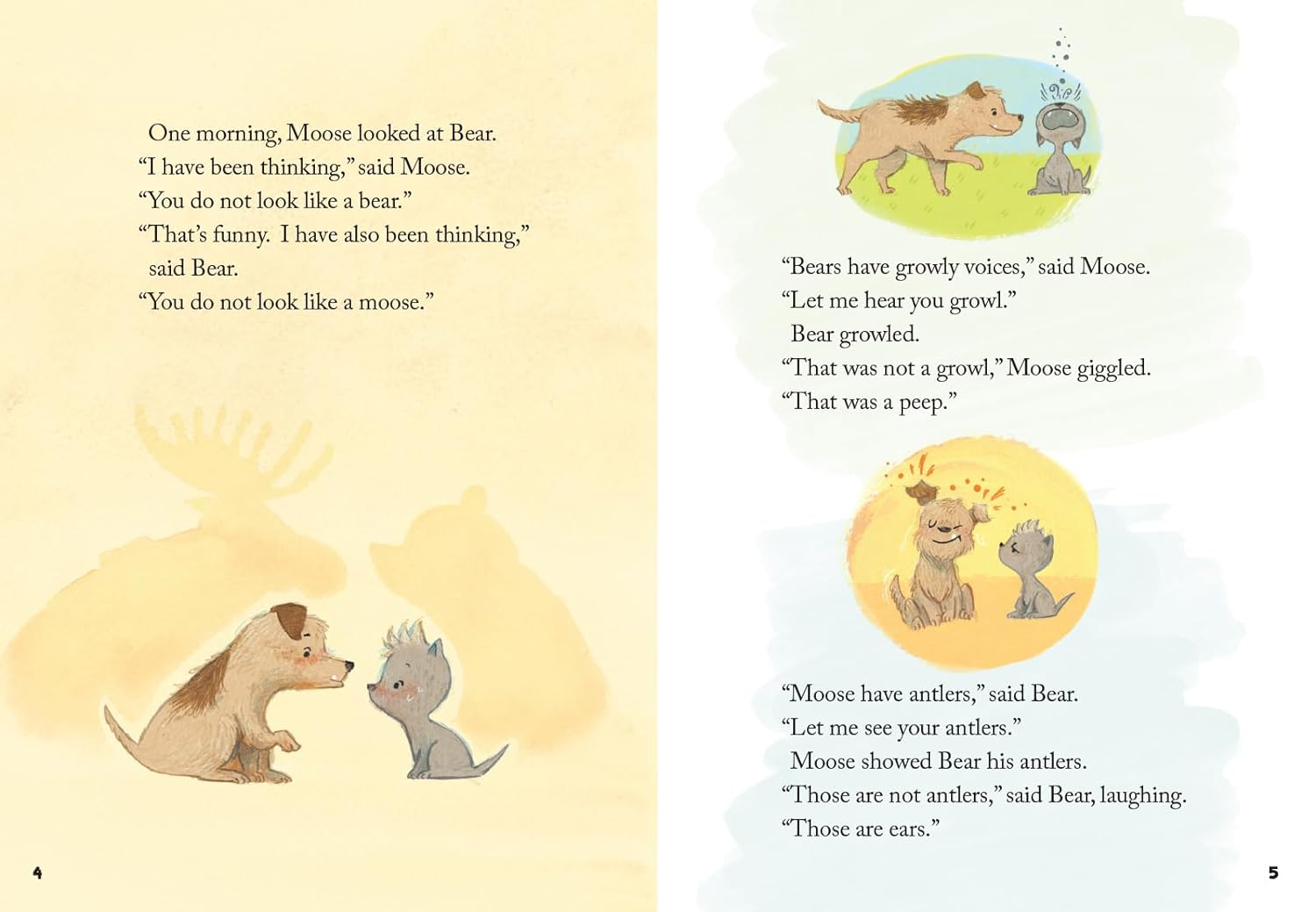
Summary: In three chapters, readers learn about one-eyed Moose and three-legged Bear, two dogs who become friends at a shelter. A woman named Cathy adopts them at the end of the first chapter, and a stray cat named Tiger joins the family in chapter two. In the final story, it’s bedtime for the three friends, but Tiger is too anxious to sleep in his new home. After trying a few unsuccessful solutions, the three pets happily snuggle up together in the dogs’ bed for the night. 40 pages; grades K-2.
Pros: I would challenge any new reader not to be completely charmed by Moose, Bear, and Tiger. This is billed as book 1, so here’s hoping there will be more.
Cons: The first two pages were so heart-rending that I could hardly go on.
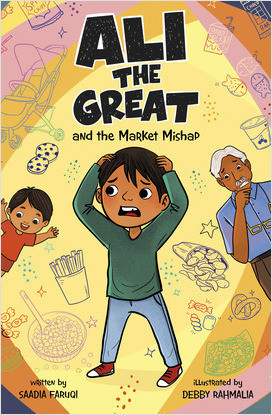
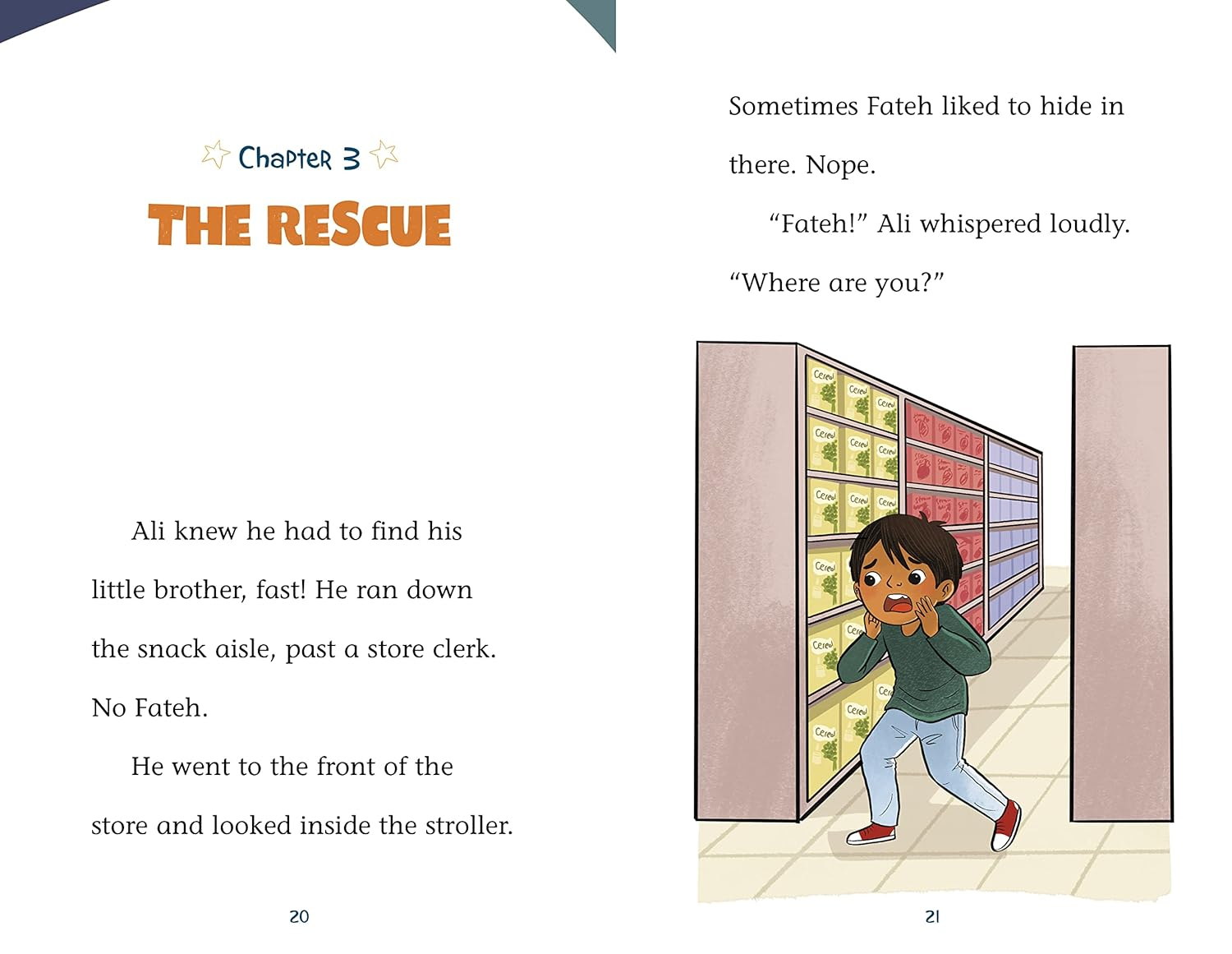
Summary: Like Yasmin from another series by Saadia Faruqi, Ali is part of a Pakistani-American family, introduced on the first page. When Dada, Ali’s grandfather, takes Ali and his little brother Fateh to the South Asian market to shop for snacks, Ali has his hands full keeping Fateh out of trouble. The story unfolds in three chapters, with the three returning home safely with Dada’s favorite spicy chips by the end. A few Urdu words are introduced with pronunciations and definitions before the story starts, and the back matter includes some jokes, a list of Dada’s favorite Pakistani snacks, and three questions/writing (and drawing) prompts about the story. Three other books about Ali were published simultaneously. 32 pages; grades K-3.
Pros: A cheerful early chapter book that introduces another Pakistani-American family and their everyday activities in a way that kids will connect to while learning a little bit about another culture.
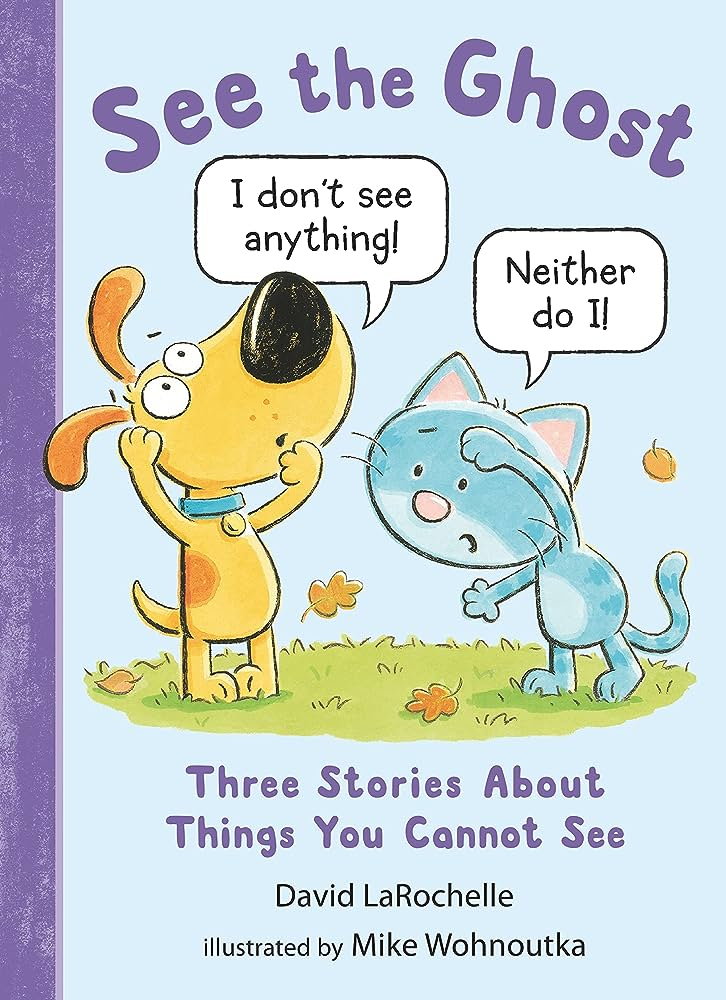
Summary: The dog and cat from See the Cat and See the Dog are back for this trio of tales about things you cannot see: namely, a scary ghost, a strong wind, and a mischievous fairy. The animals get scared, blown away, and transformed by the invisible beings. In the end, all is to put to rights, and a fun and happy day is had by all, both those you can see and those you cannot. 64 pages; ages 4-8.
Pros: This delightful series needs no introduction. I don’t usually review sequels, but I loved this one enough to make an exception. This is one of the most popular early reader series in my library, and I can’t wait to introduce fans to the newest entry, perfect for fall. See the Cat won a Geisel award, and I would love to see the same for See the Ghost.
Cons: I thought the fairy’s transformations of the dog and cat could have been milked a bit more for humor.
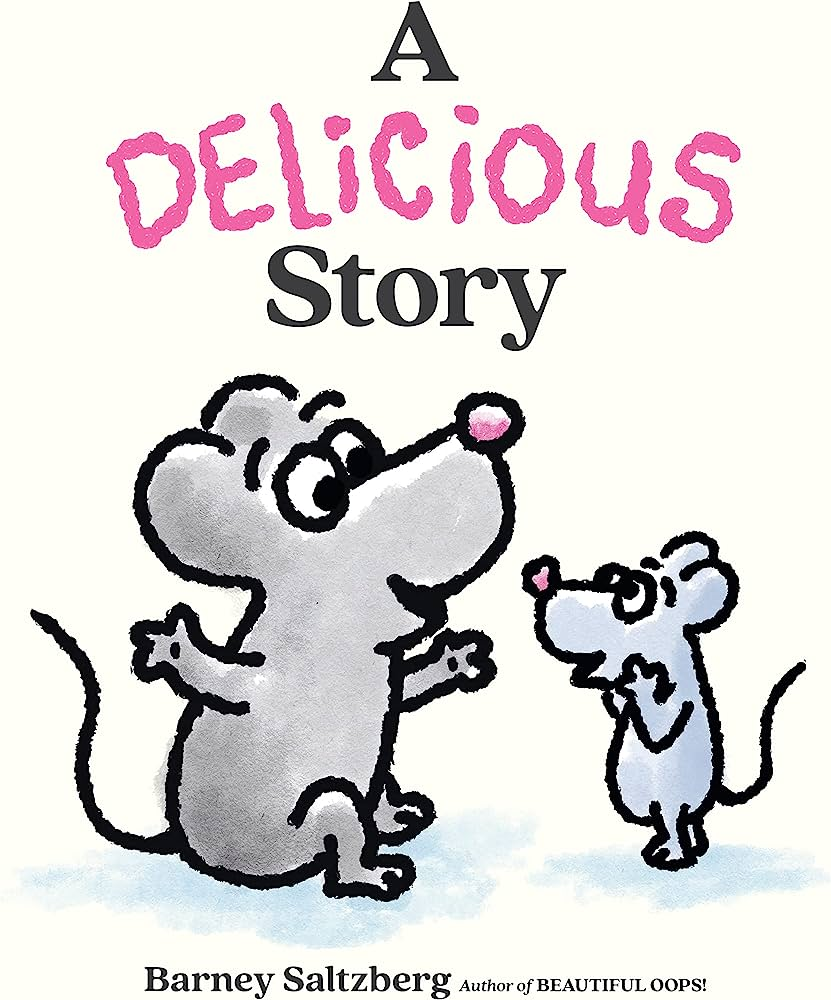
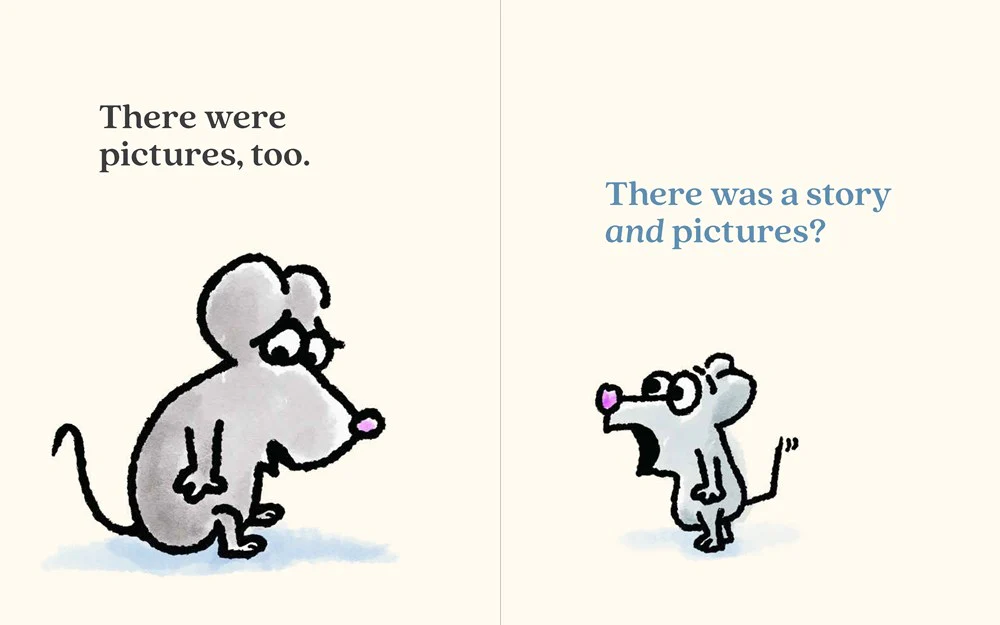
Summary: A little mouse is looking for a story. “Oh…I haven’t seen one,” says the big mouse, looking away. “Wait, isn’t this a book?” asks the little mouse. It is indeed, but there is no story. When pressed, the big mouse admits that he ate the story AND the pictures. It was a delicious story, and he offers to tell the little mouse a new one. It’s a tough process, but eventually the two mice work together to create a cozy story…with a surprise ending. 80 pages; ages 3-6.
Pros: Elephant and Piggie fans will get a big kick out of this story that’s perfect for beginning readers (and listeners) and that provides a fun introduction to stories and storytelling.
Cons: There’s not a lot of action in the illustrations.
Summary: Nat the Cat is TRYING to take a nap, but the narrator of the story keeps waking him…by narrating the story. “Oh, brother,” says Nat the Cat, and the narrator introduces his brother, Pat the Rat (“That is NOT my brother,” says Nat). The series of misunderstandings ends, happily, with ZZZ’s for both cat and rat. 32 pages; ages 2-7.
Pros: This funny early reader with its cartoon-style illustrations and conversation with an omniscient if frustratingly clueless narrator reminds me of one of the most popular early readers in my library, See the Cat: Three Stories About a Dog by David LaRochelle. That won the Geisel award, so keep any eye on Nat for a similar recognition.
Cons: Only one story, as opposed to the three in See the Cat.