Superhero graphic novels

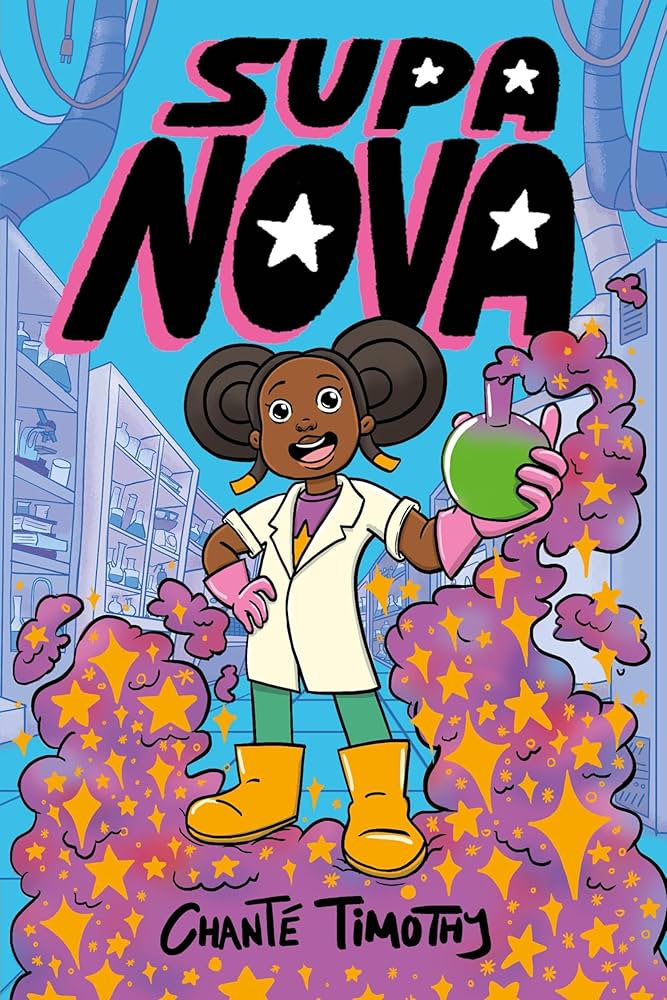
Supa Nova by Chanté Timothy (Nosy Crow, 160 pages, grades 2-5). Inspired by her scientist parents, Nova has created a secret lab that she accesses through her bedroom. After learning about islands of plastic trash floating in the ocean, Nova sets out to create a plastic-eating creature. The key to success turns out to be her teenage sister’s discarded wad of gum, and before long Nova has made an adorable pink monster named Chomp. Unfortunately, Chomp has a voracious appetite for plastic and an unfortunate propensity to grow quickly when he eats. Soon he’s threatening to consume the entire town, and Nova has to act quickly–and to reluctantly call on her sister for help. The two of them find an ingenious solution, shrinking Chomp to a more manageable size and convincing the adults to find a home for him on one of those plastic islands. Includes an author’s note on the science behind the story, some drawing tips, and a preview of the next Nova book.

This cute story is a quick read and would be a good point of entry for beginning readers to try out a full-length graphic novel. Nova’s larger-than-life adventures bring to mind TV cartoons, with the science occasionally feeling a bit like a magic trick, but she’s a spunky and resourceful protagonist who serves as a good role model for girls (and boys) who are interested in science.

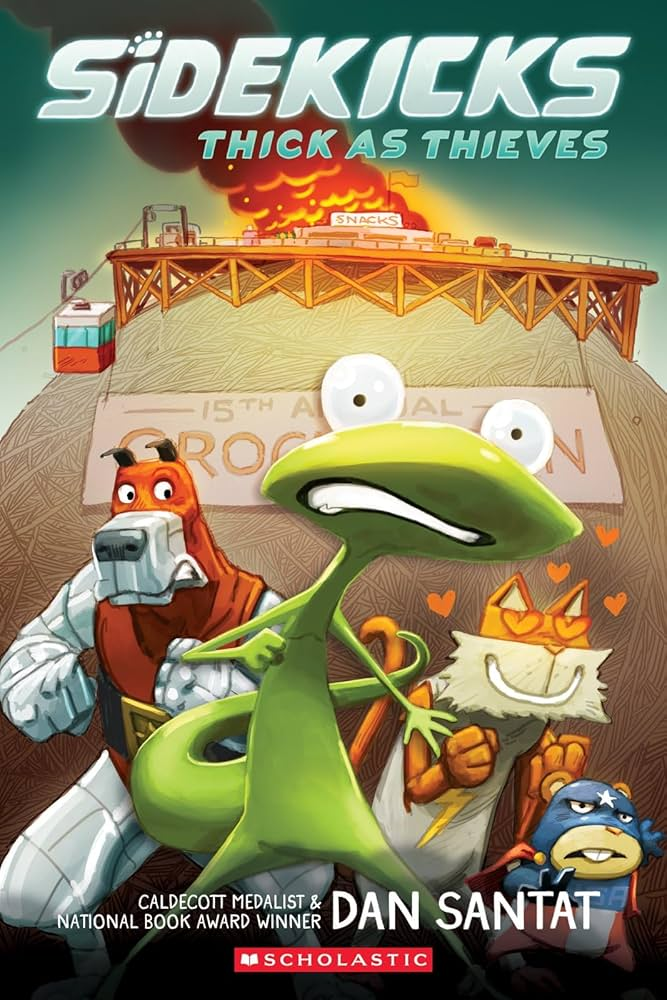
Sidekicks: Thick as Thieves by Dan Santat (Graphix, 208 pages, grades 3-7). I’m a little confused about this series: a book called Sidekicks by Dan Santat was published in 2011, but it looks like it was reissued as book 1 in a series last year. Book 2 is due to be released in the first week of 2026. When Scholastic offered to send me both books, I readily agreed, read both of them, and feel pretty sure this will be a hit series. The sidekicks are the pets of aging superhero Harry Blake, aka Captain Amazing. Each one has a superpower, but also a flaw or two, and part of the fun is watching both the people and the animals mess up.

In book 2, Harry and his older sister head off for a crochet convention as part of Harry’s attempt at retirement. While they’re away, chameleon Shifty’s older brother Whipley shows up. The two brothers were close at one point, but now the other pets–Manny the cat, Roscoe the dog, and Fluffy the hamster–are suspicious of Whipley’s intentions. Is he really there to reconnect with Shifty, or is he a spy working to bring down Captain Amazing? When Shifty leaves with Whipley, the other sidekicks go after him, and they wind up in an epic showdown right in the middle of the crochet convention. The good guys win for now, but readers are encouraged to stay tuned for two more upcoming installments. The fast-paced plot, constant humor, and Dan Santat’s incredible artwork will definitely appeal to fans of Dog Man and Bad Guys.

Two chapter books for younger elementary kids

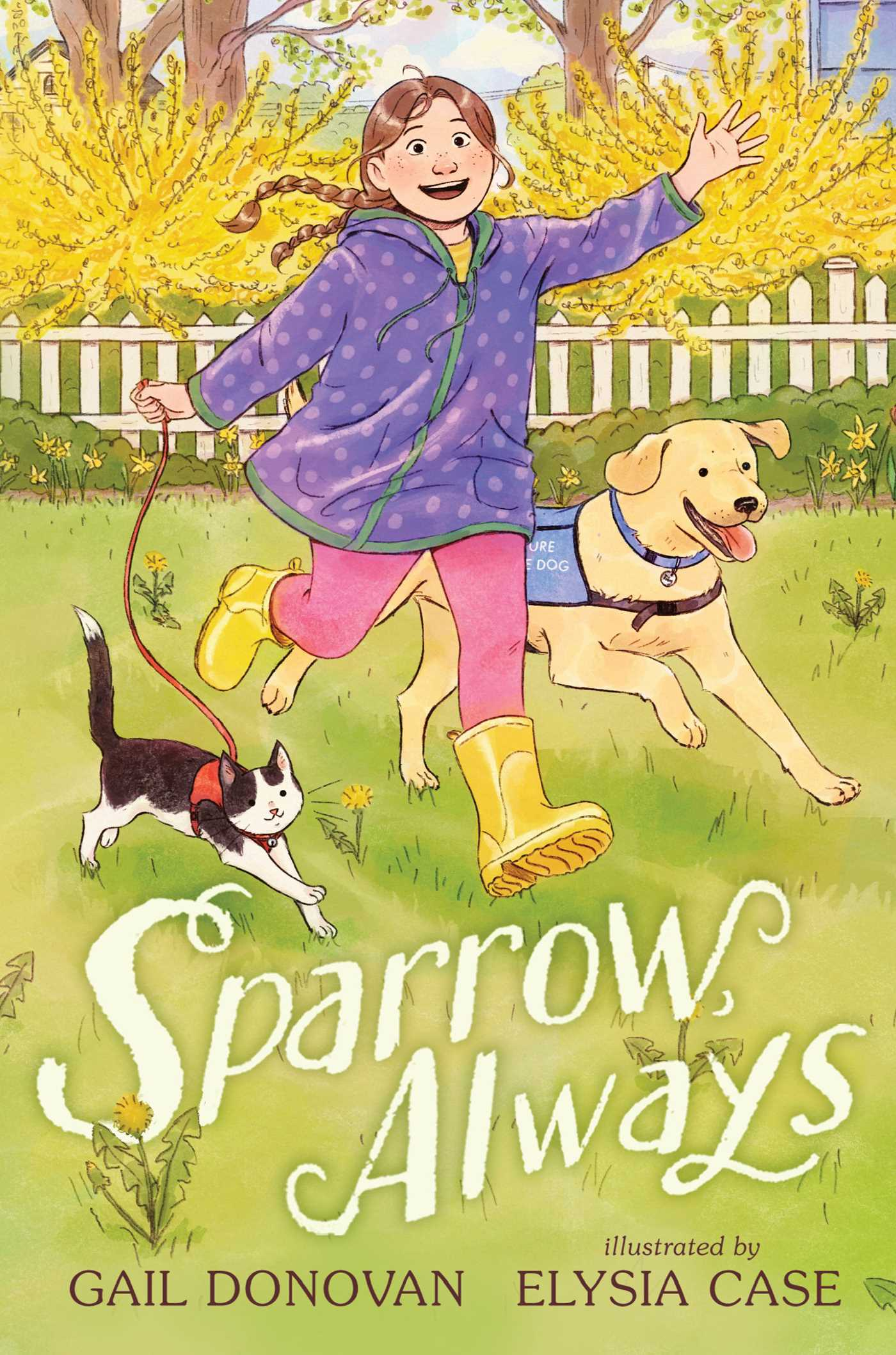
Sparrow, Always by Gail Donovan, illustrated by Elysia Case (Atheneum Books for Young Readers, 160 pages, grades 2-5). Sparrow’s dealing with a lot in fourth grade: a new baby brother, a best friend who seems to be growing up faster than Sparrow is, and some difficulties following directions at school that get her placed in a friendship group with a counselor. She loves animals, though, and the incentive of getting to helping Toby, the new puppy next door, pass his guide dog test motivates her to do better in school. Despite her difficulties, Sparrow’s heart is in the right place, and as fourth grade ends, she realizes that she’s a good friend, sister, and dog trainer, and that if she stays true to herself, she’ll be okay in fifth. Readers will enjoy the last chapter which tells about the guide dog test in Toby’s own voice.

I missed book one of this series, Sparrow Being Sparrow, which came out in 2024. Books 2 and 3 were released together, and I accidentally read book 3, but no prior knowledge was needed for me to thoroughly enjoy it. Sparrow has a Ramona Quimby vibe, and as I’ve said before, I always like discovering real middle grade books about third and fourth graders, which tend to be a bit of a rarity. Unfortunately, I find it hard to pry my students away from graphic novels long enough to read a book like this one, but I know there are many who will relate to and enjoy Sparrow’s adventures if they give her a try.

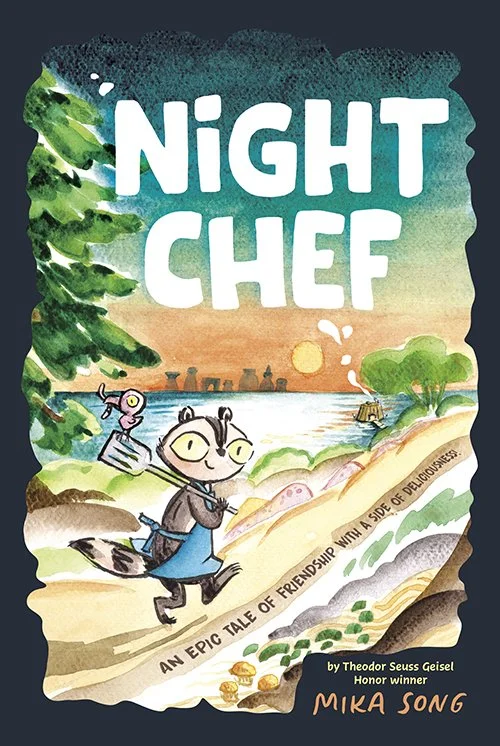
Night Chef by Mika Song (Random House Graphic, 160 pages, grades 1-4). The Night Chef is a raccoon who has learned cooking by living in the walls of a restaurant. After saving a baby crow that she names Ichi, the Night Chef decides to go on a journey to return Ichi to his flock. Along the way, the chef does a cooking stint at an animal-run restaurant called Mole’s Hole that’s being terrorized by an owl, travels as a stowaway on a train (more cooking, to pay her fare), and finally finds the crows and returns Ichi. On the way home, she stops back at the Mole’s Hole where she’s able to rescue them from the owl’s tyranny, aided by Ichi and the crows who return at just the right moment. The Night Chef learns about her early connection to the crows and discovers that she belongs at the Mole’s Hole, creating delicacies for the animals.

This cute animal graphic novel is sure to be popular with early elementary kids. It took me a minute to understand Night Chef’s circumstances and relationship to humans, but I loved all her animal adventures and the way she used her cooking talents to help herself and others, and the ending was extremely satisfying.

Survival stories for those who like the edge of their seats

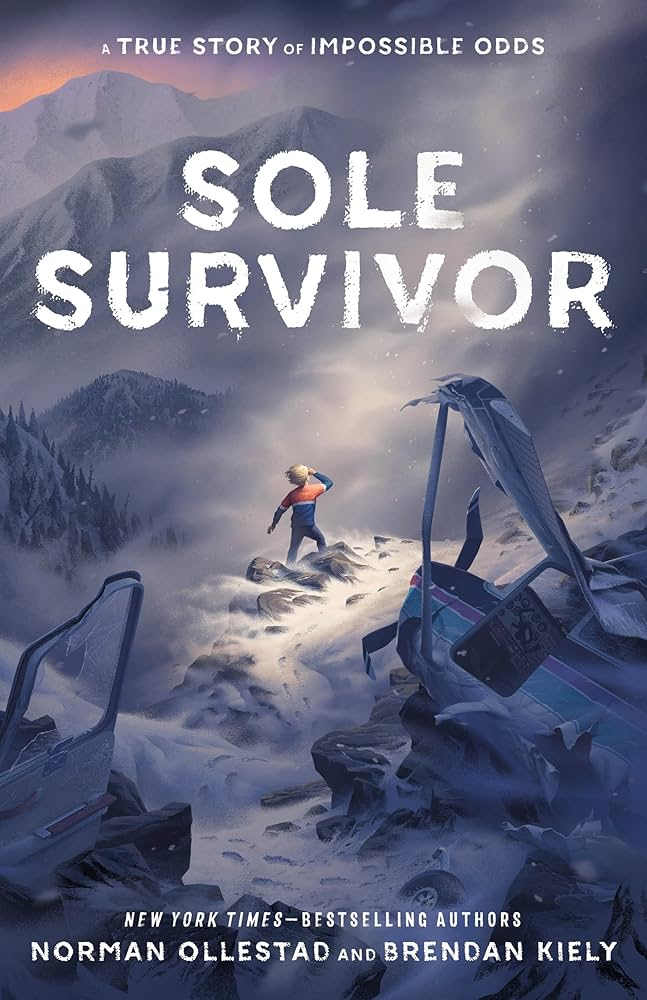
Sole Survivor by Norman Ollestad and Brendan Kiely (Farrar, Straus and Giroux, 272 pages, grades 5-8). Norman Ollestad recounts his experience of surviving a plane crash as an 11-year-old in 1979. His father and the pilot were killed instantly, and his father’s girlfriend Sandra, seriously injured, fell to her death when Norm was trying to help her. His dad had always pushed Norm to try the exhilarating but sometimes terrifying skiing and surfing adventures he enjoyed, and Norm found himself using the lessons from those experiences in his struggle to survive. Living with his mom and abusive stepfather had also taught him a thing or two about survival, and he miraculously was able to climb down the the icy California mountain in blizzard conditions to find help. The last part of the book tells of the aftermath of the event, in which Norm had to navigate his trauma while living full time with his mother and stepdad. After a rocky few years, he found release and healing through surfing. Based on the 2009 book Crazy for the Storm.

Okay, first off, if you’re looking for less stress in your life, do not read this book and Murder in the Jungle back-to-back, as I did. Norm’s story is harrowing, to say the least, made more so by the flashbacks to his abusive stepfather and risk-addicted father who put his son in some pretty questionable situations. It is definitely a page-turning survival story that will appeal to fans of Hatchet and other Gary Paulsen books.

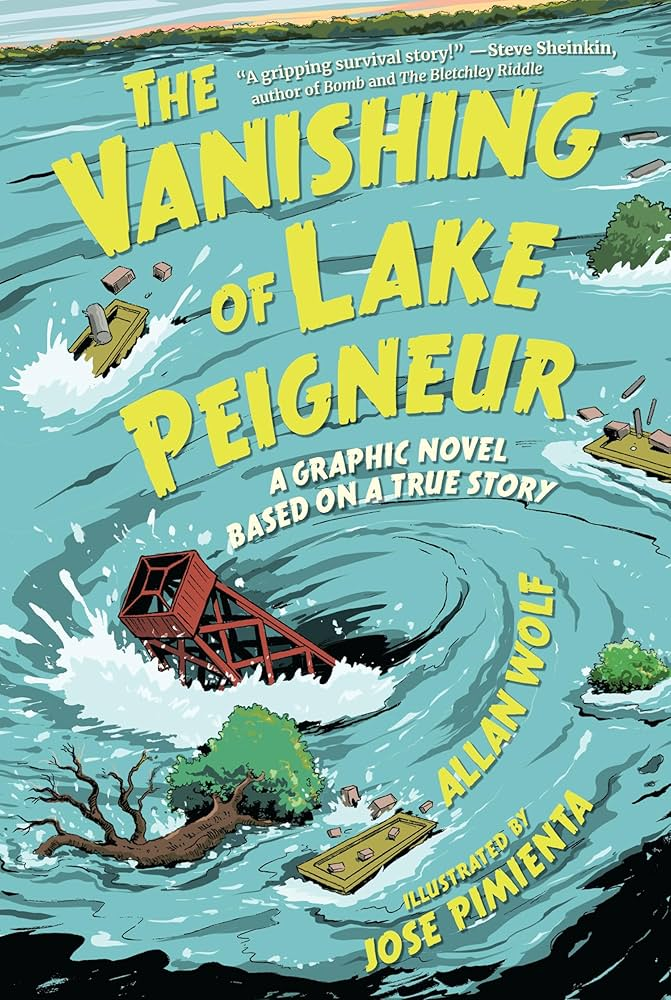
The Vanishing of Lake Peigneur: A Graphic Novel Based on a True Story by Allan Wolf, illustrated by Jose Pimenta (Candlewick, 176 pages, grades 4-8). November 20, 1980 starts as an ordinary day for Lake Peigneur (who narrates the story), the miners who work in the salt mine there, the oil rig workers, the wealthy owner of a house on the lake’s shore and his gardener, and various boaters on the lake. But it quickly becomes anything but ordinary when a combination of oil drill accident and precarious mine construction causes a huge vortex in the lake that threatens to destroy everything around it. Those in and around the lake are in a race against time to get off the rig, off the water, and out of the mine. Close calls and heroism are plentiful as the story shifts quickly from one site to another. The lake claims on page 1 that it “vanished,” and in a way that’s true, at least temporarily, as it’s transformed in size and composition from a freshwater lake to the saltwater lake that exists today. Includes an author’s note with extensive additional information, how he did his research, and clarification of what is fact and fiction.

This book took me a couple of tries to get into–the beginning feels a little stilted with many characters introduced. But once things start to happen, it’s hard to put down in a way reminiscent of the best “I Survived” books. I’m hesitant to reveal the spoiler that everyone survives, but amazingly that is the case, thanks to the good judgement and courage of many involved in rescue efforts. As Allan Wolf notes in the author’s note, this good fortune is one of the reasons it didn’t become more of a news story, and kudos to him for tracking down the story and interviewing many of the eyewitnesses to create this excellent graphic novel, greatly enhanced by Jose Pimenta’s art.

Boston Globe-Horn Book Awards

An email alerting me to the upcoming Boston Globe-Horn Book Awards ceremony coming up this Thursday, November 6, sent me on a search for some of the books that I hadn’t read yet. You can see a complete list of winners and honor books here.

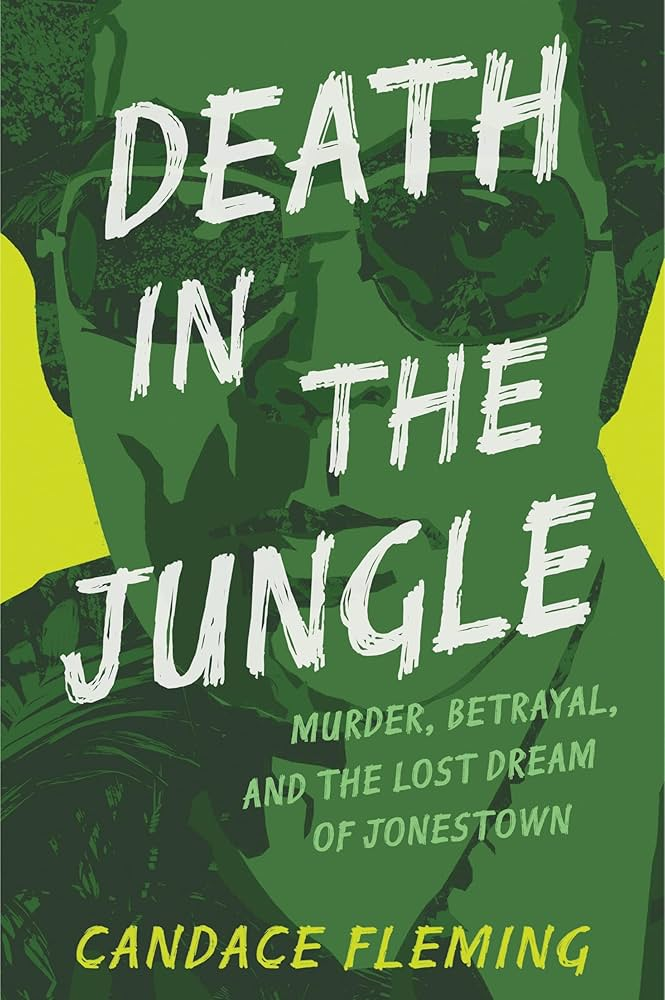
Death in the Jungle: Murder, Betrayal, and the Lost Dream of Jonestown by Candace Fleming (Anne Schwartz Books, 368 pages, grades 7 and up). Most of us know about Jonestown and the tragic end that befell more than 900 residents in the Guyana jungle. This book takes readers back to founder Jim Jones’s earliest days and shows how a bizarre mix of idealism and quest for power led him to start the People’s Temple which moved from Indiana to California, and finally to Guyana where Jones basically kept his followers imprisoned: cut off from the world and subject to his paranoid drug-fueled ravings. Individual members of the group are profiled, based on Fleming’s interviews with survivors, and their memories of enjoying being part of a warm community mixed with traumatic punishments, sleep deprivation, and overwork serve as a warning to anyone drawn to a charismatic leader like Jim Jones. Includes source notes, a bibliography, and an index.

I remember reading about this incident in the news during my own teenage years and trying to make sense of what could have possibly gone so horribly wrong. This book answers some of those question–although many are unanswerable–and is told in such a compelling style that I could not put this book down and read it in about 36 hours. It’s an especially important book for teens, as many of those interviewed were their age during the events of the story (including Jones’s son Stephan), and in many cases, a questioning attitude toward authority saved them.

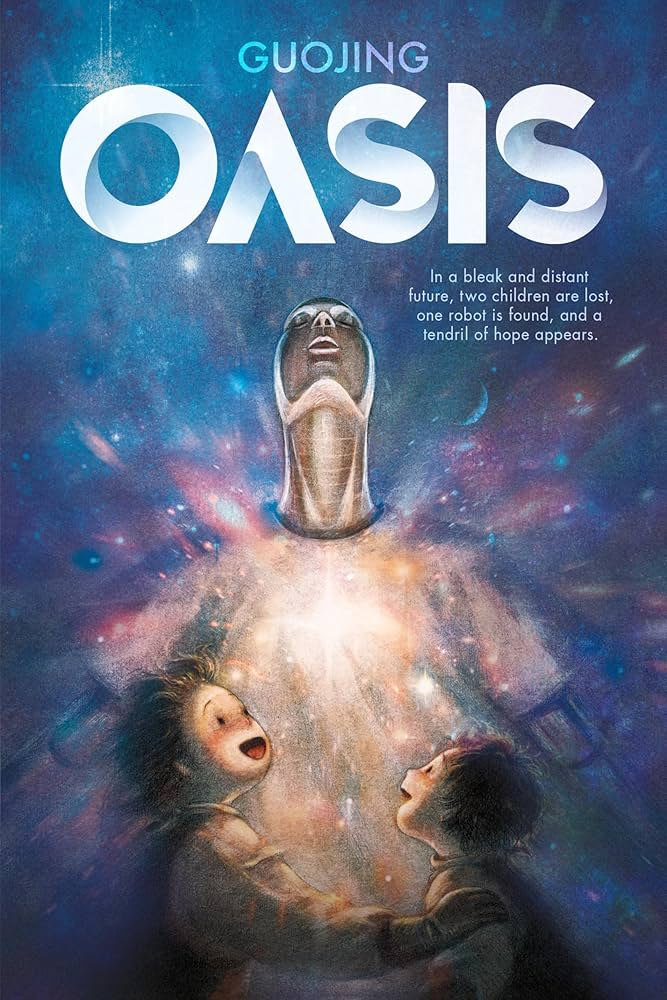
Oasis by Guojing (Godwin Books, 160 pages, grades 4-7). Two children live in the desert, fending for themselves with only occasional phone calls from their mother who works in Oasis City, trying to get permission to bring her children to live with her. When the kids find a broken robot, they’re able to repair it and activate its “mother” mode, giving them an AI mom. When their human mother comes home for a few days, she discovers the AI mother, and destroys it in a fit of fear and rage. Her daughter runs off, and the mother is able to repair the robot and bring the daughter back home. The two mothers share their hopes and dreams for the children, and the AI one shows how she has been able to reproduce conditions in Oasis City to start growing plants, giving them hope that one day they can all live in the desert together. The author information relates that Guojing was inspired by “left-behind children” in China, who stay in rural areas when their parents go to find work in the city.

I had gotten this book out of the library several months ago, after seeing its five starred reviews, but I was a little put off by the dark artwork and never got around to reading it. I’m so glad I gave it another try. It’s a quick read–it only took me about 15 minutes–but it packs a powerful punch and celebrates all sorts of family connections and love. The cover says, “In a bleak and distant future, two children are lost, one robot is found, and a tendril of hope appears,” but it didn’t seem like such a distant future to me.

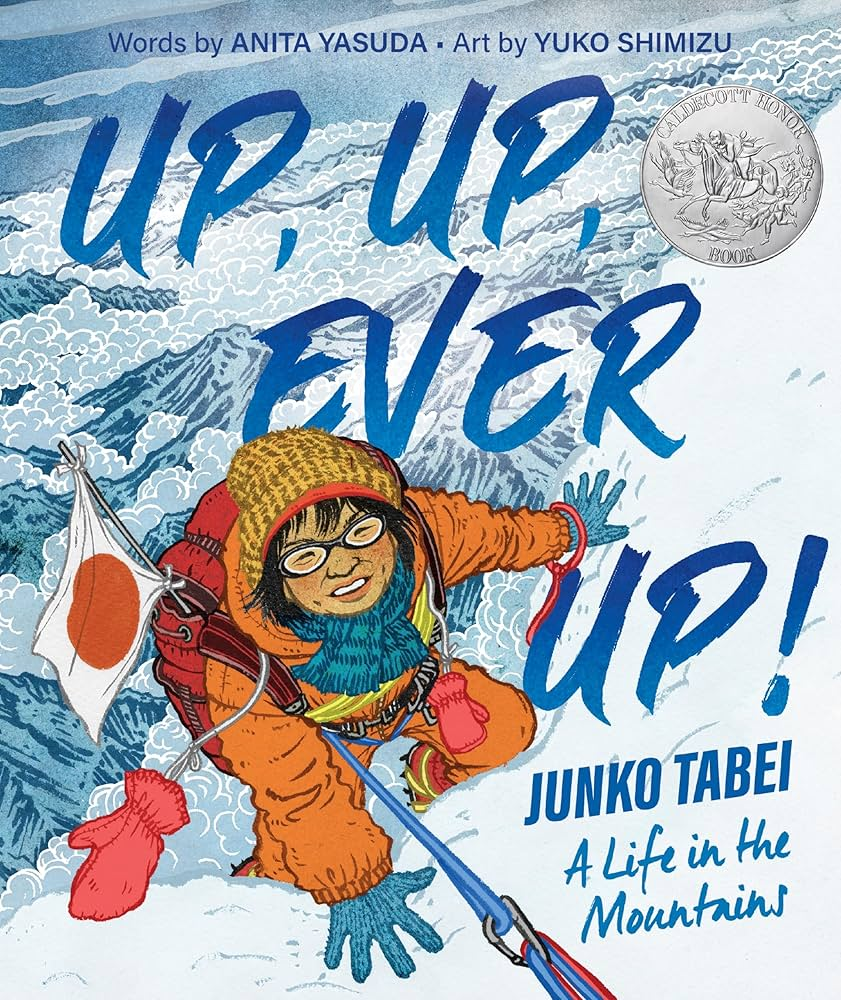
Up, Up, Ever Up! Junko Tabei: A Life in the Mountains by Anita Yasuda, illustrated by Yuko Shimizu (Clarion Books, 48 pages, grades 2-5). As a child, Junko Tabei dreamed of climbing mountains, and she pursued that dream when she moved to Tokyo as a young woman. Most mountaineering clubs didn’t take women, but Junko persevered until she found one that did. Even after marrying and having a daughter, Junko continued to climb and to encourage other women to join her. Eventually they planned an expedition to become the first all-female team to climb Mount Everest. Even an avalanche couldn’t stop her, and Junko realized her dream of being the first woman to reach Everest’s summit. In her later years, she became an activist for sustainable mountain climbing, researching the impact of trash and human waste on Everest and helping to mitigate some of those effects. Includes an author’s note, timeline, glossary, and bibliography.

I’m a little late to this 2024 book, but I’m breaking my rule of only reviewing books published in the current year. The Boston Globe-Horn Book Award follows the school year calendar, so it was eligible for this year’s award and was an honor book, in addition to winning a 2025 Caldecott Honor. Both are well-deserved for the beautiful ink and color illustrations that not only portray breathtaking mountain landscapes but celebrate Junko’s Japanese culture.

Graphic novels with girl power

Words Apart by Aimee Lucido, illustrated by Phillippa and Rachael Corcutt (Versify, 394 pages, grades 4-7). Olive is the younger sister who shares a love of words with her linguist dad. Maddie is the older sister, an artist who struggles in school. Since Maddie repeated kindergarten, the two girls are in the same grade. Maddie, who experienced bullying in her younger days, keeps to herself and encourages Olive to do the same. So when Olive gets a crush on a boy and starts working with him on the school paper, Maddie is jealous. On the home front, their dad has taken a job that requires him to live away from home during the week. When he returns on weekends, Maddie begins to suspect that he’s hiding a secret. All of the stresses come together, and the sisters end up hurting each other deeply. When their parents give them some difficult news, they must find a way to repair their relationship even if it will never be the same as it was.

Told in alternating voices, with Olive’s written in verse and Maddie’s in comics, this book took a much more serious turn than I was expecting, given the cover and the format. It deals with a lot of tough issues in a very relatable way. Don’t be put off by the page count, the comics and verse writing make it a pretty quick read.

Kindred Dragons by Sarah Mesinga (Harry N. Abrams, 208 pages, grades 4-8). Imagine if Anne of Green Gables were named Alice, her parents were still alive (but traveling with a theater company, hence her stay at Green Gables), and some of the other girls and women in the community were “kindreds,” entrusted by the fairies to take care of a dragon in a way that makes their lives dependent upon each other. Alice longs to be a kindred, but so far she hasn’t received an egg, although many of her friends have. When she encounters a dragon named Brim whose kindred–an elderly woman with a reputation for being a witch–is missing, she is determined to help him reunite with Miss Gilroy. Her advocacy for the two of them lands her in big trouble with her grandmother, but eventually Alice prevails. Although the reunion between Brim and Miss Gilroy ends with heartbreak, it results in a deeper bond between Alice and her grandmother and the revelation of Alice’s unique magical powers.

Even those unfamiliar with Anne of Green Gables will love this imaginative tale that celebrates both individuality and community and weaves an enchanting tale that combines magic with everyday life. The art is gorgeous, particularly the aerial views that showcase both the dragons and the Prince Edward Island scenery.

Strangers in strange lands

How to Say Goodbye in Cuban by Daniel Miyares (Anne Schwartz Books, 240 pages, grades 4-8). Daniel Miyares tells the story of his father, Carlos, a young boy living in the Cuban countryside in 1956. When his father wins the lottery, he decides to pursue his dream of opening a furniture store, moving the family to the big city. Carlos is heartbroken to leave his friends and grandparents, but things take a darker turn as the political landscape in Cuba changes dramatically. The beginning of each chapter shows Castro’s slow rise to power, as he gathers enough supporters to overthrow Batista and takes over the country. Carlos’s parents aren’t particularly political, but that doesn’t protect them from the state taking his dad’s business. Carlos secretly watches Papi and some other men work every night building a boat, and shortly after that, his dad disappears. When life gets more dangerous in the city, the family returns to their grandparents’ farm, where Papi reunites with them and tells them they’re going to America. Carlos is heartbroken all over again, but his father convinces him it’s their only chance for a better life. After a dangerous nighttime journey, they arrive in Florida, ready to begin that life. Includes a four-page author’s note with additional information about Carlos and how his son Daniel came to write this book, along with several photos.

I was surprised to learn that Daniel Miyares has never won a Caldecott, and this graphic novel could easily remedy that situation–or win him a Newbery. The story and gorgeous artwork capture both the beauty of Cuba and the tension, confusion, and danger of the early days of Fidel Castro’s regime. The last part of the book, covering the family’s escape is both suspenseful and moving, and readers familiar with today’s immigration situation will be surprised at the welcome the Cubans get from the American military.

The Experiment by Rebecca Stead (Feiwel and Friends, 288 pages, grades 4-7). Despite his normal New York City upbringing, Nathan has always know that he’s different from other kids. He brushes his teeth five times a day with special pink toothpaste, his mother carefully records every calorie he eats, and…he and his family are aliens. Known as the Kast, his parents have raised Daniel on tales of how they traveled from their home planet as children to begin an experiment living on Earth. Nathan meets each month on Zoom with other Kast children, and he’s begun secretly texting one of them, a girl named Izzy. But recently a few of the kids, including Izzy, haven’t been on the calls, and when Nathan discovers that he’s growing a tail, he suspects he’ll be the next to disappear. He’s not wrong, and he and his parents are summoned to the mother ship, which sits in a parking lot outside a Pennsylvania mall, disguised as a storage container. As Nathan learns more about the ship and his parents’ past, he begins to suspect that it’s all a deception, and that he and the others might be human after all.

This science fiction story is hard to put down once you get through the first few chapters, and the last half has plenty of twists and turns that will keep readers guessing until the very end. It reminded me a little bit of a Margaret Peterson Haddix story and would make a great introduction to the sci-fi genre.

Early reader graphic novels: two mysteries and quite possibly the weirdest book ever!

Cabin Head and Tree Head by Scott Campbell (Tundra Books, 88 pages, grades K-4). Obviously, Cabin Head is a creature with a cabin on his head, complete with a family inside and smoke coming out of the chimney, and Tree Head likewise has a tree on his (aww, look at the kid in the tire swing!). They’re best friends who also enjoy hanging out with other members of their community like Library Head, Pool Head, Volcano Head, and Outhouse Head. In a series of stories, they show that they may not be the brightest lightbulb heads in the chandelier head, but they are loyal friends and funny storytellers. Readers will cheer at the declaration on the final page: “Cabin Head and Tree Head shall return for more wonderful book times.”

Around page 11, I paused to consider: is this the weirdest book I have ever read? I mean, we do have the Noodleheads, not to mention a hit series based on the premise of a dog’s head being attached to a man’s body. But Cabin Head and Tree Head are definitely in the running for weirdest, but also for funniest, and I found myself laughing aloud throughout the book, particularly at the illustrations. I predict great things for these two, so be sure to stock up and keep an eagle eye out for book 2.

Detective Beans and the Case of the Missing Hat by Li Chen (Andrews McMeel, 208 pages, grades 1-4). Beans is an adorable cat detective who sets out to solve the case of the mystery note giver when he finds a series of encouraging notes stuck to his stuff. He’s derailed from this case almost immediately, though, when his lucky detective hat goes missing. Beans spends the day traveling around town, tracking down clues, generally just one step behind the hat as it’s passed from one owner to the next. He finally gets it back, and in the process accidentally catches a wanted diamond thief. The last few pages remind the reader that the mystery note giver still hasn’t been identified, but perhaps this mystery is unraveled in book 2, which came out earlier this year.

This is actually a 2024 book, but I was unable to resist the cute cover, and the rest of the book did not disappoint. Kids will love the artwork, and the story is simple yet engaging enough to hook those who are just starting to read independently. 

Detective Stanley and the Mystery Museum by Hannah Tunnicliffe, illustrated by Erica Harrison (Flying Eye Books, 64 pages, grades 1-4). Detective Stanley is enjoying his first morning of retirement from the Narlybone Criminal Investigation Department when a letter arrives at his doorstep begging him to come to the Narlybone Museum and figure out who’s behind the break-in there. Unable to resist a heartfelt plea–despite having to leave his pancakes behind–Stanley heads to the museum, where he finds a big mess but no stolen items. When he’s framed for the theft of a police officer’s watch, Stanley unexpectedly winds up in jail. From his cell, he’s able to puzzle out what really happened at the museum and convince a police officer to accompany him back to the scene of the crime. There, he unmasks the real thief in dramatic fashion and is able to return to his pancakes in time for supper. Includes information on Piet Mondrian, whose artwork is featured in the story, as well as a preview of book 2.

Another fun mystery for early readers, this one had a surprising number of twists for such a short story, some sly humor, and artwork full of cute animals that brought to mind Richard Scarry’s work as they go about their day.

A year in the life of a middle schooler

Dear Jackie by Jessixa Bagley, illustrated by Aaron Bagley (Simon and Schuster Books for Young Readers, 288 pages, grades 4-7). Jackie and Milo are best friends, born on the same day and growing up next door to each other. They’re nervous about sixth grade but certain they can navigate it together. When Milo starts hanging out more with his soccer teammates, and Jackie’s frenemy Adelle teases her about not dressing like a girl or having a crush, Jackie decides to take matters into her own hands. She types a letter to herself from a secret admirer and “accidentally” drops it into Adelle’s locker, which is right above her own. The cool kids are intrigued, so Jackie writes another note to get more positive attention. Before long, she’s in over her head, and she and Milo have both hurt each other with a series of misunderstandings and cruel pranks. Jackie gives into pressure and goes to the big school dance, but when the kids find out the identity of her “secret admirer,” she’s sure her life is over. With the help of her older sibling Bari, she figures out how to tell her parents who she really is and to make amends with Milo. A final letter to Bari at college reveals that she and Milo have found their people through a gaming club, and seventh grade promises to be a much better year for everyone. Includes notes from the wife-and-husband author and illustrator.

Fans of middle school graphic novels will enjoy this one, which really pours on the middle school cringe and cruelty in a way that all too many of us will find familiar. Non-binary Bari and Jackie will help kids see that there are many ways to express your identity, and the most important thing is to be true to yourself. I hope we get a sequel to find out how seventh grade turns out.

Winging It by Megan Wagner Lloyd, illustrated by Michelle Mee Nutter (Graphix, released October 21, 272 pages, grades 3-7). Luna’s unhappy when her dad tells her they’re moving from California to Washington, D.C., and even more so when she learns they’ll be living with her maternal grandmother until they can find their own place. Luna’s mom died when she was a baby, and while she would like to be closer to Grandma and learn more about her mom, her grandmother has always seemed stiff and distant. One day, though, Grandma shares her mother’s old nature journal, and Luna, who’s never enjoyed the outdoors, starts taking tentative steps to explore the natural world, with her biggest dream being to see the luna moth for whom she’s named. Slowly, she starts making friends with her neighbors and getting involved with her school’s environmental club. Even her busy father and her grandmother take an interest in sharing nature with Luna, and by the time a year has gone by, everything has changed so much that Luna feels like she’s truly found a new home.

Fans of Allergic and Squished will be excited to see a new graphic novel by the same team. Just like Dear Jackie, this story goes month by month through a school year, from one summer to the next, and shows the reader how much can happen in a middle school year, and how many changes there can be. Luna is forced to be brave as she deals with a big move and the adjustment of living with a grandmother she barely knows, but she rises to the occasion and discovers parts of herself she never knew existed.

Courageous women of World War II

The Spy in the Museum: How Rose Valland Saved Art from the Nazis by Erin McGuire (Beach Lane Books, 40 pages, grades 2-5). Rose Valland loved art. As curator of Paris’s Jeu de Paume Museum, she appreciated all kinds of art: ancient, classical, or modern. Adolf Hitler hated modern art. When Nazis took over Rose’s museum, they fired all the staff except Rose, who was kept on as manager. As they started to steal the art, selling it to fund the war, Rose secretly listened to their conversations and made notes about where the art was going. The soldiers didn’t know she spoke German, but they still became suspicious of her, which put her in grave danger. Towards the end of the war, as the Nazis fled Paris, Rose worked with the French Resistance to stop their final train, loaded with valuable artworks, from leaving the country. For much of the rest of her life, she used her notes to help restore the stolen artworks from around the world. Includes additional information about Rose Valland and the art she worked to save, as well as a list of sources.

This inspiring story is supplemented with interesting and timely questions in the author’s note: why does protecting art matter, and why did the Nazis want to destroy it? The illustrations, many including famous artworks, add to the story and the conversation.

Song of a Blackbird by Maria van Lieshout (First Second, 256 pages, grades 8 and up). The narrative of this graphic novel alternates between 2011 and 1943 Amsterdam. In 2011, Annick is trying to find help for her Oma’s leukemia. When bone marrow tests reveal she was adopted, the two turn to a set of prints from her childhood, each signed by “Emma B.” to try to learn more about her past. Emma is the 1943 protagonist, an artist and student whose education is interrupted by the Nazi invasion of the Netherlands. She uses her talents to aid the Resistance, helping to create false documents and working to rescue children whose parents are being sent to concentration camps. A blackbird that represents art and creativity narrates, showing how his gifts help those in the darkest of circumstances. The two stories eventually meet, and the reader learns the fate of all the characters in a moving epilogue. Includes extensive back matter about the buildings pictured in Oma’s prints and the real-life people on whom Maria van Lieshout based her story.

I learned about this book when the National Book Award Longlist was announced a couple of weeks ago, and it absolutely blew me away. I truly can’t imagine creating this impeccably researched historical fiction, with its two riveting narratives, each one portrayed in its own color palette. Usually I’m rooting for a middle grade win over YA, but this is a compelling choice for sure. Although both books take place over 80 years ago, their stories speak to the timeless power of art and will surely inspire those fighting to create a brighter world.

Elementary heroines

Dream On by Shannon Hale, illustrated by Marcela Cespedes (Roaring Brook Press, 240 pages, grades 3-6). Fourth-grader Cassie has a lot of big emotions as she navigates the difficult terrain of growing up in a small house with a large family and dealing with changing friendships at school. When she sees a flyer in the mail telling her she’s won some fancy prizes, she starts to dream about how this could change her life. Usually, she would enjoy sharing those dreams with her best friend Vali, but recently Vali’s been spending more time with another girl who alternates being friendly and being mean to Cassie. Cassie’s frequently told that she’s too sensitive, but she can’t help the way she feels, and as the story goes on, she learns that being sensitive also means having a greater sense of wonder about the world around her. Things don’t magically resolve themselves, but having good conversations with her mom (who’s often too busy for such things) and with Vali about their friendship helps Cassie feel better about her problems and to find a way to a new normal at school and at home. Includes a note from Shannon Hale about the parallels between Cassie’s 1980’s childhood and her own.

Fans of Shannon Hale’s Real Friends series will be delighted to discover this new graphic novel, with book 2 coming in August 2026. Just as with Real Friends, I found the tone of this book a little melancholy, but it’s a realistic portrayal of a character who is extra sensitive, making her prone to lower moods but also extra appreciative of more joyful ones.

Amina Banana and the Formula for Friendship by Shifa Saltagi Safadi, illustrated by Aaliya Jaleel (G. P. Putnam’s Sons, 128 pages, grades 2-5). Amina’s both excited and nervous about her first day of third grade in America. Her family has recently relocated from Syria to Indiana, and all of them have had to overcome many difficulties, with obstacles still ahead. Being scientifically inclined, Amina writes a five-step formula for making friends at her new school, only to find herself crossing off one step after another after a series of discouraging setbacks. But she finds a kind group of girls who help her with her English and encourage her to share her culture with them and with the rest of the class. By the final pages, Amina has found new friends and the courage to be herself in her new country.

I was wowed and humbled by the courage of Amina and her family in this early chapter book series starter (book 2 is out, and #3 will be published in January). Her dad, a pharmacist in Syria, is working at a fast food restaurant while her physician mom studies to pass the boards so she can practice medicine in the U.S. Despite their hardships, the family is loving, supportive, and has fun together. I’m always happy to find books featuring protagonists in younger elementary grades, so it was nice to discover these two books with girls in fourth and third grades.