Gamerville by Johnnie Christmas (HarperAlley, 256 pages, grades 3-7). Max feels like he doesn’t need friends when he immerses himself in the world of video games, and he’s excited to qualify for the big Gamerville championship. In some unfortunate timing, his mother signs Max up for Camp Reset, a monthlong summer camp designed to get kids unplugged and back to nature, which takes place the same time as Gamerville. The gaming venue is right across the lake from the camp, and Max spends his days plotting an escape. His nemesis is a girl named Zanzi, great-great-granddaughter of the camp’s founder, who eschews all technology. Surprisingly, the two eventually become friends, along with a third boy, Dylan, who has anger issues and has been shunned for being a bully. When they finally succeed in getting Max to Gamerville, he ends up using the lessons he’s learned about teamwork and friendship to make some surprising decisions at the competition.
Although this lacked the interesting historical flashbacks that made Johnnie Christmas’s Swim Team one of my favorites, it’s an engaging story with interesting characters and some good messages about friendship and finding a balance with technology. I’m sure you can introduce this as “a graphic novel about a gamer,” and kids will be clamoring for it.
Camp Prodigy by Caroline Palmer (Atheneum Books for Young Readers, 256 pages, grades 4-7). Tate is just starting viola, and they’re feeling unsure about their musical talents as well as their nonbinary identity, which is still a secret. Their original inspiration for learning viola was another nonbinary violist named Eli; when Tate went to see Eli’s debut concert, Eli got stage fright and never performed. The two meet at a summer music camp, Camp Prodigy, where they both struggle to find a balance between a love of music and a quest for perfection. Other campers help them to have fun or to perfect their playing. By the end of camp, they’ve both come a long way toward discovering what works for them, Tate has come out to friends and family, and Eli has loosened up on their perfectionism. Several pages at the end show how Caroline Palmer created the art for the book.
Kids are going to be begging their parents to go to camp after a handful of graphic novels this summer that portray it as a middle school paradise for making friends and experiencing personal growth. This one is an excellent addition, with two loveable nonbinary characters and a host of other interesting kids (I had a little trouble keeping track of them all) that make Camp Prodigy a fun and rewarding time for everyone.
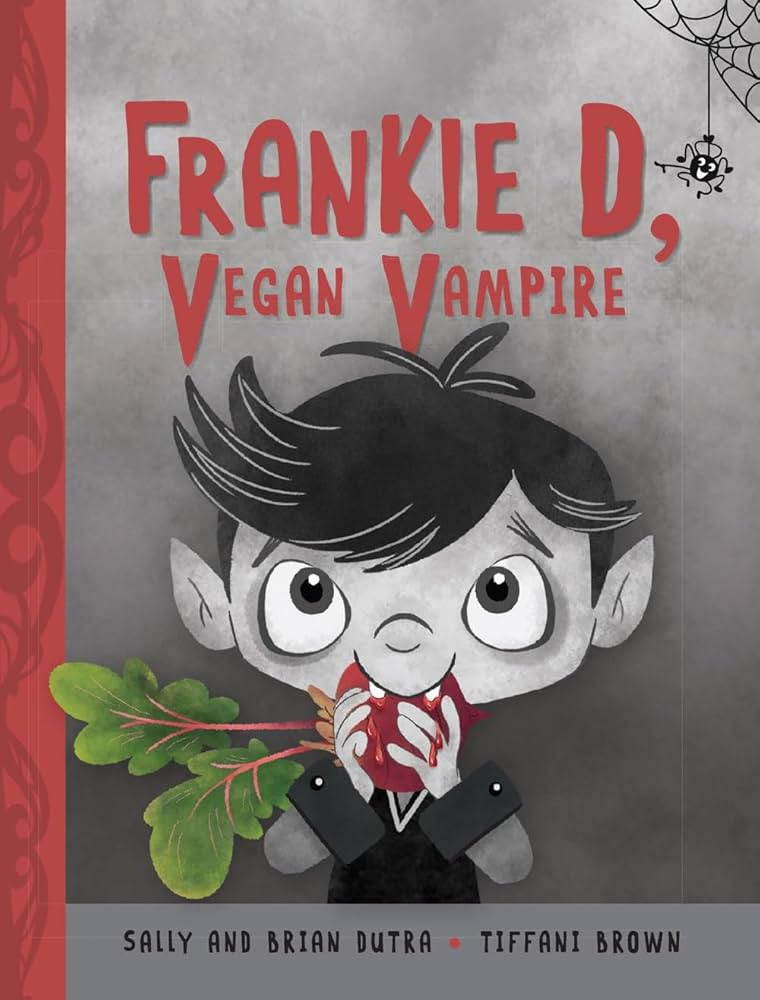
Frankie D., Vegan Vampire by Sally and Brian Dutra (Kids Can Press, 192 pages, grades 2-5). Frankie and his family have moved from Transylvania to the U.S., hoping, like so many immigrants before them, for a better life. In their case, that life is eternal, since they’re a family of vampires. Being immortal is just the beginning, as Frankie and his family struggle to hide their fangs, their ability to turn into bats, and the fact that they’re used to sleeping during the day (and in coffins). Switching to a healthy vegan diet has fortunately dampened their taste for blood, and Frankie enjoys starting fourth grade and making new friends. He suspects that one classmate, Eddie, might be a troll, but as he learns more about Eddie, he comes to realize why he’s such a bully. The family successfully negotiates having one of Frankie’s new friends and his family to dinner, and Frankie has fun at a human birthday party, but the grand finale comes with the school concert, when Frankie and Eddie save the fourth-grade performance. Pumped after this success, Frankie decides to fly home and burn off some of his excess energy, only to realize that Eddie has seen him transform into a bat.
There’s plenty of humor in this de-fanged vampire story, and the last page makes me hopeful that there will be a sequel. It’s an illustrated chapter book, but at close to 200 pages, I wouldn’t exactly call it an early chapter book. Still, I think it could find an audience with fluent readers in the earlier years of elementary school, and maybe older kids who are reading a bit below grade level.
Band Camp #1: All Together Now! by Brian “Smitty” Smith (little bee books, 80 pages, grades 1-4). This early graphic novel gives summer camp a new twist: all the campers are musical instruments. Bunk J, a.k.a. Junk Bunk, the cabin that always loses all the competitions, has four unique residents this summer: Trey the triangle, Kaylee the ukelele, Zook the kazoo, and Cordelia the accordion. Each instrument has a unique personality and well-defined likes and dislikes, but they’re united in their determination to put an end to the Bunk J legacy. In a relay race at the end of this book, they combine their talents for an unexpected victory. Camp’s not over yet, though, and book 2 is due out in September.
As a veteran of eight–yes, eight!–band camps, I love this premise and was amazed at how Smith was able to create instruments with real personalities. Early readers will get a kick out of the story and illustrations. The ending seemed abrupt, and I kind of wish the whole camp session had been included in a single volume.
Upstaged by Robin Easter (Little Brown Ink, 256 pages, grades 4-8). Ash has had a crush on their best friend Ivy for quite a while now, and they’re excited about having one last summer with her at theater camp before going off to high school. Ash is stage manager, and Ivy has the lead of the musical Ella, based on the story of Cinderella. But things don’t turn out according to Ash’s plans, and as the summer progresses, it seems as though Ivy is always with her co-star Luke. Despite a surprising crush that another girl has on them, Ash is only interested in Ivy, and eventually lets their middle school emotions get the best of them, resulting in an angry outburst at Ivy and Luke. Fortunately, Ivy is able to cool things down, and there’s a fairy-tale style happy ending in store for everyone–and a successful show to wrap things up.
Not If You Break Up with Me First by G. F. Miller (Aladdin, 288 pages, grades 6-8). Andrew and Eve have been best friends for most of their lives, but things start to change in eighth grade. Eve gets pressured by her friends into asking Andrew to a dance, and the next thing either one of them knows, the whole school considers them a couple. Both Andrew and Eve (who alternate narrating the chapters) hate the expectations that seem to come with dating and want to get back to the comfort of their old friendship. They each have their own reasons for not wanting to be the one to initiate the break, though, so they each decide to do what they can to make the other one break up. Having been friends for so long, they are experts at pushing each other’s buttons, and things escalate until the whole school gets involved, and the two of them are facing detention. Fortunately, the truth comes out at both their homes, and Andrew’s mom coaches him on “the grand gesture” that results in (finally) an honest conversation between Eve and Andrew. Both acknowledge having feelings for each other, but also wanting to keep their old friendship, and a mutual break-up seems like the best solution for the time being.
Any Way You Look by Maleeha Siddiqui (Scholastic, 256 pages, grades 4-7). Ainy is excited about the end of sixth grade and the beginning of summer, looking forward to adventures with her best friend Safiya and helping her mother, Amma, and older sister, Bajja, at Amma’s clothing boutique. Ainy dreams of designing modest fashions for a living, so she’s thrilled when Amma entrusts her with an important design job. Unwanted attention from a boy from her class threatens to ruin her summer, though, and Ainy doesn’t know who to turn to for help. Amma is swamped with work, Bajja has unexpectedly stopped being a hijabi, and their dad is back in Pakistan, taking care of his mother who has cancer. Ainy decides to start wearing hijab in the hope that it will make the boy lose interest in her, but it ends up precipitating a crisis in which the truth finally comes out. Once Amma, Bajja, and Safiya learn what’s been happening, they help Ainy find the strength to speak up and set boundaries, and they teach her the true meaning of hijab and help her to decide whether or not she’s ready for it.
I got a triple dose of middle school angst with these three books. Each featured a main character with a big problem and an unwillingness to talk to anyone about it, resulting in lots of drama and a near-crisis that finally led to getting things out in the open. Upstaged is a graphic novel perfect for fans of Raina Telgemeier’s Drama; Not if You Break Up With Me First almost drove me mad, but resulted in the sweetest ending that middle schoolers in search of realistic romance will love; and Any Way You Look is a heartfelt and engaging story that looks at sexual harassment, setting boundaries, and learning to advocate for yourself, all from the perspective of a Muslim girl considering wearing hijab. Each book could have been a very short story if the main character had just had a conversation already, but hey, that’s middle school for you.
The Life-Changing Magic of Chess by Maurice Ashley, illustrated by Denis Angelov (Harry N. Abrams, 40 pages, grades 2-6). Maurice Ashley, the first Black Chess Grandmaster, weaves together his own story with some basics of playing chess. The book is divided into ten tips from Ashley (#1 – It’s like being a magician, #2 – Everyone starts as a beginner), which he elaborates on in a series of two-page spreads. In addition to introducing the pieces and explaining how they move, he includes a few suggested series of plays. It’s clear that becoming a good chess player involves a lot of hard work and research, and Maurice talks about some of the setbacks he experienced on the road to Grandmaster, encouraging kids to persevere and hold onto their dreams. The last few pages include more information about him, along with several photos, and there’s also a glossary.
This new series includes The Life-Changing Magic of Skateboarding, with drumming and baking due out at the end of the summer. Although I have never understood chess nor had the inclination to play it, I found this book very engaging, and I like the way Maurice Ashley tells his own story as he explains the fundamentals of the game. The illustrations add a lot and are essential for showing how to move the pieces to start or end a game. I hope there will be many more additions to this series.
Curveball by Pablo Cartaya, illustrated by Miguel Diaz Rivas (Disney Hyperion, 192 pages, grades 3-7). Elena is an excellent baseball player, the only girl on the boys’ team, with a mother whose support borders on helicopter parenting. When Elena hurts her knee at the beginning of the summer, she’s a bit relieved to have to give up her planned baseball clinic, but she soon realizes that she has no friends outside of baseball. With nothing else to do, she starts hanging out with her younger brother and his live action role-playing (LARP) pals. Elena’s kind of forgotten how to use her imagination and have fun, but the other kids talk her through it, and before long she’s not only figured out a way to combine baseball and LARP, but she’s met a couple of sporty girls her age who have learned how to strike a balance between athletic competition and fun. Their example helps Elena find the courage to talk to her mom, who reveals how her own early disappointments have fueled her passion for Elena’s baseball playing and agrees to let Elena have more autonomy over her own life.
Part Roller Girl, part Cardboard Kingdom, this colorful graphic novel has something for everyone, with a strong Latina character (Spanish is expertly woven into the dialog), and a nice message about finding a balance in life.
Lucky Scramble by Peter Raymundo (Dial Books, 192 pages, grades 3-7). The story of the national Rubik’s Cube championship focuses on 12-year-old Tyler Gooden, an up-and-coming cuber who got his start after his dad died three years ago. The Rubik’s cube was a gift from his father, and although Tyler had never solved it, focusing on it after his dad’s death helped him with his grief. Other competitors are profiled, including egotistical champion Dirk Speedman, 8-year-old prodigy Eli Newton and his obnoxious dad who will stop at nothing to see his son win, twins Izzy and Lizzy who are learning to establish their own identities, and 1980’s great Miles Wizzinski, who’s hoping for a comeback despite his carpal tunnel syndrome. The national championship competition brings out the worst–and eventually the best–in many of the characters, as they all learn and grow on their way to fighting it out for the title.
This hybrid mix of illustrated chapter book and graphic novel is sure to be a hit with its colorful cartoon-style illustrations and intriguing, if slightly one-dimensional, characters. Watching the competitors solve the cube in record-breaking times will surely have readers seeking out winning strategies on YouTube.
Life After Whale: The Amazing Ecosystem of a Whale Fall by Lynn Brunelle, illustrated by Jason Chin (Neal Porter Books, 48 pages, grades 2-5). When a 90-year-old blue whale dies on her annual northern migration, her body slowly sinks a mile before settling on the bottom of the ocean. Scavengers like hagfish and sleeper sharks, attracted by the chemicals released to this rare source of food, start devouring the whale meat. This process can go on for years until only the skeleton is left. A second stage begins with a new set of scavengers (hello, bone-eating zombie worms), who feed on the whale remains for decades. 150 years later, the bones are still releasing chemicals that feed algae, which in turn feed krill. The krill is eaten by a pregnant blue whale, thus completing the cycle of life that includes the old blue whale and the new one. Includes additional information about blue whales, ecosystems, and the four phases of a whale fall ecosystem, as well as additional resources.
This beautiful, well-written science book is sure to be a contender for the Caldecott and the Sibert awards, both of which amazing illustrator Jason Chin has won before. The information is fascinating, with descriptions of a process and animals that exist so far under the sea that scientists are just beginning to learn about them. There’s a lot of text and scientific information, which made me wonder if the book would hold the attention of younger elementary readers. If it’s too much, you can direct them to Melissa Stewart’s Whale Fall.
I Was: The Story of Animal Skulls by Katherine Hocker, illustrated by Natasha Donovan (Candlewick, 40 pages, grades 2-5). A skull says, “I was,” as the teeth, bones, holes, and cracks help tell the story of the animal it belonged to. Each two-page spread shows a skull with the voice of the animal describing part of the skull that hints at its identity. Turn the page and see the animal as it looked when it was alive. There’s a lynx, a deer, a beaver, a hummingbird, a wolf, and an owl. The last few pages celebrate the human skull, which protects the brain that allows us to understand the world around us. Includes a labeled diagram of a human skull with additional information about different parts, more information about the animals in the book and the human skull, and a few additional resources.
The large, vivid illustrations capture both the skulls and the animals beautifully. I always enjoy a book that gives kids the opportunity to guess what’s coming next, as it makes for a more engaging read-aloud. I found the premise kind of sad, though, with dead animals describing themselves when they were alive, and I wish the name of the animal had been included with the picture.
Survival of the Fittest: Who Will Come Out on Top? by Rebecca Donnelly, illustrated by Misa Saburi (Henry Holt and Co., 112 pages, grades 2-5). A reality TV show has six animals competing for the best engineering feat, with a hermit crab serving as host and three sharks judging. A chameleon, humpback whale, gecko, elephant, peacock mantis shrimp, and diabolical ironclad beetle each make a case for why it should be the winner, showing off a unique adaptation that allows it to survive. A winner is declared in the final chapter, and additional information about each animal’s “invention” is given on the last few pages.
Billed as book 1, this looks to be the start of a graphic novel series that may appeal to fans of the Who Would Win series. It’s cute and funny, with some interesting animal information, although not nearly as much as Who Would Win provides. The winner seemed like kind of a random choice, but I guess that’s more or less in keeping with the nature of reality TV.
Samira’s Worst Best Summer by Nina Hamza (Quill Tree Books, 336 pages, grades 4-7). Sammy’s hoping for some down time over summer vacation to recover from a rough seventh grade year. Painfully shy and insecure, her best times are when she’s behind a camera observing and taking pictures. When her house is toilet papered on the last day of school, she’s sure her ex-best friend Kiera is behind it, part of a campaign of cruelty that has gone on all year. Sammy’s grandmother, Umma, arrives from India to look after Sammy and her younger brother Imran, while their parents and older sister travel to India for a family wedding. Umma is loving, supporting, and also extremely outgoing, and she slowly draws Sammy out of her shell, helping her to connect with some of the neighbors, especially Alice, a new girl on the street. As Sammy and Alice work together to solve the mystery of the TP’ing and another mean prank, Sammy slowly learns to speak up for herself and to claim a new identity for herself as Samira.
Summer Vamp by Violet Chan Karim (Random House Graphic, 240 pages, grades 3-7). Maya’s another one recovering from a difficult school year, her only refuge being the kitchen where she enjoys whipping up delicious masterpieces. She’s not sure how she feels when her dad and his girlfriend, Charlotte, announce on the last day of school that Charlotte is moving in, but the blow is softened when she learns that Charlotte has offered to send her to culinary camp. A mix-up at the bus station lands Maya at Camp Dracula, where the other campers have fangs, drink blood boxes instead of juice boxes, and don’t have reflections. Horrified at first, she slowly begins to bond with the other campers and finds them friendlier and more accepting than the humans she’s been around recently. By the time she gets the opportunity to switch to culinary camp, Maya realizes that Camp Dracula is where she belongs.
Although these books have many differences, they are remarkably similar with introverted protagonists who have endured a grueling middle school year, and who find supportive friends and family to help them embrace their strengths and come into their own during summer vacation. I found both of them extremely engaging stories that would make for some great beach reading. Of all the vampires I’ve been forced to read about over the years, Maya’s friends may be my favorites.
Everyone Gets a Turn by Marianne Dubuc (Princeton Architectural Press, 60 pages, ages 4-9). When friends Bear, Mouse, Turtle, and Hare discover an egg, each one wants to take it home. The egg provides the answer: “Everyone gets a turn!” Mouse found the egg, so he brings it home first, getting to know the egg and learning how to keep it comfortable. Next is Bear, who gets a surprise: the egg hatches, and Little Bird arrives. Hare and Turtle figure out how to feed and care for a young bird, and by the time the visit with Turtle ends, Little Bird has built her own home and is ready to take care of herself. There’s a housewarming party, at which time Little Bird declares she will henceforth be known as Clara, and the five friends and neighbors “continue to grow, each in their own way.” The story could hardly be any cozier or more heartwarming, and the longer page count and graphic novel format will make it appealing to older readers as well as younger kids. I’d love to know the story of how this came to be published by the Princeton Architectural Press.
The Bicycle: How an Act of Kindness Changed a Young Refugee’s Life by Patricia McCormick and Mevan Babakar, illustrated by Yas Imamura (Balzer + Bray, 40 pages, grades 1-4). Mevan tells the story of her childhood, beginning with idyllic early years surrounded by family in Kurdistan. When the Iraqi government begins persecuting the Kurdish people, Mevan and her family are forced to flee, first to Turkey, then to Russia, and finally to the Netherlands. Mevan learns to make herself as invisible as she can. In the Netherlands, she watches people outside her window riding bicycles, but she rarely leaves the apartment herself. It feels like no one sees her, but it turns out that Egbert, the building’s handyman, has noticed her, and one day he brings her a red bicycle. His gift makes Mevan feel “a hundred feet tall,” and before long, she’s outside riding with the rest of her neighbors. An epilogue describes the miraculous reunion she had with Egbert as an adult, including a photo of the two of them, and an author’s note describes her life as a refugee, how it has made her feel like an outsider, and the miraculous power of kindness. This is a touching if bittersweet memoir with an emphasis on the power of one person’s kindness to make a difference. I like how the epilogue ends, describing the ripple effect of her story of finding Egbert: “In a world where there are many people running from war, from hunger, from hatred, people everywhere, of every age, asked themselves: What’s one kind thing I can do?”
The Elephant and the Sea by Ed Vere (Doubleday Books for Young Readers, 32 pages, ages 4-8). Gabriel is an old elephant when we meet him on the first page, sitting in the harbor and remembering his younger days. Back then, he loved to visit the lifeboat crew and dreamed of helping sailors at sea, singing “Heave away, haul away, heave-HO!” But then Gabriel grows…and grows, and the other animals say he’s too big for the lifeboat. He refuses to give up his dream, though, and spends his days collecting driftwood and building. When a storm hits that’s too strong for the lifeboat crew, Gabriel is ready with his own boat that he uses to haul in the entire fleet. “Brave Gabriel, our hero!” the animals hail him. “Can we join you?” “Of course,” Gabriel replies. “But we might need a bigger boat.” And Gabriel enjoys a career of lifesaving, bringing us back to the old elephant remembering. It’s a cute story with a nice theme of perseverance and determination, with a fun “Heave away” repeating refrain. This would make a nice companion to read with Swashby and the Sea.
Timid: A Graphic Novel by Jonathan Todd (Graphix, 272 pages, grades 4-7). Based on the author’s adolescence, Timid traces Cecil’s journey from Florida, where he’s lived most of his life, to Massachusetts and figuring out how to fit into a new middle school. His passion is drawing, although this is actively discouraged by his father, who tries to get him to focus on architect rather than cartoonist as a career choice. But drawing proves the entry point into middle school society, as kids begin to ask Cecil to design posters and t-shirt when they discover his talents. Cecil experiences a different kind of racism than he did in Florida, with kids calling him an Oreo when he hangs out with white kids and assuming he’s a Metco student (bussed from Boston) because he’s Black. It takes some missteps, but Cecil finally finds his people and figures out where he belongs. Includes an author’s note and acknowledgements that made me realize how hard it is to create a graphic novel and get it published.
South of Somewhere by Kalena Miller (Albert Whitman and Company, 288 pages, grades 4-7). Chapter one: Mavis’s mom decided to take a taxi from the airport to their Chicago home, while Mavis rides in the family SUV with her dad, brother, and sister. They’re greeted by the FBI, looking for Mom, and the kids are shocked when they look out the rear window and see the taxi make a quick U-turn and speed away. Turns out their mother is wanted for embezzlement, which means the family is locked out of their home, bank accounts, and credit cards. Dad seeks refuge for the family with his estranged sister and her four-year-old daughter, and the four of them move into Aunt Melissa’s basement. Mavis not only has to come to terms with the loss of her home and wealthy lifestyle, but with the fact that her mother is not who she thought she was. The family pulls together to make ends meet, and even Mavis is able to earn money by starting a babysitting service with a new friend. When she and her siblings finally figure out where their mom is hiding, they are met with disappointment but also given the opportunity for a fresh start, their tragedy forging close family bonds with their dad, aunt, and cousin.
Kids will find a lot to relate to in both of these middle grade books, particularly the disillusionment of learning that parents can be far from perfect. While Cecil’s dad is well-intentioned but clueless about what’s important to his son, Mavis’s mom is a complete narcissist who seems to have no understanding of what she’s done to her family. I was hoping there would be at least a little redemption for her character, but there really wasn’t. Readers will take comfort in the fact that Mavis learns how to be resourceful and has great support from her family and new friend.
I was buried by an avalanche of graphic novels this week, which I managed to claw through, writing reviews as I dug my way out.
Blood City Rollers by V. P. Anderson, illustrated by Tatiana Hill (Labyrinth Road, 192 pages, grades 5-8). Mina’s a figure skater with Olympic dreams about to win a big competition when she sees some dark figures crouched in the rafters of the skating rink. Distracted, she falls and breaks her arm in what may be a career-ending injury. On her way out of the hospital, she’s abducted by a group of girl vampires and taken to an abandoned mall, where she learns their plan to make her the jammer on their roller derby team (their rules dictate that the jammer must be a human). Her arm magically healed, Mina is amazed to begin feeling more like herself as part of the vampire team than she ever has as a figure skater. A crush on the team captain adds to her emotional turmoil, and as the big match against the witches approaches, Mina wonders if she should become a vampire herself. Another injury forces her to return home, and when she finally makes her way back to the mall, she finds that it’s been abandoned by the vampires. They’ve left her a note, though, and the final page promises “to be continued…”.
Imagine Roller Girl with vampires, and you’ll get the vibe of this girl-powered story with a main character who learns to be herself and the hint of a queer romance or two thrown in. There are so many characters and subplots that I found myself confused at various points in the story, despite the excellent guide to all the team members early in the book.
Wires Crossed by Beth Fantaskey, illustrated by ONeillJones (Clarion Books, 240 pages, grades 3-7). Mia’s going through a tough time in middle school, as her former best friend Addy is making a move to get into the popular group. So it’s good timing when she learns that her science camp best friend Tariq is moving to town. When Mia’s family picks him up from the airport, though, Mia’s shocked to see that Tariq has traded his glasses for contacts and has shot up several inches. The girls at school all love Tariq, but he’s a loyal friend, and pretty soon he and Mia have paired up for the science fair, adding quirky girl Kinsey and loveable goofball Ethan to make a team. The four become good friends, and soon Kinsey has replaced Addy as Mia’s best friend. There’s trouble brewing, though, when Mia discovers that Tariq and Kinsey are going to the big dance together, but some heart-to-heart talks get everything straightened out. After a hilariously disastrous science fair presentation, the four friends end up going to the dance together, and even Addy comes around for a reconciliation.
This is your standard middle school graphic novel fare, now familiar to fans (like me) of the Raina Telgemeier genre. I appreciated the loveable nerdiness of the characters, as well as their ultimate decision to choose friendship over romance.
The Egg Incident by Ziggy Hanaor, illustrated by Daisy Wynter (Cicada Books, 72 pages, grades 1-4). Humpty Dumpty’s nephew Humphrey has the world’s most protective parents, who caution him to look where he’s going at all times, never run and jump, and of course, NEVER climb a wall. When Humphrey arrives at the park one day (after a s-l-o-w walk to get there), he meets an adventurous girl who tries to get him to climb a tree, play tag, or catch a ball. Humphrey will have none of it. When they finally decide to head home, they discover the gate is locked, and the only way out is–you guessed it–to climb the wall. Humphrey’s new friend coaches him up to the top, where he enjoys the beautiful view before losing his balance and falling! Surprisingly, he’s okay, and his friend, who turns out to be a princess, takes him to see the king’s men, who not only give him a clean bill of health but assure him that the Humpty story is a rumor. The last they heard, Humpty was running a rock-climbing school in Scotland. From that day on, Humphrey is a new egg, and even convinces his parents to take a few risks and have some fun.
Okay, it may not be great literature, but this book not only cracked me up (pun intended) but deftly delivered a message for overprotective parents. I thought it was a picture book, but at 72 pages, it’s a bit long for that designation, although a bit short to qualify as a graphic novel. It’s engaging enough that kids with a decent attention span could enjoy reading or listening to it in a single sitting.
Continental Drifter by Kathy MacLeod (First Second, 224 pages, grades 4-7). Kathy lives in Thailand with her American father, Thai mother, and older sister Jennie. She attends an international English-only school in Bangkok and feels more closely identified with her American side. But when the family spends the summer in Maine visiting her dad’s relatives, Kathy feels like an outsider wherever she goes, especially during her three weeks at summer camp. In addition, her parents are older, both were married before, and Kathy feels like she knows very little about them and their pasts. In Bangkok, they don’t spend much time together, so it feels strange at first when they do so much together in Maine. By the end of the summer, Kathy is coming to appreciate the parts of herself that are unique, and feeling less of the need to blend in with everyone else, but she realizes that whether she’s in Thailand or America, she’ll always feel a longing for the other country.
Kathy MacLeod’s memoir masterfully captures what it’s like to have strong connections two different countries and cultures as she navigates both her Thai and American roots. She makes astute observations about her family dynamics, which often sadly four lonely people whose fears kept them apart from each other.
Shiny Misfits by Maysoon Zayid, illustrated by Shadia Amin (Graphix, 256 pages, grades 4-8). Bay Ann loves to dance and is excited to perform as a tap-dancing zombie bride in the Halloween talent show. Despite her cerebral palsy, her dancing is good enough to earn her the top prize. When her crush, Alyee Maq, gives her a kiss, it seems like the perfect night. But the kiss knocks Bay Ann over, and the next day it’s all over social media, showing Alyee Maq rescuing “a special girl,” whose face is blurred out. Bay Ann is determined to both get revenge on Alyee Maq and have her own posts go viral. She’s helped by her two best friends, her talking cat, her understanding father, and–occasionally–her strict, demanding mother. Not only do they support Bay Ann in her endeavors, but they try to hold her back when her revenge plans get out of control. This causes sparks to fly on occasion, but in the end, Bay Ann learns to shine and that being a loyal friend is more important than going viral.
I had high hopes for this book, and it is a fun story featuring a character with CP who is athletic and determined. Although it’s probably an accurate portrayal of a middle schooler, I found Bay Ann a bit too uncaring of the feelings of her family and friends as she doggedly pursued her revenge. And far be it from me to judge middle school crushes, but Alyee Maq really did not seem worth the effort.
Lies My Teacher Told Me: A Graphic Adaptation by James W. Loewen, adapted and illustrated by Nate Powell (The New Press, 272 pages, grades 9-12). James W. Loewen’s 1995 book (updated in 2007 and 2018) examined twelve high school American history textbooks and how they present the history of the United States. His conclusions are fascinating, showing how the narrative presents a patriotic view of steady progress over time, with Americans defending freedom and democracy around the world. Racism, genocides, corporate greed, and government secrecy are pretty much excluded from this version of history. He also investigated how and why textbooks are written like this, which turns out to be in large part because the committees that adopt the books for their states demand it. Loewen concludes by emphasizing the importance of telling the truth to students, presenting American history in a way that makes them think critically about events from the past and how they shape the future, in order to help them become active and engaged citizens.
I’ve heard of this book but never read it, and I am grateful for Nate Powell’s amazing graphic adaptation (Powell worked with John Lewis to create his March trilogy). I found it compelling reading, with so much of the history relevant to today’s current events at home and abroad. I can usually zip through graphic novels in a few days, but this took me quite a bit longer, with text-heavy pages and lots of fascinating ideas to consider. There were times that I wish I knew more about the topics being discussed, and many readers will want to consult the original work to get a fuller picture.