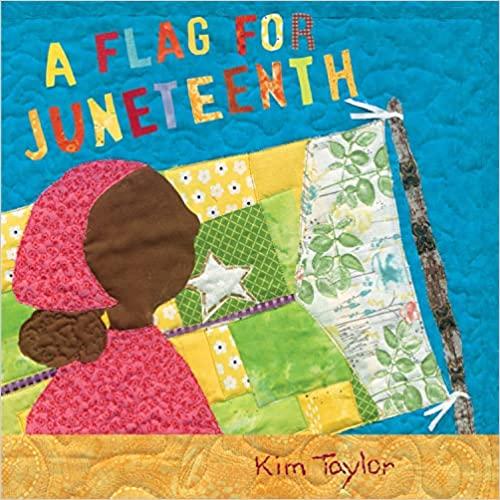
A Flag for Juneteenth by Kim Taylor

Published by Neal Porter Books

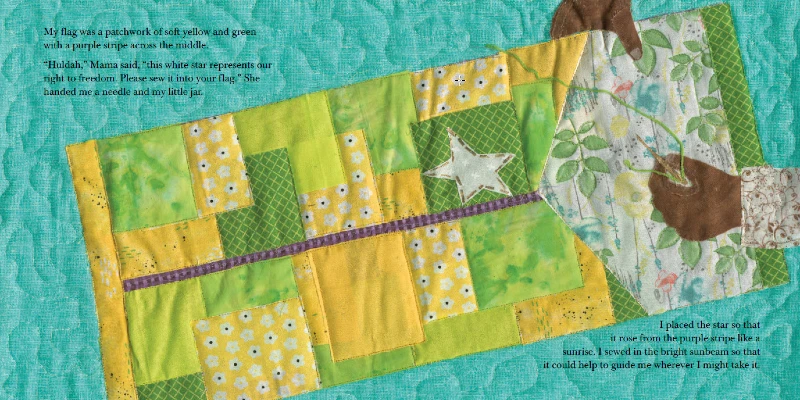
Summary:  Huldah is excited to be turning ten on June 19, 1865.  That excitement grows when, on the morning of her birthday, soldiers ride up to the Texas plantation where Huldah and her family live and announce that all slaves are free and have been since Abraham Lincoln signed the Emancipation Proclamation two years earlier.  All around her is a celebration, and a group of women begins to create freedom flags.  Huldah takes some time for herself, climbing a tree to capture a sunbeam in a jar.  When she returns, it’s time for her birthday celebration.  Her friends and family give her her own freedom flag; later, during a moonlit walk with her family, she wraps her baby sister in the flag, and the family celebrates this day of jubilee.  Includes an author’s note about how she came to create the quilts that illustrate this book.  40 pages; ages 4-8.

Pros:  With Juneteenth coming up in a few weeks, this is a great introduction for younger readers, illustrated with distinctive quilt-inspired illustrations.  Kids may want to design their own freedom flags after reading this.

Cons:  There’s not a ton of information about Juneteenth here, so you may want to supplement with some other resources.

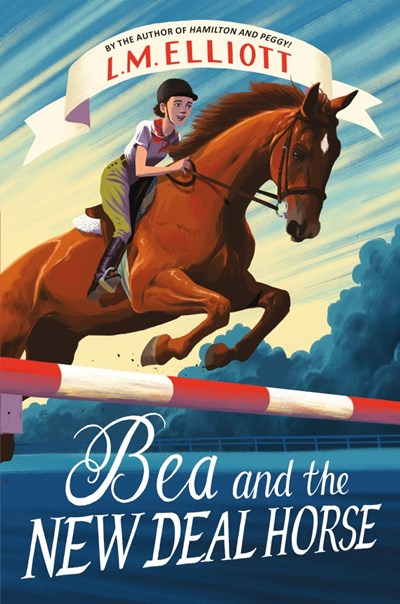
Bea and the New Deal Horse by L. M. Elliott

Published by Katherine Tegen

Summary:  The Great Depression has taken just about everything away from Bea: her dad’s job, her mother, and her home.  Now her father is drinking too much, trying to hold things together for Bea and her younger sister Vivian as they travel from one place to the next.  After sleeping in a barn in Virginia one night, Bea wakes up to discover her father has left a note and vanished.  The note says that Mrs. Scott, the owner of the farm, is the mother of the girls’ mother’s college roommate and will give them a place to live.  Bea is cautious about revealing their identity, but eventually Mrs. Scott discovers them and reluctantly lets them stay on her horse farm.  She is facing financial difficulties as well and has recently made things worse by buying an ornery chestnut horse to save him from an abusive owner.  Bea takes a liking to the horse, and after many ups and downs, Mrs. Scott agrees to train her to ride, with the hope of showing and selling him in a few months.  Bea, Mrs. Scott, and the horse have all been through some tough times, and it’s difficult for them to trust one another, but slowly they start to forge a bond, helped by Malichi, a blind Black WWI veteran who works in the house and Ralph, a loyal stable hand for many years.  By the time of the horse show, despite the high stakes, the somewhat patchwork group has solidified into something resembling a family.  Includes a lengthy author’s note with additional historical information and a list of sources.  384 pages; grades 4-7.

Pros:  Fans of The War That Saved My Life will want to check out this historical fiction novel with a heroine whose gritty determination has been shaped by hardship.  Anyone who loves horses will also appreciate the many scenes of riding and barn life, and I encourage you to keep a few Kleenexes handy for the final horse show.

Cons:  I was not crazy about the name they finally chose for the chestnut horse.

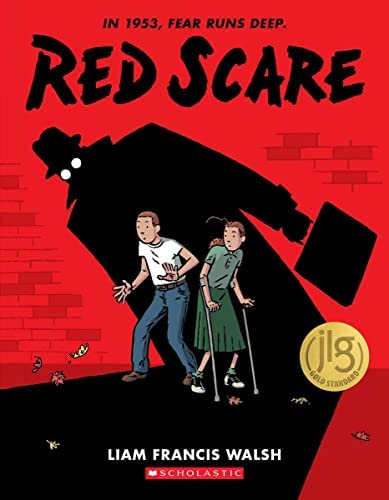
Red Scare by Liam Francis Walsh

Published by Graphix

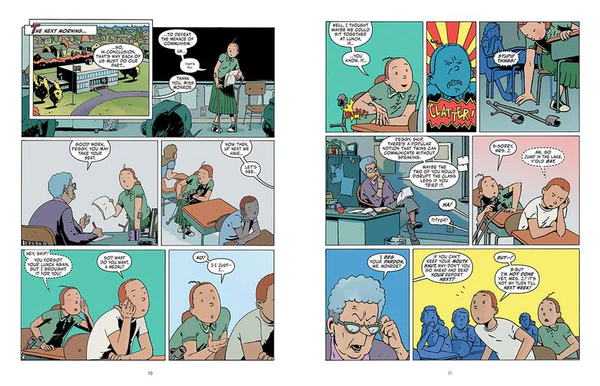
Summary:  Peggy’s got a lot going on: she’s recovering from polio and has to use crutches, her twin brother Skip has started being mean to her, and her father has returned from the Korean War with serious physical and psychological injuries, forcing her mother to work as a hotel maid.  One night, Peggy goes to work with her mom and winds up being a witness to a murder and unknowingly coming into possession of a mysterious substance.  When she realizes that she has this potion and that it enables her to fly, she and her new neighbor Jess begin having adventures all over town.  The FBI catches up with them eventually, intent on recovering the potion no matter who gets in their way.  When a suspenseful showdown atop a fire tower puts Peggy, Jess, and Skip in danger, Peggy finds out that she is braver than she thinks.  Includes additional information about polio, the red scare, and the atomic age. 240 pages; grades 4-7.

Pros:  Great snakes!  Tintin fans will love the Hergé-inspired artwork and nonstop adventures of this historical graphic novel that features the red scare of the 1950’s, polio, UFO’s, the Korean War, and a stirring speech about freedom and respecting others’ beliefs delivered by Peggy’s father to the mob going after Jess’s Communist dad.  

Cons:  There was a lot going on in 240 pages, both the rapid-fire plot and the characters’ development and growth, making some resolutions feel a bit too speedy.

The Door of No Return by Kwame Alexander

Published by Little, Brown Books for Young Readers

Summary:  11-year-old Kofi has a good life as part of his West African community.  He finds his English-speaking teacher pretentious but likes to learn and enjoys hanging out with friends at school, especially Ama, the girl he has a crush on.  His cousin is his rival, and Kofi is preparing for a swimming race between the two of them that may determine his future with Ama.  When his older brother Kwasi accidentally kills a prince in a wrestling match, life begins to take some dark turns.  The prince’s family kidnaps both Kwasi and Kofi; Kofi is eventually shackled and crowded onto a ship (the door of no return) with others to be taken away from their homes.  A plot twist in the end leaves the readers in suspense, preparing the way for the next book in this planned trilogy.  Includes a Twi glossary and guide to Adinkra symbols that appear in the book.  432 pages; grades 6-9.

Pros:  Kwame Alexander has produced another masterpiece novel in verse that is sure to win some awards.  The transition from Kofi’s life in Africa to his captivity is stark, violent, and may be disturbing to younger or more sensitive kids, but the whole story adds so many important dimensions to the narrative of slavery.

Cons:  The story takes place in 1860, which seemed late to me.  I thought the slave trade ended well before that.  I wish there had been more historical notes at the end to explain what was going on at that time.

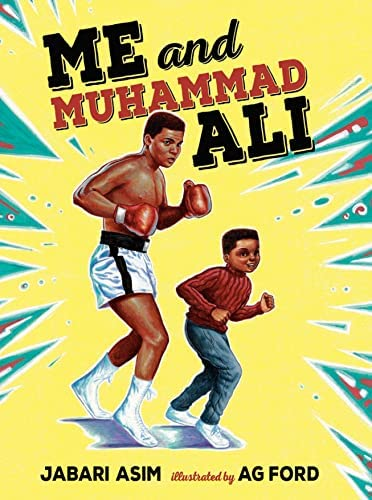
Me and Muhammad Ali by Jabari Asim, Illustrated by AG Ford

Published by Nancy Paulsen Books

Summary:  Langston is excited when he learns that Muhammad Ali is coming to his town. Langston admires Ali as much for his poetry as for his fighting, and his mom likes that the boxer is fighting to make the world a better place.  On the day of the big event, Langston gets his Afro shaped to look just like his hero’s, listening to the men in the barbershop talk about their own athletic exploits as well as their stories of Muhammad Ali.  Finally, Langston and his mom arrive at the high school, only to be stopped by a security guard who tells them the event is only for students.  No matter how much they plead with the guard, he refuses to let them inside.  “What’s the problem here?” asks a man, and when Langston looks up, Muhammad Ali is standing right in front of them.  Ali personally escorts them inside, and Langston’s dream comes true.  Includes an author’s note about the 1975 event that inspired this story.  32 pages; ages 4-8.

Pros:  It’s great to see so many Black history books for younger kids this year.  This one includes some of Muhammad Ali’s poetry, as well as poems that Langston makes up.  The illustrations do a great job of capturing the 1975 vibe.

Cons:  No list of additional resources on Ali.

Farmhouse by Sophie Blackall 

Published by Little, Brown Books for Young Readers

Summary:  The story of a farmhouse and the family of 14 that lived there is told in one long rhyming sentence.  Starting in the front hallway, the action seamlessly transitions to the parlor (the “serious room”), the attic bedroom where all 12 kids sleep and dream, the barn with its prize-winning cows, the fields, and then back to the kitchen and dining room.  Things wrap up back in the front hall where the youngest child, now an old woman, waits for her sister to pick her up to “drive to the sea, which they’d always wanted to see.”  The farmhouse, now abandoned, settles and is taken over by animals and weather until Sophie discovers it, finding objects that spark her imagination and lead her to the creation of this book.  Includes an author’s note about her discovery of the farmhouse and creation of the illustrations. 48 pages; ages 4-104.

Pros:  There’s been a fair amount of buzz around this book, and I am here to tell you that it’s all true.  I got kind of emotional at the end, appreciating the circle of life that took place in this old farmhouse, and the way it inspired the creation of a beautiful work of art.  The note at the end made me go back and marvel at the details and layers of each illustration. To not consider this for a Caldecott would be a crime against the literary establishment.

Cons:  If you’re trying to teach kids not to write in run-on sentences, you may need to look elsewhere for a mentor text.

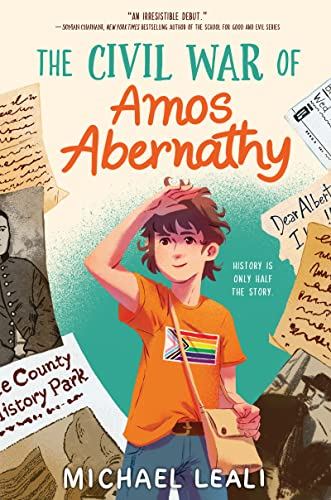
The Civil War of Amos Abernathy by Michael Leali

Published by HarperCollins

Summary:  Amos Abernathy loves history, and it’s a good thing because his mother runs the Chickaree County (Illinois) Living History Project.  Amos enjoys his work there as an interpreter, working with his best friend Chloe.  When a boy named Ben starts volunteering, Amos develops a crush, but Ben is ambivalent about whether or not he’s gay.  The three kids discover an interest in people written out of history, like those who were LGBTQ+, or Black like Chloe.  The narrative goes back and forth between Amos’s first-person narration of the present and letters he wrote the previous year to a (deceased) Civil War trans man named Albert D. J. Cashier.  In the letters, Amos describes his relationship with Ben, how it ends, and how Ben refuses to speak to him.  He also reveals a secret project that has to do with the kids presenting untold history to the public.  This presentation is the culmination of the story, where the past catches up with the present, and Amos, Ben, and Chloe get to express who they really are through their passion for history.  304 pages; grades 4-7.

Pros:  There’s lots going on in this story which would make an interesting book club choice with plenty to discuss about who has been written out of history.  The alternating chapters of letters describing the past and Amos narrating the present make for an engaging structure.

Cons:  Michael Leali makes a few rookie mistakes in this debut novel, like occasionally crossing the line between good story with a message and a story with an agenda. There also aren’t a lot of shades of gray in portraying characters who are either a little too good to be true or completely misguided/evil.

Freewater by Amina Luqman-Dawson

Published by Little, Brown Books for Young Readers

Summary:  In the author’s note, we learn that during slavery, enslaved people sometimes escaped into the swamps and lived there for years.  This story imagines such a community called Freewater, populated by those who escaped slavery and their children who have only known freedom.  Homer and Ada accidentally stumble upon Freewater while trying to escape north.  They’re taken in and soon get to know the different people there and the ways they’ve developed to survive and avoid capture.  But Homer is harboring a secret: he feels like it’s his fault that his mama was caught and sent back to the plantation the night of their escape.  Through his first-person narration and the third-person stories of many other characters from both the plantation and Freewater, the reader slowly learns of a plan to return and free Mama.  Each person has a part to play in the fiery and satisfying climax of the story, and the last page suggests a happy ending for all of them.  Includes an author’s note.  416 pages; grades 5-8.

Pros:  I’m always wowed when an author hits a home run with a debut novel. Amina Luqman-Dawson had done that here with a complex historical fiction story that will stay with readers long after the last page.  A definite contender for either Newbery or Coretta Scott King awards.

Cons:  Some reviewers recommend this for as young as third grade.  With the many characters, the shift between first-person and third-person narration, the unfamiliar setting, and the 400-page length, it requires a pretty sophisticated reader.

Cookies & Milk by Shawn Amos

Published by Little, Brown Books for Young Readers

Summary:  Ellis’s hopes for a fun and relaxing summer are dashed when his newly divorced dad informs him that they’re going to spend the next six weeks getting ready for the grand opening of Sunset Cookies.  As Ellis reluctantly begins to help clean up the filthy building and perfect the chocolate chip cookie recipe (with more than a few mishaps), he also starts to connect with people in the community.  Handing out free bags of cookies goes a long way toward making friends, and before long everyone is pitching in to get the store up and running in time.  When Ellis discovers that one of his new friends is his father’s estranged brother, he’s determined to help the two men put their differences aside and reunite the family.  New friends, family reunions, and plenty of chocolate chip cookies help make the summer of 1976 a memorable one for Ellis.  Includes a cookie recipe.  320 pages; grades 3-7.

Pros:  Written by the son of cookie entrepreneur Famous Amos, this is a funny, light-hearted story that doesn’t shy away from heavier topics like divorce and racism.  It’s a fast-paced read that a wide range of elementary school kids are sure to enjoy.

Cons:  Don’t even think about opening this book without a plate of warm cookies and a tall glass of milk by your side.

My Own Lightning by Lauren Wolk

Published by Dutton Books for Young Readers

Summary:  In this sequel to Wolf Hollow, Annabelle is still trying to recover from the events of that story when she experiences another life-changing event: she is struck by lightning.  In the aftermath, she makes two discoveries: her senses are heightened, including an ability to understand animals, particularly dogs; and the bruises on her chest show that someone brought her back to life before she was discovered by her father.  Her empathic connection to animals proves useful when dogs in the neighborhood start to go missing.  Dogs seem easier to understand than some of the humans around her, including new neighbors Mr. Edelman and his daughter Nora, and Andy, the boy who was partly responsible for the tragic events of Wolf Hollow.  As Annabelle’s new powers start to fade, she realizes that they’ve led her to discover some abilities to understand people that she’s had all along.  311 pages; grades 4-7.

Pros:  Like all of Lauren Wolk’s other books, this story is a luminous look at human nature with beautiful poetic writing and interesting, well-developed characters.  Also, the descriptions of every single meal were mouth-watering.

Cons:  I was surprised at how little World War II figured into the story in this book set in 1944.