That holiday glow

Winter Solstice Wish by Kate Allen Fox, illustrated by Elisa Paganelli (Beaming Books, 32 pages, ages 4-8).  On the shortest day of the year, a group gathers on a beach to watch the sunset and build a bonfire.  In the darkness, people long for light and the connection to each other.  “Around the globe, other hands reach out, holding hope, holding space, holding one another” is accompanied by people in three different countries reaching out to pass a light from one place to the next.  At the same time as the shortest day, in other places on Earth it is the longest day.  And on the winter solstice, we know that soon the days will start getting longer and daylight will return.  Includes information about both the winter and summer solstices and the winter solstice celebrations that are pictured in the book.

Both the poetic text and the illustrations provide a luminous introduction to the winter solstice, with a nod to the summer one and what causes both solstices.  There are lots of celebrations pictured, and readers may want to think about how they want to observe the shortest day and wishes that they may want to make.  This would be a nice December book to pair with Hanukkah Upside Down, which shows kids celebrating Hanukkah in both the northern and southern hemispheres.

Let It Glow by Marissa Meyer and Joanne Levy (Feiwel and Friends, 304 pages, grades 4-7).  Aviva and Holly take turns narrating the story of how an unexpected meeting at a holiday pageant audition leads to the discovery that they are identical twins separated at birth.  While Aviva is getting ready for Hanukkah with her parents, brothers, and bubbe, Holly and her single mom and grandfather are preparing for Christmas.  When they decide to do a Parent Trap-style switch, each learns about the other one’s family, personality, and holiday.  They’re able to hold off on a grand reveal to their families until they bring down the house with an original song and the pageant.  Although they don’t get all the answers about their birth and separation, it’s clear that the two families will be connected going forward, especially since there seems to be a budding romance between the grandparents.

This feel-good book has some serious Hallmark vibes and is sure to be a best-seller that will undoubtedly be unwrapped by many tweens by the light of the Christmas tree or Hanukkah menorah.  While a little suspension of disbelief may be needed (the girls figure out they’re twins that were separated at birth in about five minutes–and are immediately fine with it), there are enough hilarious hijinks, cozy winter scenes, and touching family interactions to satisfy readers.

‘Tis the season

Uri and the King of Darkness: A Hanukkah Story by Nati Bait, translated by Ilana Kurshan, illustrated by Carmel Ben Ami (Kalaniot Books, 32 pages, ages 4-8). Uri, his sister Shir, and their mom are awaiting Dad’s return home as it starts to get dark and rain is falling. Uri begins to worry about what could have happened to Dad: is he stuck in traffic? Did he get a flat tire? As darkness falls, Uri’s imagination kicks into overdrive, envisioning an evil king leading an army to attack their house. When he and Shir rush to fight off the invaders, the door swings open, and Dad is home! His delay was caused by a stop at the bakery for jelly donuts, a Hanukkah treat, and as Uri lights the first candle and the family sings together, the king and his army retreat back into the darkness. Includes the story of Hanukkah and the blessings that are recited when lightning Hanukkah candles, in English and Hebrew.

This Israeli import both celebrates the first night of Hanukkah and shows how a child deals with his anxieties and draws comfort from a loving family. The illustrations look like a kid’s drawings, especially the ones showing the king and his army. The rhyming text (translated from Hebrew) is catchy, although it wouldn’t have been my first choice for telling this story.

Santa’s First Christmas by Mac Barnett, illustrated by Sydney Smith (Viking Books for Young Readers, 40 pages, ages 3-8). Used to be, Santa Claus made toys all year, delivered them on Christmas Eve, and got right back to work on December 25. But when a polar bear learns of this situation, he convinces the elves that Santa deserves a real Christmas. Starting with breakfast in bed, the elves take Santa step by step through Christmas preparations, including a tree, stockings, and colorful outside lights. A white furry creature in a Santa suit stops by to deliver gifts (Santa knows who it is but doesn’t say anything). When everyone sits down to a big Christmas feast, Santa looks around the table and declares, “We should do this every year.”

Beloved author Mac Barnett has another Christmas book this season, teaming with Sydney Smith for a lovely story that touches on many familiar holiday traditions. The illustrations strike a perfect balance of light and darkness to create cozy holiday scenes, and everyone will get a kick out of the polar bear stand-in for Santa Claus.

Home for the holidays, part 2

At Our Table by Patrick Hulse, illustrated by Madelyn Goodnight (Little, Brown Books for Young Readers, 40 pages, ages 4-8). At our table, there is room for everything and everyone: old traditions, new friends, a crowd of people, but also quiet. There’s room for giving thanks for food and for the first (Native) farmers and for the Earth that supports us. There’s room for mashed potato mountains, trying new foods, second helpings, and lots of room for dessert. And at the end of the day, there’s a place to rest and feel loved and grateful. Includes a note from debut author Patrick Hulse and Chickasaw Nation illustrator Madelyn Goodnight sharing their own memories of Thanksgiving and envisioning some new interpretations for the holiday.

This book perfectly captures what I consider to be the spirit of Thanksgiving, focusing on family, food, and gratitude. As we move away from the traditional, racist history of the holiday, I hope, along with the author and illustrator, that we can reimagine it in the ways they’ve set forth in this book.

One Foggy Christmas Eve by Kerilynn Wilson (Greenwillow Books, 40 pages, ages 4-8). The persistent protagonist is determined to get to Nana and Papa’s for Christmas Eve, despite thick fog that surrounds everything. When her parents say they can’t go, she ties a flashlight to her dog’s head and tries anyway. But the thick fog is scary, and they both end up back at home. Her next attempt is to string Christmas lights over everyone, an idea that her parents decide is worth a try. They set out together, but soon a wind carries off her homemade present, and she’s left alone in the spooky darkness. Then what to her wondering eyes should appear but a herd of glowing reindeer. They guide her back to her parents, and everyone arrives safely. Nana and Papa don’t mind that there’s no present; the girl’s story becomes a gift to everyone as they gather cozily by the Christmas tree.

An enchanting and occasionally eerie Christmas tale with luminous pictures that contrast the dark fog and the lights that pierce through it. It’s hard to know what’s real and what’s imaginary, but everyone will agree with the final sentence that “stories light the way.”

Home for the holidays

Merry Christmas, Zoo by Lisa Eickholdt and Lola M. Schaefer, illustrated by Laura Watkins (Chronicle Books, 40 pages, ages 3-8). Inspired by “The Night Before Christmas,” this rhyming story shows how the zookeepers prep for Christmas, making gifts for the animals and decorating the zoo. When Santa arrives, they’re ready, and they help him load up his sleigh. An aerial view shows the right jolly old elf making deliveries, and then the action zooms in on the animals enjoying their presents. At the end of the night, Santa calls out a “Merry Christmas, Zoo!” before flying on his way. Includes information about how zoos create holiday gifts for animals designed to stimulate them both physically and mentally.

Add this adorable book to your holiday reading list. Kids will love seeing the illustrations filled with all their favorite animals and will be curious to say what they get for gifts. The end matter adds interesting information and invites readers to volunteer or donate to their local zoo. Just to add a Grinch/Scrooge note, zoos always make me a little sad, no matter how festive the occasion.

An Anishinaabe Christmas by Wab Kinew (Onigaming First Nation), illustrated by Erin Hill (Tundra Books, 48 pages, ages 4-8). As Baby and her family head to the Rez to celebrate the winter solstice, she learns some Anishinaabe words and how they help describe their holiday celebration. Kookom and Mooshom (grandparents) are waiting on the Rez. Giiwedaa means “let’s go home,” and home can be a place you live now, or a place you came from, like the Rez is for Baby’s parents. Miigiwe means “giving away”, something that the Anishinaabe people celebrate when they give each other gifts. When Baby and her parents finally arrive, everyone gets out drums and goes outside to sing a song about home, family, and wintertime. Includes an Anishinaabe glossary and a note about how Anishinaabe people include both Christmas and solstice traditions in their winter celebrations.

This affectionate family story introduces a few words and cultural practices of the Anishinaabe, including those around December holidays, and does a good job explaining how home can mean different things. I wish Baby had been given a slightly less infantilizing name, as she was old enough to have made a gift for her grandparents at school.

Dragon into Monday morning

Bakery Dragon by Devin Elle Kurtz (Knopf Books for Young Readers, 48 pages, ages 4-8). Ember loves gold, but he’s too small to terrorize villagers into giving it to him like the other dragons do. He’s excited when he sees a glimmer of gold in the distance until it turns out to be street lamp. Discouraged, he falls asleep, but when a raging storm hits, a kind baker invites him inside. Ember proves a natural at kneading dough and shaping loaves, and the baker rewards him with a sack of fresh bread. Back home, the other dragons can’t believe how good bread tastes and offer Ember a share of their gold if he can get them more. The whole group of them show up at the baker’s door, led by Ember, and pour out a bag filled with their stolen gold. Before long, dragons and humans are happily living side by side, with everyone having enough gold AND bread.

This is some good old-fashioned storytelling with enchanting illustrations that feature an adorable little dragon and mouth-watering pictures of bread. I can’t wait to share this with kids; it would make a great gift or addition to any library. I did feel like the baker was overlooking a sustainable source of energy to bake her bread with dozens of fire-breathing dragons showing up on her doorstep.

Dragon for Hanukkah by Sarah Mlynowski, illustrated by Ariel Landy (Orchard Books, 40 pages, ages 4-8). Hannah tells readers about the gifts she’s gotten so far for Hanukkah: a dragon named Nerry from her parents on the first night, a rainbow from Bubbie on the second night, a full treasure chest from her aunt on the the third. Now it’s the eighth night and time to clean up for the guests who will soon be arriving. As Hannah tidies up her room, readers can see that the dragon is stuffed, the rainbow was created with markers, and the treasure chest is full of Hanukkah gelt. Cleaning up produces some toys to donate to others, all part of the eighth night–the most magical night–of Hanukkah. The last two pages have Nerry asking questions that Hannah answers to give readers more information about the holiday.

A fun Hanukkah read-aloud just right for younger kids, who will enjoy seeing the ordinary objects in the illustrations that Hannah has created magical stories about. The additional information at the end is an enjoyable way to learn more about Hanukkah.

June holidays

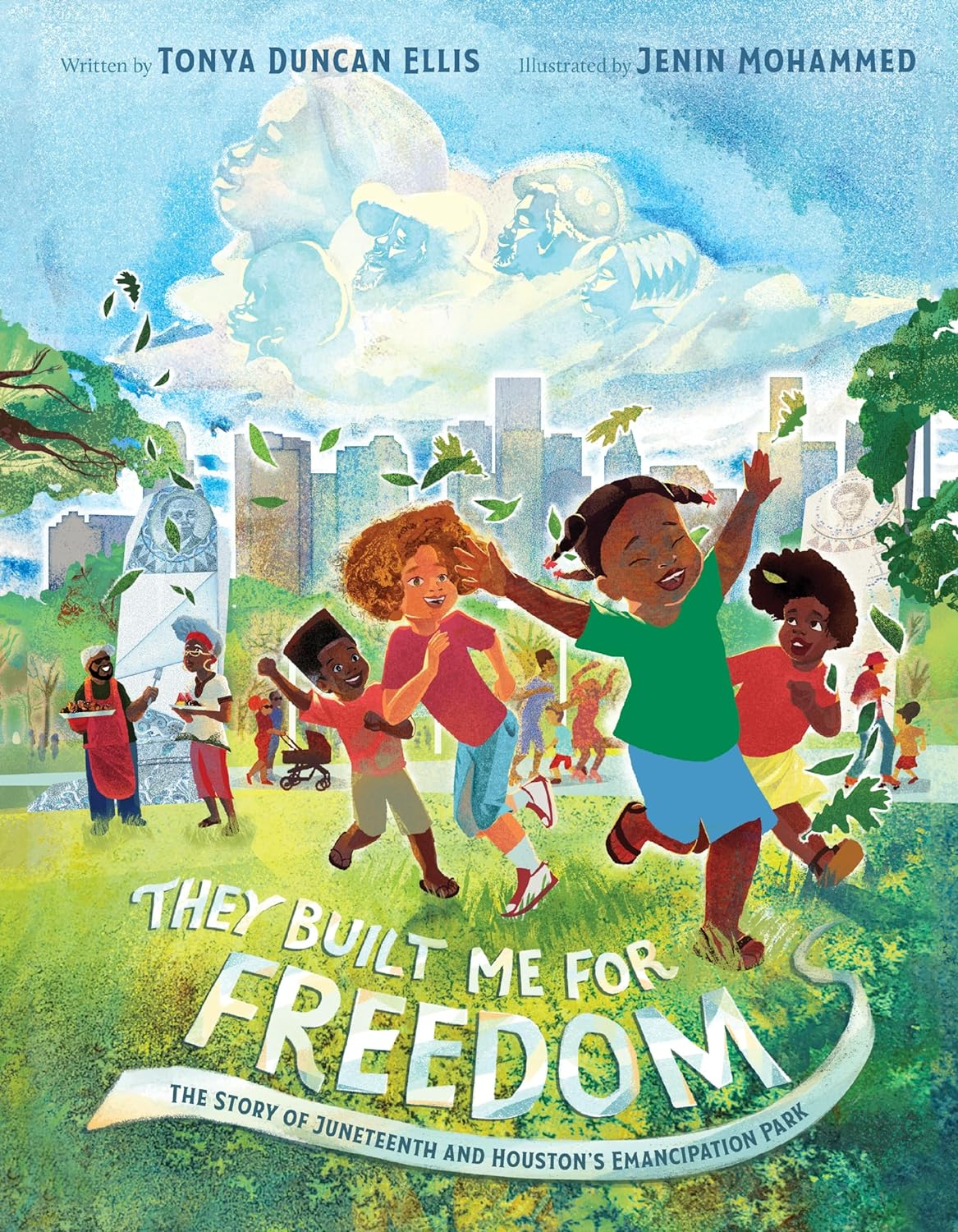
They Built Me for Freedom: The Story of Juneteenth and Houston’s Emancipation Park by Tonya Duncan Ellis, illustrated by Jenin Mohammed (Balzer + Bray, 32 pages, ages 4-8). Emancipation Park in Houston, Texas tells its history, beginning on June 19, 1865, when enslaved people in Texas learned that they were free. Most of the spreads begin with the words “they built me”: “They built me to celebrate,” “They built me to show they were strong,” “They built me to play.” Illustrations show Black people building a park on the ten acres they purchased, enjoying picnics and barbecues, swimming in a pool that allowed them access, and enjoying a baseball game. The park eventually fell into disrepair, but a new generation restored it and rededicated it in 2017. An afterword gives more information about the park, including a brief paragraph at the end about Juneteenth.

This lovely book celebrates Emancipation Park, and, to a slightly lesser extent, Juneteenth. Although the holiday provides the starting point, much of the book is dedicated to Black people persevering to create a beautiful park for themselves that allows them to experience joy, community, and celebration, which is captured in both the text and the illustrations. I wish the afterword were a foreword, as the book is more interesting with some background knowledge.

With Dad by Richard Jackson, illustrated by Brian Floca (Neal Porter Books, 40 pages, ages 4-8). A boy reminisces about a magical camping trip he took with his father, fishing, eating the fish cooked over the campfire, and sleeping in a tent from which they can hear the hoot of an owl. The last few pages fast forward to winter, when Tim and his mother are reading an airmail letter from Dad, who is overseas fighting in a war. “I want Dad home safe and soon and warm,” Tim says, planning to pick up where they left off with another camping trip.

Wow, the end of this book just about broke me! Good picture book memoirs aren’t easy to create, and this one is phenomenal, with so many details of the camping trip that show a loving father teaching his son without ever being overbearing, all enhanced by Brian Floca’s beautiful illustrations. While not explicitly about Father’s Day, this would make a perfect gift for the holiday.

A couple of holiday books

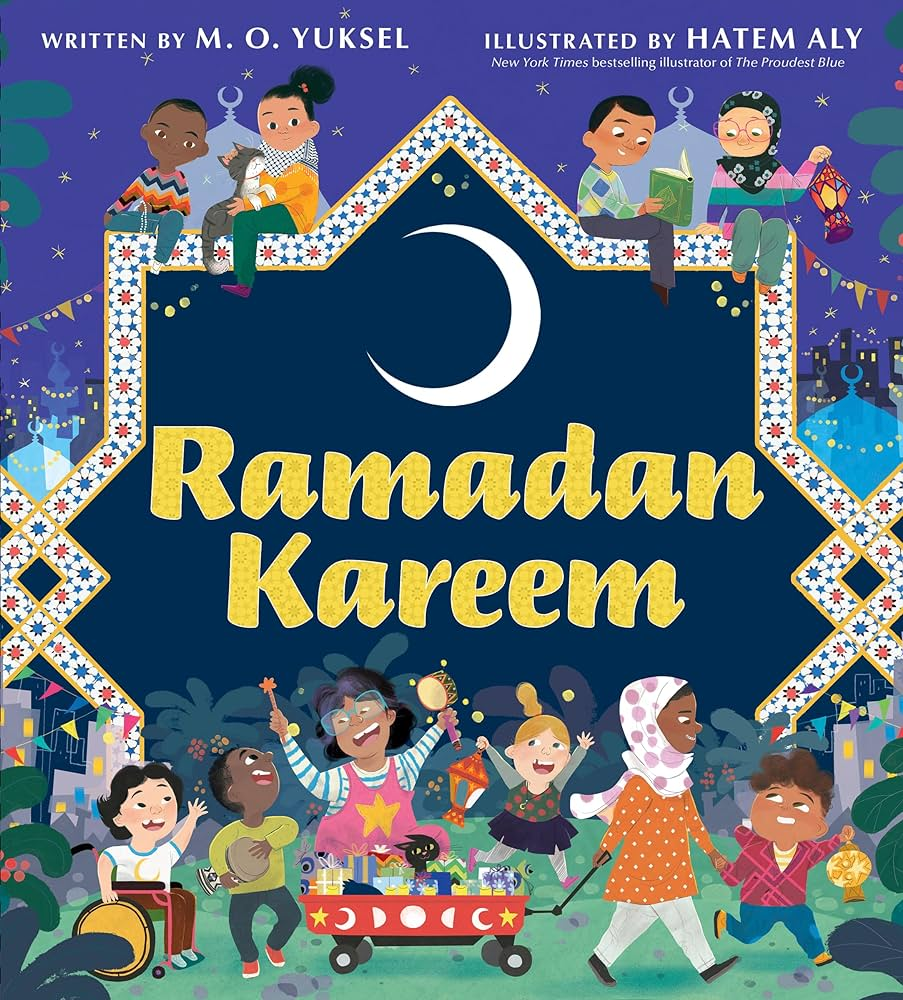
Ramadan Kareem by M. O. Yuksel, illustrated by Hatem Aly (HarperCollins, 40 pages, ages 4-8). Kids around the world celebrate Ramadan from the sighting of the crescent moon that marks the beginning to the next crescent a month later that signals that it’s time for the Eid celebration. In between, some of them fast for the first time, give money and food to neighbors, enjoy feasts before sunrise and after sunset, and attend mosque to pray and study the Qur’an. Eid means family gatherings, feasting, and gift giving, as the kids look forward to celebrating Ramadan again next year. Includes additional information, as well as a glossary and a list of three resources.

This book is packed with information, as well as colorful illustrations by Hatem Aly, for whom I’ve had a soft spot since The Inquisitor’s Tale. One fun feature is that 13 flags are hidden in the pictures, showing where in the world that celebration is taking place, although I wish this had been introduced at the beginning of the book instead of the end. I also wish I had seen this book in time for Ramadan this year, but file it away as one to purchase for 2025.

Juneteenth Is by Natasha Tripplett, illustrated by Daniel J. O’Brien (Chronicle Books, 40 pages, ages 4-8). A young girl shows readers how her family celebrates Juneteenth. The day starts with a parade, then continues to a big extended family gathering for a feast that features red food and drink. Grandparents remind everyone that red represents the color of suffering and give a quick synopsis of the history of the day, “the history lesson not taught in school.” At the end of the day, the family gathers for a photo, and the girl reminds readers, “Juneteenth is for all of us. We are America.” Includes information and resources on the significance of red in the celebration of Juneteenth.

Another beautifully illustrated book that serves as an excellent introduction to Juneteenth for younger readers. It’s a good mix of family fun and remembrance of the reasons for observing the day. Although the information about the significance of red is interesting, I would have liked more about the history of the holiday.

Celebrating spring holidays

For those who celebrate Easter (March 31 in 2024): Elijah’s Easter Suit by Brentom Jackson, illustrated by Emmanuel Boateng (Doubleday Books for Young Readers, 32 pages, ages 4-8). Every Easter, Reverend White gives a special “Hallelujah” to the congregant who’s got the most spectacular Easter outfit. Elijah’s determined to win, but the stores around town don’t have anything that looks just right. Feeling defeated, Elijah asks previous winners Mother Green and Deacon Brown for advice. They tell him that Easter’s not about winning a competition, but about new beginnings and remembering their culture. They share how when they were kids, they often wore homemade Easter outfits, not being allowed to shop in local stores. Inspired, Elijah makes an outfit from fabrics that have happy memories for him and wows the crowd on Easter morning with his colorful patchwork suit. Hallelujah!

Verdict: A definite winner with funny illustrations depicting Elijah in a variety of interesting outfits on his shopping spree, but also offering a heartwarming message about community and being true to yourself.

For those who celebrate Eid (on or around April 9 in 2024): The Most Exciting Eid by Zeba Talkhani, illustrated by Abeeha Tariq (Scholastic, 24 pages, ages 4-8). When they spot the new moon, Safa and her family start to get ready for Eid al-Fitr. Safa is excited to wear new clothes, get gifts, and get together with family. In the morning, all her wishes start to come true, and she enjoys her presents, especially a new bike. Her cousin Alissa wants a turn, but Safa doesn’t feel like sharing. Later, Safa’s mother takes her through the neighborhood to distribute gifts, and Safa realizes that sharing is one of the best parts of Eid. After a big dinner at the grandparents’, Safa is ready to go home and ride bikes with Alissa.

Verdict: A cute story that introduces several aspects of Eid, in what appears to be a Pakistani family. It definitely has a Scholastic book club vibe to it, and unfortunately, only seems to be available in paperback.

For those who celebrate Passover (April 22-April 30 in 2024): Afikoman, Where’d You Go? A Passover Hide-and-Seek Adventure by Rebecca Gardyn Levington, illustrated by Noa Kelner (Rocky Pond Books, 40 pages, ages 4-8). Kids at a seder dinner search for the elusive afikoman through every room of the house and yard. Sharp-eyed readers will see the afikoman character hiding on every busy page. He’s finally caught, everyone gets a prize, and dinner continues, but the sneaky afikoman is seen riding away in one of the cars on the last page, wishing everyone, “Happy Pesach!”

Verdict: The bouncy rhyming text and Where’s Waldo style illustrations provide a lot of holiday fun, with details about Passover included in the glossary at the beginning, as well as being woven into the story and pictures. Spell check is telling me that the correct spelling is afikomen, but both the title and the glossary of this book use afikoman.

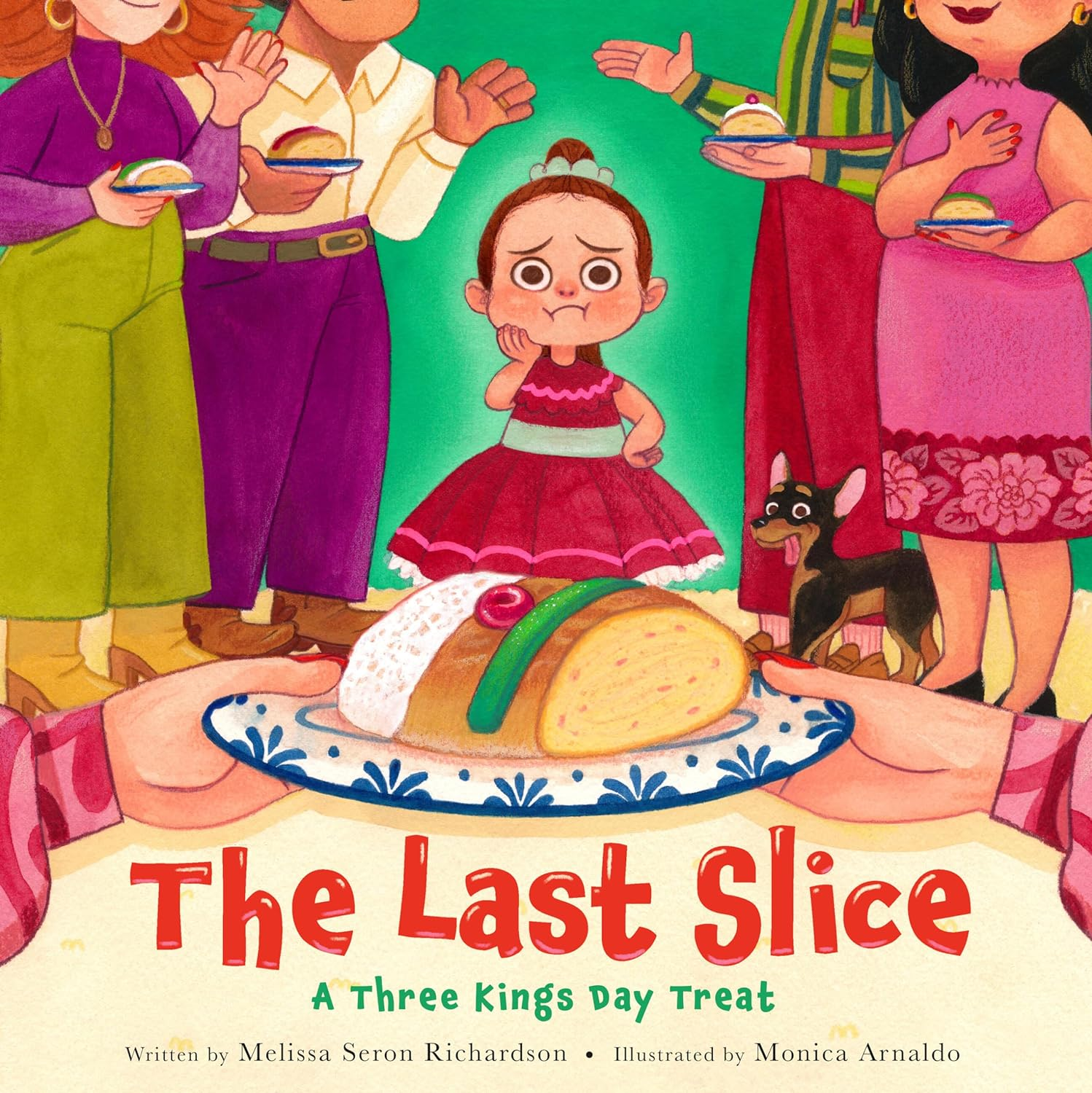
The Last Slice: A Three Kings Day Treat by Melissa Seron Richardson, illustrated by Monica Arnaldo

Published by Little, Brown Books for Young Readers

Summary: Marta suspiciously eyes La Rosca de Reyes, the cake made specially for Three Kings Day. It looks delicious, but she knows there’s a plastic baby hidden inside, the Niño Dios. In past years, she’s sampled others’ slices, but this year, the relatives say she’s big enough for her own piece. She’s worried that she’ll accidentally swallow the baby, causing it to grow inside her like a seed. Marta resolves not to eat her cake, but one by one, the other family members eat theirs, and the baby Jesus isn’t found. Finally, Marta can’t stand it. She takes a huge bite, and chomps right down on the baby. Everyone cheers, and Marta goes to bed that night feeling pleased that she was so brave and promising herself to eat two slices next year. 40 pages; ages 4-8. 

Pros: A fun and funny celebration of Three Kings Day, and a girl who overcomes her fears and finds her courage rewarded.

Cons: It honestly does feel a little creepy to have a baby baked into a cake.

Two picture books set in India

My Bollywood Dream by Avani Dwivedi

Published by Candlewick

The Light Within You by Namita Moolani Mehra, illustrated by Kamala Nair

Published by Two Lions

Summary: Two kids share their experiences in India. In My Bollywood Dream, a girl who dreams of being a filmmaker enjoys an evening at a Mumbai cinema with her family. As they drive to the theater, she imagines turning what she sees in the city streets into Bollywood-style film scenes. Everyone enjoys the movie, and during the final number, the entire audience gets out of their seats to sing and dance. The last page shows the narrator as an adult behind the camera. Includes an author’s note about her own Bollywood experiences.

In The Light Within You, Diya is back in India for a visit from her new home in the United States. She’s excited to see her grandmother, Nani, and to celebrate Diwali, a holiday that the kids in her new school know nothing about. Diya enjoys the festive preparations with Nani, with whom she is able to share some of her struggles with her new life. Nani reminds her that Diwali is about light and encourages Diya to discover her inner light to shine at her new school. The last page shows Diya sharing Indian souvenirs with her new classmates. Includes an author’s note with additional information about Diwali, a glossary, and Diya’s Diwali affirmation, a poem that celebrates the inner light. Both books 40 pages; ages 4-8.

Pros: Both books will make readers want to visit India, with their descriptive text and especially the colorful illustrations that celebrate Bollywood and Diwali. Each one is empowering in its own way, focusing on the protagonist’s gifts and encouraging her to share them with others.

Cons: It felt like Diya might still have some struggles ahead of her.