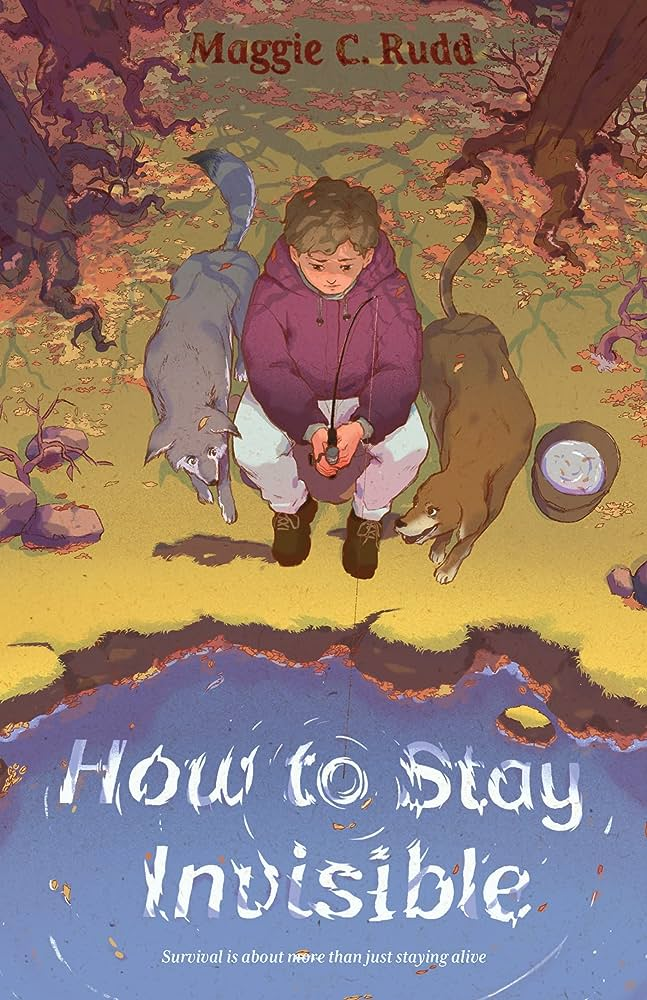
How to Stay Invisible by Maggie C. Rudd

Published by Farrar, Straus and Giroux

Summary:  When Raymond realizes that his neglectful parents have left him for good, he feels that he has no choice but to camp out in the woods near his middle school.  He manages to survive there for the better part of a year, sleeping with his dog Rosie inside a hollow fallen tree, fishing and dumpster diving for food, and occasionally helped by a couple of kind new friends: Harlin and Lexi from school and an old man named Stigs who fishes in the same river.  It’s a pretty desperate existence, but Raymond finds it preferable to foster care, which he’s had some experience with.  A combination of a middle school bully and Mother Nature eventually catches up with Raymond, but with the help of his new friends, he finds what may be a happy ending.  240 pages; grades 4-7.

Pros:  Fans of Hatchet and other survival stories will enjoy getting to know Raymond, whose situation may feel a little closer to home than Gary Paulsen’s tale.  Despite his terrible parents, Raymond is a likable kid who finds himself drawn toward friendship and connection even as he tries to be self-sufficient.

Cons:  With one somewhat notable exception, most of Raymond’s teachers seem more concerned with his grades and behavior than any of the signs that all is not well with him at home.

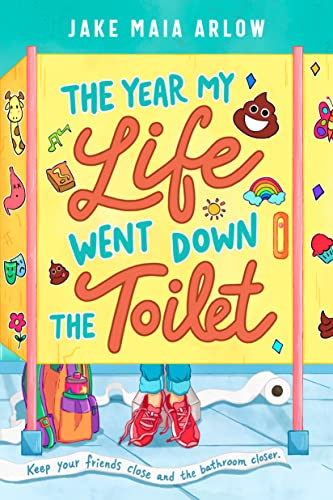
The Year My Life Went Down the Toilet by Jake Maia Arlow

Published by Dial Books

Summary:  Al is hoping her new doctor can make her stomach problems disappear, so she’s crushed to learn she has Crohn’s disease, which can be controlled but not cured.  Her flare ups seem to get worse with stress, and Al has plenty of that when her best friend Leo gets a part in the school play and has less time for her, and her mom and Leo’s mom start dating.  An IBS support group proves helpful in helping Al process some of her feelings about having a chronic disease and introducing her to some new friends who can relate to her experiences. Al develops a crush on one of the girls in the group and has to deal with the additional stress of coming out to her friends and family.  Communication proves to be the key, and after a rocky few months, Al finds her way back to those she loves the most.  288 pages; grades 4-7.

Pros:  I’ve gone my whole life without reading a book about a middle schooler with Crohn’s disease and now…two in less than a month.  Al’s story, like Will’s, conveys the difficulties of dealing with this illness and the grief of learning that it’s chronic, while at the same time containing universal and relatable middle school issues with family and friends. If you’re looking for an LGBTQ+ friendly book, every main character in this story falls into that category.

Cons:  Al spends a lot of the book being sulky and uncommunicative, behavior that is certainly understandable given her circumstances, but if I had to choose someone to hang out with from these two books, I’d have to go with Will.

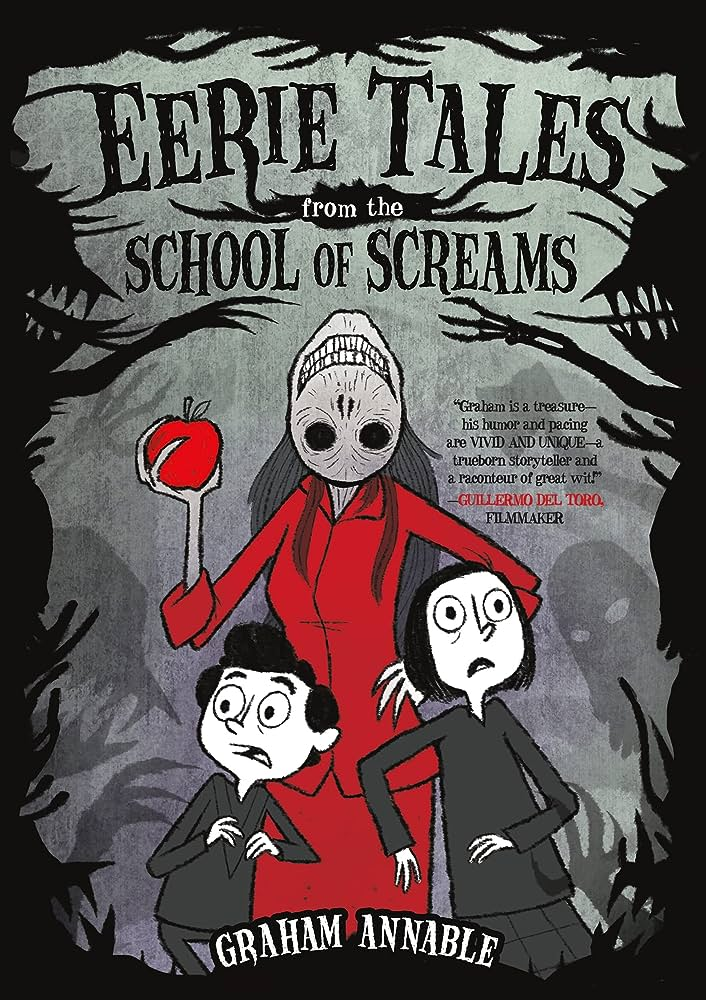
Eerie Tales from the School of Screams by Graham Annable 

Published by First Second

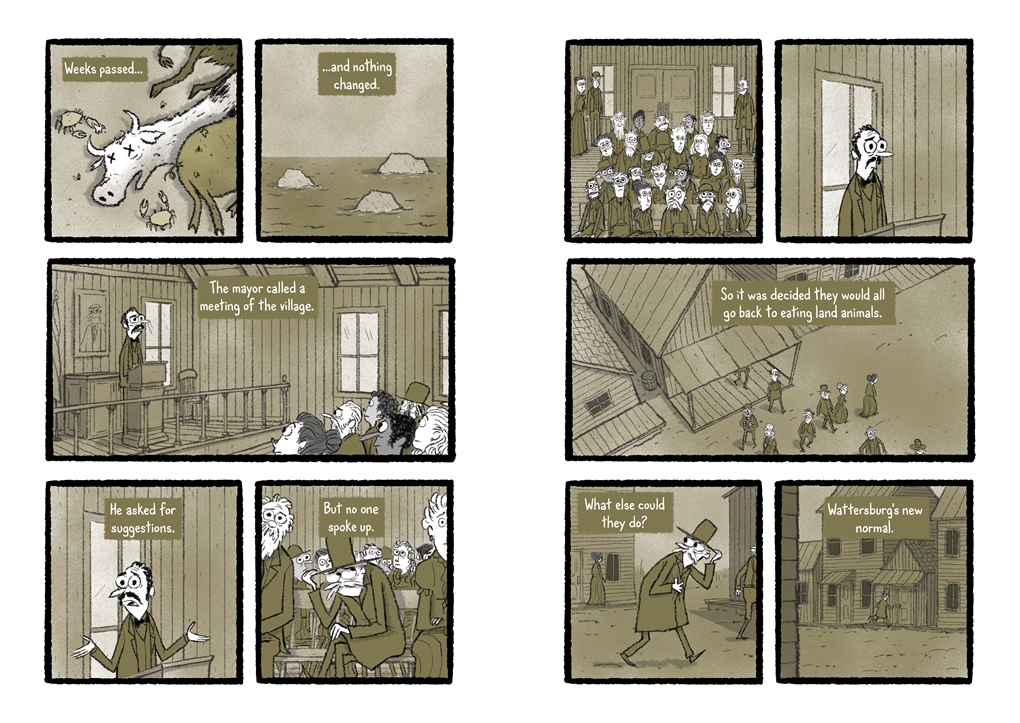
Summary:  Ms. Nomed has her students come up one by one to share a scary story with the rest of the class.  Each tale is illustrated with various shades of a single color to help differentiate one from the other.  Humorous commentary from the other kids at the end of each one lightens the mood a bit before plunging back into another creepy world where things are not always what they seem and monsters, ghosts, and zombies are real.  The final story turns out to be true, and the class has to join forces when Ms. Nomed reveals her true self.  368 pages; grades 4-7.

Pros:  A graphic novel scary story collection?  Someone has a finger on the pulse of elementary students!  Plan on buying multiple copies for the library, as this is sure to be a huge hit.  The artwork is excellent, and the stories are genuinely creepy.

Cons:  As always with scary stories for elementary kids, be aware that these may be disturbing for some readers.

Mexikid: A Graphic Memoir by Pedro Martin

Published by Dial Books

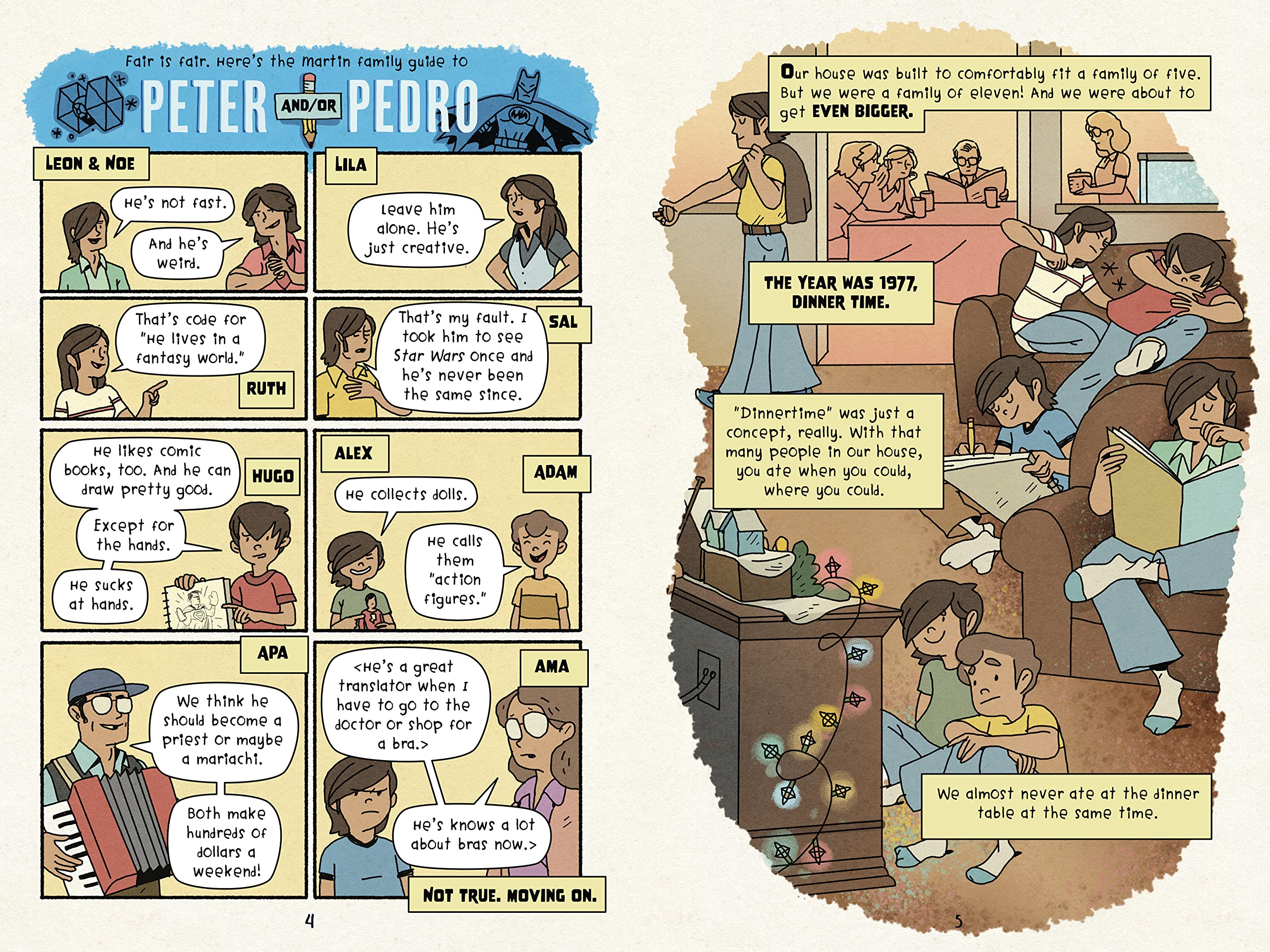
Summary:  Pedro’s house feels pretty small with his parents and eight brothers and sisters, so when he learns that his grandfather is coming to live with the family, he’s not happy.  Not only that, but the whole family has to travel to Mexico to pick up Abuelito.  The kids are divided into two groups: the five oldest were born in Mexico, and the younger four, including Pedro, arrived after the family had moved to California.  The older group takes a pick-up truck for the big road trip, and the rest of the family travels in a used RV.  There are plenty of adventures both on the trip and during the weeks they spend in Mexico with their extended family.  Pedro is in awe of his grandfather, who was part of the Mexican revolution, but by the end of the trip, he’s shown he has a few heroic qualities of his own.  Available in both English and Spanish language editions.  320 pages; grades 4-8.

Pros:  This road trip graphic novel strikes the perfect balance between funny and poignant, featuring a memorable immigrant family with ties to both Mexico and the United States.  Readers of a certain age will appreciate the loving references to Star Wars, Fleetwood Mac, Happy Days, and other 1970’s touchstones.

Cons:  I found the font a little hard to read, particularly the lowercase d’s that looked more like a’s.

Hope in the Valley by Mitali Perkins

Published by Farrar, Straus and Giroux

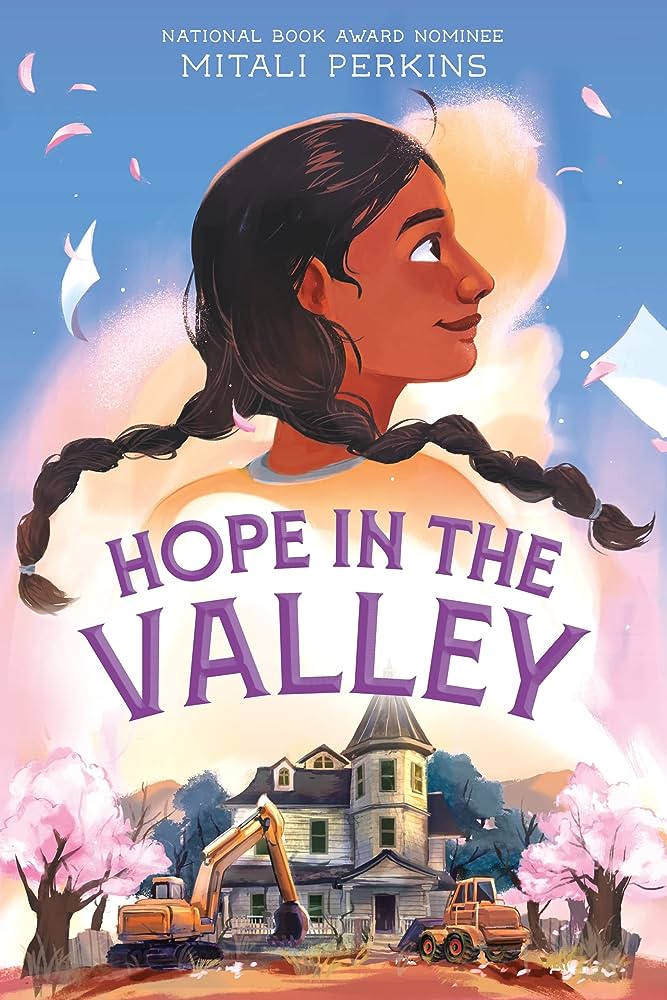
Summary:  Pandita is looking forward to a relaxing summer of reading in her favorite secret hiding place–the porch of the abandoned house next door, a place she and her late mother liked to spend time.  When she learns that the house is being torn down by developers, Pandita is horrified and becomes part of a group trying to save it for historical preservation.  Her research on the old house leads to some surprising discoveries, as well as some new friendships.  There are other changes afoot during the summer, including four weeks of drama camp and a potential new stepmother whose brash opinions cause Pandita to label her The Intruder.  At first reluctant to attend drama camp, Pandita eventually discovers a talent for singing and learns to overcome her fear of speaking in public, a lesson that serves her well in her fight for the house.  Although things don’t turn out exactly the way Pandita wants them to, she discovers that change can be a good thing sometimes, leading to new connections and experiences.  304 pages; grades 4-7.

Pros:  This engaging historical novel documents the rapid changes going on in Silicon Valley in the 1980’s.  Introverts will take Pandita’s struggles and triumphs to heart and cheer her on as she discovers new talents and makes new friends.

Cons:  Although The Intruder eventually won the family over, she seemed pretty obnoxious at times, and I foresee some rocky times ahead for her and Pandita.

What Happened to Rachel Riley? by Claire Swinarski

Published by Quill Tree Books

Summary:  Anna’s new at her Madison, Wisconsin middle school.  She’s a little young for eighth grade and still trying to figure out how the middle school social hierarchy works, so when she notices that a girl named Rachel Riley is shunned by all her classmates, she’s curious to find out why.  Digging deeper into the mystery, Anna discovers that Rachel was one of the popular girls until the end of seventh grade, when a mysterious fire disrupted the end-of-the-year dance and awards ceremony.  A devoted podcast fan, Anna decides to make a podcast to answer the question, what happened to Rachel Riley?  In addition to her own narration, the story is told through texts, emails, letters, interviews, and news reports, which slowly reveal to Anna a tale of bullying and sexual harassment that has been ignored by teachers and administrators and laughed off by students.  As Anna uncovers the truth, she learns the importance of using her own voice to speak up in defense of truth and justice.  352 pages; grades 4-8.

Pros:  It’s not often that I wish I were still running middle school book clubs, but it happened as I read this perfect middle school story.  The format and the mystery elements make it a quick and engaging read, and the story raises important questions about sexual harassment and how it affects both boys and girls.

Cons:  The large cast of characters and story format left me feeling like I didn’t really get to know several of the secondary characters.

Boomi’s Boombox by Shanthi Sekaran

Published by Katherine Tegen Books

Summary:  Boomi is reeling from the death of her father from Covid.  Remote school is isolating, her best friend seems distant, and the final blow comes when she fails an audition at her ballet school.  She receives an old boombox of her father’s under somewhat mysterious conditions, and when she tries to play the mixtape inside, she’s transported back to 1986 England.  There she meets her 12-year-old father, Jeevan, as well as his mysterious older sister, and a younger version of her grandmother, Paati, who lives with Boomi’s family in the present and suffers from dementia.  As Boomi travels back and forth between the present and the past, she learns about the racism that plagues her dad and his family, forcing Asian people to be silent and invisible in their mostly white community.  By helping them speak up, Boomi learns to accept what has happened in her life and to embrace her love of dancing, even if her body is not the size and shape her ballet teacher is looking for.  Working together, Boomi and Jeevan manage to heal the rifts within their families and change their lives for the better.  272 pages; grades 4-7.

Pros:  I wasn’t expecting the time travel twist, which allowed Boomi to get closure around her father’s death and to witness the racism that shaped both her parents’ early years.  Shanthi Sekaran deftly handles so many difficult topics including not only racism, but body image, grief, and the pandemic.

Cons:  I was actually in London in 1987, which doesn’t feel as much like ancient history as this book makes it seem.

Control Freaks by J. E. Thomas

Published by Levine Querido

Summary:  Frederick Douglass “Doug” Zezzmer is a 12-year-old genius inventor who goes to a middle school for gifted kids in Denver.  When the principal, Dr. Yee, announces a team STEAM competition, most of the kids are less than thrilled.  Doug is determined to win so he can show his dad (who’s just moved back after being absent for most of Doug’s life) that inventing, not sports, is his thing.  His best friend Huey, who suffers from stage fright, proves to be a liability in creating a five-person team, and they end up with a bunch of misfits.  As the competition goes on, though, the group goes from five quirky kids who don’t relate to each other to being a team who supports and cheers for each other.  The final results prove that winning doesn’t always mean finishing first and help Doug to stand up to his dad and show him who he really is.  320 pages; grades 4-7.

Pros:  The humor, middle school setting, and chapters told in different characters’ points of view reminded me of Gordon Korman’s books and should make this book an easy sell to upper elementary and middle school readers.

Cons:  I didn’t entirely understand why the title of this book is Control Freaks.

Picture Day by Sarah Sax (Brinkley Yearbooks)

Published by Knopf Books for Young Readers

Summary:  Although her mom urges her to keep a low profile in middle school, Olivia wants to be seen.  Renaming herself Viv to differentiate herself from all the other Olivias, she takes to heart the words of a social media follower to be true to herself.  She chops off her hair right before school pictures are taken, causing a buzz around school.  Encouraged, Viv begins staging spectacles that get her noticed by the cool kids.  But her old friends Milo and Al feel left behind, and when Viv tries to include them in one of her spectacles, it’s a disaster.  Viv is forced to do some soul searching to decide where her loyalties lie, and ultimately she’s able to find a way to keep her old friends while being true to herself.  Includes an author’s note about an interesting way she generated story ideas that led to this graphic novel.  288 pages; grades 3-7.

Pros:  Another fun middle school graphic novel with a positive message about being yourself but not at the expense of others’ feelings and with some good observations about social media.  The author’s website says this book one of a planned series of four.

Cons:  Creating spectacles in middle school = extremely cringy.

Lasagna Means I Love You by Kate O’Shaunghnessy

Published by Knopf Books for Young Readers

Summary:  Mo is reeling following the death of Nan, the grandmother who has raised her, and the refusal of her uncle to adopt her.  She’s placed in the foster care system, which she describes to Nan in a series of letters.  Several mishaps get her removed from her first placement, and she moves in with a wealthy couple who plan to adopt her.  Although the situation seems ideal in many ways, it gradually becomes evident that the couple isn’t ready for such a big move.  Mo feels rejected again and seeks solace with Joe, the doorman in her building that she’s befriended, and his wife.  Throughout the story, Mo learns to cook and, with her best friend, launches a website to collect family recipes with the hope of finding a recipe that will connect her with Nan.  The final resolution of Mo’s story doesn’t come as a particular surprise but is nonetheless extremely satisfying.  224 pages; grades 4-7.

Pros:  Kids in foster care don’t often appear in middle grade fiction, and Mo is a likable narrator whose story shows the heartache of trying to find a family.  The letter-writing format of the story gives it an immediacy and keeps the action moving along.

Cons:  Mo’s experience with the New York City foster care system seemed a lot rosier than I’m guessing most kids have, and there were only occasional mentions of the privilege of being a white girl offering hints of this.