Novels in verse by award-winning authors

It’s All or Nothing, Vale by Andrea Beatriz Arango (Random House Readers, 272 pages, grades 4-8). Vale is trying to get back to fencing after a serious motorbike accident that damaged one of her legs, possibly permanently. Despite the pain and weakness, Vale is driven to return to the one thing she feels like she is good at. Her quest to be the best before the accident was fueled by her parents and cost her at least one friendship, but now she feels alone and uncertain about what her parents really want for her. When she finally does get back to fencing class, she discovers that she’s been unseated by a new girl named Myrka. Despite Vale’s anger at Myrka for being a better fencer, she can’t help noticing she admires and likes Myrka in a way that may be more than just as a friend. When a hard-won victory over her rival results in intense physical pain, Vale has to come to terms with the fact that she is not the same person she was before the accident. By the end of the book, she has opened up honest communication with her parents and started to lean more on the people who care about her.

I was a little put off at first by Vale, who comes across as somewhat unlikable, pushing away the people who are trying to help her and focusing only on her return to fencing and her quest to be the best. But as the story went on, I started to sympathize more with what she was going through, not only the painful recovery from a serious accident, but grieving that she is no longer the same person and wondering if she’s now disabled. Kudos to Andrea Beatriz Arango for creating such a real and memorable character for whom you will be cheering by the end as she comes to terms with the new person she is becoming.

All the Blues in the Sky by Renée Watson (Bloomsbury Children’s Books, 208 pages, grades 5-8). Sage is dealing with the intense grief of losing her best friend in a hit-and-run accident on her birthday. She’s back at school, trying to cope with the help of a support group, but each day presents new challenges as she navigates feelings of sadness, guilt, and anger. Sometimes she lashes out at those who are trying to help her, and she has to figure out ways to make amends during calmer moments. One element of grief that surprises her is that there is still room for joy and laughter, and Sage finds herself making new friends and slowly moving toward her first romance. For most of the story, she refers to the deceased as “my best friend,” but by the end of the story, she is able to say her name, Angel Rodriguez, and she creates a poster with that name to put at a makeshift memorial that’s been created in the place where Angel died. An author’s note tells of her own experiences with grief, losing fifteen loved ones from 2020 to 2022, and how those experiences and the Covid pandemic led to her writing this book.

As I read the list of Renée Watson’s books on the back flap, I realized what a truly gifted writer she is who has given us an amazing collection of works in all different genres for both children and young adults. This book is no exception, tracing Sage’s experiences with grief in a very realistic yet beautifully written way that will help other kids who are dealing with the emotions of loss.

Feminism, past and present

Tear This Down by Barbara Dee (Aladdin, 304 pages, grades 4-7). Freya has always liked asking lots of questions and having strong opinions, but as she’s gotten older, she’s learned to stay quiet rather than risk being made fun of. A school project leads her to the discovery that town founder Benjamin Wellstone, an outspoken abolitionist, opposed giving women the vote. Teaming up with new friend Callie, Freya embarks on a series of actions to tear down Wellstone’s statue and replace it with one of a local suffragist Octavia Padgett. After the girls sneak out of the house for some late-night statue vandalism before a big town festival, they are both grounded and forced to reconsider their tactics. Freya’s activist grandmother helps her to see that there’s room for both Benjamin and Octavia in town and leads her to come up with an idea of creating a quilt celebrating the suffragists that unites people rather than tearing them apart.

A good choice for Women’s History Month, the latest by Barbara Dee portrays an idealistic, outspoken protagonist who sometimes feels like her strong opinions need to be silenced. I always enjoy Dee’s books that tackle difficult issues with a light touch. Thanks to Aladdin Books for providing me with a free copy.

One Girl’s Vote: How Lucy Stone Helped Change the Law of the Land by Vivian Kirkfield, illustrated by Rebecca Gibbon (Calkins Creek, 40 pages, grades 2-5). From an early age, Lucy Stone felt the unfairness of the ways she and other girls were treated as inferior to boys. Her teacher called on the boys before Lucy, even though Lucy’s hand was raised first, and her father dictated family policy, including the decision that Lucy would not attend college like her brothers. Lucy was determined, though, and earned enough money to pay her tuition at Oberlin College, the first American college to accept women. But even at Oberlin, there was inequality, and Lucy fought back, organizing a secret women’s debate society and striking for equal wages to men’s for her campus jobs. After graduation, she was hired by William Lloyd Garrison to work for the New England Anti-Slavery Society. She soon became well-known as a passionate speaker, and her work evolved to include women’s rights. The work and travel was exhausting, but Lucy Stone’s voice helped pass the Thirteenth Amendment, abolishing slavery, and paved the way for women to get full voting rights 27 years after her death. Includes a timeline for Lucy Stone and the fight for women’s rights and equality for all, a couple photos, fun facts, and a bibliography.

In my experience, Lucy Stone is lesser known than fellow suffragists Elizabeth Cady Stanton and Susan B. Anthony, so I’m happy to see this delightful picture book that emphasizes Lucy’s early days but gives a nod to her tireless work for abolition and women’s rights. The timeline offers quite a few milestones in women’s history. I did not know that Lucy Stone was married to Elizabeth Blackwell’s brother, and that women who kept their maiden names, as Lucy did, were sometimes called Lucy Stoners.

Two books for Ramadan

Almost Sunset by Wahab Algarmi (HarperAlley, 224 pages, grades 4-7). Hassan is fasting for Ramadan in this graphic novel, and, although it’s his third year doing so, this year seems harder than before. He’s going to the mosque for nightly prayers with his father for the first time, and there’s not as much community support as there was when his family was back in Yemen. Not only is Hassan falling asleep in math class, but he’s not performing up to par on the soccer field, getting shown up by teammate and frenemy Rosie. Everywhere he goes, Hassan sees delicious food, and when some cousins talk him into sneaking off for snacks, he’s wracked with guilt. When Hassan finally tells his soccer coach why his performance is off and he’s leaving practices early, he’s happily surprised to learn that Coach is also observing Ramadan with his own fast. Finally, Eid arrives, and Hassan is rewarded for his determination with a joyous celebration that include friends and family who help him to acknowledge his perseverance and to forgive himself for mistakes.

Muslim kids observing Ramadan will relate to Hassan’s struggles and hopefully learn to open up to those around them about what is going on with them for the month; non-Muslims will learn more about Ramadan and how to support their friends. The artwork is excellent, with lots of wordless pages that move the story along at a good clip, and some funny pictures of Hassan imagining food in all kinds of contexts.

The Gift of Eid by Shifa Saltagi Safadi, illustrated by Aaliya Jaleel (Holiday House, 40 pages, ages 4-8). Yasmine and Mama are shopping in Damascus’s Souq Al-Hamidiyeh. They’re both grieving the recent death of Yasmine’s dad, and Yasmine wishes she could find the perfect Eid gift to bring a smile to Mama’s face. When she sees a sign offering money for jewelry, she sells the chain she’s wearing around her neck. At the Masjid Al-Umawi mosque, Mama and Yasmine meet up again for prayers. At the end, they agree to exchange early Eid gifts, but when Yasmine gives Mama the beautiful box she’s bought for Mama to keep her bracelet in, Mama starts to laugh. She sold the bracelet to buy Yasmine a charm to put on her gold chain. They realize that their love for each other is the greatest gift they can give, and head for home with a charm but no chain, a box but no bracelet, and “all the love we need.” Includes an author’s note about how her childhood in Syria inspired this story.

Based on the O. Henry story The Gift of the Magi, this sweet story introduces readers to daily life in Syria, beautifully portrayed in the illustrations. It’s also a tale of grief and healing, as Yasmine and Mama look for ways to help each other through a difficult time.

Graphic novels with a STEAM theme

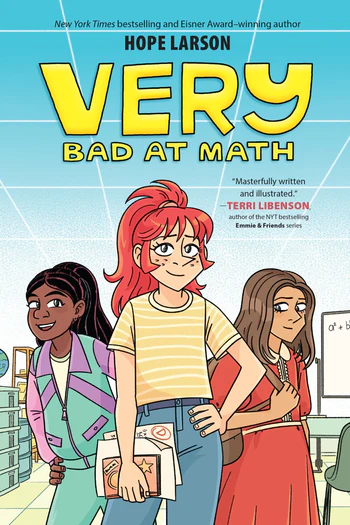
Very Bad at Math by Hope Larson (HarperAlley, 240 pages, grades 4-8). Verity “Very” Nelson is an athlete, musician, popular eighth-grade class president, and ace student…except when it comes to math, which she is failing miserably. When she’s told she has to bring up her math grade to stay on student council, Very starts working with a tutor. Despite her hard work, her progress is slow, and when Very makes a costly mistake at a class fundraiser, her tutor realizes she’s transposed two numbers and diagnoses her with dyscalculia. He starts to work with her on learning strategies to help her with this disability, and by the end of the book, Very’s back on top and on her way to being successful at math. But Very is something of an activist, and she’s determined to make school a better, more just place for students with disabilities, and the last few pages show her talking to her favorite local politician about ideas she has to do just that.

I’m always happy to see a new graphic novel by Hope Larson, especially one for elementary readers, since most of her books are for young adults. This one is sure to be popular with both elementary and middle school, particularly those who are dealing with some sort of learning issue. Very is resilient and persistent in her efforts, but she also has to learn how to deal with setbacks and not making progress even with hard work. I hope we’ll see a second book to find out how she brings her fight for justice to her school.

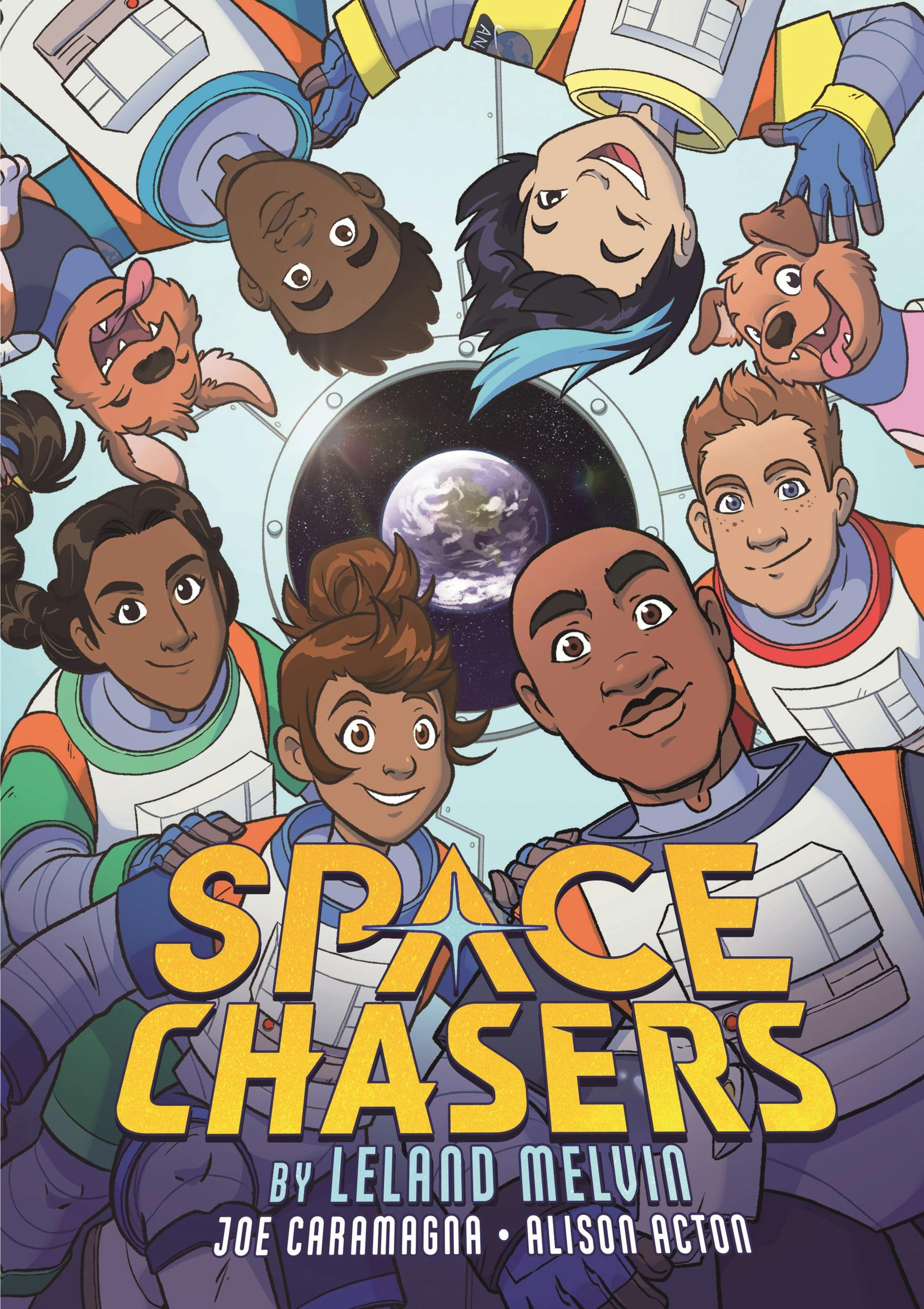
Space Chasers by Leland Melvin and Joe Caramagna, illustrated by Alison Acton (First Second, 240 pages, grades 3-7). Five middle school students are chosen to be part of NASA’s new STEAM team program, undergoing rigorous training to prepare them for a mission into space. When that mission goes awry, three of the kids wind up on a space station with no adult supervision and must figure out what to do to save the mission…and themselves. Each of the participants brings unique skills to the program but also their own insecurities that sometimes get in the way of solving problems, particularly under pressure. When everyone’s safely back on Earth, the powers-that-be deem the program too dangerous, but the kids manage to convince them otherwise, opening the door for book 2. Includes some work-in-progress art and an author’s note.

Former astronaut Leland Melvin has written a fun space adventure with five endearing kids who get the opportunity of a lifetime. I haven’t been so nervous about the outcome of a space adventure since I watched Apollo 13, which made it hard for me to put the book down. I’ll admit it took some suspension of disbelief to believe that NASA would send middle school kids into space, but heck, if you had told me a few months ago that a 19-year-old nicknamed “Big Balls” would be a senior advisor at the State Department, I would have been pretty skeptical of that as well.

Once upon a time

The Princess Swap: Cinderella and the Beast or Beauty and the Glass Slipper by Kim Bussing (Random House Books for Young Readers, 304 pages, grades 3-7). Ella from Cinderella and Belle from Beauty and the Beast unexpectedly switch places in this fairy tale mash-up. The bold and adventurous Belle winds up as a servant in Ella’s stepmother’s basement, while Ella, whose glass leg has always kept her on the sidelines, finds herself sharing a gloomy castle with a fearsome beast. Cinderella’s prince is just a kid named Amir in this telling, and he’s sad that his sister Anisa has mysteriously vanished for the last few years. The two stories come together as Ella learns more about the cursed beast, and each heroine has to take matters into her own hands to create a happily-ever-after ending for both of them. A preview of book two, featuring Snow White and Sleeping Beauty, is featured at the end.

I’m not really much of a fractured fairy tale fan, but this version was so clever and well-told, once I got into it, I couldn’t put it down. The stories are told in alternating third-person chapters, and many of the chapters ends on a cliff-hanger that will keep the reader turning the pages. Even the villains are treated with some sympathy in the end, and both girls are strong and brave, with just enough flaws to be believable.

Lily’s Dream: A Fairy Friendship by Bea Jackson (Aladdin, 40 pages, ages 4-8). Although Lily dreams of flying, so far her fairy wings haven’t worked. As a result, she knows more about beauty close to the ground, and one day she stumbles upon a beautiful fairy house. When the human creator reveals herself, Lily runs away, accidentally leaving behind her cherished gold anklet. The next day, she goes back to look for it, and the girl, who introduces herself as Willow, has found it. Willow makes Lily a fairy-sized acorn helmet, pillow, and trampoline to help her practice flying. Soon she’s taken to the air, and although she still can’t fly high, “Lily was over the moon.” Includes an author’s note that gives more of Willow’s backstory.

Those who judge books by their covers will be captivated by the picture of Lily on this one, and will undoubtedly find the rest of the story equally enchanting. I hope that this is the beginning of a beautiful friendship and that Willow and Lily will have more stories, maybe told from Willow’s point of view. I enjoyed reading about her in the author’s note and wished that more of it had been incorporated into he main story.

Struggles at school

Mixed-Up by Kami Garcia, illustrated by Brittney Williams (First Second, 208 pages, grades 3-7). Stella is excited to start fifth grade, but her excitement turns to panic as the homework starts to pile up and she falls further and further behind. She and her two best friends often play a favorite video game, but when a new manual comes out, Stella feels alienated when she can’t keep up with her friends’ reading. And to add to her worries, the big fifth grade project isn’t the art project she was hoping for, but one that features students’ writing. When Stella’s teacher calls home, she’s sure she’s in trouble, but it turns out that the adults in her life want to help. Once she’s gotten a dyslexia diagnosis, Stella’s able to work with special education teachers to develop new skills to help with her reading. This also takes away her shame at feeling like she’s not as smart as everyone else, leading to an honest conversation with her friends that helps them resolve their issues. And Stella’s understanding teacher lets her create a graphic novel for the writing project that allows Stella’s artistic talents to shine.

Speechless by Aron Nels Steinke (Graphix, 256 pages, grades 3-7). Mira’s determined that middle school will be a fresh start for her, but on the first day, she finds that, once again, she can’t bring herself to talk at school. Home is a different story, the place where she can be herself and pursue her passion of stop-motion photography. But this haven is taken away when former-friend-turned-mean girl Chloe comes for an extended stay. A phone call from school alerts Mira’s parents to her selective mutism, and she begins to work on her issues with an understanding therapist. A kind and patient new friend, Alex, also helps her by volunteering to be Mira’s partner with a project and defending her from bullies. Mira learns to take things one step at a time, communicating with notes and whispers. She even finds a way to reach out to Chloe (by letter), opening the way for them to resolve their differences. By the end of the story, Mira’s enjoying sixth grade, learning to succeed in her own way. Includes a note from the author (creator of the Mr. Wolf’s Class series) about his own struggles with social anxiety and difficulties talking in public.

These graphic novels offer stories that will both empower kids who may be dealing with learning differences like Stella’s or social anxieties like Mira’s, and create empathy in kids who may have classmates like them. I loved how the girls got help and support both at school and home but ultimately had to find their own ways. Each was able to discover her own talents and see her struggles as something she could overcome while staying true to herself.

\

Gabby and Abby

Gabby Torres Gets a Billion Followers by Angela Dominguez (Roaring Brook Press, 160 pages, grades 2-5). Gabby is an enthusiastic member of the Sea Musketeers, a club dedicated to preserving the oceans. At 9 years old, Gabby’s the youngest member, and she sometimes feels insecure at the meetings. When she suggests starting a social media account for the group, she’s surprised that everyone not only reacts positively but puts her in charge. At home, her parents tell her she can only go online when they’re supervising, and Mom helps her get the Sea Musketeers’ account up and running. But Gabby can’t help sneaking a peek a few days later to find out how things are going. While she’s delighted to find 100 followers, she’s also dismayed when she sees a comment saying that the club is stupid. Gabby immediately goes into detective mode, and no one is safe from her suspicions, not even her two best friends. When her parents start to receive irate phone calls, the truth comes out, and Gabby is relieved of her social media position and grounded for a week. She realizes that she needs to make amends with her friends, using one of her other budding talents–cookie baking–to do so, and at the next club meeting, she discovers a more age-appropriate way to contribute.

This is a cute series opener by the author of the Stella Diaz books (Stella, now a middle schooler, is the co-president of the Sea Musketeers.) I’m always happy to see a protagonist who’s still in elementary school, and Gabby has the enthusiasms and makes the mistakes that many a fourth-grader will relate to. The social media storyline got a little preachy, and also, what kid uses the term “social media”? I feel like the club would have decided to start an Instagram or TikTok account, or some fictional equivalent.

Chickenpox by Remy Lai (Henry Holt and Co., 240 pages, grades 3-7). Abby Lai is the oldest of five children, and at 12 years old she resents often being call on to supervise the younger kids. When all five get chickenpox at the same time, she knows she’s in for a rough couple of weeks. Compounding her worries are the difficulties she’s having with her two best friends and another friend who’s a boy and maybe a bit of a crush. As the itchy days go by, Abby has her share of frustrating moments, but she and her siblings also manage to have some fun, such as playing a game called Ghost that their mother has forbidden and starting a comic book lending library. When their youngest brother develops some complications and has to go to the hospital, Abby worries and realizes that she really does love her brothers and sisters. A few phone calls straighten out the friendship problems, and when quarantine finally ends, Abby has fading red spots and some interesting stories to tell to commemorate her time with chickenpox. Includes an author’s note with additional information about chickenpox and her family.

I’m glad Remy Lai has veered away (at least for the moment) from horror and back to a more lighthearted genre. In this semi autobiographical tale, she casts herself as the pesky younger sister who often gets in trouble and picks fights with all of her siblings. Older sister Abby is portrayed realistically and sympathetically, and each member of the large family has a distinctive personality. Fans of Squished by Megan Wagner Lloyd will no doubt enjoy this graphic tale of the ups and downs of being part of a large family.

Let’s see what some of the Baby-Sitters Club graphic novel artists have been up to!

Fresh Start by Gale Galligan (Graphix, 288 pages, grades 3-7). Ollie is used to starting over at a new school, since her diplomat father’s career means moving every year or two. She tells herself she doesn’t care, sometimes finding a reason to get mad at a friend before leaving. But this time around, her parents announce that they’ve decided to stay in Chestnut Falls, Virginia. Ollie’s excited to discover a group of girls as devoted to anime and manga as she is, and before long, she’s made some new friends, one of whom shares her Thai heritage. The two of them wind up in a Thai dance group, courtesy of their mothers, despite Ollie’s aversion to both dance and wearing the feminine clothes and make-up that are part of the performance. That’s not the only place Ollie struggles with her parents, who are constantly butting heads with her younger sister Cat. As Ollie learns more about herself through the year, she finds herself regretting the ties she cut with friends after each move and also starts to feel more empathy for Cat, putting her in the role of family negotiator. By the end of the year, she’s realized the importance of her connections to friends and family members and is starting to appreciate the feeling of putting down roots. Includes an author’s note, photos, bonus comics, and additional information about Thai language and traditions.

The many fans of middle grade novels/memoirs will enjoy this latest entry by the author of some of the Baby-Sitters Club graphic novels as well as Freestyle. Gale Galligan addresses the issues of fitting in, family dynamics, and racial, cultural, and gender identities with a story featuring manga-inspired artwork and a spunky protagonist. The back matter about their own childhood makes it even more interesting.

The Cartoonists Club by Raina Telgemeier and Scott McCloud (Graphix, 288 pages, grades 3-7). Makayla and Howard love creating comics: Makayla had endless story ideas, while Howard can draw anything she imagines. Encouraged by their librarian Ms. Fatima, they decide to start a comics club and soon are joined by Art, a maker with all kinds of interests, and Lynda, a talented artist who is shy about sharing her work. Led by Ms. Fatima, they take turns teaching each other about comics, including step-by-step directions for making minicomics and the importance of facial expressions, body language, and combining words and pictures. The newly-named Cartoonists Club is thrilled to be selected for participation in a local comics convention, where they meet one of their favorite artists and soon develop a following of their own. Includes interviews with Raina and Scott, a glossary, a list of comics jobs, the steps involved in making the book, and lists of additional resources and museums for learning more about comics.

I was delighted to receive an advance copy of this book (it comes out in April) and read it in a single sitting. While Raina’s legion of fans may be a little disappointed that it doesn’t have quite the involved storylines of her previous works, they will be excited to get so many interesting and useful tips for making their own comics. While that’s the main emphasis, the four characters still have engaging stories of their own. The two things that struck me the most about this book are: 1. The respect shown to young comic fans and artists that will encourage them to take their work seriously (but not too seriously!), and 2. Raina’s down-to-earth humility and sincere appreciation for other comic artists, even with her enormous success.

And two final 2024 novels in verse

Black Star by Kwame Alexander (Little, Brown Books for Young Readers, 384 pages, grades 5-8). In this sequel to The Door of No Return, Kofi is now Nana Kofi, grandfather to Charlene, a.k.a. Charley, who dreams of being the first Black female baseball player. She and her best friend Willie Green get tricked into a bet with a local bully, forcing them to quickly organize a baseball team and play a game at the church picnic. When the picnic grounds are being used for other activities, the team sneaks over the bridge to the whites-only field, where an encounter with a group of white kids ends with Willie accidentally hitting one of the boys with a baseball. Back home, Charley can’t figure out what’s going on, but the adults start talking in hushed tones and seem to be preparing for a journey. In the final pages, the family flees in Uncle Albert’s car, except for Daddy who stays behind to defend their home, while Willie Green and his brother Johnnie run from their burning home to join them after the Klan has done something unspeakable to their father. Those in the car are heading north, with Charley wracked by guilt over her actions that have led to this moment. Readers will have to wait for the third book of the trilogy to find out what happens next in the family saga.

This incredibly rich novel has so many elements woven together: Nana Kofi’s stories that fill in some of the details between books 1 and 2, appearances by real-life people like Marcus Garvey and Mary McLeod Bethune, and everyday descriptions of the life of a Black family living on the 1920’s South. I do think most readers will need some guidance with this book, particularly with the historical context, and they will understand and appreciate it much more if they have read book 1.

Unsinkable Cayenne by Jessica Vitalis (Greenwillow Books, 304 pages, grades 4-7). It’s 1985, and 12-year-old Cayenne is excited at the prospect of finally settling down. She and her free-spirited parents have always l lived in a van, but with the addition of twins to the family, they’re feeling the need for a home and some money. Cayenne loves seventh grade, making a few new friends and developing a crush on the new boy Beau, but when there are layoffs at the local sawmill, her dad loses his job, and she learns that Beau’s father was responsible. As food gets leaner and her parents start fighting more, Cayenne fears that her days in a real home may be numbered. By the end of the story, her hunch proves correct, and the family takes to the road again, although Cayenne feels a bit wiser about appreciating herself and her family and about questioning the importance of “fitting in.” An ongoing school project about the Titanic offers additional insights about class, and the author includes additional information at the end, as well as the connections to her own family, and Cayenne’s dad’s PTSD from Vietnam which he self-medicates by smoking weed.

While not exactly an upbeat story, Cayenne is an endearing protagonist who learns some important life lessons, and the focus on class and poverty is one that’s often not explored much in children’s books. I was kind of surprised when Dad was smoking a joint on page 1, but the author’s note gave his marijuana use some good context.

New year, old books

I’m trying out a few tweaks to my schedule in the new year, and this has led to more reading! So instead of my usual practice of taking a few weeks off at the beginning of January, waiting for new books to pile up, I have a few more 2024 posts to share. To start, here are three books that would be perfect for middle school or early high school readers, a demographic that often gets neglected, as they’re often feeling too old for middle grade but not quite ready for many young adult books.

Boy 2.0 by Tracy Baptiste (Little, Brown Books for Young Readers, 304 pages, grades 5-9). The story opens with Coal going to live with a new foster family after his long-term foster father had a mental breakdown. When Coal sneaks off to do a chalk drawing commemorating a woman shot by the police, he’s confronted by a man with a rifle. He runs off, trying to evade the police, and is amazed when they surround him but don’t seem to see him. Looking down at his body, he realizes he has become invisible, a condition that gradually reverses itself when the crisis is over. The rest of the story details his search for answers about this new power he had, leading him to new realizations about his birth mother as well as a deep conspiracy that includes both of his foster families. Although there’s a certain necessity to suspend disbelief, readers will love this page-turning science fiction adventure.

Bye Forever, I Guess by Jodi Meadows (Holiday House, 288 pages, grades 5-9). Awkward, shy Ingrid has a secret–she’s Anony Mouse on Scrollr, where she has a popular scroll called Bye Forever, I Guess, posting wrong-number texts that she’s received. The only people who know about her scroll are her online gaming friend Lorren, her grandmother who’s raised her since her parents died, and her best friend Rachel. When Rachel betrays her, Ingrid is afraid her secret will get out, but she’s soon distracted by a mysterious boy who sent her a wrong-number text. They start texting and gaming, and before long she finds herself with a huge crush–even though she only knows him by his gaming name, Traveler. As things unravel in Ingrid’s real life, she starts to wish she could meet Traveler in person, a wish that’s granted when they agree to meet at a bookstore where their favorite author is signing a long-awaited book. Their meeting provides a shocking surprise to Ingrid–and an extremely surprising and romantic ending to their story. While Traveler’s identity seemed glaringly obvious to me by about halfway through the book, Ingrid remains clueless. Just as I was getting completely frustrated by this, the bookstore meeting proved so sweet that I forgave Ingrid and the author everything. Fans of the genre will undoubtedly enjoy this nerdy tech-infused romance.

Keeping Pace by Laurie Morrison (Harry N. Abrams, 304 pages, grades 5-9). Grace’s focus throughout middle school has been on academic achievement, specifically to win the top student award at eighth grade graduation and to beat her rival and former best friend Jonah. When Jonah bests her by half a point, Grace is devastated and faces a depressing summer. Her more laid-back sister and cousin help her come up with a list of goals for the summer that include making a new friend, taking a baby-sitting job to help her dad’s new girlfriend, taking a class just for fun, and running a half marathon. Grace secretly plots to beat Jonah, who is also running the half marathon, but as the summer unfolds, an injury derails her plans. Meanwhile, shifting relationships cause Grace to begin to question her single-minded ambitions: a new friend that she meets who’s recently given up competitive gymnastics to pursue other interests; her dad’s career ambitions that get in the way of his relationships, and most of all, her former friendship with Jonah that’s rekindled as they train for the race. As with Bye Forever, I Guess, I got kind of frustrated by the drawn-out will-they-or-won’t-they romance between Grace and Jonah, but it would undoubtedly speak to a younger teen reader, and I really liked the message about the importance of living a balanced life.