Book Scavenger by Jennifer Chambliss Bertman

Published by Henry Holt

Summary: Emily’s parents have a plan to live in all 50 states, and this year’s move is to California. Emily has learned not to put down roots, knowing that she’ll have to move again before long.  In spite of her resolve, she finds herself in a friendship with her neighbor James, who shares her love of books and puzzles.  She introduces him to Book Scavenger, the online book treasure hunting game created by San Francisco publisher Garrison Griswold.  About the time of her move, Griswold is shot in a BART subway station.  Soon after, Emily and James find a mysterious copy of The Gold-Bug by Edgar Allan Poe, and soon discover it’s the first clue in a new game Griswold was about to debut when he was attacked.  As the publisher’s life hangs in the balance, Emily and James race to solve the Poe puzzles before Griswold’s enemy can discover the whereabouts of his book.  Grades 4-7.

Pros: A fast-paced mystery for fans of ciphers, codes, and puzzles. Emily and James are endearing characters, and there are a couple of interesting subplots about Emily’s family’s unusual goal to live in all the states, and a rivalry between James and a fellow cipher fan.

Cons:  At 343 pages, the intricate plot occasionally becomes a bit unwieldy.

A Night Divided by Jennifer A. Nielsen

Published by Scholastic 

Summary: When Gerta is 8, her father and brother Dominic go to West Berlin to look for work, preparing to move there from the east. While they’re gone, the Berlin wall goes up overnight. Four years later, she spots the two of them on an observation platform on the western side of the wall. Her father seems to be pantomiming for her to dig. When he manages to smuggle her a picture of a building, Gerta is sure he means for her and her other brother Fritz to start there and tunnel an escape route through the wall. As they work on their tunnel, their neighbors and friends grow more and more suspicious, and before long, completing it has become a life-and-death proposition. Grades 5-8.

Pros: An eye-opening story of life behind the Iron Curtain during the early 1960’s, with danger lurking everywhere for Gerta and her family, resulting in an exciting story from start to finish.

Cons: The page-turning suspense was so intense that I almost booked a cardiologist appointment before I was done.

Wrap-Up Wednesday: Fifth Grade Favorites

During these first few weeks of school, I’ve tried some “book tastings” with fifth graders.  I put out a lot of the new books and have them sample three different books for a couple minutes each.  I’ve supplemented this with some book talks.  After doing this in seven fifth grades, I’ve gotten a sense of what are some favorites this year:

The Terrible Two by Mac Barnett and Jory John, illustrated by Kevin Cornell, published by Harry N. Abrams.

Wimpy kid fans have been checking out this book about two battling pranksters who unite to create the ultimate prank against their principal.

Fish in a Tree by Lynda Mullaly Hunt.  Published by Nancy Paulsen Books.

Sixth-grader Ally has moved so frequently that her dyslexia has gone undiagnosed.  She feels like an outsider at school until substitute extraordinaire Mr. Daniels gets her some help.  Definitely the sleeper of the new school year, with quite a few fifth-grade girls clamoring for this title.

Roller Girl by Victoria Jamieson.  Published by Dial Books.

No surprise here.  Astrid’s story about joining the roller derby has been popular with my Raina Telgemeier fans, and I expect word-of-mouth to play a large role as the school year progresses.

How to Speak Dolphin by Ginny Rorby.  Published by Scholastic.

Any book with a dolphin on the cover is sure to generate some interest.  The story is compelling, too, with Lily forced to make a difficult choice when she suspects the dolphin who is helping her autistic brother is being mistreated.

Ava and Taco Cat by Carol Weston.  Published by Sourcebook Jabberwocky.

I’ve been surprised at the interest in this book.  One reader has already finished it and asked me for the sequel, Ava and Pip (fortunately, I had it).  Ava’s story about her new cat is told in diary format, with some of the wordplay her entire family enjoys.

The Trouble with Ants (The Nora Notebooks, Book 1) by Claudia Mills, illustrated by Katie Kath

Published by Knopf Books for Young Readers 

Summary: Nora’s parents and two older siblings are all scientists, and Nora knows that she is going to grow up to be a scientist, too. Her field of study is ants, and she keeps careful notes on her ant farm. Some of her friends think ants are gross, but this doesn’t deter Nora from continuing her studies. One of her experiments proves so interesting that she decides to write up her results and send them to Nature. A few weeks later, she gets a kindly rejection letter, which makes her consider giving up on her ants forever. Fortunately, a school assignment results in her writing a persuasive essay about girls studying science, her teacher sends it to the local paper, and Nora becomes a published author at last. Grades 2-4.

Pros: It’s refreshing to find a girl protagonist who is passionate about science, while at the same time enjoying basketball and a large group of friends. Fans of Judy Blume or Megan McDonald will want to get acquainted with Nora.

Cons: This is one of those books that you know kids would enjoy, but that lacks a flashy hook to get them to pick it up.

From the Notebooks of a Middle School Princess by Meg Cabot

Published by Feiwel and Friends 

Summary: Olivia lives with her aunt, uncle, and two cousins. Her father has a mysterious job—Olivia thinks he’s an archaeologist—and sends big checks for her support to her aunt and uncle. One day at school, Annabelle Jenkins threatens to beat up Olivia at dismissal time. The fight is just starting up when Olivia is suddenly rescued by Princess Mia Thermopolis of Genovia and whisked off in a limousine. Turns out Olivia and Mia are half-sisters, their father is king of Genovia, and Olivia is a princess! She learns that royalty has its ups and downs, but the best part of her new life is finally being part of a family who truly loves her. After a few bumps in the road regarding her custody, the last chapter finds her happily reporting from her grand new home in Genovia. Grades 3-6.

Pros: The Princess Diaries for a younger generation. Reluctant readers will enjoy this light real-life fairy tale.

Cons: Being a huge fan of Meg Cabot’s Allie Finkle series, I was a little underwhelmed by the plot and characters in Olivia’s story.

Fuzzy Mud by Louis Sachar

Published by Delacorte Books for Young Readers 

Summary: Fifth-grader Tamaya and her seventh-grade neighbor Marshall always walk home from school together. One day Marshall, fearing he is about to be beat up by classroom bully Chad, tells Tamaya he knows a shortcut through the woods. Chad finds them anyway, and when he attacks Marshall, Tamaya scoops up some mud and throws it in Chad’s face. Unbeknownst to any of them, it’s “fuzzy mud” crawling with ergonyms created by an eccentric inventor looking to create a biofuel to replace gasoline for cars. The microscopic creatures multiply, slowly eating away the flesh on Tamaya’s hand and Chad’s face, and before long, an epidemic threatens their town. Sachar inserts Senate testimony on the disaster to give a larger perspective on the issue. Grades 4-8.

Pros: Michael Crichton for kids.  A real page-turning adventure, with several different layers, including questions about overpopulation, dangerous science, and doing the right thing. Readers will enjoy the fast-paced story and also find plenty to discuss.

Cons: While I love a happy ending, the denouement felt a little too quick and easy. On the plus side, I  got to use the word “denouement”.

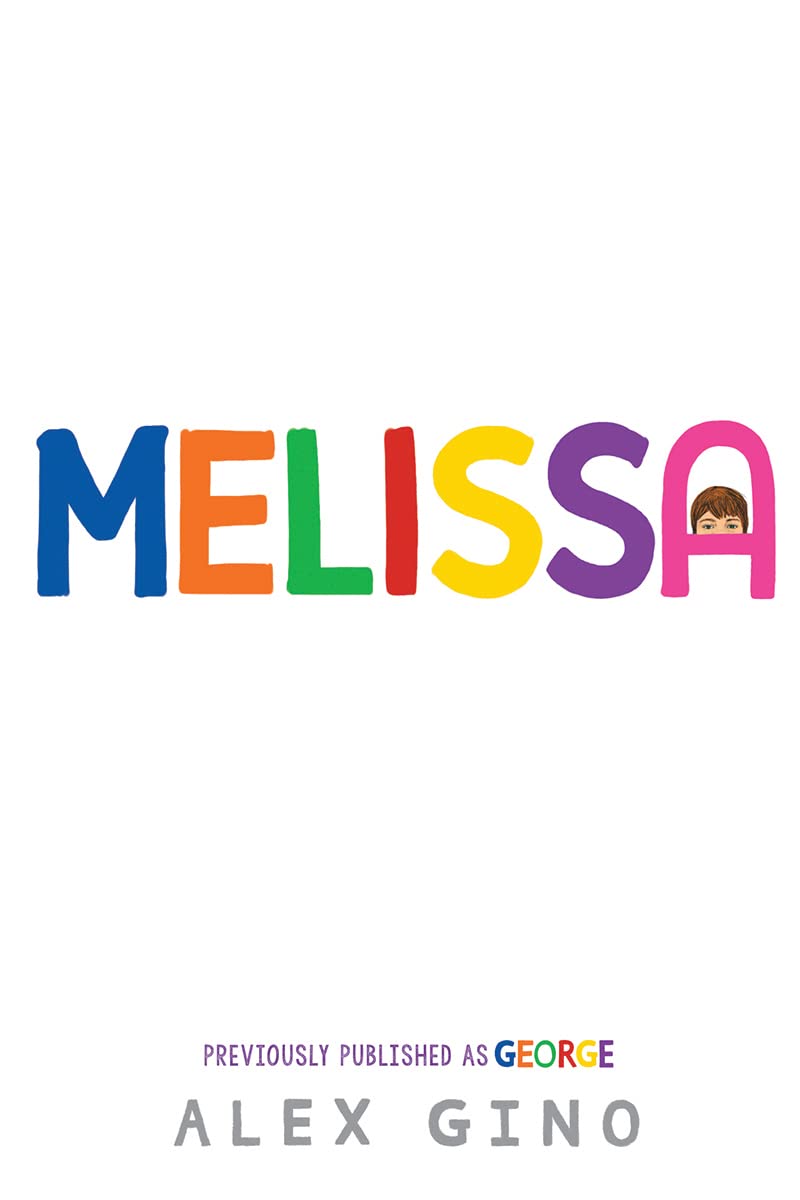
Melissa by Alex Gino

Published by Scholastic Press 

Amazon.com: Melissa (previously published as GEORGE): 9781338843408: Gino,  Alex: Books

Summary: George has a boy’s body, but she’s always felt she is a girl. She has a secret stash of magazines like Seventeen that she pores over to learn more about girls’ clothes, makeup, and lifestyles. Her fourth grade class is doing a play of Charlotte’s Web, and more than anything, George wants the part of Charlotte. Coached by her best friend Kelly, George decides to try out for Charlotte, but her teacher takes her audition as a joke and instead gives the part to Kelly. As a result of this painful experience, George finally comes out to Kelly, who hatches a plan to allow George to be Charlotte in one of the performances. Reactions to George in this clearly feminine role are mixed, but strong, and ultimately lead to a greater understanding of George by her mother and older brother. While there are no easy answers for George, the book ends on a hopeful note. Grades 4-7.

Pros: Whatever a reader’s views on transgender kids, this book makes a powerful statement about the importance of gender to personal identity, and how narrow society’s definition is on what is masculine and feminine. George would make an interesting read for educators  trying to create schools that are safe and comfortable for all students.

Cons: George addresses a controversial topic, and there will undoubtedly be those who feel it doesn’t belong in an elementary classroom or library.

Ruby on the Outside by Nora Raleigh Baskin

Published by Simon and Schuster Books for Young Readers 

Summary: Ruby has kept a big secret for many years: when she was five, her mother was arrested and sentenced to 20-25 years in jail. Since then, Ruby has lived with her aunt and gone to visit her mother in prison every weekend. She’s kept her distance from other kids because she doesn’t want them to know about her mom. The summer before middle school, Margalit moves into Ruby’s condo complex, and the two girls quickly become friends. Just as Ruby is about to reveal the truth to Margalit, she learns that Margalit’s brother may have been the victim of Ruby’s mother’s crime. Can Ruby risk being honest with her friend?  Grades 4-6.

Pros: This book takes a sensitive look at an issue not often addressed in children’s literature. Readers will take Ruby to heart as she navigates the difficult issues life has dealt her. Her mother is portrayed sympathetically, but Ruby still struggles with anger, hurt, and a sense of loss. The realities of life in prison and what it’s like to visit a loved one there are described unflinchingly.

Cons: The emotional issues occasionally slow down the action a bit.

Goodbye, Stranger by Rebecca Stead

Published by Wendy Lamb Books

Summary: Bridge and her friends Tabitha and Emily have been best friends for years, having sworn a vow never to fight. Seventh grade tests that promise, as the girls begin to move in different directions, with Em swooning over a new crush, Tab becoming a human rights activist, and Bridge still trying to figure out why she got a second chance at life after surviving a car accident years before. The story, which begins with the new school year, is mostly told from Bridge’s point of view, interspersed with narratives from Sherm, Bridge’s new friend, who may or may not be a boyfriend. Then there are sections about a mysterious character, referred to in the second person, who is having a crisis on Valentine’s Day. Her story slowly unfolds over that single day as the rest of the story moves from September to the culmination on Valentine’s Day when all stories converge. Grades 6-9.

Pros: Rebecca Stead seamlessly blends many, many elements, large and small, into a fabulously satisfactory resolution. The middle school characters are so real you expect them to pass you on the sidewalk whenever you put down the book.

Cons: I really wanted to have this book in my elementary library, but I just can’t see a fifth grader appreciating it nearly as much as he/she would as a middle schooler. Also, can someone tell me why the title of this book is Goodbye, Stranger?

Circus Mirandus by Cassie Beasley

Published by Dial Books

Summary: When Ephraim Tuttle was a boy, he discovered the magical Circus Mirandus, accessible only to those who believe. He showed the Man Who Bends Light a magic trick, and in return the magician promised him a miracle. Ephraim couldn’t think what he wanted, so he saved his miracle all his life. Now he’s dying, and his grandson Micah, who’s grown up on stories of Circus Mirandus, knows it’s time for Grandpa Ephraim to use his miracle. Micah and his new friend Jenny go off in search of the circus and the Man Who Bends Light. There are heroes, villains, stories within the story, and through it all, the power of magic and the imagination. Grades 4-7.

Pros: One of the most highly-touted books of 2015, Circus Mirandus just about lives up to the hype. The best part about it is, it’s a great story. Peopled with endearing characters, it unfolds at just the right pace, with magic and adventure woven throughout. This would make a captivating read-aloud for second grade and up.

Cons: The two main villains, Victoria and Aunt Gertrudis were a little one-dimensional.