The Monster and the Maze (Monkey King and the World of Myths) by Maple Lam (G. P. Putnam’s Sons Books for Young Readers, 240 pages, grades 3-7). Sun Wukong, or the Monkey King, comes to life in a graphic tale combining Chinese and Greek mythologies. Bold, confident and fearless, the Monkey King sneaks into heaven where he confronts the gods with his request to become one of them. Although he’s a lowly beast, he’s told his wish will be considered if he can go on a quest to slay a monster. Sun Wukong ends up in Crete, on a quest to destroy the legendary Minotaur. When he finds the monster, tough, he learns that he’s not evil and is suffering at the hands of his father, King Aegeus. The Monkey King discovers the problem–an evil spirit has possessed Aegeus–and is able to convince the king to release the spirit and return to his kindly ways, making an impassioned case for beasts and monsters in the process. Sun Wukong’s work may be done in Crete, but it looks like there will be more adventures for him ahead. The two mythologies are woven together seamlessly, making a fun and extremely engaging story. Includes additional information about the mythical characters and an author’s note.
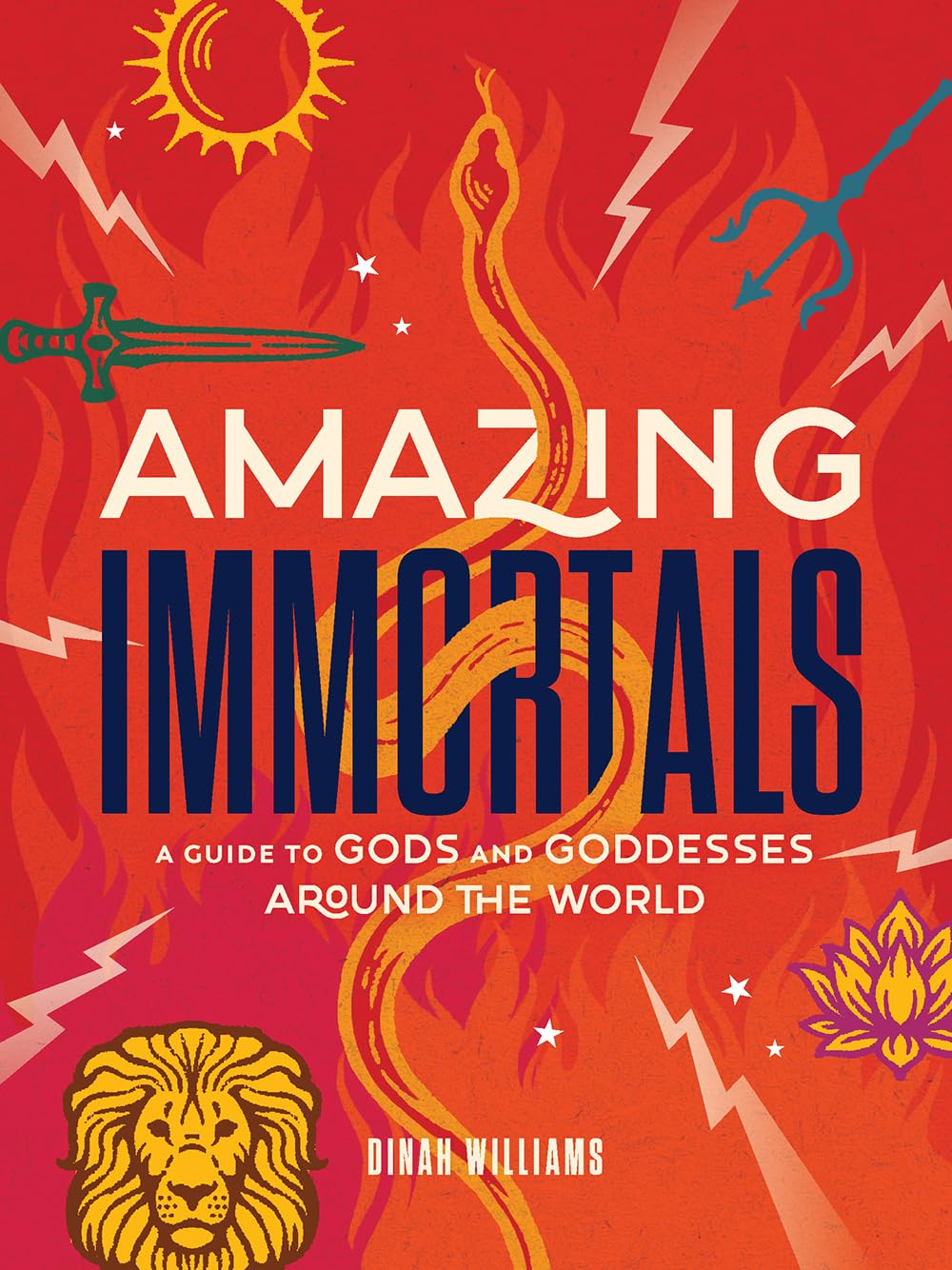
Amazing Immortals: A Guide to Gods and Goddesses Around the World by Dinah Williams (Harry N. Abrams, 208 pages, grades 4-8). Arranged by categories of power (creation, weather, tricksters, etc.), this collection of myths focuses on cultures other than the familiar Greek and Roman ones. Each two-page spread contains a brief retelling of the myth, along with gorgeous color art, created by 17 different artists. The left-hand margin contains information about the country (or region), culture, and era of each myth, which is unfortunately small enough that it took some diligent searching for me to discover. Each myth includes a fun fact or a tie-in to modern times, like Marvel movies or Rick Riordan books. The back matter includes information about the author and artists, as well as an index, a list for further reading, and an extensive bibliography, making this a great starting place for more research. It’s an amazing and visually appealing resource for upper elementary and middle school mythology fans.
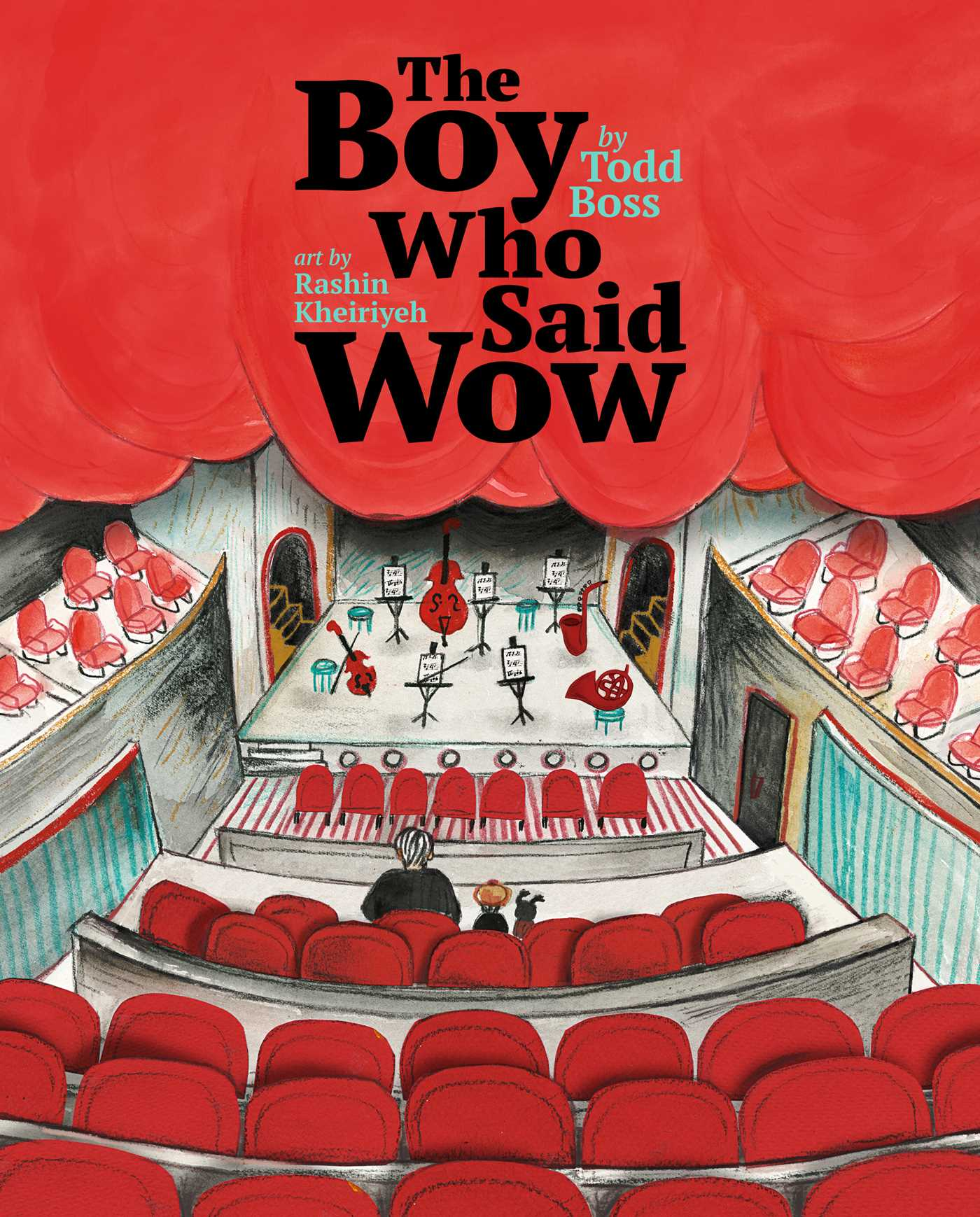
The Boy Who Said Wow by Todd Boss, illustrated by Rashin Kheiriyeh (Beach Lane Books, 40 pages, ages 4-8). Ronan is a boy who rarely speaks, and when Grandfather proposes a trip to the symphony, his parents are a bit skeptical. But Grandfather persists, and the two of them drive to the concert hall and find their seats. The lights go down, the music begins, and Ronan is swept away. In the moment of silence when the music ends, Ronan opens his mouth, and utters a loud, “Wow!” The audience laughs and claps, both for the orchestra and for Ronan. An author’s note shares that the story is based on an actual event that happened at Boston’s Symphony Hall in 2019. The illustrations look more like the 1950’s than 2019, but it’s a fun and interesting story with a sympathetic nonverbal main character.
Nothing: John Cage and 4′ 33″ by Nicholas Day, illustrated by Chris Raschka (Neal Porter Books, 40 pages, grades 1-5). The story opens with a 1952 performance at the Maverick Concert Hall in Woodstock, NY, where a pianist named David Tudor sits down at a piano and proceeds to do nothing for just over four and a half minutes. The word “nothing” is repeated a few times as the audience sits and wonders what is happening. The narrative then goes back 40 years to the birth of John Cage, a boy with unusually large ears and a penchant for inventing. Of all his radical compositions, his 4′ 33″ may be both the most unusual and the best-known. He wanted people to listen in the absence of sound to create their own music from what they heard around them. There’s an extensive author’s note, along with photos and a bibliography at the end.
The idea of this silent piece is fascinating and thought-provoking, stretching the boundaries of what can be considered music, and the subject is brought to life by Chris Raschka’s illustrations. The back matter seems more geared for older readers, and the concepts introduced may be a bit over the heads of the intended audience. Also, John Cage’s ears are described in a way that makes them sound freakishly large, but when I saw photos of him that seemed like an unnecessary exaggeration.
Piper Chen Sings by Philippa Soo and Maris Pasquale Doran, illustrated by Qin Leng (Random House Studio, 40 pages, ages 4-8). Piper loves to sing whenever she can, whether it’s joining the birds outside her bedroom window or performing for her stuffed animals. At school, she loves chorus, and when the teacher asks her to sing a solo in the spring concert, Piper offers an unequivocal “Yes!” But when it comes time to practice the solo, Piper gets stage fright and can’t do it. At home, she’s sad, no longer singing, until her grandmother Nai Nai has a talk with her, explaining that scary experiences can produce butterflies in the stomach, but so can exciting ones. Nai Nai is a pianist, and she tells Piper that the butterflies before a recital always settled once she started to play. Piper decides she will do the solo, and on the night of the concert, she welcomes the butterflies and feels them settle as she starts to sing. A lovely story by the Grammy-winning Hamilton actress that will show kids the importance of recognizing that fear and excitement often feel the same.
Finding Home: Words from Kids Seeking Sanctuary by Gwen Agna and Shelley Rotner, photographed by Shelley Rotner (Clarion Books, 32 pages, ages 4-8). Children and their families from around the world come to the United States seeking sanctuary from war, famine, natural disasters, and other dangers. Many of the photos have cartoon bubbles with kids describing in their own words how they felt when they had to leave their countries, what they miss, and the difficulties and joys in their new homes. There’s additional narrative at the end about how some of the families got to the United States, as well as resources for kids, adults, and parents, caregivers, and educators about how to make families feel welcome.
This book has some personal connections to me, because: 1. the author and photographer live near me, and I have met Shelley Rotner, 2. my Quaker meeting is part of a Circle of Care for one of the families in this book, and 3. my school in Springfield has three classes of refugee kids who have missed at least two years of school due to their circumstances. This book is at just the right level for helping kids (and adults) understand what these families have gone through and to help make them welcome in the U.S.
The Circuit: Graphic Novel by Francisco Jiménez, illustrated by Celia Jacobs (Clarion Books, 240 pages, grades 4-8). Francisco Jiménez’s memoir has been adapted as a graphic novel, telling the story of Francisco as a child, moving with his family from Mexico to California, where they became migrant workers, traveling from one farm to the next to pick cotton, strawberries, grapes, and other crops. Francisco loves to learn, but school is sandwiched between jobs, and his story is a series of losses, as he befriends kids he’ll never see again and loses his precious journal in a fire. There’s enough humor and joy to prevent the story from getting too bleak, and the story feels somewhat timeless, although I think it takes place in the 1940’s. The heart stopping cliffhanger on the last few pages will leave readers like me fervently hoping that more of Jiménez’s books will be published in graphic format.
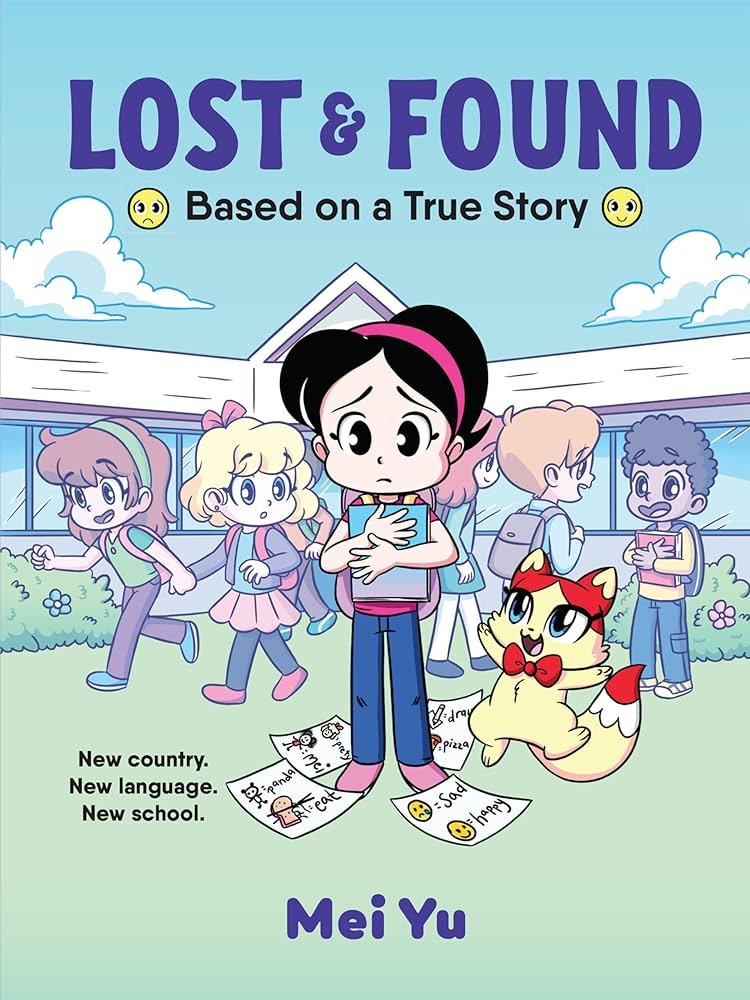
Lost & Found: Based on a True Story by Mei Yu (Union Square Kids, 128 pages, grades 2-5). Mei Yu recounts her memories of moving from China to Canada at a young age (probably six or seven). With English words in a green font, readers can see how few words she understands at school and the scary situations that ensue: using the wrong bathroom, thinking kids are laughing at her, losing her beloved sketchbook. Mei eventually uses the sketchbook to create a collection of English words, and before long, she is able to communicate and begin to make friends. An author’s note gives more information about her experience, as well as a simple glossary of Chinese words. There’s a funny bonus story about how Mei got her beloved toy cat, who appears real to her, a la Calvin and Hobbes.
It’s a pretty simple story, but the difficulties of immigration are presented in a way that beginning readers will be able to understand, and everyone is sure to love the manga-style artwork.
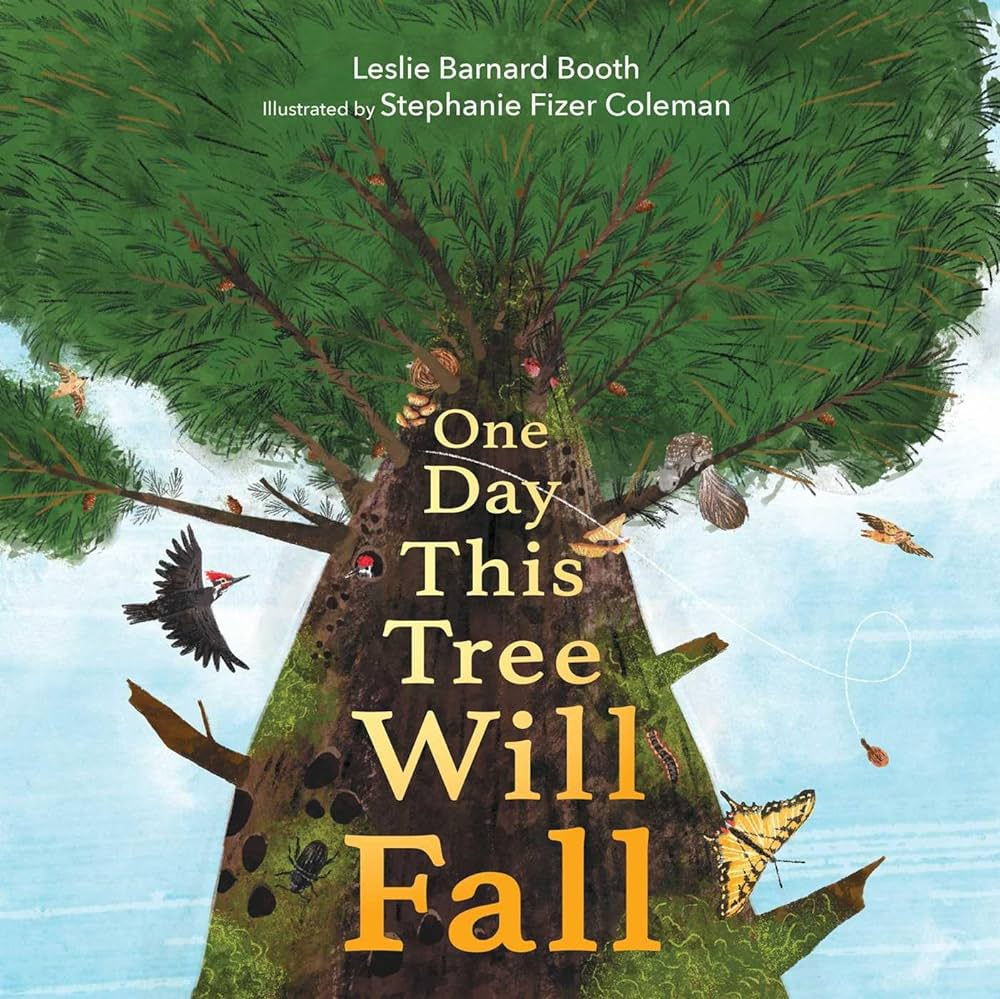
One Day This Tree Will Fall by Leslie Bernard Booth, illustrated by Stephanie Fizer Coleman (Margaret K. McElderry Books, 40 pages, grades K-4). “Wounded, worn, twisted, torn. One day this tree will fall and this story will end. Won’t it?” To learn the answer to this question posed on page 1, the narrative goes back to the beginning when a seed survives its journey to become a seedling. Its story could have ended before it began, and it could have also been ended by wind, ice, drought, and fire. But the tree survives, becoming a home to many creatures. Eventually, the tree does fall, but even when it’s lying on the forest floor, it provides food and homes to animals. Finally, it becomes part of the soil that supports a new tree seed. Includes additional information about trees and the interactions between trees and people, as well as a glossary and selected sources.
This Book Is Full of Holes: From Underground to Outer Space and Everywhere In Between by Nora Nickum, illustrated by Robert Meganck (Peachtree, 40 pages, grades 1-4). Maybe you haven’t thought a lot about holes, but you’ll start to notice them after reading this book. Whether tiny (a bleed hole in an airplane window) or enormous (the Bingham Canyon Mine in Utah), forming slowly (potholes) or quickly (sinkholes), mysterious (a wormhole) or annoyingly familiar (a hole in your sock), holes generally have interesting stories, many of which are told here. The last few pages cover English idioms that use the word hole (loophole, pigeonhole, a square peg in a round hole) and describe one last hole that’s not really a hole–a black hole. Includes a list for further reading.
Here are two STEM related titles for elementary readers to enjoy. This Book Is Full of Holes has a more unique premise, but I think I’d be less likely to use it as a read-aloud than the beautifully illustrated One Day This Tree Will Fall, which tells a fascinating story in a way that’s simple enough for kindergarteners and first graders to understand. This Book Is Full of Holes is a bit text-heavier and may lend itself better to reading on one’s own.
Brave Baby Hummingbird by Sy Montgomery, illustrated by Tiffany Bozic (Simon and Schuster, 48 pages, ages 4-8). A hummingbird tells his story, beginning with his birth when he and his sister hatch from eggs the size of navy beans. They’re fed every twenty minutes until the day their mother doesn’t return to the nest. Fortunately, they’re rescued and taken to a place where a human, known only as the Voice, takes care of them until they are old enough to survive on their own. Woven into the story are facts about hummingbirds’ food, flight, bodies, and migrations, and more information is given at the end, including the author’s experience with a hummingbird rescue and ways that readers can help these birds. This lovely book provides plenty of information about hummingbirds, illuminated with beautiful illustrations of the birds at every stage of their lives and the colorful landscapes they inhabit.
The Iguanadon’s Horn: How Artists and Scientists Put a Dinosaur Back Together Again and Again…and Again! by Sean Rubin (Clarion Books, 48 pages, grades K-4). Ever since humans first realized that dinosaurs once existed, they’ve been trying to imagine what these creatures looked like. Using the dinosaurs’ fossilized remains, artists have painted and sculpted prehistoric depictions…and generally gotten things completely wrong. A case in point is the iguanodon’s horn, which turned out to be (we think) a thumb spike. Sean Rubin goes through the evolution of ideas about the iguanodon, showing how increased scientific knowledge changed perceptions about what the animal looks like. He speculates on what the next ideas may be, emphasizing the fact that, barring time travel, we will never know for sure. The endnotes give additional information about each two-page spread.
Dinosaur fanatics will love this book, both the fascinating story of how science works and the illustrations, which are at once informative and funny (I liked the cartoon bubbles showing the comments of the various wrong iguanodon models: “I DO look pretty terrible here,” “Seriously. This is embarrassing.” I felt a little bogged down reading the repeated wrong guesses, but I suspect a true paleo fan will find them captivating.
Cactus Queen: Minerva Hoy Establishes Joshua Tree National Park by Lori Alexander, illustrated by Jenn Ely (Calkins Creek, 40 pages, grades 1-4). Minerva Hoyt grew up in Mississippi, where she loved to play outside and was not afraid to speak her mind. She grew up, got married, and moved to Pasadena, California with her husband. When Minerva needed a break from the city, her favorite place to visit was the Mojave Desert.
Over the years, Minerva watched as people from Los Angeles slowly stripped the Mojave of its cacti, yucca, and Joshua trees to transplant (usually unsuccessfully) to their gardens. To try to preserve this ecosystem, Minerva did something similar, but for a different purpose–she gathered plants from the desert and created an exhibit at the 1928 International Flower Show to raise awareness. Later, she worked to turn some of the Mojave into a national park. There was quite a bit of resistance to this idea from those who thought the desert was a barren wasteland, but Minerva never gave up. In 1936, President Franklin D. Roosevelt signed the law that created Joshua Tree National Monument. Almost 50 years after Minerva’s death in 1945, President Bill Clinton established Joshua Tree National Park. There’s more information about Minerva, Joshua Tree, and national parks, as well as environmental tips and a bibliography in the back.
Tasha’s Voice by Carmen Bogan, illustrated by Floyd Cooper and Daria Peoples (Yosemite Conservancy, 38 pages, grades K-3). In this companion to Carmen Bogan’s Where’s Rodney? a young girl has a transformative experience in nature, just as Rodney does in his story. Tasha is a new girl in Rodney’s class, so shy that she can’t speak when the teacher calls on her or talk to the other kids in the class. When the class takes a field trip to the park, a ranger shows them around, then lets them explore on their own. An encounter with a small turtle helps Tasha to make two new friends and to finally find her own voice.
Be sure to read the last two pages, which include an interview with Daria Peoples who completed the artwork after Floyd Cooper passed away in 2021. There’s also a brief note about parks that includes websites for Outdoor-Afro and Latino Outdoors.
Enjoy these two books for the last part of Women’s History Month! (Although Tasha’s Voice won’t be out until April). They are a celebration of national parks, the healing power of nature, and making outdoor experiences available to groups, like women and people of color, who may not have always felt welcome there.
Max in the House of Spies: A Tale of World War II by Adam Gidwitz (Dutton Books for Young Readers, 336 pages, grades 4-7). “Once there was a boy who had two immortal creatures living on his shoulders. This was the fourth most interesting thing about him.” The other things about Max are that he’s a genius, particularly in the mechanical realm, that his parents send him from Berlin to England as part of the Kindertransport in 1939, and that he falls in with some spies, even though he’s only 11. The immortal creatures, a kobold named Berg and a dybbuk named Stein are invisible and inaudible to everyone but Max, which proves both huge help and a terrific nuisance.
Max wants nothing more than to return home and save his parents. Much to his surprise, he ends up living with a Jewish family in London, giving him the chance to observe British antisemitism up close. It’s this family that brings him into contact with the spies, allowing Max to use his genius to get them to agree to send him back to Berlin as a British spy. First there’s an intense training, where it takes every bit of Max’s brains, as well as help from Berg and Stein, to pass to the next level. Finally, Max is ready to go, assigned to be carried in by a paratrooper in the dead of night. That’s as much as I can tell you now, except to assure you that the cliffhanger ending will have you praying that Adam Gidwitz is a speedy writer who can produce book 2 ASAP.
The Enigma Girls: How Ten Teenagers Broke Ciphers, Kept Secrets, and Helped Win World War II by Candace Fleming (Scholastic Focus, 384 pages, grades 5-9). If you’ve seen The Imitation Game, you’re familiar with Bletchley Park, the top-secret British facility where thousands of men and women worked day and night to crack German codes. This book focuses on ten of the young women, many still in their teens, who came to work in various jobs there. Each one had a very specialized task, whether it was translating, indexing, or keeping machines running. The work was absolutely grueling, with rotating eight-hour shifts to keep a 24-hour schedule, and it was top, top secret. Workers couldn’t even discuss what they were doing with those in a different department.
All were motivated by a desire to save lives and win the war, although at one point, one of the women reflects on the fact that saving British lives meant losing German lives. They all put their lives on hold, some for years, to do their important work. When the war ended, the girls went their separate ways, never telling anyone, including spouses and family members, what they had done. It wasn’t until the late 1970’s that some of the secrecy was lifted and stories started to be told. In the 1990’s, what was left of Bletchley Park was restored and opened as a museum. An author’s note and extensive source notes and index are a testament to the research done by Candace Fleming.
Reading these two books caused me to reflect on how World War II is still being mined for stories for all ages, more than any other time period I can think of. It seems like an era that easily lends itself to unambiguous tales of good versus evil. I appreciate how Adam Gidwitz subtly points out the racism and antisemitism that was prevalent in Britain, as well as making a point of England’s centuries of colonialism and empire building that preceded the war, with little concern for indigenous people in the conquered lands. The Enigma Girls is a more straightforward war story, with an interesting emphasis on the importance of women’s work that is often missing (e.g., Christopher Nolan’s Oppenheimer). Ten enigma girls were a lot for me to keep track of, especially since their stories were all woven together, and, although I would have liked to have known each one better, it did emphasize the diversity of backgrounds of those who ended up at Bletchley Park. It’s also unfortunate, although understandable, that not many photos exist of the facility, and Candace Fleming made the decision not to include any of the women’s photos, since she couldn’t find pictures of all of them.
The Observologist by Giselle Clarkson (Gecko Press, 120 pages; grades 3-7). Giselle Clarkson defines observology as the study of looking and encourages kids to become observologists, closely examining the world around them. Following the introductory chapter, there are four sections, each focusing on a specific place to observe: a damp corner, pavement, a weedy patch, and behind the curtains. Each of these has several subsections that look at topics as diverse as how to relocate a spider, droppings and eggs, and things to spot at night.
Kids are encouraged to draw what they see, and the whole book has the look of a naturalist’s notebook, with lots of sketches and labels. The text and illustrations are both humorous and informative. It may take a dedicated naturalist to read this book from cover to cover, but it’s an easy one to browse. I could also see it being used as a textbook for a fun and fascinating observology class. The book concludes with a very complete index, in a font so small that this observologist was compelled to break out her magnifying glass to read it.
This Book Will Make You an Artist by Ruth Millington, illustrated by Ellen Surrey (Nosy Crow, 64 pages, grades 2-5). The title’s bold claim is supported by profiles of 25 different artists, with step-by-step instructions to make art projects based on each person’s work. It’s a diverse group of artists, starting with cave painters, and continuing through time to include famous artists like Leonardo da Vinci, Pablo Picasso, and Frida Kahlo, and those who may not be as well-known, such as Judith Scott, Liu Bolin, and Esther Mahlangu. There’s plenty of diversity in the art as well, allowing kids to create paintings, mosaics, collages, sculptures, and more. The introduction shows readers how to set up their own art studio, and the glossary will help with unfamiliar words that they may encounter throughout the book.
Just like The Observologist, this is a book that’s unlikely to be read from start to finish but could be used to teach a pretty awesome class combining art history and hands-on art. The projects all look like fun and are broken down into 4-6 easy-to-follow steps with illustrations. The pages felt kind of crowded, with information and illustrations about the artist taking up about 2/3 of each spread, and the directions crammed into the remaining portion of one page. The plus side of this is that each spread is chock full of information, ideas, and inspiration, and readers are likely to come away with some artwork they will feel proud of.
A Grand Idea: How William J. Wilgus Created Grand Central Terminal by Megan Hoyt, illustrated by Dav Szalay (Quill Tree Books, 48 pages, grades 1-5). At the turn of the (previous) century, Manhattan was filled with the smoke of trains, not to mention the snarl of traffic they caused, at one point resulting in a crash that killed 15 people and injured dozens more. Chief engineer William J. Wilgus struggled to find a solution, finally proposing the revolutionary idea of moving the trains underground, electrifying them, and building a bigger station.
Another country might have invested some government funding, but in the U.S., the project was taken on by robber baron Cornelius Vanderbilt. Although the winning design was submitted by architectural firm Reed and Stern, Vanderbilt’s cousin owned another company that he insisted be part of the design process. This resulted in 18 months of feuding, but the new design finally emerged. The rest of the book traces the magnificent station, with its amenities that over the years included a movie theater, a hospital, and a ski slope. As planes replaced trains, Grand Central Station was used less. Demolition was on the table, until a group of citizens led by Jacqueline Kennedy Onassis campaigned to save and restore it to its present glory. Includes additional information about Wingus and Grand Central Station, along with a timeline and a list of sources.
A Plate of Hope: The Inspiring Story of José Andrés by Erin Frankel, illustrated by Paola Escobar (Random House Studio, 48 pages, grades 1-5). As a child, José Andrés loved to help his parents cook for big gatherings at their home in Spain. Cooking school, a stint on a Navy ship, and a job at a Spanish restaurant prepared him for a move to the U.S., where he quickly rose to become a star chef. But he wanted his cooking to be for everyone, not just for those who could afford to eat in his restaurants.
When he was invited to help after the 2010 earthquake in Haiti, José learned to prepare large quantities of local cuisine for people who desperately needed food. This experience gave birth to World Central Kitchen, an organization that travels around the world offering humanitarian food aid. When Huracán María hit Puerto Rico in 2017, José and World Central Kitchen spent three months serving almost four million meals all around the island. They continue to travel around the world, as described in the author’s note at the end, doing work that earned José a Nobel Peace Prize nomination in 2019. There’s also a bibliography.
Amazing Abe: How Abraham Cahan’s Newspaper Gave a Voice to Jewish Immigrants by Norman H. Finkelstein, illustrated by Vesper Stamper (Holiday House, 40 pages, grades 1-5). Growing up in Lithuania, Abraham Cahan loved languages, learning Hebrew, Russian, and Yiddish. He became a teacher and political activist, which eventually forced him to flee to the United States. He added English to the list of languages he spoke, and gradually became fluent enough to begin writing about the experience of Jewish immigrants for American newspapers.
His first love was Yiddish, though, and in 1897, Abe founded Forverts, a Yiddish newspaper which grew to become the largest foreign-language newspaper in the country. In addition to news, the paper helped immigrants adjust to their new home, providing them with detailed instructions about baseball, how Americans set a table, and explanations of democracy and the importance of voting. The author’s note describes how the paper evolved over time, continuing as an online publication to this day. There’s also additional information about Abe and the Yiddish language, as well as a timeline and a bibliography.
I know, I know, March is Women’s History Month! But these three picture book biographies all landed on the library hold shelf for me at approximately the same time, all of them telling inspiring stories about men I knew nothing about who made significant contributions to their communities that continue to this day. All three have excellent illustrations; I particularly liked the endpapers of Amazing Abe that show laundry day in a busy NYC tenement, and the full-circle beginning and ending illustrations of A Plate of Hope that portray José Andrés as a child and an adult cooking large meals over an open fire. Readers will find plenty of additional resources in all three books to continue their research about these men.
The Last Stand by Antwan Eady, illustrated by Jarrett and Jerome Pumphrey (Knopf Books for Young Readers, 40 pages, ages 4-8). A boy tells the story of his grandfather’s farm stand, the last stand in a community where there used to be a whole farmers’ market. Not only does Papa grow food and sell it at his stand, but he delivers to neighbors who can’t get out. The day comes when Papa is the one who isn’t well enough to go to the stand, and the boy has to use his own resourcefulness to keep the business going. Fast forward a few years, and the last page shows the boy grown, Papa apparently having passed away, and another stand re-opened, offering hope that the market can come back again.
I’m thrilled to see a new book illustrated by the Pumphrey brothers, almost as thrilled as I was when they won a Caldecott Honor this year for There Was a Party for Langston. This story harkens back to my favorite book of theirs, The Old Truck, with its empowering themes of Black farmers surviving despite the odds being stacked against them and passing a legacy down to the next generation. Be sure to read the author’s note to learn more about the struggles of Black farmers, as well as offering an acknowledgement of discrimination against other farmers, including women and Indigenous communities.
Tree of Life: How a Holocaust Sapling Inspired the World by Elisa Boxer, illustrated by Alianna Rozentsveig (Rocky Pond Books, 40 pages, grades 1-4). In the Czechoslovakian ghetto of Terezin, a teacher named Irma Lauscher secretly taught children to read, write, and celebrate Jewish holidays. To help them observe Tu Bishvat (The New Year of the Trees), she obtained a maple sapling, putting herself and the prisoner who got it for her at enormous risk. The children shared their water rations with the sapling, watching it grow, until many of them were “taken away on trains to a place that was even worse.” Miraculously, the tree grew and flourished until the end of the war when it was five feet tall. Eventually it grew to sixty feet, and Irma Lauscher, who also miraculously survived, sent seeds from the tree to places around the globe. When the tree finally died in 2007, there were 600 descendants all over the world, including one planted outside New York City’s Museum of Jewish Heritage in 2021.
Elise Boxer’s author’s note also adds context to this story of brave people finding hope in tragedy, and offers additional information about Terezin, a Nazi propaganda camp that sent most of its inhabitants to Auschwitz. It includes the chilling statistic that 90% of Europe’s Jewish children were killed in the Holocaust, serving as a timely reminder of the horrors of war in which the innocent are victims. I hope this will be a contender for the Sydney Taylor award.





 A Kids Book A Day