Virginia Wouldn’t Slow Down: The Unstoppable Dr. Apgar and Her Life-Saving Invention by Carrie A. Pearson, illustrated by Nancy Carpenter

Published by Norton Young Readers

Summary:  Ginny Apgar was an active child, shunning traditional female pursuits and curious about the world around her.  She decided to become a doctor, specializing in the relatively new practice of anesthesiology, and eventually became the second woman to be board certified in the field.  Working in the delivery room, she noticed that doctors and nurses were usually more focused on the mothers than the babies, whose needs for breathing assistance often went unnoticed.  Ginny started paying attention to the babies, using her knowledge as an anesthesiologist to help them.  When a young doctor asked her for signs of health in a newborn, she quickly scribbled down the five markers she checked for.  Ginny’s last name lent itself to the acronym that became a test for newborn health, and today most babies receive an APGAR score within minutes of birth.  Includes an author’s note with additional information, a timeline, and a couple of photos.  48 pages; grades 1-5.

Pros:  I didn’t expect to find this book so engaging, featuring a woman who dealt with career obstacles (she had to give up her dream of becoming a surgeon due to financial constraints) but went on to make a huge contribution to medicine.  She sounds like a real character, and as a New Jersey native who often traveled on the Garden State Parkway before the age of E-ZPass, I particularly appreciated the special gun she had for firing quarters at toll booths so she wouldn’t have to slow down.

Cons:  This may not be a topic kids will be drawn to on their own.

On the Line: My Story of Becoming the First African American Rockette by Jennifer Jones and Lissette Norman, illustrated by Robert Paul Jr.

Published by HarperCollins

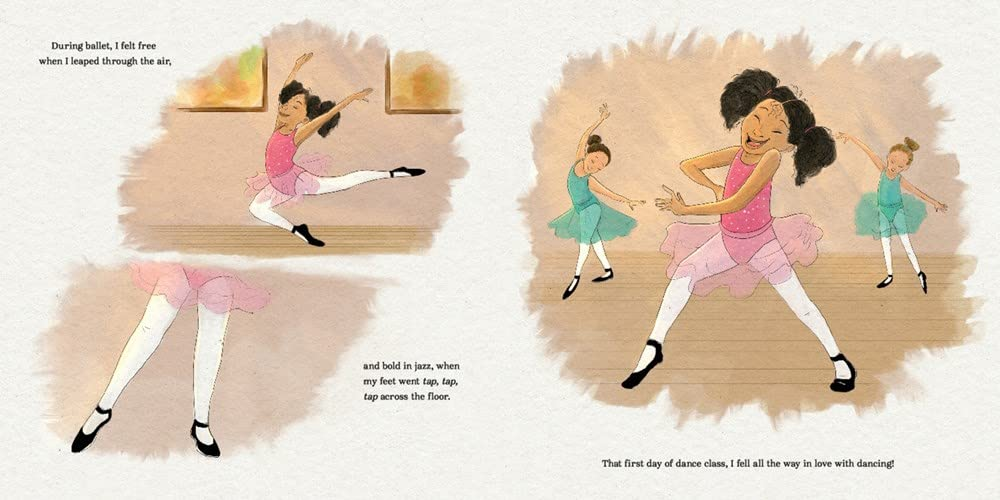
Summary: Jennifer Jones fell in love with dance in her first class at age nine. Dance was a way to express herself when she felt shy, which was often. With a white mother and a Black father, Jennifer felt conspicuous and out of place in her New Jersey hometown. When a supermarket clerk made racist remarks and told her that “girls like you don’t become dancers,” Jennifer’s mom set up a dance studio in their basement. Seeing The Wiz on Broadway showed her that people like her could be dancers, and Jennifer auditioned for the Rockettes at age 19. As there had never been a Black Rockette since the group’s start in 1925, she was up against tough odds, but in 1987, Jennifer became the first African American Rockette. She ends the book by acknowledging her family’s support of her dreams and encouraging readers to figure out what they love to do and pursue it. Includes additional information about Jennifer Jones and the Rockettes. 40 pages; grades K-4.

Pros: An inspiring story of a woman whose passion led her to break down barriers and open doors for others. The conversational tone of the story makes Jennifer feel like an old friend, encouraging kids to follow their dreams as she did hers.

Cons: A few photos would have made a nice addition.

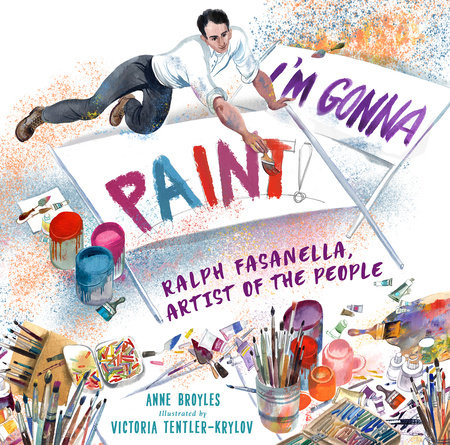
I’m Gonna Paint! Ralph Fasanella, Artist of the People by Anne Broyles, illustrated by Victoria Tentler-Krylov

Published by Holiday House

Summary:  Ralph Fasanella’s early life didn’t seem particularly auspicious for becoming a renowned artist.  The son of Italian immigrants, Ralph grew up in a tenement with five siblings and was in and out of a Catholic reform school from the age of ten.  He left school as a teenager and took a series of jobs before becoming a trade union organizer.  When he started having pain in his hands, a friend recommended drawing, and Ralph created his first art at the age of 31.  Recalling his mother’s labor activism, as well as his own union experiences, Ralph focused on working people and political messages in his paintings.  Family members supported him so he could quit working and paint full time.  His works hang today in the Smithsonian, Ellis Island, and other museums around the world, as well as in union halls and subway stations.  “I didn’t paint my paintings to hang in some rich guy’s living room,” Ralph said.  “My paintings are about people, and they should be seen by people, not hidden away.”  Includes additional information with photos and reproductions of some of Ralph’s paintings; a timeline of his life with relevant events from American history; a list of some of his paintings; and additional resources.  48 pages; grades 1-5.

Pros:  A fascinating, well-written introduction to the life of an artist who captured many important moments from American history, with illustrations that perfectly reflect Ralph’s style.  This would pair nicely with Cynthia Levinson’s The People’s Painter, about Ralph’s contemporary Ben Shahn.

Cons:  Although several museums were mentioned, I wish there had been a list of places to see Ralph Fasanella’s works.

Two books about birds

How to Bird by Rasha Hamid

Published by Free Spirit Publishing

How Birds Sleep by David Obuchowski, illustrated by Sarah Pedry

Published by minedition

Summary: These two books about birds encourage kids to be curious about the world around them. In How Birds Sleep, the author and illustrator explore the unusual ways birds slumber, including sleeping while flying, hanging upside down, or standing on one leg. Each page or spread has an illustration of the resting bird, labeled, with a few sentences of text. The back matter includes additional information about birds’ sleep, the effects of climate change, and how the book came to be written. While there hasn’t been a lot written on the topic, there are three additional resources listed.

How to Bird is a bright, colorful celebration of birding, illustrated with photos of kids getting out in the city to observe the birds. Different birders have different superpowers, such as keen observation, good listening, and fast counting. The emphasis is on the fun and easy accessibility of birding, which requires little more than being curious and getting outside. Includes an author’s note, a list of questions to think about, birding words with definitions, and additional resources. Both books are 40 pages; ages 4-8.

Pros: I love how both authors encourage kids to go outside and look at the world around them. The illustrations in both books are eye-catching and add to the appeal of birds and birdwatching, and the additional information at the end makes them both great resources for older readers.

Cons: I was curious as to how long birds sleep each night, but that wasn’t covered.

How to Eat in Space by Helen Taylor, illustrated by Stevie Lewis

Published by Little, Brown Books for Young Readers

Summary:  You can’t eat everything in space, but the options have improved considerably since the early days of space travel.  It’s a whole different experience from Earth eating, though, and this book gives lots of good tips.  Water is at a premium and can’t be poured.  Burping in space can have some pretty unpleasant consequences.  Floating crumbs can become a menace on board the spaceship. From cooking to doing dishes to growing your own food, there are plenty of details here that are sure to intrigue kids.  Includes three pages of additional information, along with additional resources and a list of sources.  40 pages; grades 1-4.

Pros:  Life in space is a fascinating topic, and this book provides a wealth of interesting information presented with a chatty tone and appealing illustrations.

Cons:  Reading this made me realize how much I take gravity for granted.

Why Do Elephants Have Big Ears? Questions–and Surprising Answers–About Animals by Steve Jenkins and Robin Page

Published by Little, Brown Books for Young Readers

Summary:  Nineteen animals are profiled with the trademark Steve Jenkins cut-paper illustrations and a question and answer about each.  Why do hippos swish their tail when they poop?  Why are naked mole rats naked?  Why do red-eyed tree frogs have big red eyes?  Each question is answered with a short paragraph.  A small silhouette at the bottom shows the animal in comparison to a human or a human hand for smaller animals.  Includes additional information about each animal and a bibliography.  40 pages; ages 4-8.

Pros:  You can’t go wrong with a Steve Jenkins-Robin Page animal book.  This one is full of striking illustrations and fascinating information that will engage even the most reluctant readers.

Cons:  I was hoping for a format that would lend itself to guessing, like Jenkins’s Biggest, Strongest, Fastest, which is one of my all-time favorite books to share with kids.

We Are Palestinian: A Celebration of Culture and Tradition by Reem Kassis, illustrated by Noha Eilouti

Published by Crocodile Books

Summary:  This introduction to Palestine and Palestinian culture includes chapters on geography, cultural symbols, creative minds, agriculture, cuisine, performing arts, and history and religion.  The author has written cookbooks (the food section is particularly strong) and seeks to preserve her Palestinian culture for her daughters.  Each section contains “Did you know?” and “Fun fact” sidebars, as well as an illustration or two. The difficult history of Palestine is woven throughout the text, not only in the history section.  Includes an index.  112 pages; grades 3-7.

Pros:  I enjoyed learning more about Palestine, which, of course, is all over the news, but is probably a culture that is not well known to most Americans, including myself.

Cons:  I would have liked more back matter, especially additional resources.

Stone Age Beasts by Ben Lerwill, illustrated by Grahame Baker-Smith

Published by Candlewick

Summary:  Following a four-page introduction to the Stone Age, the book gets down to business with a series of two-page spreads on some of the large animals of the era.  Each one includes a portrait with a few paragraphs of information and some sidebars, including one with fast facts, a map showing the animal’s range, and a size comparison to a human.  There are old favorites like the woolly mammoth and saber-toothed cat, along with some that may be less familiar, such as the elephant bird and giant short-faced kangaroo.  A final page looks at why the animals disappeared and how we learned about them.  Includes a glossary.  48 pages; grades 2-5.

Pros:  Dinosaur fans will enjoy learning about gigantic beasts from another time period, particularly the ferocious illustrations that dominate each page.  The information is engagingly written and presented.

Cons:  The Stone Age seems scary.

Tomfoolery!: Randolph Caldecott and the Rambunctious Coming-of-Age Children’s Books by Michelle Markel, illustrated by Barbara McClintock

Published by Chronicle Books

Summary:  In this follow-up to Balderdash! John Newbery and the Birth of Children’s Books, Michelle Markel looks at the man who was the namesake for another famous children’s literature award.  Despite a weak heart, Randolph Caldecott loved being outdoors, hanging out with animals, and capturing what he saw on paper.  His father sought to quash his love of art with a career as a banker, but Randolph kept drawing.  When offered a chance to illustrate children’s books, he went against the prevailing fashion of stilted decorations and created art with plenty of action and animals.  Kids and adults loved his work, and Randolph became an international success, his work continuing to influence illustrators 150 years later.  Includes a list of the Caldecott reproductions included in the illustrations; a list of annotations; a picture of the Caldecott medal; additional information about illustrated Victorian periodicals and the big three toy book illustrators (Caldecott, Walter Crane, and Kate Greenaway); and a list of books by Randolph Caldecott.  44 pages; grades K-3.

Pros:  This exuberant book brings Randolph Caldecott to life with beautiful illustrations inspired by his art.  It seems only fitting for this to be considered for a Caldecott medal or honor.

Cons:  There’s a great illustration of several Caldecott medalists reading their own books; I wasn’t able to identify all of them, and I wish the back matter had included a list.

Accountable: The True Story of a Racist Social Media Account and the Teenagers Whose Lives It Changed by Dashka Slater

Published by Farrar, Straus and Giroux

Summary:  When Albany (CA) High School junior Charles created a “fake” Instagram account for posting racist memes, he thought it was a way to be funny that his friends would appreciate.  But some of the Black girls he targeted found the account in 2017, and the discovery ripped the school and the community apart.  The school administration tried both traditional methods of discipline (suspension and expulsion) as well as a disastrous restorative justice mediation session to try to bring healing.  A messy combination of lawsuits, school board confrontations, and conversations among the kids themselves eventually allowed them to move on, but the reverberations continue to affect the students, now young adults, and the community.  496 pages; grades 9-12.

Pros:  I don’t usually review young adult books, but I loved Dashka Slater’s The 57 Bus, and a long train ride gave me some extra time to dive into this book.  Like her previous book, this one looks at a hateful incident through the eyes of teenagers, emphasizing the devastating impact on the victims, while digging into the motivations of the perpetrators.  All the kids are presented sympathetically, even the boys, who, with one striking exception, came to see, at least to a certain extent, the harm that they caused.  There are no easy answers, and diving into the complexity of the issues would make this an amazing book discussion choice for high school and possibly older middle school students.

Cons:  It was sadly evident how ill-prepared educational institutions are to deal with cyberbullying and social media in general.