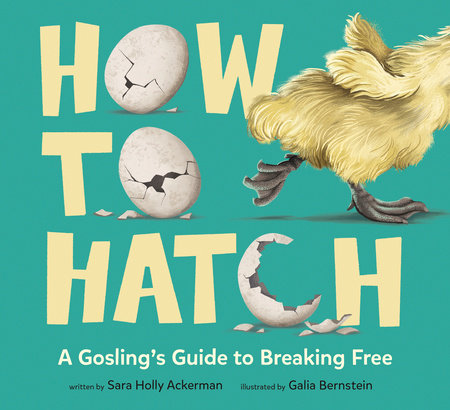
How to Hatch: A Gosling’s Guide to Breaking Free by Sara Holly Ackerman, illustrated by Galia Bernstein (Knopf Books for Young Readers, 32 pages, ages 4-8). Written as a how-to manual for a gosling about to hatch out of its egg, the main part of the text gives six steps from Breathe! to Flop! as the baby makes its exhausting sojourn into the world. Cutaway illustrations give detailed views of what’s going on inside the egg, while sidebars give additional information about each step in the process. The final illustration shows the newly-hatched gosling joining its siblings in a line behind a parent. Includes a glossary, a list of selected sources, and an author’s note about the wonder children experience when watching eggs hatch.
Spring will be here before you know it, and egg incubators will be making appearances in preschool and primary grades classrooms. This is an excellent introduction to the process, with the step-by-step instructions and illustrations explaining the process for the youngest readers and the sidebars adding more scientific information for older ones.
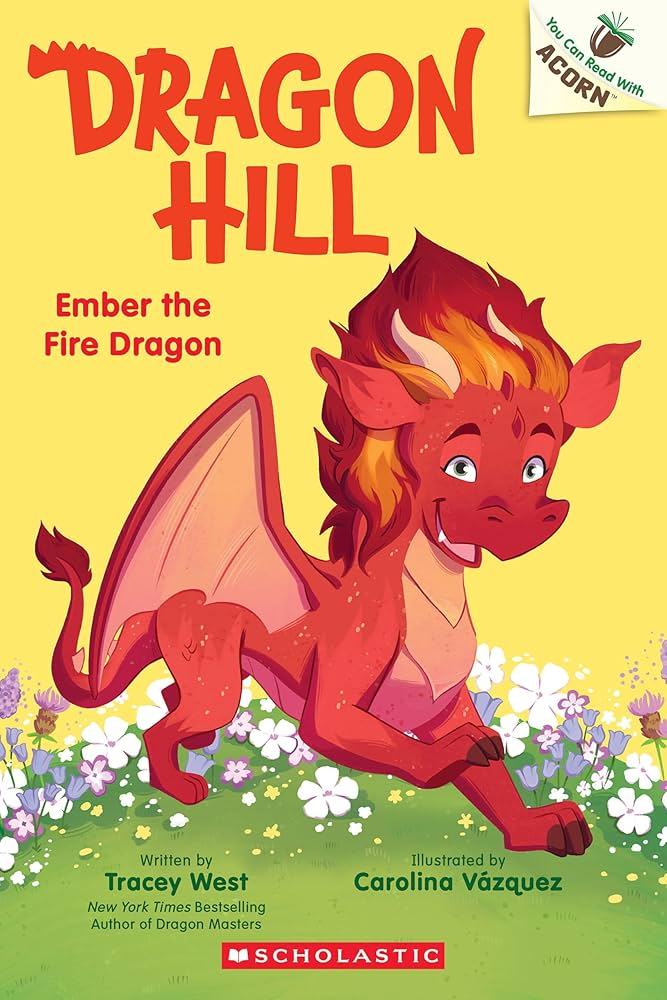
Ember the Fire Dragon (Dragon Hill book 1) by Tracey West, illustrated by Carolina Vázquez (Scholastic, 64 pages, ages 5-7). When Alden the Hill Dragon tells young Ember (Fire Dragon) and Gus (Mushroom Dragon) that his magic Jewel of the Hill is missing, the two friends get on the case. Although they don’t have their full dragon powers, they use some sharp detective skills to track it down. Instead of breathing fire, Ember can only sneeze sparks, so when they find the jewel hidden in a dark hole, Gus remembers the flowers that make her sneeze, and the two work together to recover the treasure. Alden hangs it up over his cave, and the forest is protected by its magic once again.
This cute series opener from Dragon Masters author Tracey West is sure to find an audience with those not quite ready for the longer chapter books. With five chapters, there’s a decent plot, and readers will undoubtedly find the illustrations enchanting. Gus gets his own book when the second installment comes out in early March.
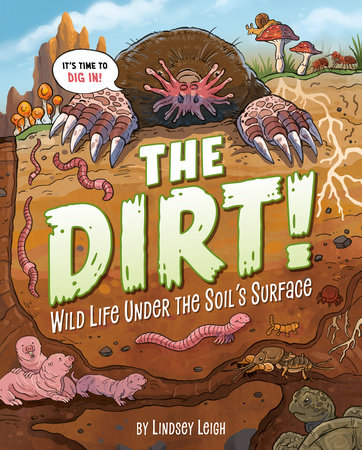
The Dirt!: Wild Life Under the Soil’s Surface by Lindsey Leigh (Penguin Workshop, 96 pages, grades 3-8). In this companion to The Dark! (caves) and The Deep! (oceans), readers get to explore the layer of soil that covers much of the surface of the planet. They’ll learn about the life forms that keep that soil healthy and fertile, from tiny bacteria to larger animals like meerkats and armadillos whose burrows help to aerate the soil. The final two pages offer tips for helping to protect soil from erosion, acid rain, and chemical fertilizers. Includes an index.
The graphic format and humorous tone in the writing and illustrations will draw in readers, but don’t be fooled by the light touch–there is plenty of fascinating information here about soil and the importance of the many, many life forms that support it. Readers will come away with a greater appreciation of the delicate balance necessary to keep soil healthy, and the final pages offers them ways to do their share to protect it.
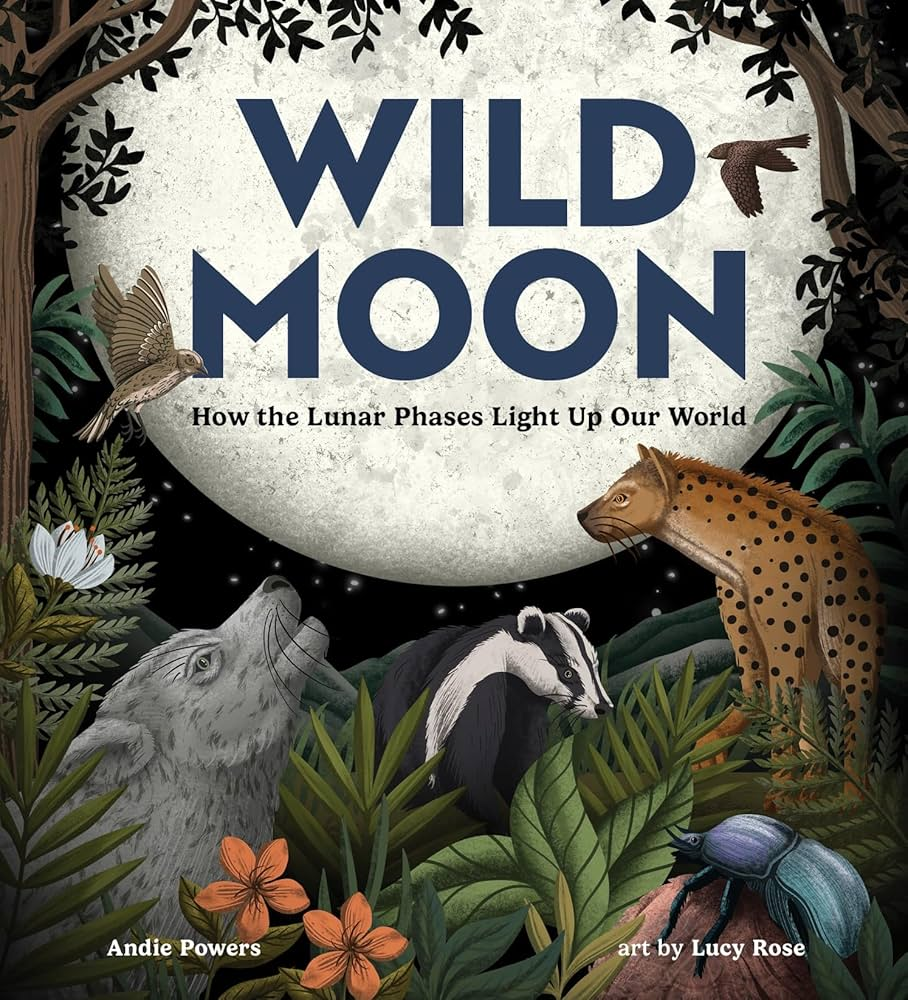
Wild Moon: How the Lunar Phases Light Up our World by Andie Powers, illustrated by Lucy Rose (Published by Gibbs Smith, 32 pages, grades K-4). The moon narrates this story of how its phases change, shifting the amount of light to reach the Earth, which affects animal behavior around the globe. The darker nights of the moon are better for animals such as lions who have good night vision, but more dangerous for prey animals with poorer eyesight, like zebras. The bright light of the full moon is a signal to some animals, such as coral in the Great Barrier Reef, to mate and breed. The super moon, micromoon, blood moon, and lunar eclipse are all briefly defined, and the end matter summarizes the moon phases, gives traditional full moon names for each month, and explains what a blue moon is.
The main text of this beautiful book is written as a poem, while facts about the different animals are presented in a smaller font around each page. The nighttime illustrations are gorgeous, with all kinds of animals shown in their habitats. Although the text is pretty short, there’s a lot of information packed into it, although I wish the explanation of the moon on the tides had been expanded on a bit, as that is a concept I struggle with.
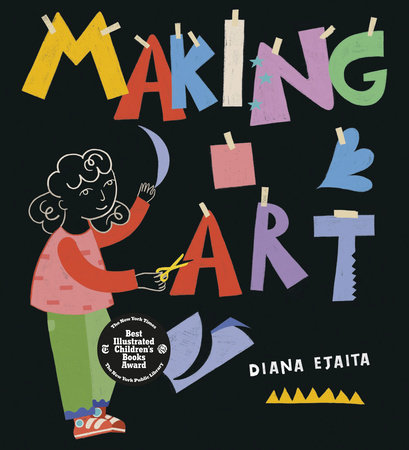
Making Art by Diana Ejaita (Rise x Penguin Workshop, 32 pages, ages 4-8). “Let’s look around and make some art,” begins this introduction to all different aspects of art. You can make new things or create from old things. It’s important to listen to your feelings, and those feelings can be communicated through your art. It can be difficult (and frustrating) to come up with ideas for your art, but then sometimes inspiration will strike like magic! Works of art can be given away or kept as a gift to yourself. No matter what, art adds beauty to the world, so thank you for your art!
This introduction to art could be used for anyone from a preschool class exploring art for the first time to a group of retirees rediscovering their creativity. The message is simple, yet wise and universal, and invites anyone to use art to express themselves. The illustrations portray a wide range of visual arts, as well as music, dance, and writing.
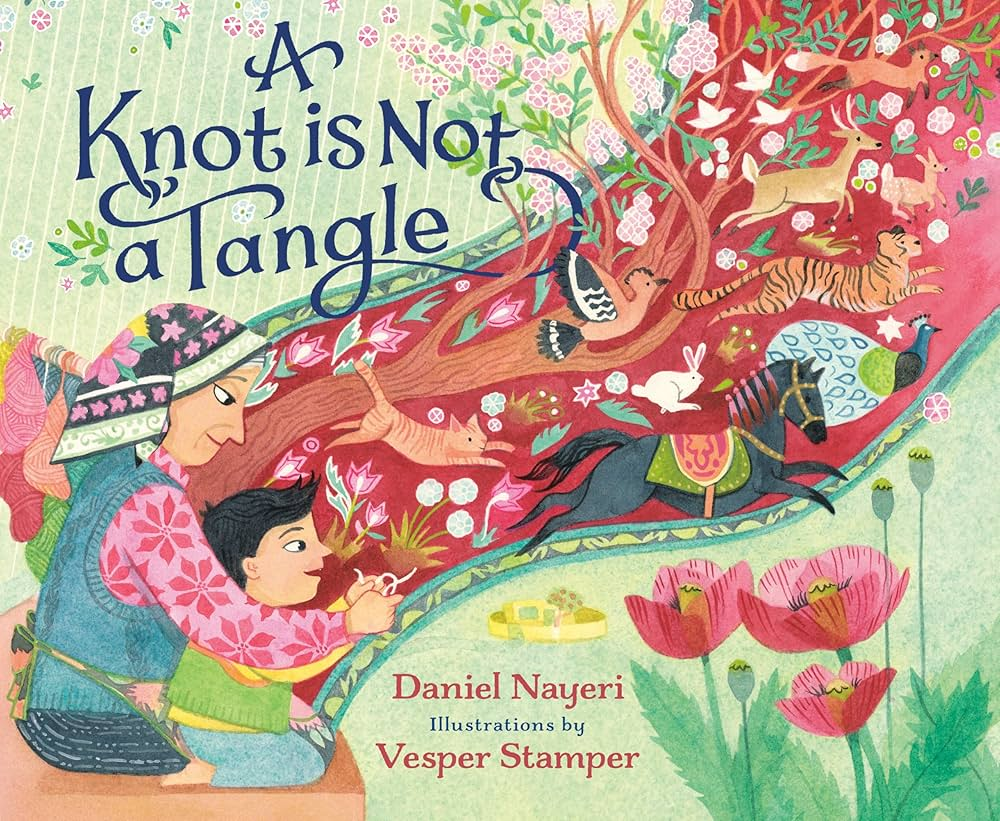
A Knot Is Not a Tangle by Daniel Nayeri, illustrated by Vesper Stamper (Knopf Books for Young Readers, 48 pages, grades 1 and up). A boy narrates the process of creating a Persian rug with his grandmother in Iran. “All of this takes weeks, but in my memory, it’s one long wonderful day.” In that day from his memory, he and his grandmother wash, card, and spin wool that his grandfather has sheared from their sheep. They dye it and plan the pattern and colors for the new rug on graph paper, then finally start knotting on the loom. The boy keeps wanting perfection, but his grandmother reminds him that the most important part of their rug is that it will become a place for the family to gather, just like the old one that they’re replacing has been. She even pulls one knot out, the “Persian flaw,” symbolizing that that there is no such thing as perfection. Finally, the new rug is done, and the old one gets moved underneath the loom, and “It feels just right to have it there.” Includes an author’s note with additional information on Persian rugs.
Award-winning author Daniel Nayeri has crafted a beautiful picture book celebrating an art form that will be new to many readers. The illustrations do a great job of showing the process of knotting–although, I’ll be honest, I still don’t really get it, but this may whet readers’ appetites to dig deeper. The message about tempering perfectionist tendencies is delivered gently by a wise grandmother who clearly values her heritage and enjoys passing it on to her grandson.
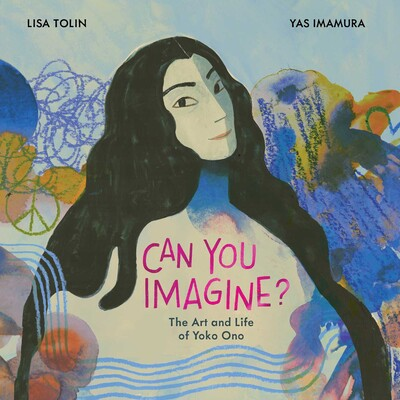
Can You Imagine? The Art and Life of Yoko Ono by Lisa Tolin, illustrated by Yas Imamura (Atheneum Books for Young Readers, 48 pages, grades 2-5). Yoko Ono spent her childhood moving between Japan and the U.S. during a time when she felt unwelcome in both places. After enduring wartime hardships in Japan, she moved permanently to the United States, where she studied art and music. Refusing to embrace norms in either field, she explored her own ways of creating art, which often involved audience participation designed to provoke thoughts and ideas. Her greatest fame came after she met and married John Lennon, when racism, misogyny, and the idea that she broke up the Beatles unleashed waves of public hatred toward her. After Lennon’s murder, Ono has continued to create art while working to preserve her husband’s legacy. Includes quite a bit of additional information about Yoko Ono and her art, as well as a bibliography.
I confess I grew up with a pretty negative impression of Yoko Ono, having absorbed the “she broke up the Beatles” message, but my daughter, an episode of the You’re Wrong About podcast, and now this beautiful book have helped me to see her in a completely different light. She had a pretty horrific childhood but instead of being broken by it, she emerged resilient and with a desire to work for peace through her art. It’s pretty clear that the Beatles broke themselves up, and this book focuses on the positive aspects of the Lennon-Oko collaboration. I’m grateful that this talented author-illustrator team continues the revisionist history, although it may be more appreciated by adults than children.
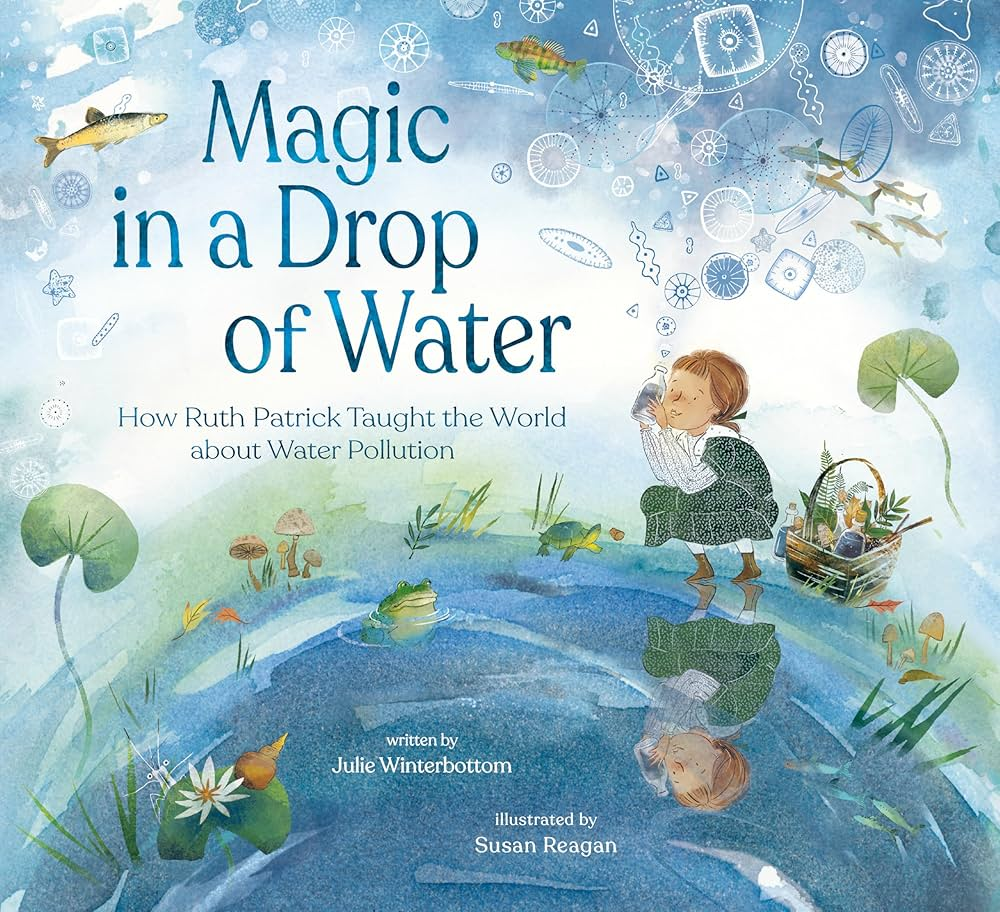
Magic in a Drop of Water: How Ruth Patrick Taught the World about Water Pollution by Julie Winterbottom, illustrated by Susan Reagan (Rocky Pond Books, 48 pages, grades 1-5). Encouraged by her father, Ruth Patrick grew up exploring woods and streams, fascinated by what she saw when she looked at her collections under a microscope. She went on to study biology, specializing in diatoms, the microscopic algae found in all bodies of water. Her questions about the effects of pollution on water led her to study both healthy and polluted streams, documenting all the life forms found in each, and discovering that pollution destroyed the balance of life that healthy water had. She became a lifelong advocate for clean water, including helping to write the Clean Water Act of 1972, and continuing to wade into streams and rivers just a few years before her death at age 105. Includes additional information, a timeline, and a bibliography.
Ruth Patrick lived up to her father’s advice to leave the world a better place than she found it, following her passion at a time when women weren’t particularly welcome in the scientific world and making many contributions to our understanding of water pollution and biodiversity. Her story is told in an engaging fashion, and the illustrations do a magnificent job of capturing Ruth’s work and her underwater observations, although I wouldn’t have said no to a slightly larger font for the text.
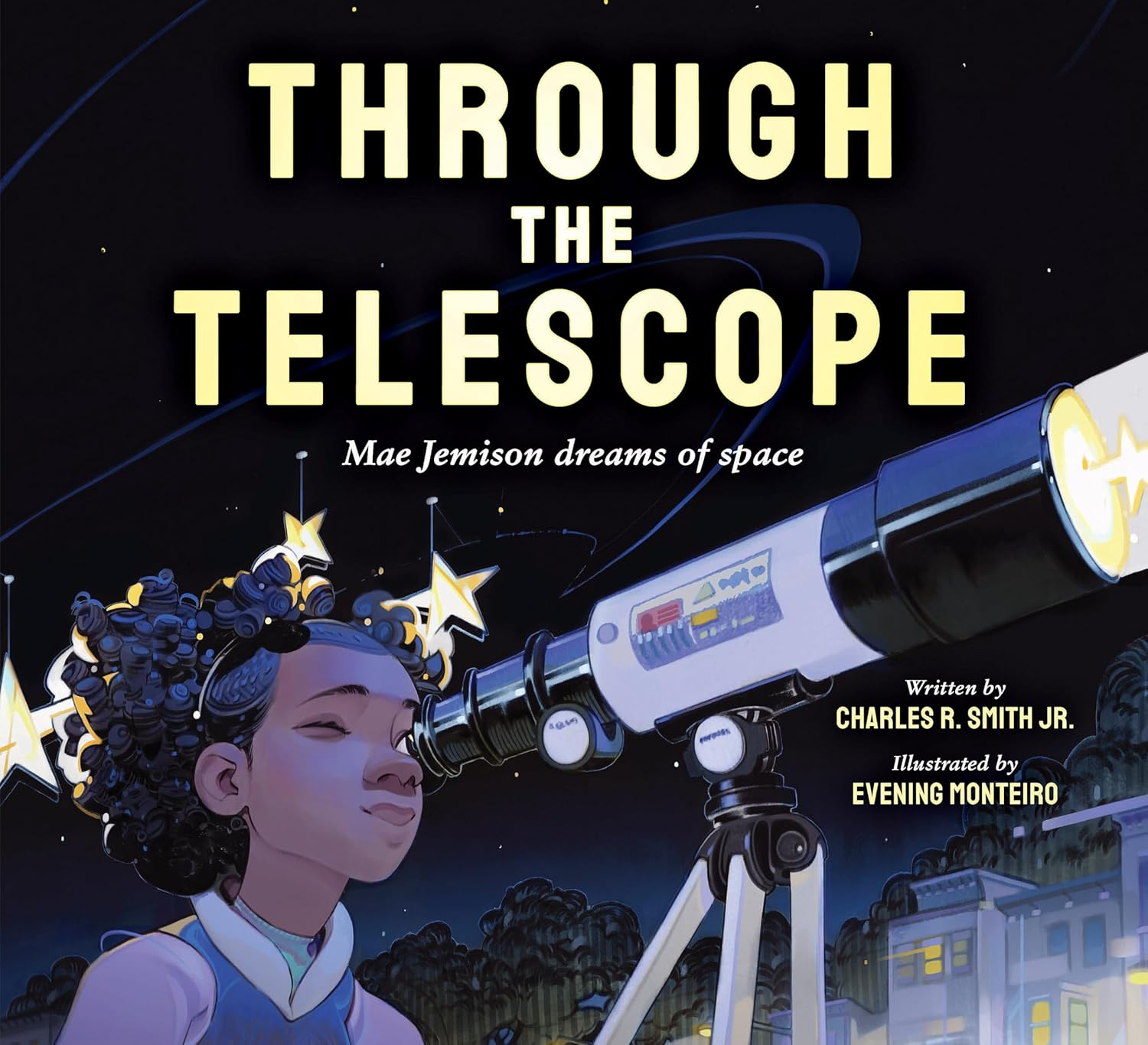
Through the Telescope: Mae Jemison Dreams of Space by Charles R. Smith, Jr., illustrated by Evening Monteiro (Orchard Books, 40 pages, ages 4-8). A young Mae Jemison peers through the telescope, dreaming of traveling into space. Rhyming text and illustrations explain what she sees: the moon, planets, constellations, and galaxies. As she looks, she imagines floating through space, and the final illustration shows an adult Mae in her astronaut suit standing behind the child. Includes ten facts about Mae Jemison.
This would make a good introduction to Mae Jemison for younger readers, and it includes quite a few astronomy terms and facts which they will find interesting as well. Like Mae Among the Stars, there’s very little biographical information. It would be great to get a longer picture book biography that gives a fuller picture of Jemison’s life.
How Sweet the Sound: A Soundtrack for America by Kwame Alexander, illustrated by Charly Palmer (Little, Brown Books for Young Readers, 48 pages, ages 7 and up). Kwame Alexander’s poetry and Charly Palmer’s bright, bold paintings trace the history of Black music, beginning with drumming, dancing, and chanting in Africa, then moving to the gospel music and blues that grew out of slavery in America. Next comes jazz, which, along with the blues, leads to rock and roll, and finally, hip hop and rap. “Listen to the soundtrack of America/a symphony/of refuge and redemption/the sweet sound of a people/surviving and thriving/all the while learning/to love themselves/ by singing it LOUD and PROUD.” Includes six pages of “musical notes” that offer additional information about each musician along with a thumbnail portrait from the illustrations.
Music fans of all ages will appreciate this celebration of Black musicians who have made incredible contributions to American music. Every illustration feels like a party, and readers will have fun figuring out who’s who in them. Put this on the watch list for Caldecott and Coretta Scott King awards.
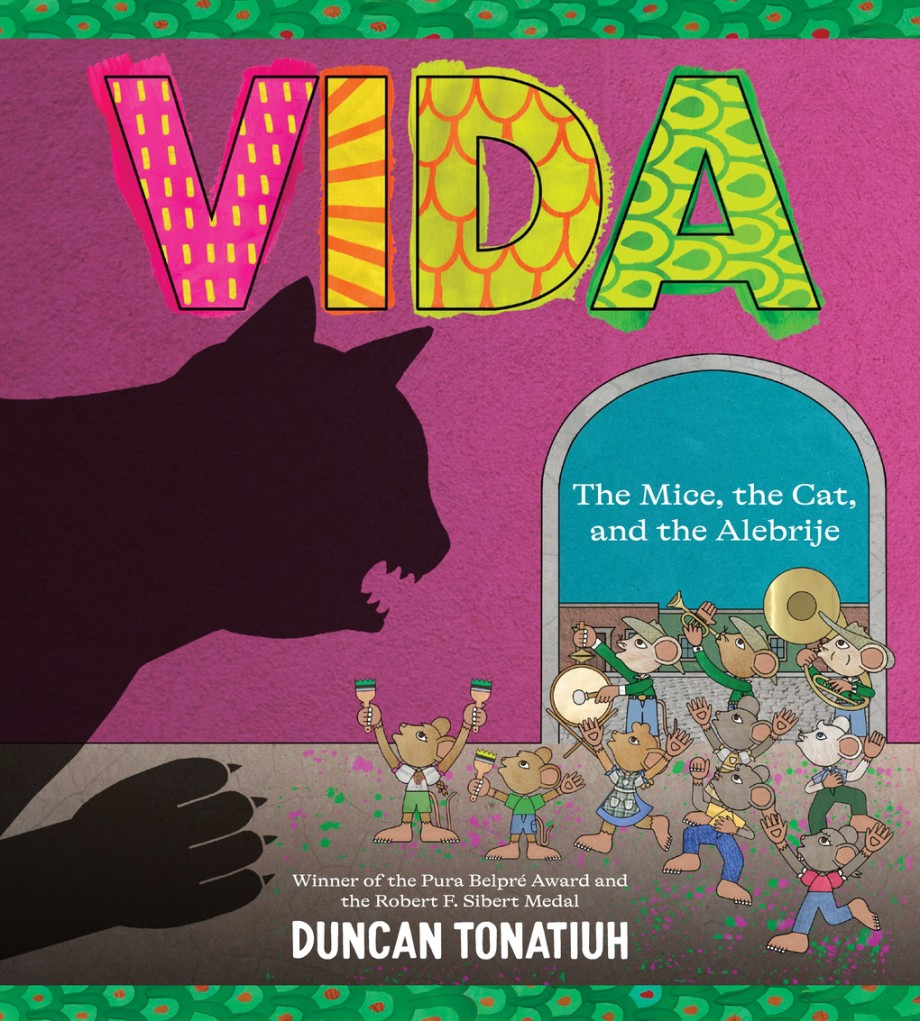
Vida: The Mice, the Cat, and the Alebrije by Duncan Tonatiuh (Harry N. Abrams, 48 pages, ages 5 and up). Mousetepec is a thriving mouse community with a vibrant culture, filled with art, music, good food, and fiestas. But one day a cat appears, and gradually the mice go into hiding, no longer able to engage in their enjoyable pursuits. Vida and her brother miss their old life and try to re-create it by making brightly-colored animals in their house. One night Vida has a dream about a fantastic creature called an alebrije, and when she wakes up, she knows how to scare the cat away. She gathers all the mice to make a huge creature like the one in her dream, covering it with brilliantly painted designs. When it’s completed, the mice lure the cat with a fiesta and loud music. The alebrije and all the noise terrify the cat, and Mousetepec is able to thrive once again. Includes an author’s note with information on alebrijes and Pedro Linares, the artist who created them. There’s also a note on the inspiration for Vida, which is a response to Aesop’s fable about belling the cat, and champions art and solidarity for overcoming evil forces in the world; also a glossary and pronunciation guide and a bibliography.
I read this book just hours after learning about the Fall of Freedom movement taking place this weekend, with artists all over the country creating works to protest what is happening in the U.S (you can read about it on my other blog). It’s a perfect complement to that, with the themes of art, community, and resistance, plus it’s an engaging story with plenty of cute mice and colorful creatures, plus it features Duncan Tonatiuh’s unique illustrations that manage to work in a few lessons about Mexican art. So win-win-win, and maybe a contender for an award or two.
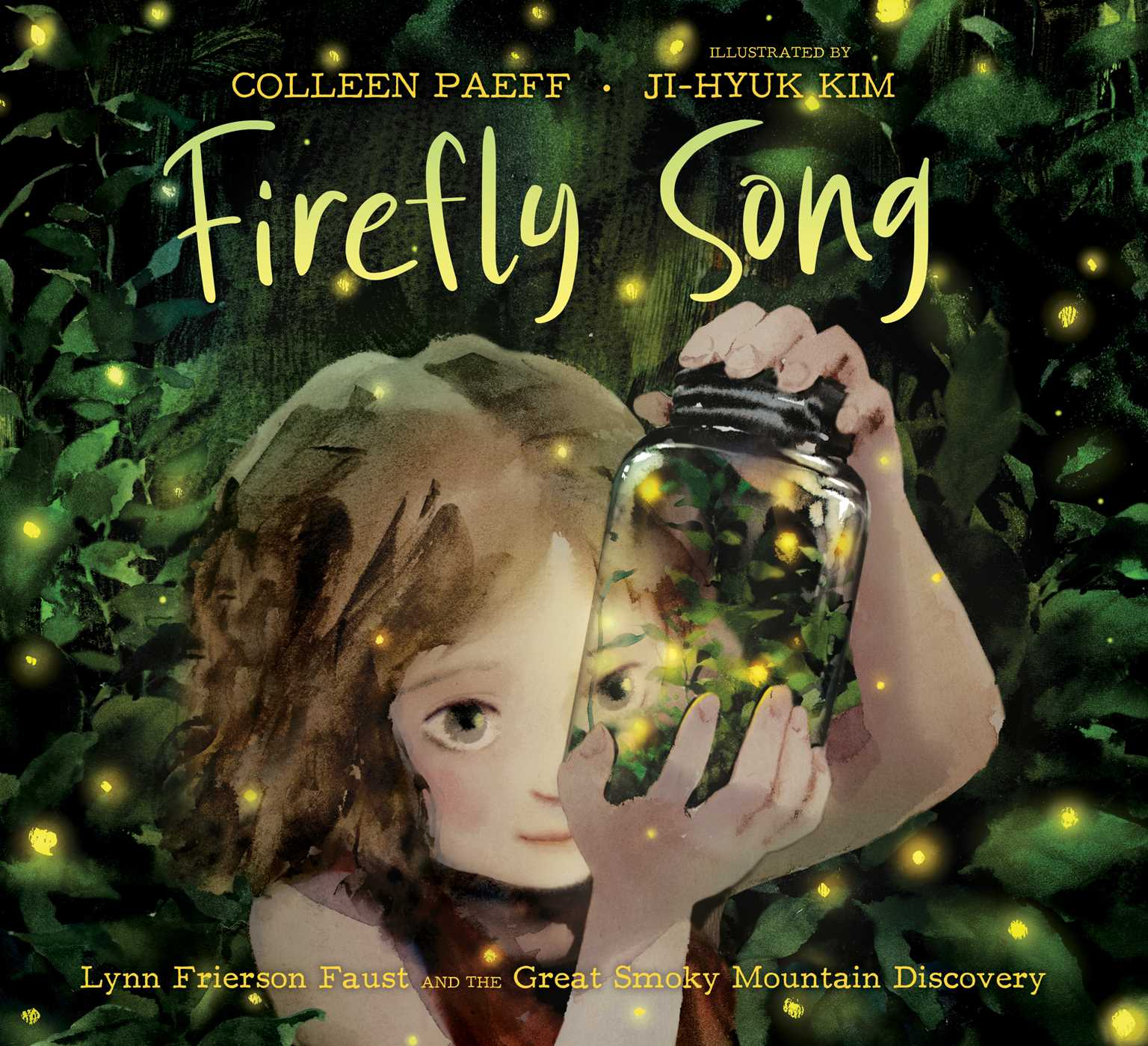
Firefly Song: Lynn Frierson Faust and the Great Smoky Mountain Discovery by Colleen Paeff, illustrated by Ji-Hyuk Kim (Margaret K. McElderry Books, 40 pages, grades 1-5). As a child spending summers in the Great Smoky Mountains, Lynn Frierson Faust was fascinated by fireflies who would flash their lights and go dark in unison. Years later, her family’s summer cabin and the land it was on became part of the national park, but Lynn never forgot those fireflies. When she read that synchronous fireflies didn’t exist in North America, she was determined to prove that they did. Working with other scientists, Lynn’s perseverance over many years finally paid off when she helped a biologist and his team observe the synchronous phenomenon. Although her scientific training is self-taught, Lynn is known globally for her firefly expertise. Includes tips for observing fireflies, firefly facts, a bibliography, and an author’s note.
Lynn’s story is a fascinating one and may inspire readers to become citizen scientists, or at least to be persistent in pursuing their passions. The illustrations are gorgeous, with backgrounds that look like slightly blurry photos, making the fireflies’ lights even more striking. I think the illustrator lives in South Korea, so unfortunately not eligible for a Caldecott, but this would be a good choice for another Sibert award for Colleen Paeff.
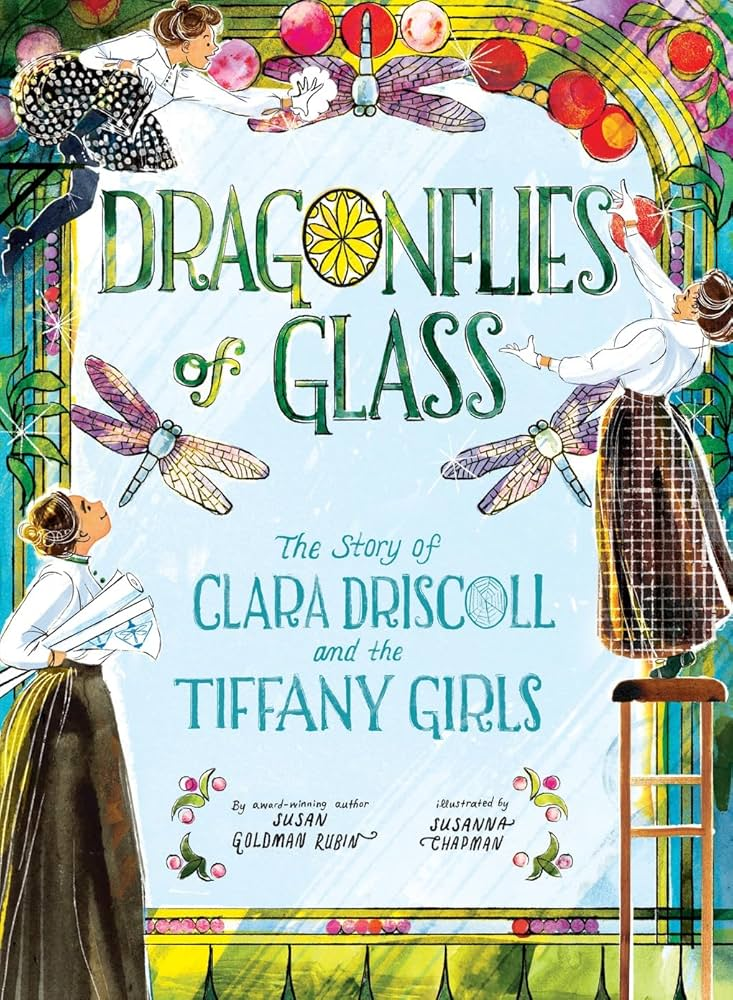
Dragonflies of Glass: the Story of Clara Driscoll and the Tiffany Girls by Susan Goldman Rubin, illustrated by Susanna Chapman (Harry N. Abrams, 40 pages, grades 1-5). Clara Driscoll grew up on a farm in Ohio, where she loved drawing the flowers and animals she observed around her. Her father died when she was 12, but her mother encouraged Clara and her sisters to become self-sufficient. In 1888, Clara and her sister Josephine moved to New York City to study at the Metropolitan Museum of Art School. Clara was hired by Louis Comfort Tiffany, son of the famous jeweler, to work in his studio making stained glass. She was part of the women’s division there, where she learned to cut glass and turn it into designs. Drawing on her memories of the Ohio farm, she was soon creating her own designs incorporating dragonflies, butterflies, and flowers, including the wisteria that was part of Tiffany’s most famous lamp. Includes notes from the author and artist, a list of places to see Clara’s work, and a bibliography.
Another story of an amazing woman who built a full artistic life at a time when sexism was a big obstacle. While Louis Comfort Tiffany sounds pretty progressive (he defended the women’s division when the men threatened to strike if he didn’t get rid of it), the author’s note reveals that Clara was forced to quit working there after she got married. The illustrations are gorgeous, especially the depictions of the Tiffany lamps. Clara’s story came to light thanks to round robin letters that she, her mother, and sisters wrote, and the story of those letters arriving at the farm is shown in small illustrations running along the bottom of each page.
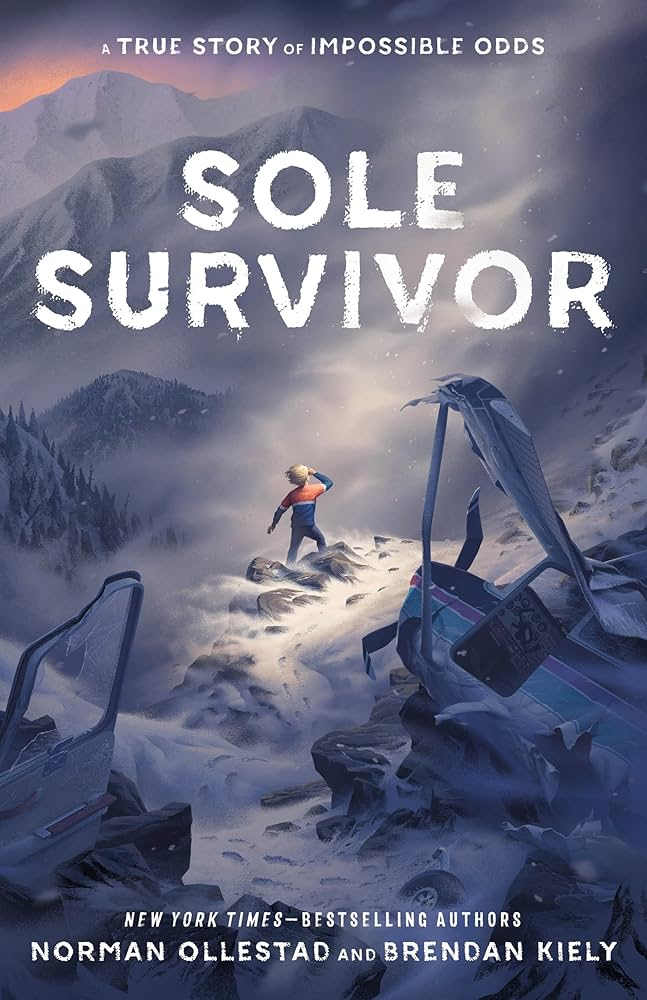
Sole Survivor by Norman Ollestad and Brendan Kiely(Farrar, Straus and Giroux, 272 pages, grades 5-8). Norman Ollestad recounts his experience of surviving a plane crash as an 11-year-old in 1979. His father and the pilot were killed instantly, and his father’s girlfriend Sandra, seriously injured, fell to her death when Norm was trying to help her. His dad had always pushed Norm to try the exhilarating but sometimes terrifying skiing and surfing adventures he enjoyed, and Norm found himself using the lessons from those experiences in his struggle to survive. Living with his mom and abusive stepfather had also taught him a thing or two about survival, and he miraculously was able to climb down the the icy California mountain in blizzard conditions to find help. The last part of the book tells of the aftermath of the event, in which Norm had to navigate his trauma while living full time with his mother and stepdad. After a rocky few years, he found release and healing through surfing. Based on the 2009 book Crazy for the Storm.
Okay, first off, if you’re looking for less stress in your life, do not read this book and Murder in the Jungle back-to-back, as I did. Norm’s story is harrowing, to say the least, made more so by the flashbacks to his abusive stepfather and risk-addicted father who put his son in some pretty questionable situations. It is definitely a page-turning survival story that will appeal to fans of Hatchet and other Gary Paulsen books.
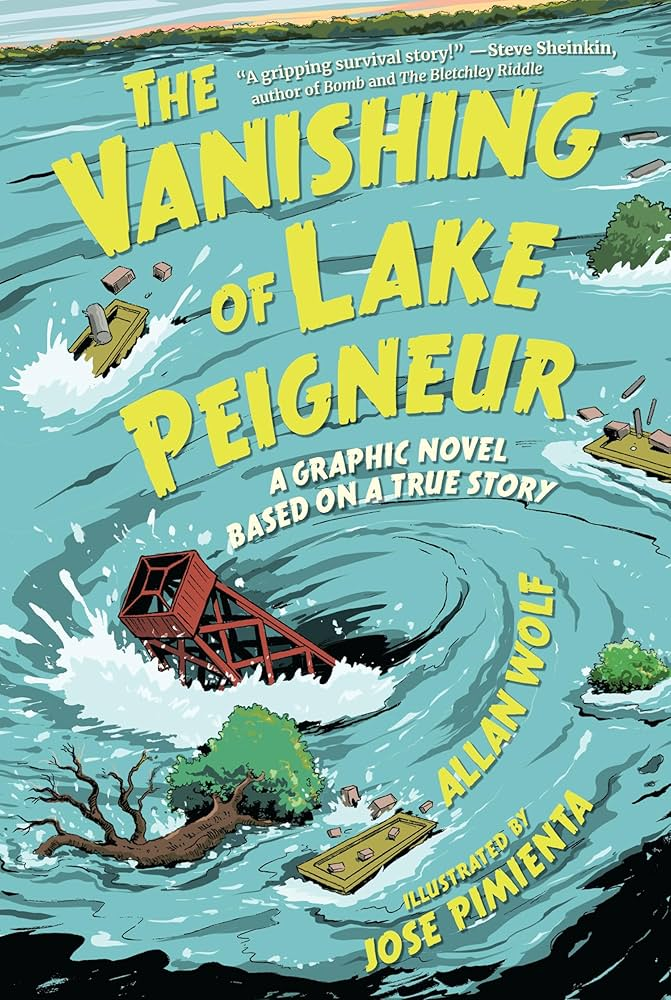
The Vanishing of Lake Peigneur: A Graphic Novel Based on a True Story by Allan Wolf, illustrated by Jose Pimenta (Candlewick, 176 pages, grades 4-8). November 20, 1980 starts as an ordinary day for Lake Peigneur (who narrates the story), the miners who work in the salt mine there, the oil rig workers, the wealthy owner of a house on the lake’s shore and his gardener, and various boaters on the lake. But it quickly becomes anything but ordinary when a combination of oil drill accident and precarious mine construction causes a huge vortex in the lake that threatens to destroy everything around it. Those in and around the lake are in a race against time to get off the rig, off the water, and out of the mine. Close calls and heroism are plentiful as the story shifts quickly from one site to another. The lake claims on page 1 that it “vanished,” and in a way that’s true, at least temporarily, as it’s transformed in size and composition from a freshwater lake to the saltwater lake that exists today. Includes an author’s note with extensive additional information, how he did his research, and clarification of what is fact and fiction.
This book took me a couple of tries to get into–the beginning feels a little stilted with many characters introduced. But once things start to happen, it’s hard to put down in a way reminiscent of the best “I Survived” books. I’m hesitant to reveal the spoiler that everyone survives, but amazingly that is the case, thanks to the good judgement and courage of many involved in rescue efforts. As Allan Wolf notes in the author’s note, this good fortune is one of the reasons it didn’t become more of a news story, and kudos to him for tracking down the story and interviewing many of the eyewitnesses to create this excellent graphic novel, greatly enhanced by Jose Pimenta’s art.
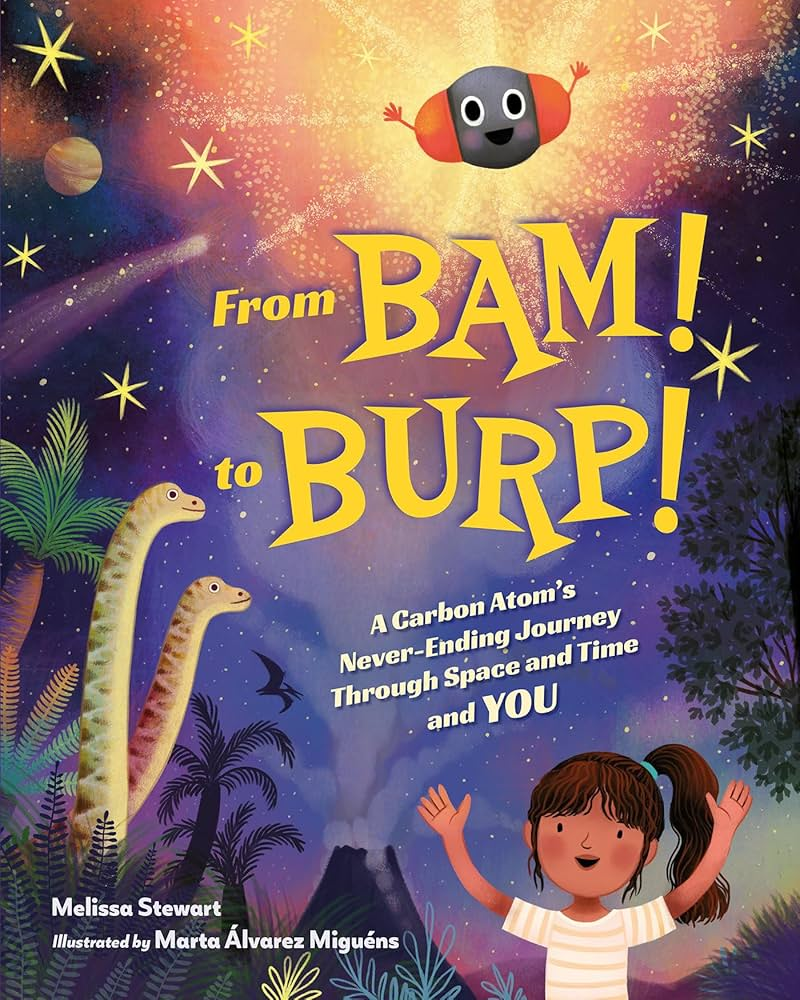
From Bam! to Burp!: A Carbon Atom’s Never-Ending Journey Through Space and Time and You! by Melissa Stewart, illustrated by Marta Alvarez Miguens (Charlesbridge, 40 pages, grades 1-4). The story begins with a planet called Theia, which 4.5 billion years ago smashed into Earth (the bam! of the title) and broke into pieces, some of which eventually became the moon, and some of which were buried deep into the Earth’s core, including carbon atoms. The carbon atom featured in this story combined with oxygen to become carbon dioxide, which was later released from the Earth’s core following a volcanic eruption. The molecule wanders the Earth until it’s pulled apart by a plant that uses it to make sugar. The journey continues through a dinosaur, a rotting pumpkin, even toilet paper, until the carbon winds up in maple syrup, entering the body of a present-day kid who eats it on pancakes, and later burps it out into the world once again. Includes a wonder wall with questions and answers about carbon and related topics, additional facts about carbon, fossil fuels, and the climate crisis, as well as notes from the author and illustrator about the evolution of this book.
Seems like finding a fun picture about chemistry is about as likely as a carbon atom becoming a diamond, but budding scientists will enjoy this one and learn all sorts of information about carbon in the process. The presentation, both text and illustrations, really bring this potentially dry topic to life. I also appreciated the notes from the author and illustrator that emphasized the need for many drafts and much hard work to produce the final book.
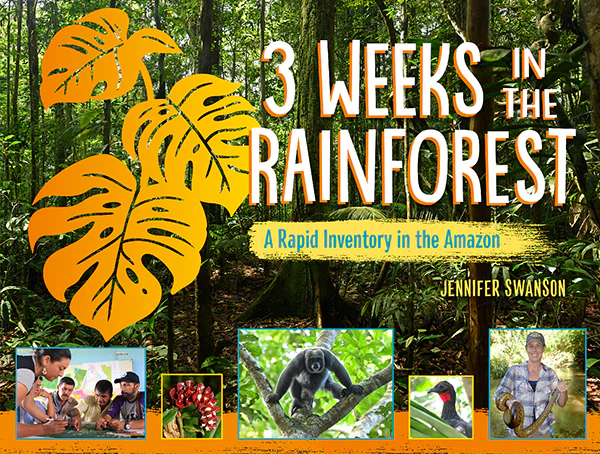
3 Weeks in the Rainforest: A Rapid Inventory in the Amazon by Jennifer Swanson (Charlesbridge, 80 pages, grades 3-7). To measure the health of Colombia’s rainforest, a rapid inventory team from Chicago’s Field Museum spends three weeks observing and recording plants, birds, fish, mammals, and reptiles. They also work with the indigenous people there to learn what they need to live sustainably on the land. The narrative follows different teams of scientists as they travel to this remote area, set up camp, and tirelessly work round the clock in all kinds of weather to inventory as many species of plants and animals as they can in three weeks. After leaving the rainforest, the team compiles its findings into a report to the Colombian government with their recommendations for preserving this ecosystem. Includes a note from the rapid inventory team, an author’s note that recounts how an exhibit at the Field Museum inspired her to write this book, a list of those who were on the team, and an index.
This engagingly written science book offers readers an intriguing look at scientists in the field, with plenty of photos and sidebars to keep things interesting. It was refreshing to read a book about the rainforest that was pretty upbeat in its reports on the health of this particular portion of it, and the descriptions of the fascinating work being done to preserve it will no doubt inspire future generations of scientists.
An email alerting me to the upcoming Boston Globe-Horn Book Awards ceremony coming up this Thursday, November 6, sent me on a search for some of the books that I hadn’t read yet. You can see a complete list of winners and honor books here.
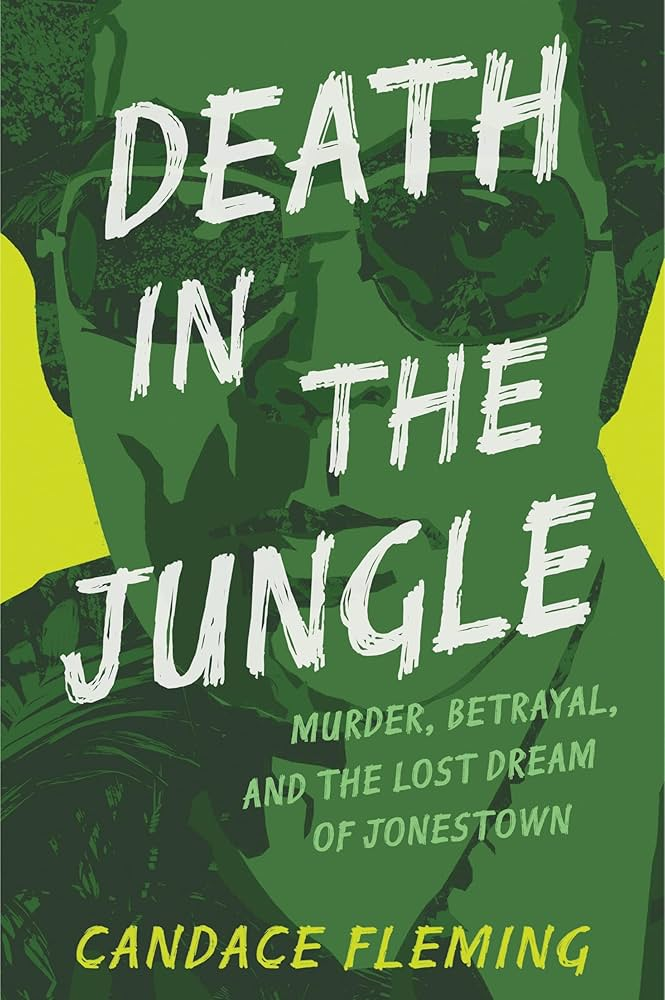
Death in the Jungle: Murder, Betrayal, and the Lost Dream of Jonestown by Candace Fleming (Anne Schwartz Books, 368 pages, grades 7 and up). Most of us know about Jonestown and the tragic end that befell more than 900 residents in the Guyana jungle. This book takes readers back to founder Jim Jones’s earliest days and shows how a bizarre mix of idealism and quest for power led him to start the People’s Temple which moved from Indiana to California, and finally to Guyana where Jones basically kept his followers imprisoned: cut off from the world and subject to his paranoid drug-fueled ravings. Individual members of the group are profiled, based on Fleming’s interviews with survivors, and their memories of enjoying being part of a warm community mixed with traumatic punishments, sleep deprivation, and overwork serve as a warning to anyone drawn to a charismatic leader like Jim Jones. Includes source notes, a bibliography, and an index.
I remember reading about this incident in the news during my own teenage years and trying to make sense of what could have possibly gone so horribly wrong. This book answers some of those question–although many are unanswerable–and is told in such a compelling style that I could not put this book down and read it in about 36 hours. It’s an especially important book for teens, as many of those interviewed were their age during the events of the story (including Jones’s son Stephan), and in many cases, a questioning attitude toward authority saved them.
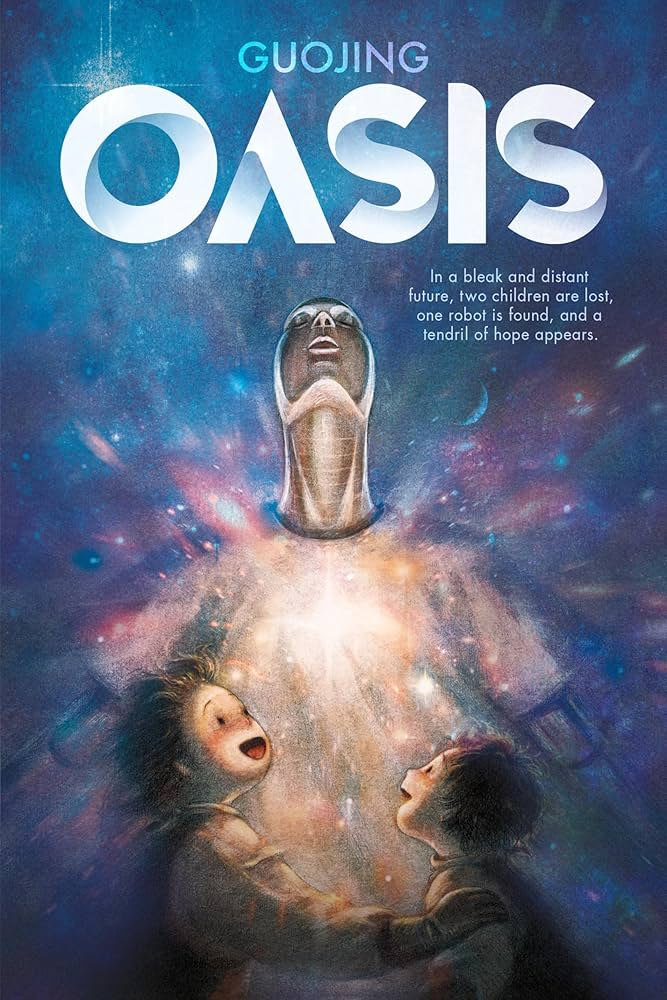
Oasis by Guojing (Godwin Books, 160 pages, grades 4-7). Two children live in the desert, fending for themselves with only occasional phone calls from their mother who works in Oasis City, trying to get permission to bring her children to live with her. When the kids find a broken robot, they’re able to repair it and activate its “mother” mode, giving them an AI mom. When their human mother comes home for a few days, she discovers the AI mother, and destroys it in a fit of fear and rage. Her daughter runs off, and the mother is able to repair the robot and bring the daughter back home. The two mothers share their hopes and dreams for the children, and the AI one shows how she has been able to reproduce conditions in Oasis City to start growing plants, giving them hope that one day they can all live in the desert together. The author information relates that Guojing was inspired by “left-behind children” in China, who stay in rural areas when their parents go to find work in the city.
I had gotten this book out of the library several months ago, after seeing its five starred reviews, but I was a little put off by the dark artwork and never got around to reading it. I’m so glad I gave it another try. It’s a quick read–it only took me about 15 minutes–but it packs a powerful punch and celebrates all sorts of family connections and love. The cover says, “In a bleak and distant future, two children are lost, one robot is found, and a tendril of hope appears,” but it didn’t seem like such a distant future to me.
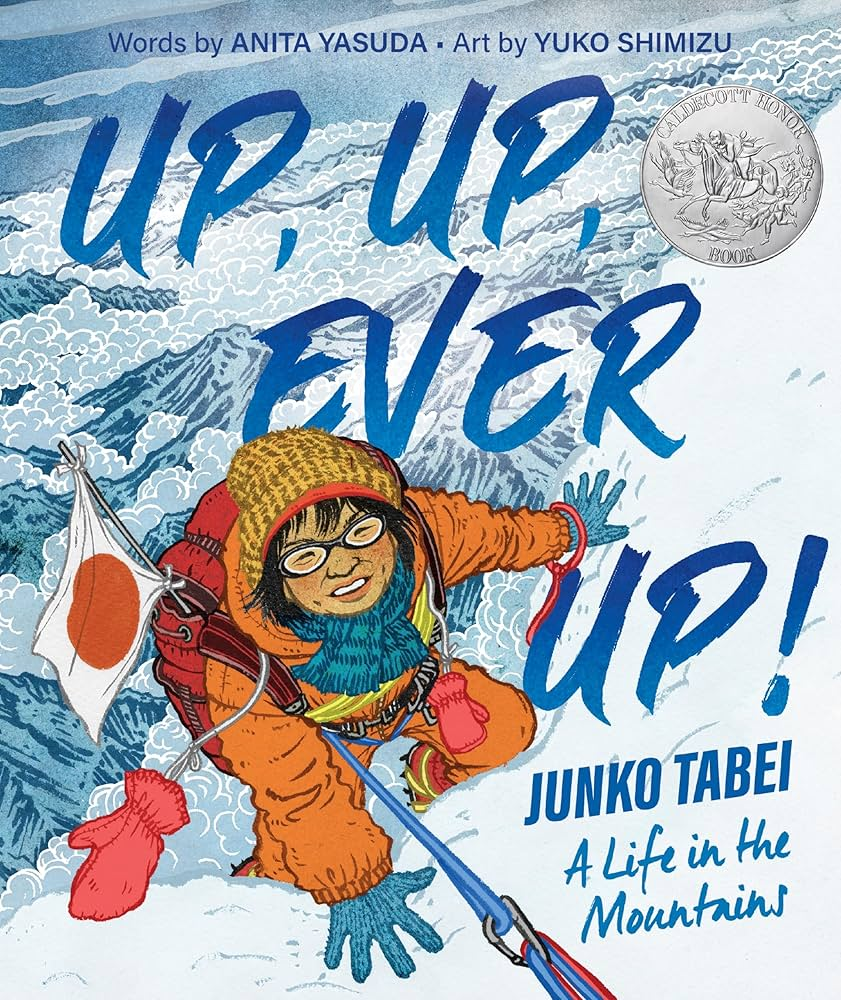
Up, Up, Ever Up! Junko Tabei: A Life in the Mountains by Anita Yasuda, illustrated by Yuko Shimizu (Clarion Books, 48 pages, grades 2-5). As a child, Junko Tabei dreamed of climbing mountains, and she pursued that dream when she moved to Tokyo as a young woman. Most mountaineering clubs didn’t take women, but Junko persevered until she found one that did. Even after marrying and having a daughter, Junko continued to climb and to encourage other women to join her. Eventually they planned an expedition to become the first all-female team to climb Mount Everest. Even an avalanche couldn’t stop her, and Junko realized her dream of being the first woman to reach Everest’s summit. In her later years, she became an activist for sustainable mountain climbing, researching the impact of trash and human waste on Everest and helping to mitigate some of those effects. Includes an author’s note, timeline, glossary, and bibliography.
I’m a little late to this 2024 book, but I’m breaking my rule of only reviewing books published in the current year. The Boston Globe-Horn Book Award follows the school year calendar, so it was eligible for this year’s award and was an honor book, in addition to winning a 2025 Caldecott Honor. Both are well-deserved for the beautiful ink and color illustrations that not only portray breathtaking mountain landscapes but celebrate Junko’s Japanese culture.
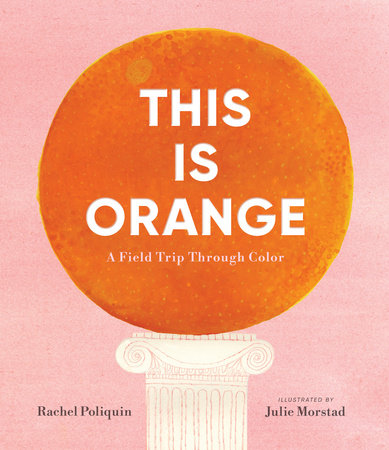
This Is Orange: A Field Trip Through Color by Rachel Poliquin, illustrated by Julie Morstad (Candlewick, 48 pages, grades K-4). Which do you think came first, the color orange or the fruit? If you guessed the color, as I did, you’re in for a surprise to kick off this book that traces the history of the color, then meanders through the worlds of art, science, nature, and history looking for examples of it. Birds’ feet are orange, and so are cantaloupe and mimolette cheese. A color called International Orange that shows up in murky skies or seas is used for astronauts’ suits and the Golden Gate Bridge. You’ll find orange in Halloween jack-o-lanterns, Buddhist monks’ robes (from orange turmeric), and a number of countries’ flags. “Now it is time for you to find orange in your world,” the book concludes. “If you look carefully, you will see orange almost everywhere.”
Although the tone is lighter, this book reminded me of Blue: A History of the Color as Deep as the Sky by Nana Ekua Brew-Hammond, in that both books wake readers up to colors so common that we take them for granted. This would be a great book for an art class, or just to sharpen observational skills. I was disappointed there was no back matter, but the last page does a great job of sending readers off into the world with a new appreciation for the color orange.
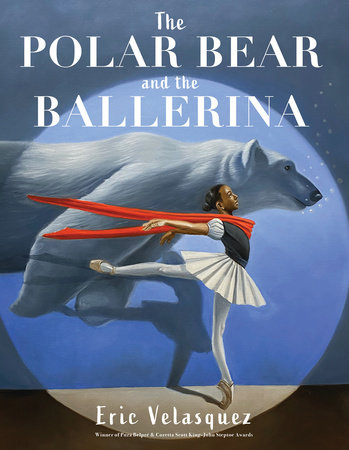
The Polar Bear and the Ballerina by Eric Velasquez (Holiday House, 48 pages, ages 4-8). A young ballerina and a polar bear bond at an aquarium in this wordless book. After the girl leaves with her mom, the bear notices that she’s left her long red scarf behind. Hoisting himself out of his tank, he walks across Manhattan to Lincoln Center, where he’s met with a “No polar bears allowed!” sign at the ticket window. His growl alerts the girl, who leaves the practice room to escort him inside to a seat. Despite disgruntled looks from his neighbors, the bear is enraptured by the show. Afterwards, he returns the scarf, then dances home, where he dreams about performing on stage with the girl. Endpapers give profiles of both the bear and the girl, a soloist at Harlem Children’s Ballet.
Kids will love the adorable polar bear and spunky ballerina in the gorgeous illustrations, and adults can use their story to facilitate conversations about making the arts accessible to everyone. For a moment, I thought ballerina Chloe Maldonado was a real girl, but then I realized the ballets listed on her resume are both books by Eric Velazquez! Those endpapers add some fun and depth to the story, though.

 A Kids Book A Day