Election Day

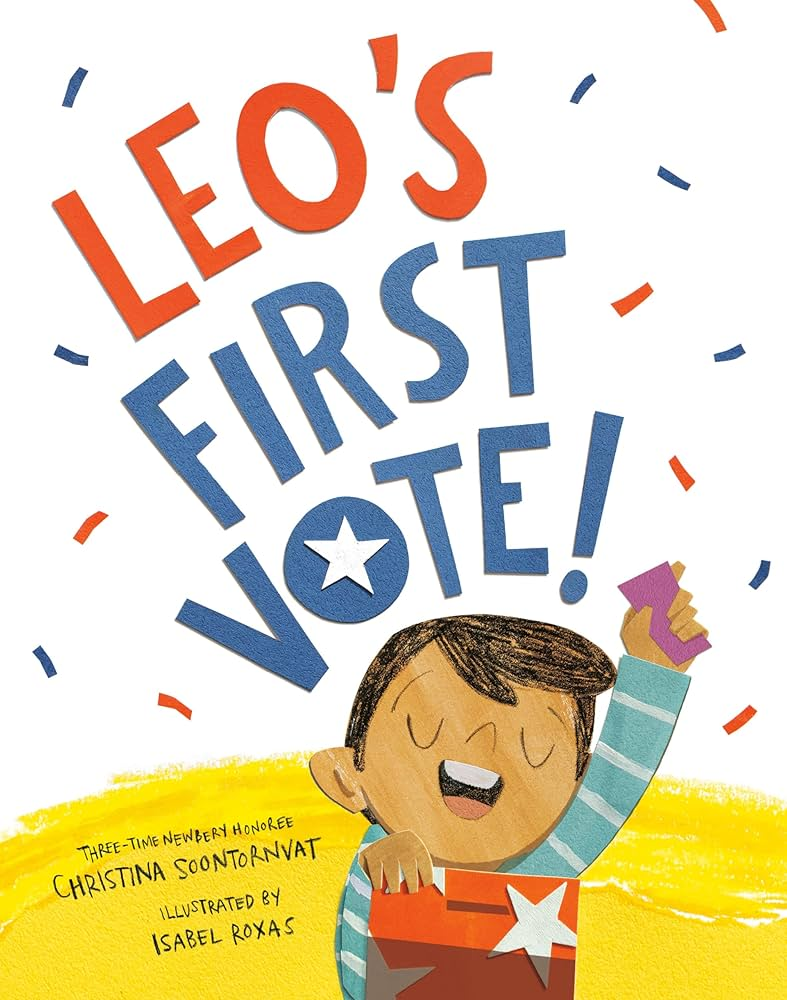
Leo’s First Vote by Christina Soontornvat, illustrated by Isabel Roxas (Knopf Books for Young Readers, 48 pages, ages 4-8). Leo’s excited that his dad has recently become a naturalized U.S. citizen, which means Dad gets to vote in the upcoming presidential election. Leo plans to go with him to the polls, but in the meantime, his class is having a mock presidential election. The kids learn about elections, and at home, Leo watches conventions and debates with his family. Everyone’s talking about the upcoming election, and when Leo hears a cousin say he’s not going to vote (“What’s the point?”), he feels deflated. But when his class’s mock election is determined by one vote, Leo finds his enthusiasm again. The last page shows Dad reading a newspaper with a headline declaring, “Historic turnout!” Also available in a Spanish language edition, ¡El primer voto de Leo!

Lots of facts about elections are woven into Leo’s story, and the excitement around voting will have kids eagerly anticipating Election Day. Personally, I am feeling so jaded about the day (Leo’s cousin really spoke to me) that I almost didn’t write this review, but good for Leo and his dad (and Christina Soontornvat) for having such enthusiasm about it.

Presidential Elections and Other Cool Facts: Understanding How Our Country Picks Its President by Syl Sobel, J.D. (Sourcebooks Explore, 5th edition, 48 pages, grades 2-5). This straightforward introduction to the presidency tells how elections work, as well as giving interesting facts about campaigns, the electoral college, First Ladies, and the order of succession should the President die or become disabled. There’s a list of all the U.S. Presidents, along with the years of their terms, and party affiliations. Includes a glossary, index, and lists of resources.

Rumor has it there’s an updated version of this book, but interlibrary loan has only been able to send me older ones, so I got to travel back to a time when Barack Obama was President, and Ronald Reagan was the oldest person to have been elected President at age 73. It’s a good introduction to the presidency and the election process, and although the writing and illustrations aren’t particularly exciting, it includes the kinds of facts and trivia kids (and adults) enjoy learning.

A pair of award contenders

Barrio Rising: The Protest That Built Chicano Park by María Dolores Águila, illustrated by Magdalena Mora (Dial Books, 40 pages, grades 1-4). The narrator lives in a neighborhood called Barrio Logan, one of San Diego’s oldest Chicano neighborhoods, where residents have been looking forward to finally getting the park they’ve been promised for years. When they find out that the new construction being done is for a police station, they’ve had enough. Neighbors band together to take over the land and protest, despite orders from the police to disperse. For twelve days, the crowd grows, drawing protesters from nearby barrios. Finally, the city council holds a meeting, led by Leon Williams, San Diego’s first Black councilman, and announces they’ve changed the plan from a police station to a park. Everyone celebrates and pitches in to create Chicano Park. Includes additional information about the park, which is now a National Historic Landmark. Also available in a Spanish language edition, El barrio se levanta: La protesta que construyó el Parque Chicano.

Keep this book in mind when Hispanic Heritage kicks off on September 15. The story about this 1970 event is inspiring, and the illustrations juxtapose birds, butterflies, and purple flowers with the gritty urban setting. I’d love to see it get some Belpré Award recognition for either the story or the illustrations.

Before the Ships: The Birth of Black Excellence by Maisha Oso, illustrated by Candice Bradley (Orchard Books, 40 pages, grades K-5). Instead of starting with the slave trade, as is often the case with Black history in America, this book begins “before the ships” when civilizations flourished across Africa. There were kings and queens, doctors, scribes, artisans, and merchants. Impressive buildings were created, as were stories and music, while scientists and mathematicians studied the world. A wordless page showing a slave ship sailing through the darkness divides the book between the past and the present, “after the ships.” The descendants of those Africans now live different lives, but they are still warriors, scholars, and leaders, or, as the final page says, “We are the light.” Includes an author’s note telling how her time in Africa showed her the cultures of Ethiopia, South Africa, Kenya, and Nigeria.

I’ll be surprised if this doesn’t get a Coretta Scott King award or honor. I love the focus, all too rare, on the civilizations that existed before African people were captured and sold into slavery, and I will definitely be sharing this book with teachers at my school. I would have enjoyed even more back matter, including a map or two.

Fighting fevers and moving beavers

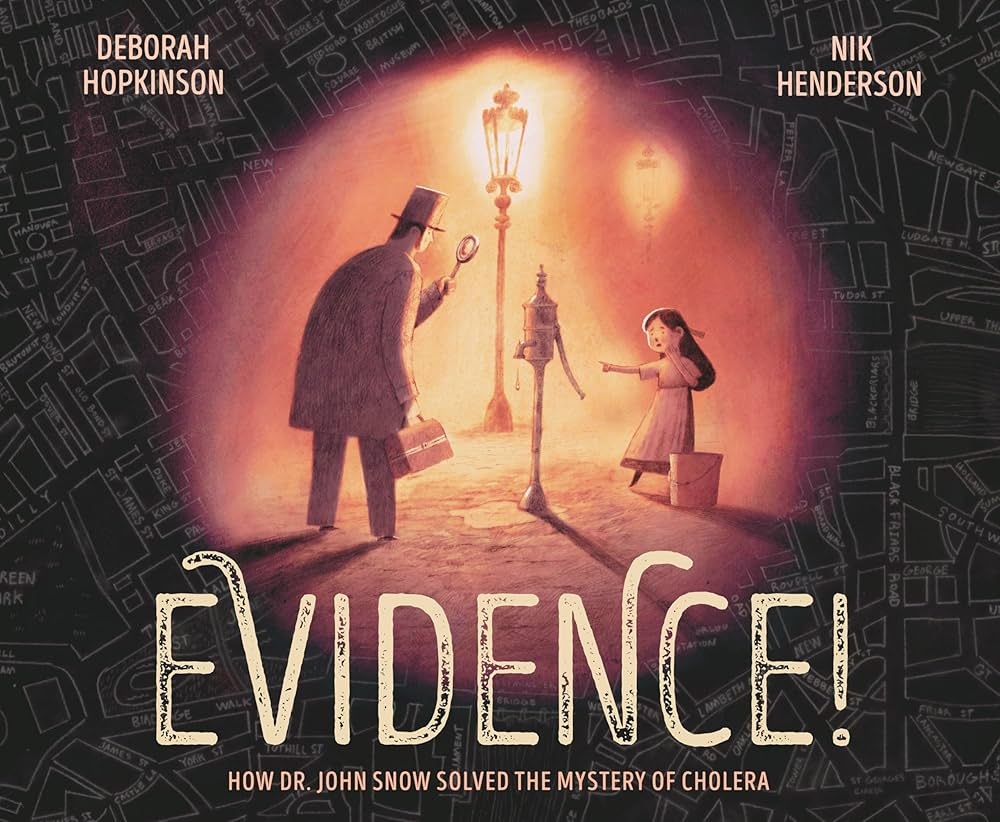
Evidence! How Dr. John Snow Solved the Mystery of Cholera by Deborah Hopkinson, illustrated by Nik Henderson (Knopf Books for Young Readers, 40 pages, grades 2+). When an 1854 cholera outbreak hit Broad Street in “stinky old London”, most people accepted the prevailing theory that it was caused by bad air. With human waste and garbage filling the streets, there was no shortage of that, but Dr. John Snow believed there was a different cause. He’d been gathering clues for years, working as a medical detective to solve the mystery of cholera. When he heard of the Broad Street outbreak, he hurried over to interview families of victims. Their answers led him to hypothesize that the water used by the neighborhood was a possible cause. But old beliefs are hard to change, and Dr. Snow had to keep gathering evidence to persuade the local neighborhood board to remove the pump handle. The back matter gives more information about this particular cholera outbreak as well as Dr. John Snow’s impressive career and contributions to modern medicine.

I’d love to see this exciting medical mystery considered for a Sibert award. The pacing is perfect, as Deborah Hopkinson tells the story of Dr. Snow’s race against time to gather evidence before the upcoming board meeting, skillfully incorporating details about cholera and London at that time. The sepia-toned illustrations convey both the time period and the wretched conditions many people were living in. The reviews I saw recommended this book for kids as young as 4 or 5 (making me wonder if these reviewers know any actual 4- or 5-year-olds), but I think upper elementary as well as middle school or even high school science students would find it interesting. Incidentally, I did learn via Google that a fever is rarely a symptom or cholera, but the rhyme was just too good, so I took poetic license with this blog post title.

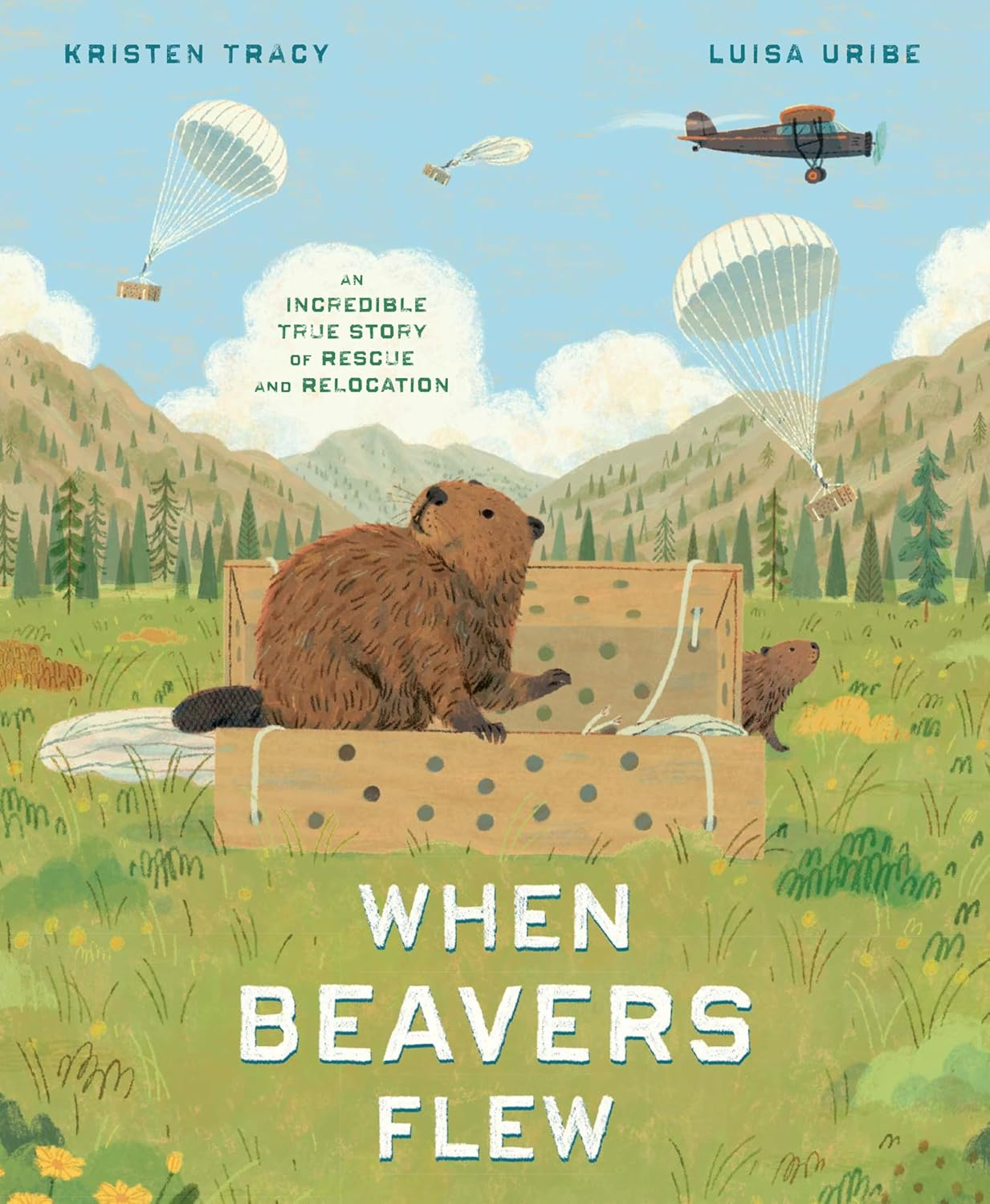
When Beavers Flew: An Incredible True Story of Rescue and Relocation by Kristen Tracy, illustrated by Luisa Uribe (Random House Studio, 40 pages, grades K-3). In 1948, the town of McCall, Idaho was booming, and the beavers that lived there were becoming a nuisance. Fish and Game warden Elmo Heter thought it would be best for both the beavers and the humans if the animals could be transported to a wilderness area called Chamberlain Basin. The problem was, the basin was surrounded by mountains that were almost impassable. Elmo tried strapping beavers in their traps onto pack horses, but this didn’t work well for the beavers, the horses, or the human riders. His next idea was to attach the beavers to surplus World War II parachutes and drop them into their new home. After experimenting with a variety of boxes, he finally found one that seemed like it would work. When he tried it out with a beaver named Geronimo, the animal landed safely and got out of the box. So Elmo boxed up 75 beavers and dropped them from a plane. When he checked on them a year later, he found that they were thriving, as was the wetland environment they helped create, and the beaver population continues in Chamberlain Basin to this day. Includes an author’s note with additional information, a couple for photos, and a list of sources.

Sometimes I find myself writing a sentence like, “So Elmo boxed up 75 beavers and dropped them from a plane,” and wonder how we got here. But I’m sure kids will find this story fascinating as well as surprising, and Elmo demonstrates some tenacious and creative problem-solving skills. Although the ending is reassuring, dropping beavers out of a plane seems like kind of an ethically gray area, and I’m glad the author’s note discusses the problems that can be associated with moving species out of their natural habitat.

Animal (and human) homes

City of Leafcutter ants: A Sustainable Society of Millions by Amy Hevron (Neal Porter Books, 40 pages, ages 4-8). Enter the fascinating world of leafcutter ants, a rainforest community of eight million that produces their own food, uses antibiotics to prevent diseases, manages their trash, and builds and defends their city. Each job is described with a sentence or two of text and collage illustrations that show the different ants at work. There’s a surprising amount of action, including an amazing defense against an invading poison dart frog (don’t worry, everyone’s okay). The back matter provides a lot more information along with a list of additional resources. This is an excellent science book that would be perfect to share with preschool and early elementary kids, although the boys may be bummed by the limited role of the male drones in this largely female society.

A Terrible Place for a Nest by Sara Levine, illustrated by Erika Meza (Roaring Brook Press, 40 pages, ages 4-8). “When Juno and his mom lost their home, they had to move to a new place.” Juno is sure the new place will never feel like home. He and his mom notice he mourning doves that live outside of their new building. When Juno sees two of the birds making a nest on the fence, he tells them it’s a terrible place for a nest. Sure enough, a deliveryman accidentally knocks it down, breaking the eggs inside. Juno tries to rebuild the nest, doing some research to learn more about mourning doves, but the birds stay away. Meanwhile, the illustrations show him making a new friend and settling into his home. By the time a pair of doves settles into the nest, Juno and his friend are ready, with signs warning people to watch out for the nest. “I told them it wasn’t a great place for a nest,” Juno says, “But we made it work.” This sweet picture book will reassure kids who have to move to a new home, with its parallel story about the doves and Juno and his mom. Kids will find plenty to look at in the illustrations, which tell more of Juno’s story than the text does. A little back matter about mourning doves would have been a nice addition.

Two books from Eerdmans

Long-time subscribers may recall that a few years ago I reviewed a book every week from an independent publisher. I haven’t kept up with it recently, but a few of those publishers still reach out to me from time to time. I recently received these two excellent books from Eerdmans Books for Young Readers. They are a great reminder of the unique and beautiful work being produced by smaller publishers. Both books will be released in September.

Counting Winter by Nancy White Carlstrom, illustrated by Claudia McGhee (44 pages, ages 4-8). Nancy White Carlstrom drew on her eighteen years in Alaska to create this counting book that includes eleven different animals, with verses written in similar fashion: “One red fox walks/across the white snow/quietly/stalking winter.” These could be used as models for kids to write their own four-line poems about animals with a similar combination of verbs, adverbs, and adjectives. The stunning scratch board and watercolor illustrations perfectly capture the animals and the snowy landscapes. When the counting reached eleven, I started to think it was going all the way to twenty, but the last page features twelve excited children, which was the perfect stopping place. Includes a wordless two page spread showing all the animals, two pages of animal profiles, and notes from the author and illustrator.

Fast Cheetah, Slow Tortoise: Poems of Animal Opposites by Bette Westera and Mies van Hout, illustrated by David Colmer. (40 pages, grades K-4). This Dutch import pairs animal poems that illustrate antonyms; a two-page spread features the tortoise in a poem entitled “Slow” with the cheetah, which is “Fast.” Others are noisy and quiet (cricket and pill bug), relaxed and busy (sloth and ant), and bossy and meek (gorilla and lesula). As this last example shows, there are some animals that may be new to kids. Each poem is accompanied by an illustration, which will help kids visualize those unfamiliar animals. This would be fun to share by reading a poem and having kids guess the animal and maybe the antonym as well. Unfortunately, there’s no back matter that could have offered more information on the animals.

Finding their voices

Ida B. Wells Marches for the Vote by Dinah Johnson, illustrated by Jerry Jordan (Christy Ottaviano Books, 48 pages, grades 1-5). Although this book tells the story of Ida B. Wells’s life, starting with her birth in Mississippi and continuing with some of her activism in Tennessee and Chicago, the main event is a march in Washington DC in 1913 for women’s right to vote. Many of the organizers felt that this march should be for white women only, or at least segregated (Alice Paul is specifically mentioned as expressing that view). Despite these protests and the suggestions that Ida march at the back of the line with her sorority, she made her way to the Illinois delegation and joined the white women in that group to march for their right to vote. Includes an author’s note, photos, a timeline of Ida B. Wells-Barnett’s life, and a list of sources.

The author does a masterful job of giving readers an overview of Ida’s life but focusing on one specific event that demonstrates the way she stood up for herself and other Black people. The back matter adds a lot and makes this a great resource for research.

Ode to Grapefruit: How James Earl Jones Found His Voice by Kari Lavelle, illustrated by Bryan Collier (Knopf Books for Young Readers, 48 pages, grades 1-5). Young James loved words, especially poetry, but when asked to read in front of the class or to say hello to a visitor at home, the words stuck in his throat. He finally stopped talking and just listened, paying close attention to his teachers, especially Professor Crouch who taught him poetry. James recited the poetry when he was alone, and sometimes he tried writing his own, but sharing it with the class was out of the question for him. One day, a shipment of grapefruit to his house inspired him to write a poem, and with Professor Crouch’s encouragement, James read “Ode to Grapefruit” to the class. This recitation opened the door for him, and he began performing on stage, as a debater and an actor, and eventually the distinctive voice of James Earl Jones became known around the world. Includes notes from the author (a speech pathologist) and the illustrator, as well as information and resources on stuttering and a list of sources.

This would make an excellent read-aloud, since the text is pretty short, and James’s issues are something most kids would relate to. I did wonder about the illustrations with all the kids having a slice of grapefruit in their mouths–did James hand them out, or was he just imagining them? But it would be fun to reveal at the end that the story is about the man who became the voice of both Darth Vader and The Lion King’s Mufasa.

Seeker of Truth: Kailash Satyarthi’s Fight to End Child Labor by Srividhya Venkat, illustrated by Danica da Silva Pereira (little bee books, 40 pages, grades 2-5). As a child in India, Kailash Satyarthi was inspired by the story of how a hummingbird stopped a forest fire by carrying drops of water in its beak. When he saw a boy working as a cobbler by the side of the road, Kailash wondered how he could help him go to school. Like the hummingbird, Kailash started with small deeds to make a difference–raising money and collecting books to help kids who couldn’t afford to go to school. As an adult, Kailash started his career as a teacher, but he wanted to do more. He quit his job and began rescue missions to free children forced to work in factories, mines, and quarries. His work gained international recognition, including the 2014 Nobel Peace Prize, which he shared with Malala Yousafzi, and resulted in worldwide changes to child labor laws. Includes an author’s note with additional information and a couple of photos, and a list for further reading.

This excellent picture book biography tells the story of Kailash Satyarthi’s life in a way that will easily be understandable to kids and will show them the power of a single individual to make a difference in the world. I liked that it tells the story of his entire life, so the reader can see how his ideas evolved, yet keeps the text brief enough for a good read-aloud.

A couple of nonfiction picture books

Clever Crow by Chris Butterworth, illustrated by Olivia Lomenech Gill (Candlewick, 32 pages, ages 4-8). “Wherever you are right now, there’s sure to be a crow or two nearby.” Crows are easy to spot, but also easy to miss. They tend to be plain, not particularly fancy fliers, and have a hoarse caw instead of a melodious song. But they’re smart enough to use tools and store food, and sometimes you can see them acting playfully. To summarize, they are “smart, clever, crafty and playful…just like you!” Includes a list of suggestions for learning more about crows and a short index.

The illustrations in this book are stunning, beginning with the endpapers, which show various crow eggs in the front and the birds that hatch out of them in the back. The text is quirky but interesting, although it left me wanting to know a lot more…for instance, is a crow a specific bird or a family of birds? I was surprised by the inclusion of a blue jay on the back endpapers, since I don’t think of it as a crow, but a quick Google search revealed that it’s part of the crow family. This is an eye-catching introduction, but curious readers will want to dig deeper for more information.

Sleepy: Surprising Ways Animals Snooze by Jennifer Ward, illustrated by Robin Page (Beach Lane Books, 32 pages, grades K-3). Whether it’s the half-sleeping brain of the dolphin, the deep torpor of the hummingbird, or the eyes-wide-open slumber of a snake, animals get their rest in a variety of fascinating ways. Each page features a close-up illustration of the animal with four lines of rhyming text describing its sleep, with a paragraph of additional information giving more details. The last page features a human child experiencing what scientists call “monophasic sleep.” Includes a list of the types of sleep in the book, a list of sources, and pie charts showing sleeping and waking times for all 16 animals and five more showing humans at different developmental stages.

As much as I mourn the loss of Steve Jenkins, his talented wife Robin Page has found an able partner with Jennifer Ward, whose rhyming text and fascinating facts reminded me of many a Jenkins book. The pie charts were very similar to some in his Animals by the Numbers (and the fact that I know that is a testament to how many times I’ve shared that book with classes.) The rhyming text and pictures will appeal to younger readers, and older ones will enjoy the additional information about each animal.

Stories and songs

Go Forth and Tell: The Life of Augusta Baker, Librarian and Master Storyteller by Breanna J. McDaniel, illustrated by April Harrison (Dial Books, 40 pages, grades 2-5). Augusta Baker was raised on her grandmother’s tales of Br’er Rabbit and King Arthur. A college class on folklore encouraged Augusta to become a storyteller herself, and she got a job at a branch of the New York Public Library in Harlem, where she found audiences of children eager for her stories. While most of her young patrons were African American, the books Augusta found in the library rarely had Black characters, and when they did, the portrayals were “RUDE, MEAN, and JUST PLAIN WRONG.” She searched for books (and wrote some of her own) that sought to correct that, compiling lists to share those books with others. Over the years, her work influenced Black writers and educators like James Baldwin, Audre Lorde, Carter Woodson, John Steptoe, and Virginia Hamilton. She extended her outreach through teaching at Columbia and the University of South Carolina, a radio show, and an appearance on Sesame Street and is honored by the city of Columbia, SC each year with a festival called A(ugusta) Baker’s Dozen. Includes a timeline, citations, an author’s note, and photos.

Bridges Instead of Walls: The Story of Mavis Staples by Mavis Staples and Carole Boston Weatherford, illustrated by Steffi Walthall (Rocky Pond Books, 48 pages, grades 2-5). Mavis Staples tells the story of her life (in third person), beginning with her family’s trip north during the Great Migration. Mavis was the youngest, born in Chicago, and as she grew older, she began singing with her father and siblings. They became popular as the Staples Singers, performing gospel music in churches around the Midwest, gradually expanding their repertoire to include blues and folk music. Although their lives and music were firmly grounded in their faith, eventually their fame spread to the secular entertainment world, as well as to supporting Martin Luther King, Jr. and the civil rights movement. Mavis also enjoyed a solo career, which continues to this day, as she is the last surviving member of the Staples Singers. Includes a timeline and lists of recommended listening (songs by the Staples Singers and Mavis Staples) and recommended viewing (documentaries).

These two excellent picture book biographies will introduce readers to amazing Black women who overcame discrimination and other barriers to share their gifts of storytelling and singing. Both are pretty long with lots of references to historical figures that will likely need some introductions for kids. The illustrations in both are amazing and do a great job of incorporating each woman’s art into the story.

Labor pains

Shift Happens: The History of Labor in the United States by J. Albert Mann (HarperCollins, 416 pages, grades 8-12). Low wages, long hours, wealth inequality, immigrants accused of “stealing” jobs: issues workers face today have in fact been around since the earliest days of United States history. This breezy but thoroughly researched account tells the painful story of American labor, in which actions for improved conditions have all too often been met with resistance, violence, and even murder. There are occasional hard-won victories for workers, and the twentieth century brought substantial legislation and improvements for labor–until they were eroded during the backlash of the Reagan years and beyond. The media is also implicated here for telling stories that favor capitalists and demonize labor organizers and unions. Teens looking for the truth about labor’s history will find plenty to think about, presented with short chapters and irreverent humor that will keep them engaged.

It’s taken me weeks to work my way through this book, but it was well worth it, with fascinating and disheartening stories that make it a good companion to Lies My Teacher Told Me. I was hoping to be able to recommend this for younger kids, but there’s definitely some language that might raise a few middle school eyebrows (starting with the title), and I think that, and the complexity of the topic make it more appropriate for high school.

For a more in-depth look at a single incident in U.S. labor history, try The Mine Wars: The Bloody Fight for Workers’ Rights in the West Virginia Coalfields by Steve Watkins (Bloomsbury Children’s Books, 272 pages, grades 6-10). I was too saturated on labor history from Mann’s book to read this one, but it looks like it includes many of the elements I read about: workers paid paltry wages in scrip for long hours of dangerous and back-breaking labor, and a strike that ultimately resulted in several killings. This particular story takes place in West Virginia in the early 1920’s, an era when it was particularly dangerous to be part of a union. This might be a better choice for a middle school introduction to labor history and will potentially appeal to fans of Steve Sheinkin.

Animal books

Animal Superpowers by Amy Cherrix, illustrated by Frann Preston-Gannon (Beach Lane Books, 48 pages, grades K-4). From a seemingly immortal jellyfish to a gravity-defying ibex to a snake-killing, venom-resistant opossum, these animals have superpowers that allow them to survive and thrive in their environments. Even your pet dog has a smelling superpower! Each two-page spread has a vivid illustration with boxed text. One spread gives the introduction to the power, then turn the page to reveal what it is and how the animal uses it. The last couple pages, entitled “Action is your superpower!”, tells how the different animals are threatened by pollution and climate change, encouraging kids to take action to help them. There’s also a list of sources.

Wolf Effect: A Wilderness Revival Story by Rosanne Parry, illustrated by Jennifer Thermes (Greenwillow Books, 40 pages, grades K-4). The story of wolves in Yellowstone, from their disappearance due to hunting to their reintroduction in the 1990’s, is told with rhyming text, prose, and illustrations. The wolves’ demise is told in verses, showing farmers and rangers hunting the wolves, with newspaper headlines declaring that Yellowstone is free of them. Then the text goes into a sort of “house that Jack built” rhyme, showing the ripple effects of reintroducing the wolves on the environment, as beavers, willows, and songbirds all return to the park. Boxes of narrative text provide more details, as do the illustrations, which sometimes depict a bear and a coyote discussing the effects of the wolves’ return. Eighteen animals from the pages are shown at the end; there are also notes from the author and illustrator, as well as a glossary and a list of resources.

Animal fans will be happy to see both of these books on the library shelves, with their eye-catching covers and beautiful illustrations. Animal Superpowers will appeal to readers who like collecting interesting facts while Wolf Effect is more of a story. I found the way the latter book was written a bit confusing, and I’m not sure that rhyming verses were the best way to go, particularly from an author as knowledgeable about wolves as Rosanne Parry (A Wolf Called Wander is one of my all-time favorite animal stories). Jennifer Thermes is amazing, though, and I found the illustrations to be the main attraction of both books.