The Big Book of Bugs by Yuval Zommer

Published by Thames & Hudson 
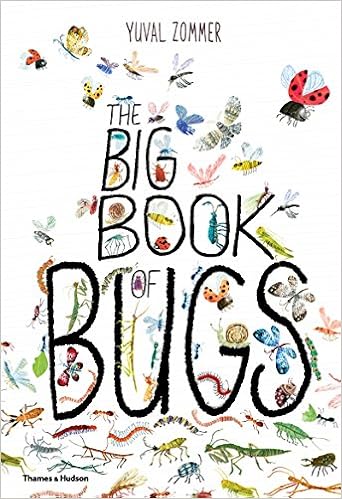
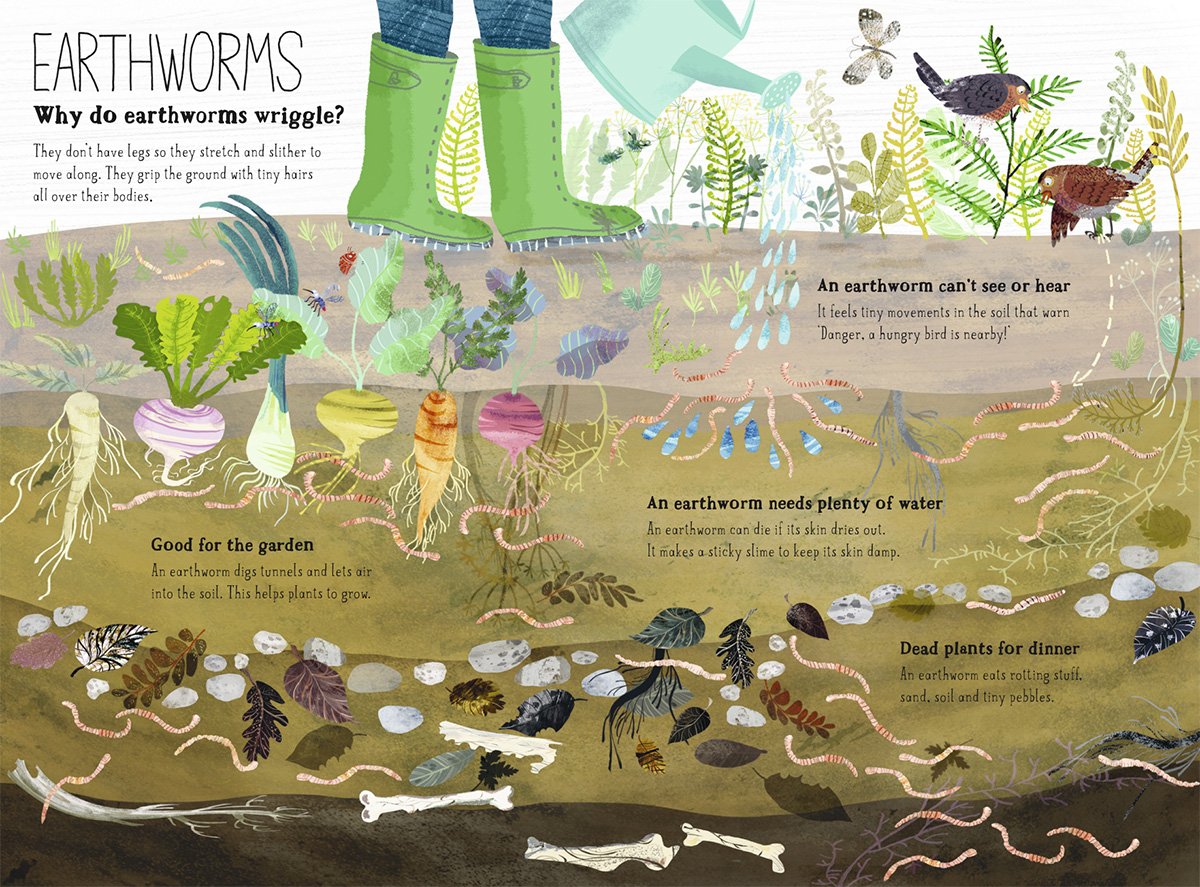
Summary: It’s difficult to come up with an insect category that doesn’t have its own section in this oversized book. Beetles, praying mantises, flies, crickets…they’re all there, as well as a few non-insects like spiders and snails. Each two-page spread has several facts and detailed illustrations. Some pages contain an “I Spy” type challenge, such as finding 29 moths, two praying mantises eating dinner, or a family of silverfish. There are also sections on baby bugs, bugs on the move, house-loving bugs, bugs at work, and bugs in your garden. The last several pages include answers to the challenges, an illustrated glossary (“Bug words”), and an index. 64 pages; grades Pre-K-2.

Pros: Anyone with even the slightest interest in insects will find a lot of interesting facts here, as well as have the opportunity to see the beautiful Eric Carle-like illustrations of all the different creatures in their natural habitats. The wealth of information and attractive pictures might even be able to help the squeamish overcome their trepidation around creepy-crawlies.

Cons: This is indeed a big book—almost 14 inches tall—so you may need some special accommodations for library shelving.


America’s Tea Parties: Not One But Four! Boston, Charleston, New York, Philadelphia by Marissa Moss

Published by Abrams 

Summary:  Everyone knows about the Boston Tea Party, but it turns out that event was just the beginning.  After word got around to the other colonies, Sons of Liberty groups in Charleston, New York, and Philadelphia had their own tea parties to prevent British tea from getting into colonial shops and to protest the hated tax on tea.  The four tea parties are put into context with a thorough look at the events leading up to them, as well as the various players in each colony.  Plentiful illustrations and sidebars add even more information.  End matter includes a six-page author’s note, a timeline covering events from fall of 1773 to the end of 1774, an extensive bibliography, and an index.  48 pages; grades 3-7.

Pros:  Middle grade social studies curricula will be given a boost with this well-written history of the period leading up to the American Revolution.  Thorough research, an engaging writing style, and plenty of illustrations make this an excellent nonfiction choice.

Cons:  There’s a lot of information here for the average fifth or sixth grader to wade through.

Two Friends: Susan B. Anthony and Frederick Douglass by Dean Robbins, illustrated by Sean Qualls and Selina Alko

Published by Orchard Books 

Summary:  Imagine Susan B. Anthony and Frederick Douglass, both civil rights activists who lived in Rochester, New York, sitting down to tea and cake together.  That’s the starting point of Two Friends, which then takes a look back at the early life of both Anthony and Douglass and how they became involved in the struggles to end slavery and give women the right to vote.  An author’s note gives a bit more information, as well as dates when both goals were achieved in the United States.  32 pages; grades K-3.

Pros:  An interesting introduction to two important 19th century activists whose civil rights struggles are still relevant today.  The colorful folk-artsy illustrations nicely portray Anthony, Douglass, and their homes in Rochester.

Cons:  A pretty brief introduction with only a little biographical information.

Every Day Birds by Amy Ludwig VanDerwater, illustrations by Dylan Metrano

Published by Orchard Books 

Summary:  20 North American birds are introduced in simple rhyming text (“Chickadee wears a wee black cap/Jay is loud and bold/Nuthatch perches upside down/Finch is clothed in gold”).  Each line of the rhyme is on a separate page with a large cut-paper illustration of the bird.  The entire text is included on two pages at the end, followed by smaller pictures and additional information about each bird, listed alphabetically.  32 pages; ages 2-5.

Pros:  Each line perfectly captures a characteristic of the bird it describes.  The illustrations are simple and bright, appealing for young kids, yet accurately depicting the bird.  Readers will be ready to head outside and look in trees and the sky for some feathered friends.

Cons:  So many birds in one place triggered a brief Alfred Hitchcock moment.

The Hole Story of the Doughnut by Pat Miller, illustrated by Vincent X. Kirsch

Published by Houghton Mifflin Harcourt 

Summary:  Hanson Gregory left his family’s farm for a life at sea in 1844 at the age of 13.  He quickly rose from cook’s assistant to become captain of a clipper ship.  By all accounts, he became an excellent commander, even receiving a medal for heroism from the queen of Spain after rescuing seven Spanish sailors.  But what Hanson Gregory is remembered for today is inventing the doughnut.  As cook’s assistant, he was charged with making breakfast cakes of fried dough.  Because the centers of these cakes remained raw and heavy, they were called sinkers.  One day Gregory had the brilliant idea to cut out the centers with the top of the pepper shaker.  The rest is baking history.  Over the years, legends arose about the genesis of the doughnut, and others even claimed to have invented it, but this book lays these rumors to rest once and for all.  An author’s note gives a bit more information about Gregory.  A timeline and bibliography are also included.  32 pages; grades K-3.

Pros:  An excellent introduction to the invention of ordinary items, told with plenty of humor in both the text and the illustrations.

Cons:  Does not really address the question, Dunkin’ or Krispy Kreme?


Flying Frogs and Walking Fish: Leaping Lemurs, Tumbling Toads, Jet-Propelled Jellyfish, and More Surprising Ways That Animals Move by Steve Jenkins and Robin Page

Published by Houghton Mifflin Harcourt 

Summary:  The Jenkins-Page team takes on animal movement, asking if you’ve ever seen a walking octopus or a swimming elephant.  After the page on the walking octopus, for example, comes a two-page spread of several other animals that walk in some unusual way.  The illustrations are done in Jenkins’ inimitable cut-paper style with amazing details.  The last two pages include thumbnail pictures of all the animals with a few sentences of additional information for each.  40 pages; ages 4-7.

Pros:  This award-winning team just keeps cranking out beautifully-illustrated, engaging science picture books.  Kids will love browsing through the pictures and descriptions, or listening to the book as a fun read-aloud.

Cons:  The format is nothing new, similar to other Jenkins books like What Do You Do With a Tail Like This? and How Many Ways Can You Catch a Fly?

We Came to America by Faith Ringgold

Published by Alfred A. Knopf 

Summary:  An illustrated poem celebrating immigration.  Ringgold starts with the lines, “We came to America/Every color, race, and religion/From every country in the world” then repeats them several times through the book.  In between, she mentions those who were here already, those who came in chains, those who came to escape from a dangerous situation, and other ways immigrants came to America.  She celebrates the contributions each culture made to American culture.  All the people are depicted with simple, brightly colored illustrations.  The entire poem is printed on the last page.  32 pages; grades K-3.

Pros:  A perfect introduction to immigration for the primary grades (although a little context would be needed before reading).  The illustrations are eye-catching, and the repeating text invites kids to chant along.

Cons:  Every time I saw this book sitting on my desk, Neil Diamond’s “Coming to America” got stuck in my head.

Rising Above: How 11 Athletes Overcame Challenges to Become Stars by Gregory Zuckerman with Elijah and Gabriel Zuckerman

Published by Philomel Books 

Summary:  11 athletes in different sports are profiled.  Each one had a very difficult childhood.  Tim Howard was diagnosed with OCD and Tourette’s at age 10; Dwayne Wade grew up in poverty with a drug-addicted mother; coach Jacques Demers was so traumatized by his abusive father that he never learned to read or write.  Yet each one made a decision at some point to work hard and stay positive, and this led to a successful and lucrative sports career.  An afterword explains how the author came to write the book, inspired and assisted by his two sons.  256 pages; grades 3-7.

Pros:  The stories are fast-paced and fun to read, as well as extremely inspiring.  The trials that each athlete faced are pretty severe, yet their positive attitudes and hard work are the common threads running through each narrative.

Cons:  Only one woman was profiled, Althea Gibson whose career was in the 1950’s, unlike the more contemporary male athletes.  Also, there were no pictures.

The Airport Book by Lisa Brown

Published by Roaring Brook Press 

Summary:  A boy describes each step involved in taking a trip on an airplane.  He starts at home with packing, using the second person voice (“You drive on the highway to where the ground is really flat.”), then moves on to the different steps of checking in and boarding.  The trip is briefly described, followed by what happens once the plane lands.  Woven through the story is a subplot about the boy’s younger sister’s missing stuffed monkey.  The busy illustrations show different people making their own trips, complete with cartoon-bubble dialogue.  The final page shows the happy family driving with Grandma and Grandpa past palm tree-lined beaches under a hot sun.  40 pages; ages 4-8.

Pros:  A fun book for the first-time flyer to learn what to expect, as well as for the seasoned traveler to recognize different parts of the airport and plane.  The illustrations and monkey story add plenty of humor.

Cons:  Take-off and landing which, in my opinion, are the most disconcerting part of air travel, are not described at all.

Worms for Breakfast: How to Feed a Zoo by Helaine Becker, illustrated by Kathy Boake

Published by Owlkids Books

Summary:  “Real Recipes Included!” boasts the front cover, but don’t head to the kitchen just yet: these recipes are for such treats as Predator Popsicles (bones and blood are involved) and Flamingo Chick Formula (simulating regurgitated fish).  As you may have guessed, the focus of this book is feeding animals at the zoo.  In addition to the recipes, it includes lots of information about zoo animals, how and what animals eat, profiles of zoo nutritionists, and tips for how kids can help animals, both inside and outside of the zoo.  Glossary and index are included.  40 pages; grades 1-5.

Pros:  Lots of information with plenty of humor, both in the writing and the illustrations.  The text is presented in (appropriately) bite-sized chunks, with lots of side bars and captioned illustrations.  The illustrations are a nicely goofy mix of photos and paintings.  Animal lovers of all reading levels will enjoy browsing and learn quite a bit in the process.

Cons:  “Tiger’s Birthday Cupcake” may have permanently put me off of cupcakes.