Will’s Words: How William Shakespeare Changed the Way You Talk by Jane Sutcliffe, illustrated by John Shelley

Published by Charlesbridge 

Summary: A letter from the author at the beginning of the book tells her dilemma: in trying to tell the story of William Shakespeare and the Globe Theater, she kept running into Will’s words. Shakespeare created and/or popularized so many words and phrases that it’s almost impossible to tell a story without using some of them. She then proceeds with her original task on the left-hand pages, bolding Will’s words. The right-hand pages explain the history of those words and where they appear in Shakespeare’s plays. A final author’s letter tells a bit more about William Shakespeare, mostly how little we know of him. A time line and bibliography are also included at the end. 40 pages; grades 3-6.

Pros: A nice introduction to Shakespeare’s plays and the Globe Theater, with the added element of looking at the impact these plays had on the English language. The illustrations do a wonderful job of conveying the enthusiastic audiences crowded into the theater and the exuberant actors preparing and performing the shows.

Cons: Although this book is targeted to an elementary audience, I couldn’t help feeling it would be more appreciate by older students studying Shakespeare’s works.

The Secret Subway by Shana Corey, illustrated by Red Nose Studio

Published by Schwartz and Wade

Summary:  New York City in the 1860’s had a horrendous traffic problem.  Alfred Ely Beach thought he had a solution: build an underground tunnel and send a train through the tunnel to transport people in a way that would keep them off the street.  Unable to get approval for his project, he pretended he was constructing a pneumatic mail tube under the city.  In reality, he was creating a tunnel big enough for a train.  In just two months, he built the first subway, unveiling his invention to the public on February 26, 1870.  People loved his train at first, but eventually the novelty wore off, and it would be decades before the rest of New York City caught up with Beach and built the present-day subway.  40 pages; ages 4-9.

Pros:  The story is well-told, and will appeal to fans of trains and other inventions.  The real marvel of this book are the multimedia pictures which are a cross between Claymation and Hanna Barbera animation.  The illustrations will sell this book to many readers.

Cons:  I thought Beach had created the subway used in New York today, so it was a bit of an anticlimax to learn his invention never really took off.


Clean Sweep! Frank Zamboni’s Ice Machine by Monica Kulling, illustrated by Renne Benoit

Published by Tundra Books


Summary:  Anyone who’s ever gone ice skating, or watched a sports event that took place on ice, has observed the giant Zamboni machine that drives around the rink and quickly resurfaces the ice.  But 70 years ago, there was no machine, and it took several men 90 minutes or more for that ice treatment.  And for Frank Zamboni, owner of the Iceland rink in California, that was too many man hours.  Fortunately, Frank was a tinkerer who knew a lot about machinery.  He had come up with an innovative way to design Iceland that resulted in smoother ice than other rinks.  Nine years passed, as Frank got busy raising a family and was shut down from working on his machine during World War II.  Many people said what he was trying to do was impossible, but he persevered.  In 1949, his machine took to the ice, and did in minutes what had previously taken over an hour.  Frank named his new machine after himself, which is good, because it’s so much fun to say “Zamboni”.  Today, Zamboni machines are on every continent…except the ice-covered continent of Antarctica.  32 pages; grades K-4.

Pros:  The story of an ordinary man who saw a problem, persevered, and succeeded in solving it.  This would be a great book to include in a unit on inventors and inventions.

Cons:  The poem at the beginning about ice skating is cute but seems sort of unnecessary.

Jazz Day: The Making of a Famous Photograph by Roxanne Orgill, illustrated by Francis Vallejo

Published by Candlewick


Summary: In 1958, graphic designer Art Kane sold Esquire on the idea of taking a picture of as many jazz musicians as he could gather together. Looking for the perfect backdrop, he traveled to Harlem, where he spent a full day seeking the brownstone he wanted to use for the shot. Although he wasn’t a professional photographer, Kane got his photo of 57 jazz musicians, now known as Harlem 1958. This book tells the history of that day through poems about Kane and some of his subjects. Thelonius Monk was an hour late because he was picking out the perfect outfit to wear. Count Bassie explains many of the musicians’ nicknames, including his own. “There’s A Hole in the Picture” recounts the reason Duke Ellington is missing from the photo (he was on the road). Other poems are about lesser-known performers, as well as some of the Harlem kids who ended up in the photo, lining up in the front row or peeking out the windows of the house. An oversized page near the end unfolds to finally reveal the photograph. Back matter includes an extensive author’s note, an outline picture identifying all the musicians, thumbnail biographies of all the subjects of the poems, and a huge bibliography. 66 pages; grades 4-7.

Pros: This carefully researched, beautifully illustrated collection of poems requires a slow reading. Readers will find themselves flipping between the poems, the photo, and the back matter. 66 pages jam-packed with information, presented with enormous artistic flair.

Cons: It’s difficult to know who the audience would be for this book. Most kids in grades 4-7 won’t have the context to really appreciate it, yet clearly it’s written for an upper elementary/middle school reader.


Green City: How One Community Survived a Tornado and Rebuilt for a Sustainable Future by Allan Drummond

Published by Farrar Straus Giroux 

Summary: When a tornado hit Greensburg, Kansas in 2007, so much of the city was destroyed that  townspeople questioned whether it should be rebuilt at all.  But some forward-thinking residents decided to create a new community.  Not only would the houses and commercial buildings be tornado-proof, but they would be as energy efficient and green as possible.  Donations came in from all across the country, and people in neighboring communities helped design and build the new town.  It took a few years, and some former residents didn’t want to wait, or couldn’t afford to.  But about 800 of the 1400 townspeople stuck it out, and today they live in one of America’s greenest cities.  Back matter includes an author’s note and tips for going green.  40 pages; grades K-4.

Pros:  Busy, colorful illustrations show the many steps of planning and creating a new town.  The anonymous child narrator tells the story in a chatty, optimistic voice.  Sidebars give more information on green living and construction.

Cons:  The idea of an entire town being destroyed in just a few minutes.

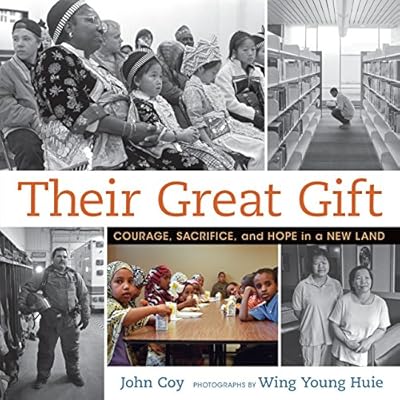
Their Great Gift: Courage, Sacrifice, and Hope in a New Land by John Coy, photographs by Wing Young Huie

Published by Carolrhoda Books

Image result for their great gift amazon 

Summary:  Each page has 3-6 photographs of 21st-century immigrants. The brief text explains how people have come to the United States from many countries.  They may not speak English, they may make embarrassing mistakes, but they work hard and often do the jobs that no one else wants.  They push their children to also work hard and to never give up, with the hope that those children will have opportunities they never knew.  The final page asks, “What will we do with their great gift?”  Back matter includes photos of the author’s and illustrator’s ancestors and their stories of how those families came to America, as well as a description of how they came to work together on this book.  32 pages; grades 1-5.

Pros:  Although the text is brief, almost like a poem, the photographs are captivating and will make readers want to spend a lot of time with this book, imagining what life is like for the subjects of those photos.  This would be a perfect introduction to a unit on immigration, demonstrating that seeking a new life in the United States has been, and continues to be, an ongoing theme in American history.

Cons:  I wanted to know more about every single photograph.

The Wildest Race Ever: The Story of the 1904 Olympic Marathon by Meghan McCarthy

Published by Simon and Schuster 

Summary:  How times have changed.  Back when the 1904 Olympic marathon was held, it was part of the World’s Fair in St. Louis.  41  men signed up to participate, but on race day, only 32 showed up.  The course washed out several days before the event, so a new course was mapped, much hillier than the original.  One of the participants was chased off the road by a dog; another kept stopping for snack breaks along the way; a third struggled when his trainer fed him strychnine mixed with an egg white to keep up his energy.  Despite the 90-degree heat, there were only two water stops, and some of the water was contaminated, forcing more than one man to drop out due to stomach issues.  One racer jumped into a car for several miles, then tried to pass himself off as the winner by running the last bit of the race.  In the end, Thomas Hicks, the American guy who consumed strychnine, managed to stumble across the finish line as the first legitimate winner.  End matter includes additional information about the race and a few of the racers, plus a bibliography.

Pros:  Lots of laughs reading about a race that resembled “It’s A Mad, Mad, Mad, Mad World”.  Kids will enjoy comparing and contrasting the 1904 marathon with today’s Olympics.  Meghan McCarthy’s pop-eyed cartoon illustrations add a great deal of fun to the story.

Cons:  The cast of characters was a little large to keep track of in a picture book.  I had to keep referring back to a two-page spread at the beginning that profiled the main runners.

Our Moon: New Discoveries About Earth’s Closest Companion by Elaine Scott

Published by Clarion Books


Summary:  Everything you ever wanted to know about the moon but were afraid to ask..  From the earliest ancient astronomers who observed Earth’s satellite with the naked eye to the scientists today who are trying to figure out a way to colonize the moon, Our Moon traces the history of humans’ lunar interactions.  It also looks at how the moon has also been studied to learn more about the history of the solar system, particularly after rocks and dust were brought back to Earth from the Apollo missions.  Back matter includes an extensive glossary and index and sources for further information.  72 pages; ages 10-13

Pros:  This book is positively dripping with information. The engaging writing style will appeal to researchers and browsers alike.  Filled with color photos, diagrams, and sidebars, this is nonfiction at its best.

Cons:  The subtitle makes it sound like this is a book about new discoveries about the moon, while that is actually only one small part of the whole.


Fabulous Frogs by Martin Jenkins, illustrated by Tim Hopgood

Published by Candlewick Press 

Summary:  “Did you know that there are more than 5,000 kinds of frogs?” begins this book, and then proceeds to describe some of the more unusual ones.  There are big frogs and little ones, poisonous frogs, and frogs that can jump sixteen feet, appear to fly, and live buried underground for years.  The last two pages include eight more frog portraits, a very short index, and a recommended website for learning more.  32 pages; ages 5-8.

Pros:  This would be a great nonfiction read-aloud for young animal lovers.  The big, colorful illustrations (by Tim Hopgood, how perfect is that?) nicely complement the conversational text.

Cons:  My curiosity at how the Australian water-holding frog lives underground for “years and years” in a very small hole was not satisfied.

Tooth by Tooth: Comparing Fangs, Tusks, and Chompers by Sara Levine, illustrations by T. S. Spookytooth

Published by Millbrook Press 

Summary:  How many teeth do you have?  What are the names and functions of different types of teeth?  What kind of an animal would you be if you had really long incisors?  Or teeth that were all the same? Tooth by Tooth draws readers right in with questions about something all of us are pretty familiar with—our teeth.  Kids will learn which types of teeth are used by carnivores, herbivores, and omnivores, and why only mammals have different types of teeth.  The last few pages include a glossary, additional resources, and more information about mammals and their teeth.  32 pages; grades K-4.

Pros:  The first book by this author/illustrator team, Bone by Bone is one of my favorite nonfiction read-alouds.  The questions make both books very interactive, and the illustrations are lots of fun, showing what you would look like with different types of bones or teeth.  Not only that, but there’s a ton of information packed into a short amount of text.

Cons:  I didn’t find teeth quite as varied and interesting as bones.