Finding Winnie: The True Story of the World’s Most Famous Bear by Lindsay Mattick, illustrated by Sophia Blackall

Published by Little, Brown and Company 

Summary:  When Cole asks him for a bedtime story, his mother tells him the tale of Harry Coleburn, a veterinarian who rescued a bear at a train station.  It was 1914, and Harry was traveling from Winnipeg to basic training before going overseas to be an army veterinarian.  The bear, named Winnie for Winnipeg, went with him on all his travels, proving himself to be a most intelligent and entertaining addition to the troops.  Finally, it was time to go to the front, and Harry knew he couldn’t take Winnie with him. Winnie moved to a new home in the London Zoo, where he was later discovered by Christopher Robin Milne, and found his way into stories written by Christopher’s father, Alan Alexander (A. A.) Milne.  The story unfolds in much the same way the Winnie-the-Pooh books do, with a parent telling a child a story.  At the end, the mom/author reveals that Harry Coleburn was her great-grandfather and is her son Coe’s namesake.  Six pages of photos of Harry, Winnie, Lindsay, and Cole are included at the end.  Grades K-3.

Pros:  Lovely illustrations illuminate Lindsay’s fascinating and endearing story to her son.  The revelation of the family connection is an interesting bonus, and the photos enhance that.

Cons:  Two excellent, well-illustrated picture books telling this exact same story (see Winnie: The True Story of the Bear Who Inspired Winnie-the-Pooh by Sally Walker) in the same year seems like a bit of an unfortunate glut on the market.

The Nutcracker Comes to America: How Three Ballet-Loving Brothers Created a Holiday Tradition by Chris Barton, illustrated by Cathy Gendron.

Published by Millbrook Press 

Summary:  Although the Nutcracker ballet seems like a timeless holiday tradition, it’s only been around since the second half of the twentieth century.  Three brothers from Utah, Willam, Harold, and Lew Christensen, were responsible for bringing the Russian ballet to the U.S.  The Christensens came from a dancing family and grew up to become dancers, vaudevillians, and, eventually, teachers and producers.  During World War II, money and dancers were both in short supply.  The brothers were working in San Francisco and needed a hit to keep ballet alive in that city. When Willam heard someone whistling Tschaikovsky on a city street, he was reminded of a production of the Nutcracker he had been involved with years before.  The brothers’ low-budget production premiered on Christmas Eve and was a huge hit.  Over the next several years, the show spread to other cities across the country, so that by the 1960’s, the Nutcracker tradition had taken hold.  Back matter includes notes from the author and illustrator about their research, a timeline, a summary of the story of the Nutrcracker, and suggestions for further reading.  Grades 2-5.

Pros:  I was surprised to learn how recently the Nutcracker came to America.  The history was interesting, and the illustrations, inspired by Edgar Degas, capture the grace and beauty of ballet.  The conversational tone of the text keeps the story moving along.

Cons:  Some of the details of the brothers’ lives seemed extraneous to the main story.  A little editing might have made this a better read-aloud for younger readers.

We Rock! (Music Lab): A Fun Family Guide for Exploring Rock Music History by Jason Hanley

Published by Quarry Books

Summary:  Billed as a book to help families enjoy rock and roll music together, each two-page spread of this book features a single hit by a famous artist.  There’s a “Historical Fact/Social Connections” paragraph, “Song Facts”, “Try This at Home”, and a sidebar that tells what to listen to in each verse of the song, broken down by time.  Chapters include Rock and Roll Basics, Rocking Out, Deep Soul, Punk Rock, Dance Music, New Rock Sounds, and New Wave.  An appendix includes additional singers and bands related to each of the 52 artists profiled.  Ages 10-110.

Pros:  Written by the director of education at the Rock and Roll Hall of Fame, this is a pretty definitive guide to rock music.  Any fan will find it a difficult book to put down, and it would make sharing your favorite oldies with the kids a great deal of fun.

Cons:  No Grateful Dead?

Aaron and Alexander: The Most Famous Duel in American History by Don Brown

Published by Roaring Brook Press 

Summary: Aaron Burr and Alexander Hamilton were almost the same age.  Both grew up as orphans, fought in the American Revolution, and were key figures in early American government and politics.  Moving in the same social and professional circles, they were friends early in their careers, but later became bitter political enemies.  Hamilton helped defeat Burr in his presidential campaign against Thomas Jefferson, and again in his bid for governor of New York.  Finally, Burr challenged Hamilton to a duel.  It was an illegal but not uncommon practice at the time; Hamilton had been challenged eleven times before, and Burr had had had a hole shot through his coat in a previous encounter.  On the morning of July 11, 1804, they met in Weehawken, New Jersey, stood thirty feet apart, and shot at each other.  Hamilton was hit and died the next day.  Burr survived, but was forever after despised by much of America.  Includes an author’s note and bibliography.  Grades 2-5.

Pros:  The names Aaron Burr and Alexander Hamilton may be familiar to kids, but they are unlikely to know much about them aside from their famous duel.  This picture book introduces both men sympathetically and gives a good overview of their lives.

Cons: The details of their political differences are a bit skimpy.

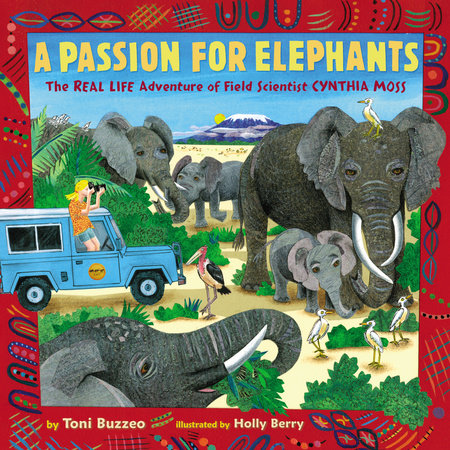
A Passion for Elephants: the real life adventure of field scientist Cynthia Moss by Toni Buzzeo, illustrated by Holly Berry

Published by Dial Books for Young Readers 

Summary:  Cynthia Moss was never afraid of BIG things.  That’s the recurring refrain in this story of scientist Cynthia Moss, who grew up riding horses in Virginia and went on to become a journalist.  An invitation from a college friend sent her to Africa, where she got a job photographing elephants for a zoologist.  This ignited a passion, and she began to recognize individual elephants and their families.  She went on to found the Amboseli Elephant Research Project and made many new discoveries about elephant behavior.  Eventually, concerned about the decline of elephant populations caused by poaching, Cynthia became an activist, working to get a global ban on the sale of ivory in 1990.  Her work continues today, both researching and protecting the elephants she loves.  Back matter includes further information about Moss, further reading, and additional sources.  Grades K-3.

Pros:  An inspiring biography of a scientist who has made a difference.  Less well-known the Jane Goodall, Cynthia Moss’s career parallels hers, in her long years studying animals in Africa and her work around the world to protect them.  The colorful illustrations would make this a great read-aloud to share with kids.

Cons:  The most recent source listed in the additional resources is from 2010.

Enormous Smallness: a story of E. E. Cummings by Matthew Burgess, illustrations by Kris Di Giacomo

Published by Enchanted Lion Books 

Summary: Starting with his somewhat enchanted childhood in Cambridge, Massachusetts (complete with happy family, summers on a New Hampshire farm, and a large tree house heated by a wood stove), this book recounts the life of Edward Estlin Cummings. Estlin was both a poet and an artist.  From an early age, he loved spending time drawing and playing with words, and he continued with both activities for his entire life.  This book emphasizes how he responded to life with his creativity, experimenting with words and poetic forms to express what he experienced as he moved from his home in Cambridge, to Harvard, to France, where he drove an ambulance during World War I, and to 4 Patchin Place in Greenwich Village, his home for much of his adult life.  End matter includes a chronology, several poems, and an author’s note.  Grades 2-5.

Pros:  This book captures the joy E. E. Cummings experienced through his creativity, both in the writing and the illustrations, in which Estlin is consistently portrayed with a smile on his face.  The poems are well-selected to appeal to young readers.

Cons:  Despite their brevity, the poems of E. E. Cummings could be a bit difficult for elementary readers.

Swan: the life and dance of Anna Pavlova by Laurel Snyder, illustrated by Julie Morstad

Published by Chronicle Books 

Summary:  When Anna Pavlova was a small girl growing up in Petrograd, her mother took her to see a ballet.  From then on, she could think of nothing but dancing.  After two years of dreaming, she was finally admitted to the Russian Imperial Ballet School.  While she had natural grace and beauty, her body was very different from the sturdy, acrobatic dancers of the time.  Nevertheless, she worked hard and became a famous ballerina, best known for her role as the lead in The Dying Swan.  Always remembering her own impoverished childhood, Anna traveled the world, bringing dance to people who wouldn’t otherwise have the chance to experience it.  Sadly, at the age of 50, she was in a train accident, caught pneumonia from being outside in the cold, and died.  Grades 1-5.

Pros:  Dance fans will love this beautifully illustrated book with spare, poetic text telling the inspiring story of Anna Pavlova’s life.

Cons:  The text is spare enough that readers might be a bit confused by some aspects of the story.  Be sure to read the author’s note at the end for some clarity.

Spidermania: Friends on the Web by Alexandra Siy, photomicrographs by Dennis Kunkel

Published by Holiday House

Summary: The cover of this book will undoubtedly scare off some potential readers. And that’s kind of the point of this book…to debunk the myths that spiders are scary and dangerous.  Sure they have fangs and venom, but most of them are pretty harmless to humans and they do some darn interesting things, the most famous of which is spinning amazing webs from a material that is strong, tough, flexible, lightweight, hypoallergenic, and totally biodegradable.  Ten unusual spiders are profiled, all with amazing photomicrographs of various parts of the spiders that have been brilliantly colored to make them stand out.  Back matter includes information on how to identify spiders, additional resources, and a pretty extensive glossary and index.  Grades 3-6.

Pros:  There’s a lot of great information that might make an arachnophobia sufferer see spiders in a much more positive light.  The pictures are super cool; spider fans will enjoy seeing the amazing details of various arachnid body parts.

Cons:  I would have liked to learn more about the photography process used.  I was unfamiliar with the word “photomicrograph” and finally found a brief paragraph about this process under the copyright information.  It didn’t completely satisfy my curiosity, though, and made no mention of the brilliant colors used.

My Leaf Book by Monica Wellington

Published by Dial Books for Young Readers 

Summary: It’s autumn, and the narrator fills up her leaf book with specimens she finds around her. She sees leaves that look like fans, stars, and hearts. Some are red, some orange, yellow, or violet. Pages alternate between bright trees with simple shapes on them and close-ups of more accurate renditions of the different types of leaves; these pages have a fact or two about trees and leaves. The last page gives directions for leaf prints and leaf rubbings. Ages 3-7.

Pros: A good introduction to different types of leaves. Young kids will be inspired to get outside and see if they can find leaves that match the ones in the illustrations.

Cons: Yet another tiny font, this time for the facts about leaves. And, editors, yellow print on an orange background?  No.

How to Swallow a Pig: Step-by-Step Advice from the Animal Kingdom by Steve Jenkins and Robin Page

Published by HMH Books for Young Readers

Summary: Each page gives an illustrated how-to guide for different animals and the unusual things they do: how to trap fish like a humpback whale, how to crack a nut like a crow, how to woo a ewe like a mountain sheep. There are 4-6 steps for each process, all featuring lots of interesting animal information with a touch of humor. The last three pages include thumbnail pictures and further information on each animal, plus a bibliography. Grades 1-4.

Pros: Steve Jenkins and Robin Page team up yet again for another fascinating look at the animal kingdom. Lots of gross, funny, and interesting facts are illustrated with the usual detailed cut paper illustrations. This would make a good mentor text for teaching procedural writing.

Cons: The format of this book makes it a bit difficult to read cover to cover. Unlike the pig of the title, it is probably best digested in small chunks.