The Walk by Winsome Bingham, illustrated by E. B. Lewis

Published by Harry N. Abrams

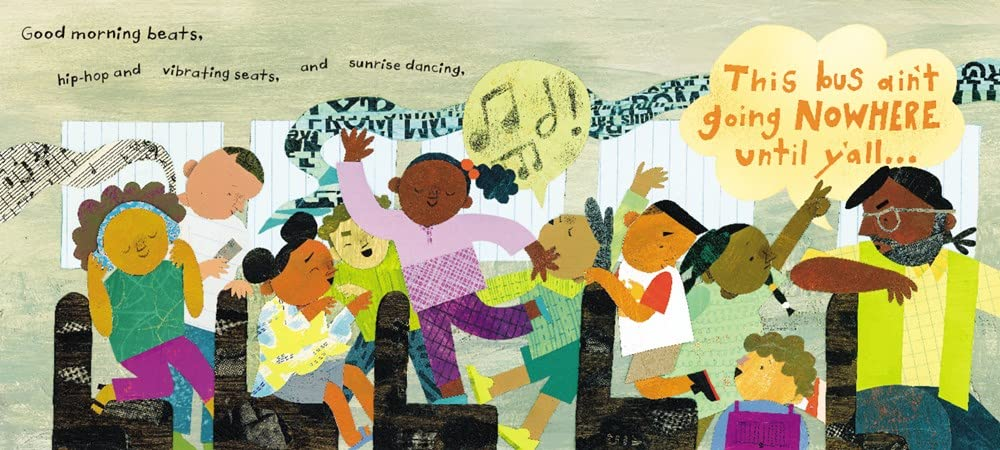
Summary:  A girl and her granny are headed out for a walk to an undisclosed destination.  As they travel through the neighborhood, more and more people join them.  Comments give some hints about their journey: “I thought after 2008, I could skip a few of these walks. But I see we need them more than ever.”  “The walk wasn’t always this long, but folks keep making it longer.”  Finally, the group arrives at the girl’s school.  “You’re silly, Granny,” says the girl.  “There’s no school today.”  The school is closed for Election Day, but open for voting.  Everyone marks their ballots, then the group heads home, reversing the walk until it’s just the girl and her granny once again.  40 pages; ages 4-8.

Pros:  An excellent read-aloud for Election Day, emphasizing the importance of voting and the attempts to limit it, particularly in communities of color.

Cons:  An unfortunate lack of back matter that could have given some context to comments made by people about the history of voting.

Good Books for Bad Children: The Genius of Ursula Nordstrom by Beth Klephart, illustrated by Chloe Bristol

Published by Anne Schwartz Books

Summary:  Legendary children’s book editor Ursula Nordstrom began life as an only child whose parents divorced when she was seven years old and sent her to boarding school shortly thereafter.  Unable to attend college, she began working as a clerk in the college textbook division of Harper & Brothers, eventually becoming assistant to Louise Raymond, editor in the Department of Books for Boys and Girls.  When Louise left, Ursula was promoted to head the department, and spent the rest of her career nurturing authors like E.B. White, Maurice Sendak, Margaret Wise Brown, and Laura Ingalls Wilder (who is surprisingly never mentioned in this book).  Drawing on her own lonely childhood, Ursula understood that kids have different needs, whether they feel sad, mad, or left out, and that having all sorts of books can be helpful.  Includes an author’s note with additional information about Ursula Nordstrom and a list of sources.  48 pages; grades 1-5.

Pros:  I’ve long been fascinated by Ursula Nordstrom and enjoyed this engaging introduction to her life. The endearing illustrations contain lots of references to the many of the classic books and authors that were part of Ursula’s long career.

Cons:  I’m not sure how many children will be interested in the topic.

Loud and Proud: The Life of Congresswoman Shirley Chisholm by Lesa Cline-Ransome, illustrated by Kaylani Juanita

Published by Simon and Schuster/Paula Wiseman Books

Summary:  Shirley Chisholm learned about the fight for justice by listening through her apartment walls to the union meetings her father was part of.  In college, she took the advice of a professor who told her she should go into politics and joined a variety of movements.  After graduating, marrying, and starting a teaching career, Shirley decided to run for the New York State Assembly in 1964.  A landslide victory led to four years in the Assembly before running for U.S. Representative.  She became the first Black Congresswoman and a force to be reckoned with, fighting for issues that impacted women, children, and the poor.  In 1972, she ran an impressive campaign for President, then returned to Congress for another decade before retiring in 1983.  Her tenure in politics paved the way for other women of color, many of whom are shown on the last page.  Includes an author’s note with additional information and a timeline.  48 pages; grades 2-5.

Pros:  This book is the latest in a recent group of biographies about Shirley Chisholm and provides a comprehensive look at her life, with illustrations that capture her energy and fighting spirit.  

Cons:  It’s long for a picture book and may work better for kids doing research than as a read-aloud.

Flat Cat by Tara Lazar, illustrated by Pete Oswald

Published by Flamingo Books

Summary:  How did Flat Cat get so flat?  Was he squashed by an ice cream truck or smushed in a waffle iron?  Nope, he was born flat, and he likes it that way.  He can slide under doors, fly like a kite, and hide almost anywhere.  But when he takes a nap in a laundry basket, the dryer turns him into “the most adorable puffy, fluffy, fuzzy-wuzzy feline you ever did see!”  At first Flat Cat tries desperate measures to become flat again, but he discovers that he kind of likes getting hugged and petted.  When Aunt Harriet sits on him, he’s Flat Cat once again, but he decides to go for another spin in the dryer to fluff himself up.  Now that he knows how to be flat or fluffy, Flat Cat enjoys his life, alternating between the two states.  40 pages; ages 4-8.

Pros:  A fun, quirky story enhanced by the funny illustrations.  Flat/Fluffy Cat embodies the introvert who also likes to socialize. Sure to be a hit at story time. 

Cons:  A flat creature that slides under doors and flies like a kite…Flat Stanley rip-off or homage?

Once a Bird by Rina Singh, illustrated by Nathalie Dion

Published by Orca Book Publishers

Summary:  There’s still snow on the ground when a robin starts a journey that offers a bird’s-eye view of the landscape: water, roads, farms.  As the bird makes stops on a playground, at a church, and in a fountain, the reader can see that the world is slowly turning green again.  Finally, the robin lands in a tree outside an apartment building, many of the windows covered by blinds or curtains.  When it starts to sing, people appear in the windows, looking out and connecting with each other over this novelty outside.  Before long there’s a bird feeder hanging in the tree just above the robin’s new nest.  Eggs are laid, babies hatch, and soon people are drawn outside and to be with each other in a new community.  32 pages; ages 4-8.

Pros:  This beautiful wordless book could be interpreted in many different ways: I read three very different reviews that ranged from a bleak environmental message to a post-pandemic liberation.  Readers will enjoy the artwork and the freedom to interpret the story in their own way.

Cons:  Building a nest and reproducing seems like a two-bird job, but there was just the one robin to be seen.

How Does Santa Go Down the Chimney? by Mac Barnett, illustrated by Jon Klassen

Published by Candlewick

Summary:  The dynamic Barnett-Klassen duo ponder the question of the title with a whole brainstorm of ideas.  Does Santa cinch up his belt or shrink to the size of the mouse?  Does he ever get stuck partway down and need a kick from the reindeer?  And what about those homes without chimneys?  Does he turn into a letter and drop through the mail slot?  Or slip through the pipes and come out the faucet?  And don’t even get started on how Santa goes back up the chimney!  However it is accomplished, the narrator concludes, we’re all so glad he can do it.  32 pages; ages 4-8.

Pros:  Get ready for some ho-ho-ho’s when you share this book with kids, who will no doubt be inspired to come up with some new ideas about Santa to add to Mac Barnett’s list.  Jon Klassen takes the idea and runs with it, and readers will love the images of Santa dripping through the faucet and flattening himself to go under the door.

Cons:  We can speculate, but we will never know for sure.

An Ofrenda for Perro by Judith Valdés B., illustrated by Carlos Veléz Aguilera

Published by little bee books

Summary:  Benito is devastated to lose his dog Perro, who has been his companion since he was born.  As his family gets ready to celebrate Día de Los Muertos, Benito is slowly drawn into the preparations.  His father explains that the holiday isn’t a celebration of the dead, but of the love they have for those who have passed.  His mother shows him that her memories of her great-grandfather mean that he’s not really gone.  When Benito finds Perro’s ball, he is able to smile at his memories of his beloved dog, realizing that his memories will always be with him.  Includes an author’s note with additional information about Día de Los Muertos and a glossary. 32 pages; ages 4-8.

Pros:  A great resource for Día de Los Muertos, or for anyone who has lost a pet, with explanations that kids will understand and relate to, and beautiful illustrations inspired by the holiday.

Cons:  I couldn’t help thinking that Perro (Spanish for dog) deserved a slightly more imaginative name.

Veo, Veo, I See You by Lulu Delacre

Published by Atheneum Books for Young Readers

Summary:  During the pandemic, a girl and her mother and brother play a game of Veo, Veo, or I Spy, to spot essential workers in their community.  Mami lost her job as a cook, so she cooks at home now, and the family takes food and medicine to some older relatives before stopping at the food pantry on the way home.  In the course of their errands, they see trash collectors, a nurse, a pharmacist, a bus driver, and other workers who are keeping their city going so that others can safely stay at home.  Back at home, the girl makes a collage sign saying, “I see you!” that includes pictures of many of the workers, leading to cheers and applause from the community.  Includes an author’s note about the pandemic, and how it brought essential workers, and the fact that many of them are Black or Brown, to people’s attention.  40 pages; ages 4-8.

Pros:  Although the setting is the Covid pandemic, this book could be used to introduce lots of different community helpers.  The illustrations are bright and appealing, with cartoon bubbles for dialog: Spanish for Mami and English for the kids.

Cons:  The pandemic setting makes this already feel a little dated, as many of the kids reading the book will have little or no memory of that time.

Dasher Can’t Wait for Christmas by Matt Tavares

Published by Candlewick

Summary:  Dasher the reindeer is back in this follow-up to Matt Tavares’s 2019 book Dasher.  Excited for Christmas, Dasher finds herself unable to sleep on the night of December 23 and goes off to look for adventure.  She finds carolers singing around a Christmas tree and enjoys herself so much she doesn’t notice the snow moving in.  When she realizes it’s time to go home, the storm is so thick that she can’t find her way.  She winds up at the home of a young boy named Charlie who gives her a compass to guide her back north.  Dasher makes it back just in time to take her place pulling Santa’s sleigh and makes sure that the jolly old elf has a compass to leave under Charlie’s tree.  40 pages; ages 4-8.

Pros:  Another beautiful Christmas story from Matt Tavares that perfectly captures kids’ excitement about the holiday and all of its magic.  

Cons:  In my opinion, the best Matt Tavares Christmas book remains Red and Lulu.

The Artivist by Nikkolas Smith

Published by Kokila

Summary:  Nikkolas Smith draws on his experiences as an artist and an activist to create a narrator who calls himself an artivist.  Observing the world around him, the boy says, “I want to hold up a mirror to the world and show everyone what isn’t working right.”  His murals and signs draw attention to issues like homelessness, gun violence, environmental concerns, racism, and trans rights.  He invites others to join him, saying that artivists can also sing, write, build, or film.  “The Artivist is you.  What change will you create?”  40 pages; all ages.  Includes a brief note about Smith’s own Artivist journey.

Pros:  The age recommendation I saw in other reviews was 4-8, but as I read this book, I envisioned it being used by older elementary and middle school kids as a jumping-off point for thinking about the issues they care about and creating art to express that.  In a world that seems more uncertain than ever, this book gives an empowering message to kids about using creativity to make change.

Cons:  Nikkolas Smith refers to an illustration he made that went viral.  I think it’s his portrait of George Floyd, but I wish there had been more information about it.