Yenebi’s Drive to School by Sendy Santamaria

Published by Chronicle Books

Summary:  Yenebi and her younger sister Melanie get woken up at 4:00 a.m. to begin their trip to school.  On the road with Mami and Melanie, Yenebi confronts her archenemy: la línea, the line of cars waiting to cross the border.  Will they wait two or three hours this morning?  Mami and Yenebi debate while Melanie sleeps.  Then Mami says the magic words, “hora de desayunar!”  It’s time to decide what to buy for breakfast, choosing from the vendors all around them.  They enjoy chicken tamales as they get closer to the border.  After showing their papers to the stern border patrol agent, they’re finally in the United States and on their way to school.  It’s 7:00 a.m., right on schedule, and when they finally get to school, Yenebi is feeling wide awake.  “Estoy listo,” she declares, ready for her day.  Includes an author’s note about her own experiences crossing the border to go to school.  Available in English and Spanish (El viaje de Yenebi a la escuela). 40 pages; grades K-4.

Pros:  I plan to pair this book with 9 Kilometers as an introduction to the lengths some kids have to go to to get to school.  Yenebi is pretty cheerful about her long drive, and Sendy Santamaria beautifully portrays the sense of community she experienced from this daily journey. I’ve added this to my back to school book list.

Cons:  I wondered what Mami did all day, since I assume she would have to take her daughters home after school.

Together We Swim by Valerie Bolling, illustrated by Kaylani Juanita

Published by Chronicle Books

Summary:  A family is enjoying some time at the pool.  Mom, Dad, and the sister are all accomplished swimmers, but the youngest is still learning.  Short rhymes describe the action (“Toe dip/Side grip”) as he tentatively explores the water.  The other family members are encouraging, showing him the basics and staying nearby with a kickboard and noodle to keep him safe.  By the end, he’s learned how to move his arms and legs and is thrilled to be starting to swim.  They towel off, have a family hug, and “filled with pride/off I stride.”  40 pages; ages 3-6.

Pros:  A perfect summer book and an empowering one that shows a Black family that loves swimming and is making sure their kids know how to swim too.  I missed last year’s Together We Ride, which features the same family teaching the daughter how to ride a bike.

Cons:  Seems like June 15 would have been a better release date for this book than August 15.

Night Owl Night by Susan Edwards Richmond, illustrated by Maribel Lechuga

Published by Charlesbridge

Summary:  Sova is eager to accompany her scientist mother on one of her evening owl watches, but every time she asks, Mama tells her that a scientist must learn to wait.  Finally, Sora is old enough, and the big night arrives when the two of them go off together.  Once again, there’s a lot of waiting: Mama sets a timer for thirty minutes, and the two of them play games in the wildlife sanctuary’s cabin until the timer goes off.  They go out to check the nets for owls.  The first two times, there are just leaves, but on the third trip–finally–there’s a saw-whet owl.  Back at the cabin, Mama measures and bands the owl, explaining how the bands help scientists track the owls’ migration.  Together, the two of them release the owl, and Sora feels a part of herself take wing and fly away with the owl.  Includes additional information about four types of owls; a note from the author about saw-whet owl banding (with a photo); and additional resources.  32 pages; ages 4-9.

Pros:  Fans of Jane Yolen’s Owl Moon will enjoy this story with its portrayal of a woman scientist.  It’s remarkably engaging, considering how much waiting is involved, and incorporates quite a bit of scientific information.

Cons:  I was getting a little impatient to finally see an owl.

Two books about self-acceptance

Greenlight by Breanna Carzoo

Published by HarperCollins

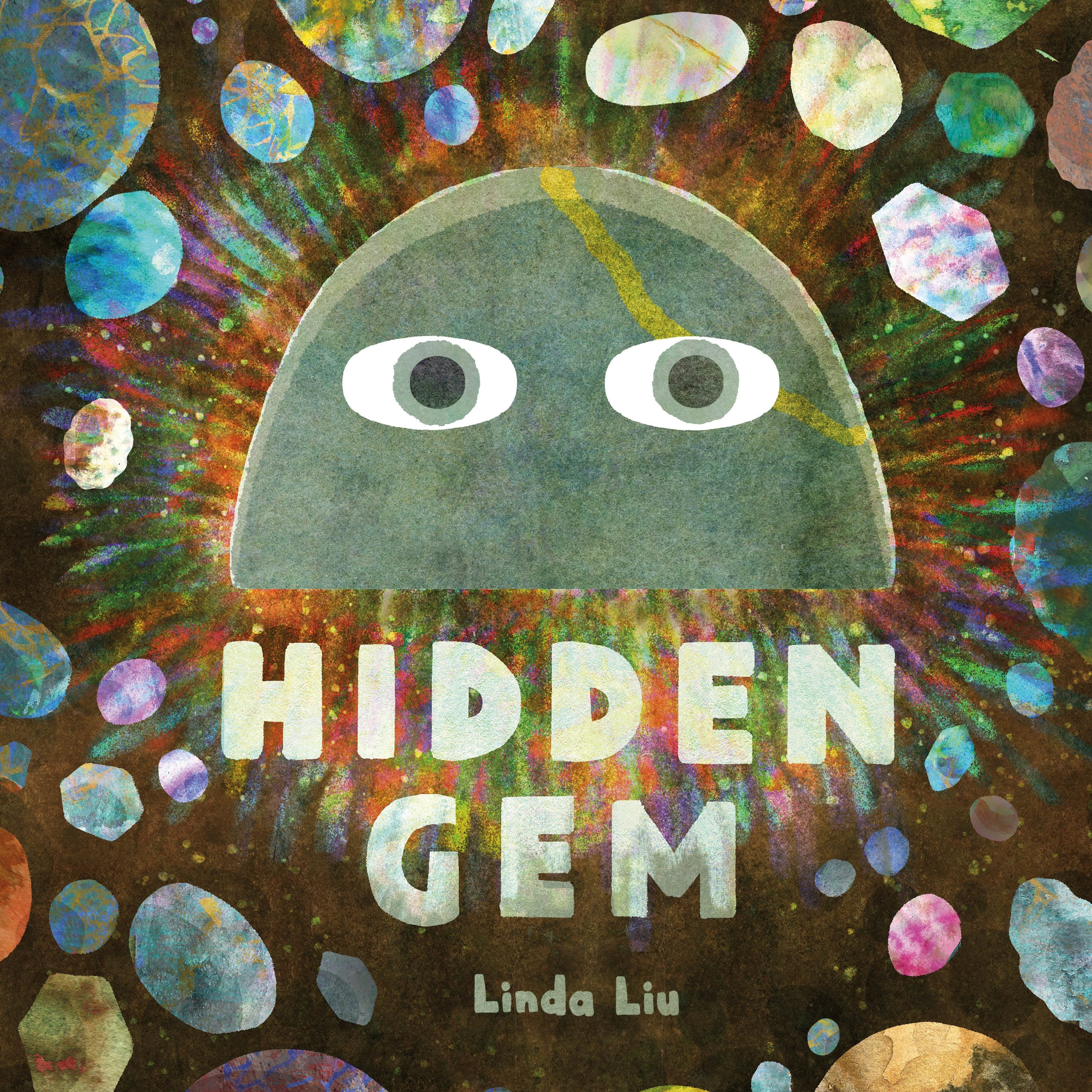
Hidden Gem by Linda Liu

Published by Henry Holt

Summary: Two unconventional narrators discover their own value. Greenlight doesn’t like the fact that the cars slow down for Yellowlight, stop for Redlight, but speed through Greenlight, seeming to ignore it. Taking a break for a few minutes, with closed eyes and some affirmations repeated, Greenlight starts to see its own value and is ready to shine bright. In Hidden Gem, an ordinary rock can’t help comparing itself unfavorably when it goes to a museum exhibit of gems. But with the help of a spectacular diamond, the narrator comes to realize that every rock is special in its own way. 32 pages (Greenlight) and 40 pages (Hidden Gem); both ages 4-8.

Pros: With school starting up again, teachers and counselors will be looking for books like these that incorporate humor and striking illustrations (especially in Hidden Gem) to give kids some strategies for feeling good about themselves and accepting others for what they are.

Cons: Both books seemed to prioritize the message over the story.

The Red Jacket by Bob Holt

Published by HarperCollins

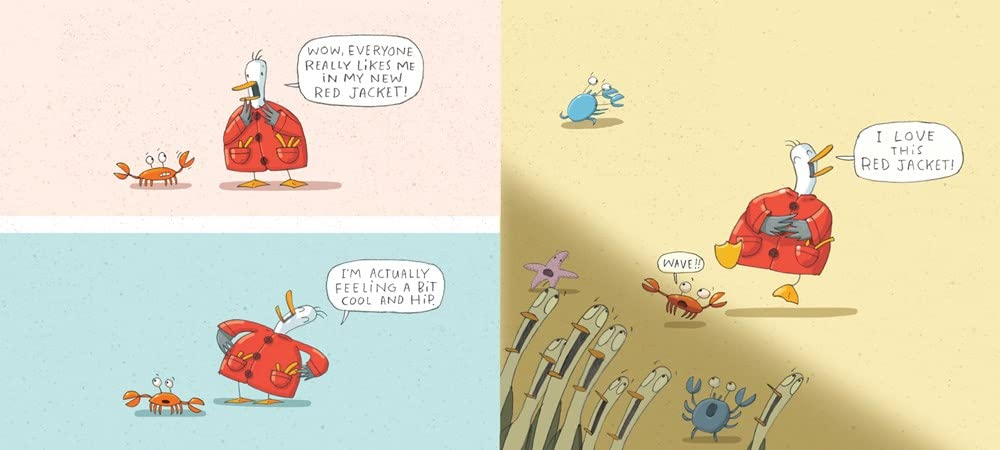
Summary:  The first few wordless pages show Bob the seagull watching other sea creatures having fun together while he feels left out and alone.  Another bird comes along and offers Bob her red jacket (with fries in the pockets!), saying that she no longer needs it.  The jacket gives Bob the confidence to talk to the other animals.  Their responses reveal that they’ve always liked Bob but never had the chance to get to know him (“I didn’t know Bob could talk”).  When a huge wave causes Bob to lose his beloved jacket, his friends pitch in and help him recover it.  Bob spots a lonely turtle and offers the jacket to her, saying that he no longer needs it.  The turtle walks away happily, fries spilling from the pockets of her new red jacket.  40 pages; ages 4-8.

Pros:  A cute story with appealing comic-style illustrations that could open up some interesting conversations about where self-confidence comes from.

Cons:  Those have to be some soggy fries.

What a Map Can Do by Gabrielle Balkan, illustrated by Alberto Lot

Published by Rise x Penguin Workshop

Summary:  An adventurous raccoon narrates its travels by showing kids a series of maps, beginning with its bedroom and continuing to the neighborhood, a museum, a road map, and more (12 altogether).  Each map has questions for kids to answer and introduces concepts like a compass rose and a map key with symbols.  There are maps that show things other than geography, like the stars and the weather.  Includes an index of all the maps with thumbnail drawings, definitions, and the pages where each can be found.  48 pages; grades K-2.

Pros:  Kindergarteners at my school learn about maps, so I have read quite a few picture books on the subject, and this is the best that I have seen.  I love how interactive it is, with the questions the kids can answer using the maps.  It’s lots of fun, but also a pretty thorough introduction to all kinds of maps.

Cons:  It felt a little long to maintain a kindergartener’s attention.  You might want to break it into two or three reading sessions.

Mine! by Candace Fleming, illustrated by Eric Rohmann

Published by Anne Schwartz Books

Summary:  A red apple hangs from a tree, ready to drop to the ground.  One by one, animals plan to grab that apple when it falls, each one imagining how delicious it will be, shown with a cartoon bubble and the word “MINE!”  Finally, the wind blows the apple from the tree, and Mouse, Hare, Fox, Deer, and Bear all pounce, resulting in a free-for-all that pushes the apple away.  It lands at the feet of Possum, who eyes it curiously: “Mine?”  A worm pops out, and the two say in unison, “Ours!”  40 pages; ages 3-6.

Pros:  With illustrations reminiscent of Eric Rohmann’s Caldecott book My Friend Rabbit, this story uses catchy rhymes and adorable (if greedy) animals to impart a fun lesson about sharing.

Cons:  Generally, apple trees produce more than one apple at a time, so it seemed like the animals could have just chilled and waited for more apples to fall.

You Are My Pride: A Love Letter from Your Motherland by Carole Boston Weatherford, illustrated by E. B. Lewis

Published by Astra Young Readers

Summary:  “I am the mother of all humanity.  I have a long history and a longer memory,” begins this poem that is addressed to humans from the continent of Africa.  The narrator traces time from the first cells that evolved into the first humans.  “Child, you are mine as much as Mount Kilimanjaro, as much as the Serengiti and the Sahara, as much as the baobab and the bush.”  And although those children are her treasure, she sends them around the globe to let their gifts shine.  Includes additional information about human evolution, specifically in Africa, and a timeline of key species and developments in early human evolution.  40 pages; grades K-5.

Pros:  This loving poem with beautiful illustrations celebrates all of humanity, but especially those with roots in Africa.  The additional information makes it a resource that older kids will find useful as well.

Cons:  No additional resources.

The Umbrella by Beth Ferry, illustrated by Tom Lichtenheld

Published by Clarion Books

Summary:  “Dreary. Weary. Dim. Grim. Drip. Drop. Nonstop.”  From the looks of things on the first pages, the rainy weather has been around for way too long.  But rain or shine, dogs gotta go, and so a girl takes her pup out for a walk in the rain.  When thunder booms, a curio shop provides them with some shelter, and they find a free, albeit tattered, yellow umbrella there.  On the walk home, though, the umbrella disintegrates with a crumble and a tumble, strewing yellow pieces in the grass along the sidewalk.  The rain continues through the night, and when the girl and dog go for another walk, they make a surprising discovery–new yellow umbrellas have sprouted wherever the pieces of the old one fell!  Before long, the whole town is outside celebrating with their sunny new umbrellas despite the rain.  48 pages; ages 4-8.

Pros:  I will definitely be reading this book to some of my preschool and kindergarten classes, maybe pairing it with Stick and Stone by the same author and illustrator.  The umbrella garden was such a fun surprise, complemented by the gray illustrations with their bright spots of yellow.

Cons:  There have been a few weeks this summer that felt like the first few pages of this book.

Little Land by Diana Sudyka

Published by Little, Brown Books for Young Readers

Summary:  The story of a small piece of land began five hundred million years ago, when it was part of the ocean.  Dinosaurs walked on it sixty-seven million years ago, and ice covered it one hundred thousand years ago.  There have been many, many changes, and different forms of life have come and gone.  But the land has always survived…until humans came along.  Starting with a single house, people gradually built more and more on the land, even digging into it to create structures to support them.  The impacts grew and grew until one day “…it seemed unstoppable,” shown with an upside down black and gray illustration.  Kids start to make changes, reclaiming the land with clean-up efforts, flowers, and trees.  Even a small gift to the Earth can reap big rewards.  Includes an author’s note, a list of words that inspired the book, animals and plants in the book, a list of epochs represented, and additional resources.  48 pages; grades K-3.

Pros:  A gorgeous introduction to environmental concerns, covering a surprising amount of information with deceptively simple text and illustrations that reminded me a little bit of Virginia Lee Burton (and should be considered for a Caldecott!).  The last few pages and back matter will empower kids to figure out what they can do to help the planet.

Cons:  My usual discouragement and angst when I read books about the environment.