Salat in Secret by Jamilah Thompkins-Bigelow, illustrated by Hatem Aly

Published by Random House Studio

Summary:  When Muhammad gets a salat rug for his seventh birthday, he’s determined to pray five times a day like his father does.  It’s easy at home, but more challenging to do dhuhr, the prayer that comes in the middle of the day, when he’s at school.  He tries praying in the bathroom and the coat closet, but neither works out for him, and he ends up missing the midday prayer.  When he joins his father selling ice cream from his truck, he watches as Dad sets up his rug on the sidewalk and begins his prayers.  A woman and some police officers stop and stare, and with shaking hands, Muhammad gets out of the truck and joins his dad.  He notices that Dad is a bit shaky too, but they finish their prayers, and the policemen walk away.  The next day, Muhammad overcomes his fears and tells his teacher that he needs a place to pray.  Includes an author’s note with more information about salat and a glossary.  40 pages; ages 4-8.

Pros:  This empowering story encourages Muslim kids to live their faith and will show any reader how to find the courage to do what feels right.

Cons:  The story ends with the teacher happily agreeing to Muhammad’s request, but I was curious to see what would happen after that.

Champion Chompers, Super Stinkers and Other Poems by Extraordinary Animals by Linda Ashman, illustrated by Aparna Varma

Published by Harry N. Abrams

Summary:  Using mask poems (poems in which the writer speaks in the voice of someone or something else), Linda Ashman has animals give hints as to what they are and what superlatives (fastest, biggest, stinkiest, etc.) they hold in the animal world.  Each poem has an illustration showing part of the animal to give an additional clue.  Turn the page, and the animal is pictured in full, along with a paragraph of information.  Opening and closing poems introduce the contest.  Includes additional information about protecting endangered animals, measurements, and mask poems, as well as a glossary, and lists of websites and books.  48 pages; grades 1-4.

Pros:  I do love a good guessing book to keep kids engaged, and this one lets readers guess both the animals and the records they hold.  The illustrations are cute and offer hints to go with each poem.  Kids can try their hands at mask poems after reading these.

Cons:  It may be a little long for primary kids to get through all of these in one sitting.

Summer Is for Cousins by Rajani LaRocca, illustrated by Abhi Alwar

Published by Harry N. Abrams

Summary:  Every year, Ravi’s extended family rents a house by the ocean and a lake.  He’s the second youngest of seven cousins, with two uncles, two aunties, Mom, and Dad.  The only other boy is his oldest cousin Dhruv, who has grown several inches and gotten a deeper voice since last summer.  Ravi feels shy around him, but Dhruv still enjoys hanging out with Ravi, helping him to learn to paddleboard and to find the courage to jump into the water from the rope swing for the first time ever.  In turn, Ravi enjoys the role of older cousin with baby Leela.  There’s mini golf, biking, shared cooking, and ice cream–lots of ice cream.  One night the cousins cook, and Ravi finds a way to create his favorite ice cream, banana, with help from the rest of the crew.  “Because,” he concludes.  “Summer is for cousins.  And ice cream.”  40 pages; ages 4-8.

Pros:  Just like yesterday’s The Firefly Summer, this lovely picture book perfectly captures the simple joys of a summer spent with extended family. While the illustrations, names, and some of the food prepared indicate that the family is from India (like the author), the experiences of family and summer fun are universal.

Cons:  All the cousins were labeled on the first page, but I wish there had been more of a family tree to show parents and siblings.

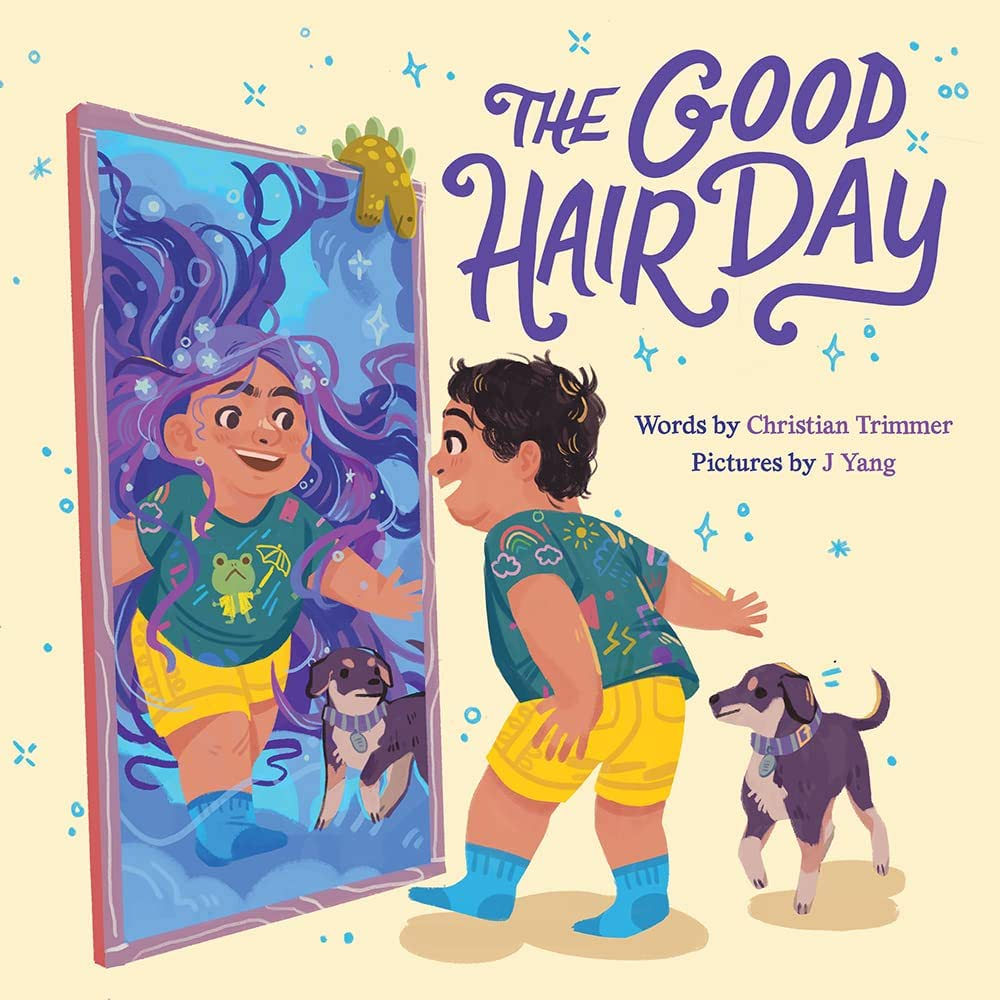
The Good Hair Day by Christian Trimmer, illustrated by J Yang

Published by Harry N. Abrams

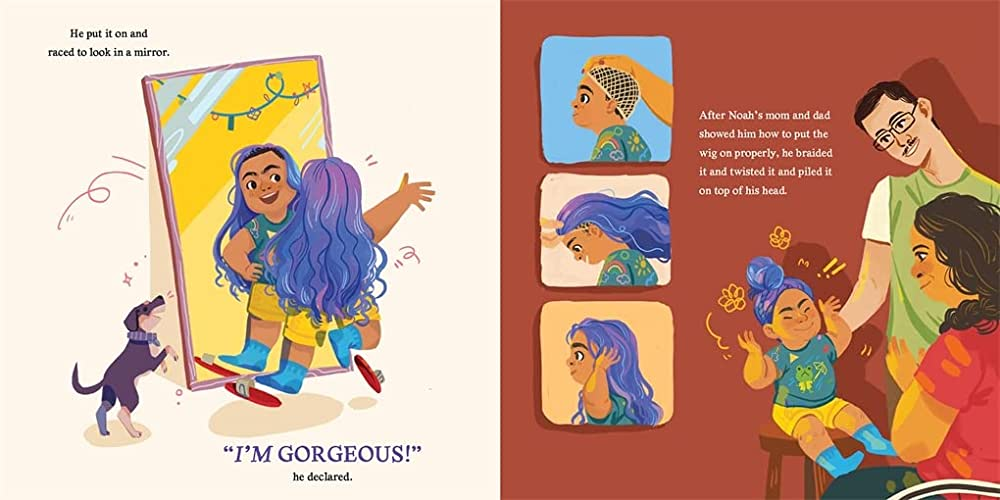
Summary:  Noah is excited about his upcoming birthday, dropping lots of not-too-subtle hints about what he hopes to get.  But he keeps his greatest wish–to grow his hair–to himself, worried that it’s not acceptable for boys to have long hair.  At his pre-birthday haircut, the barber follows Dad’s instructions for “the usual,” causing Noah to burst into tears at the sight of his short hair.  Mom and Dad figure out what’s going on, and on his birthday, Noah’s favorite gift is a long purple wig.  A year later, he’s back at the barber, but now the directions are, “A little off the ends, please,” as Noah is revealed to have shoulder-length hair.  Includes a list of conversation starters about gender, identity, and self-expression.  40 pages; ages 4-8.

Pros:  The author of Teddy’s Favorite Toy has created another fun story with a likable narrator that facilitates discussions around gender norms and expectations and provides some excellent parental role models.

Cons:  I almost missed the list of conversation starters which is printed on the endpapers.

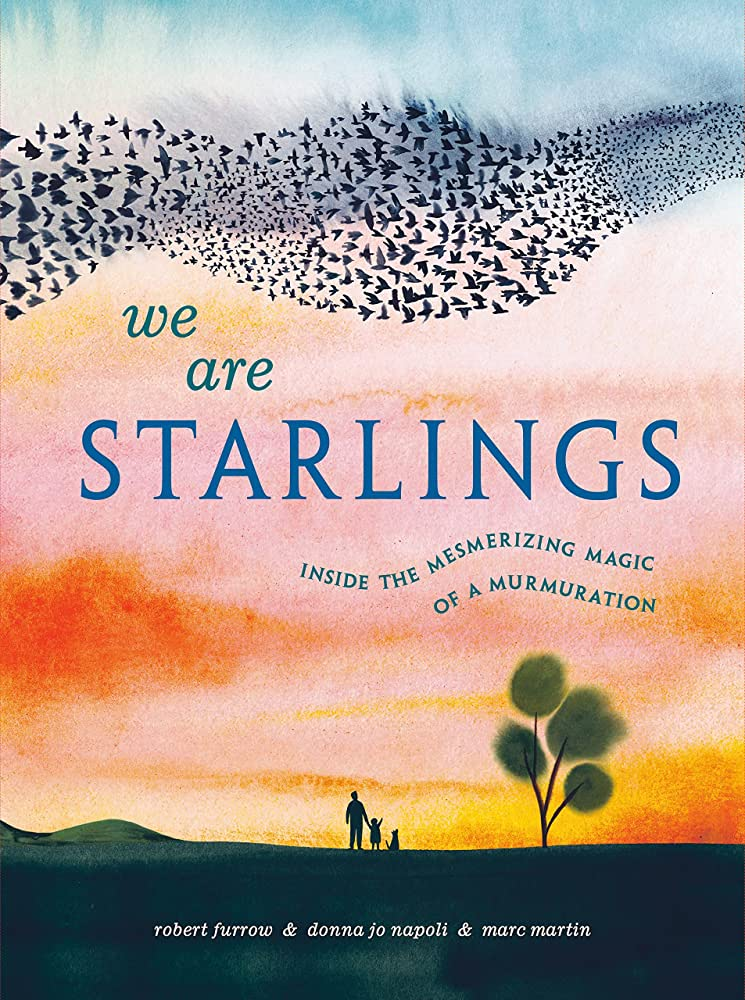
We Are Starlings: Inside the Mesmerizing Magic of a Murmuration by Robert Furrow and Donna Jo Napoli, illustrated by Marc Martin

Published by Random House Studio

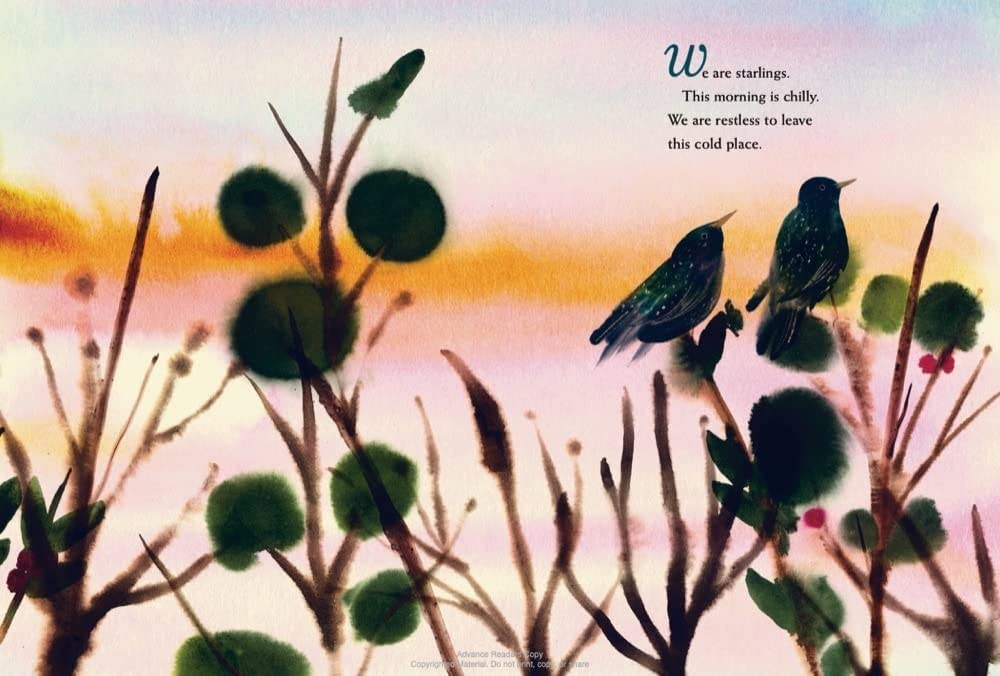
Summary:  Two starlings rest on a chilly morning, then fly away with others.  They travel for days, with more starlings joining them, until thousands of them are flying as a group, called a murmuration for the sound all those flapping wings make.  The huge flock provides warmth and protection, demonstrated when a peregrine falcon tries to attack.  After surviving that, the starlings are ready for some fun, diving and swooping in spectacular formations until they find a place to land and roost together.  Includes a two-page note about starlings.  40 pages; ages 4-8.

Pros:  The spectacular illustrations capture the movement of the murmuration, showing the black birds silhouetted against a beautiful sky at sunrise or sunset.  The poetic text gives just enough information to intrigue readers, with more offered in the note at the end.

Cons:  No additional resources.

Simon and the Better Bone by Corey R. Tabor

Published by Balzer + Bray

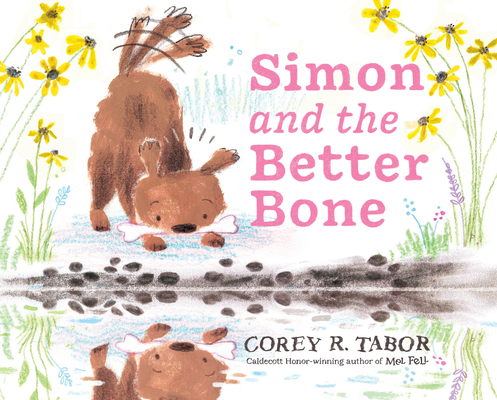
Summary:  Based on Aesop’s fable about the dog and its reflection, this story shows Simon, a dog who has found what he considers to be the best bone ever.  When he looks into the water, though, he discovers another dog with what looks to be an even better bone.  After a staring contest, some growling, and a few other tactics to get the dog to give up its bone, Simon dives in after it, losing his own bone in the process.  Back out of the water, he discovers a new bone and generously drops it into the water for the other dog.  Simon heads for home, feeling happy that he’s made a new friend.  40 pages; ages 3-8.

Pros:  This book is read from top to bottom in the style of Tabor’s Caldecott honor book Mel Fell.  The illustrations are charming, kids will get some laughs from Simon’s antics, and it could make a good intro to Aesop’s fables.

Cons:  One of my favorite parts of Mel Fell is all the funny animals Mel passes on her way down the tree and back up again. There wasn’t as much of that visual humor in this book.

Grandma’s Tipi: A Present-Day Lakota Story by S. D. Nelson

Published by Harry N. Abrams

Summary:  Clara spends a summer on the Standing Rock reservation with her unci (grandmother) and cousin Juniper.  Both live there, as does Uncle Louie, who frequently comes to visit.  They set up a tipi where they learn traditions, spend time with family, and add spirit pictures of the cousins to the other artwork that decorate the walls.  Clara watches unci make a beautiful beaded dress, which turns out to be a gift for Clara when her parents come to pick her up.  Plans are made to return in the fall so that Clara can dance in the powwow wearing her new dress.  Includes a two-page author’s note with photos, providing additional information about the tipi..  40 pages; grades K-4.

Pros:  There’s a lot of information about Lakota culture and contemporary life on the reservation packed into this story.  Clara’s family seems warm and loving, and her summer is lots of fun while also connecting her with her heritage.

Cons:  The text is small, and the story is long, making this perhaps a better choice for older elementary kids.

Jackie Ormes Draws the Future: The Remarkable Life of a Pioneering Cartoonist by Liz Montague

Published by Random House Studio

Summary:  Jackie Ormes loved drawing from an early age and captured her dreams of adventure through her art.  After high school, she took a job as a freelance reporter for the Pittsburgh Courier, a Black newspaper, and eventually created the cartoon character Torchy Brown, a fashionable nightclub star who moved from the South to Harlem.  Torchy made people laugh but also addressed issues like racism and segregation.  When Jackie and her husband moved to Chicago, Torchy’s run ended, and Jackie had the opportunity to formally study art for the first time in her life.  Several years later, she returned to the world of comics with Patty-Jo, a six-year-old girl who spoke out about current events, and who would become Jackie’s most famous creation.  Includes additional information about Jackie Ormes and Patty-Jo, including a photo of the Patty-Jo doll, described as “America’s first upscale Black play doll,” an author’s note, and a list of selected sources.  40 pages; grades 2-5.

Pros:  A fun and insightful look at cartoonist Jackie Ormes’s life, with illustrations inspired by Jackie’s work, and an emphasis on the theme of the perseverance that led to her success.  Kids will relate to Jackie’s love of art and her determination to be successful and make a difference.

Cons:  The story ends shortly after World War II, and Jackie died in 1985; like another recent biography of Ormes, this doesn’t tell much about the second half of her life.

The High Line: A Park to Look Up To by Victoria Tentler-Krylov

Published by Harry N. Abrams

Summary:  After New York City’s elevated railroad became obsolete, a group of neighbors saw the possibility of turning the tracks into a park.  They held a competition to generate ideas and chose a proposal that created a space inspired by the old railroad.  The short section that was built was immediately popular, drawing both locals and tourists, and resulted in the “High Line effect” with new businesses opening nearby.  An unfortunate downside was the gentrification that made it difficult for the original residents to afford the new neighborhood, and when similar parks were built in other cities, efforts were made to mitigate this effect.  Today, the High Line continues to thrive in New York City and in other places around the world that were inspired by the original.  Includes an author’s note, a timeline, a selected bibliography, and endpapers showing places in the park. 40 pages; grades 2-5.

Pros:  You’ll want to head for NYC after reading this fascinating introduction to the High Line and the similar parks it’s inspired, with colorful watercolor illustrations that capture the construction process and the beautiful finished result.  I liked that the author included the issue of gentrification that has been addressed but not completely remedied.

Cons:  No photos.

Wings, Waves & Webs: Patterns in Nature by Robin Mitchell Cranfield

Published by Greystone Books

Summary:  Readers are invited to find patterns in nature, beginning with simple ones like spots (a ladybug and a guinea fowl feather) and stripes (a skunk and a sunflower seed).  The patterns become increasingly complex, moving on to mirror and radial symmetry, branching, and collective motion.  Each type is accompanied by one or two illustrations that show the pattern in nature.  The final spread of a flower garden invites the reader to look for the different patterns that have just been introduced.  36 pages; ages 4-8.

Pros:  A simple but thorough introduction to patterns that will have kids recognizing them in everyday life.  The beautiful graphics make this an eye-catching addition to STEM collections.

Cons:  I know the Oxford comma is optional, but I would have made the title Wings, Waves, & Webs.