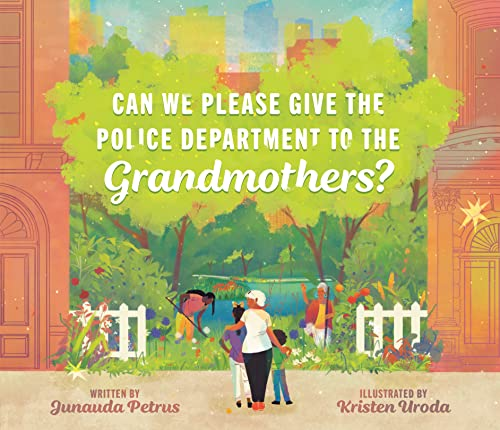
Can We Please Give the Police Department to the Grandmothers? by Junauda Petrus, illustrated by Kristen Uroda

Published by Dutton Books for Young Readers

Summary:  If we give the police department to the grandmothers, they’ll patrol the streets in solar-powered cars like Corvettes, Jaguars, and Cadillacs, blasting “old school jams” from Patti LaBelle, Stevie Wonder, and Anita Baker.  If you get into trouble, the grandmas will give you a hard look but then take you home and feed you, help you with your homework, practice yoga, and rub your back while you fall asleep.  Grandmothers (some of whom look like grandfathers) “see the pain in our bravado, the confusion in our anger, the depth behind our coldness,” and know how to change people through unconditional love. Includes a playlist on both sets of endpapers. 32 pages; ages 4-8. 

Pros:  This book by writer and activist Junauda Petrus will bring a smile to your face but also make you think about what is lacking in our current society, particularly for young people of color.  Younger kids will enjoy it, but it could also be used as a text for older kids and adults to start a discussion about less harmful ways of policing.

Cons:  Some additional resources would have been useful.

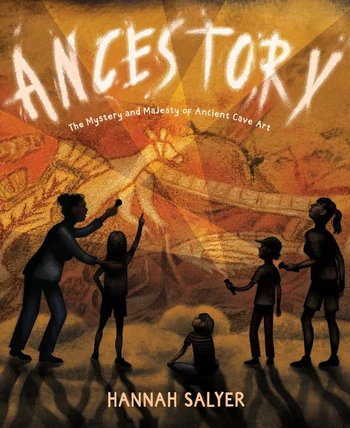
Ancestory: The Mystery and Majesty of Ancient Cave Art by Hannah Salyer

Published by Clarion Books

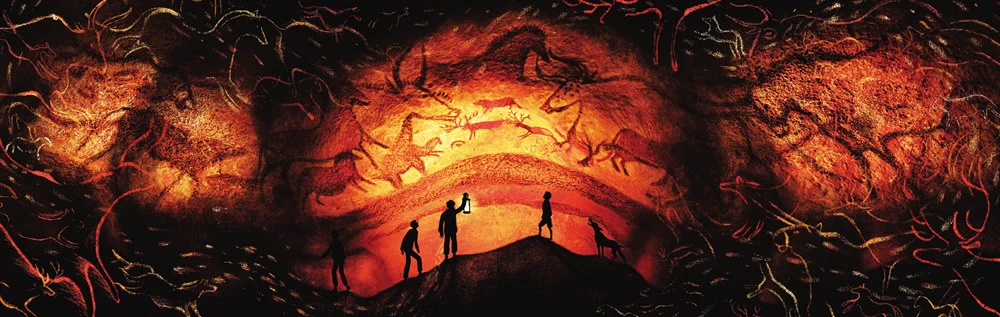
Summary:  All over the world, ancient rock paintings, drawings, and etchings have been discovered.  Who made them?  How did they create the artwork?  This book looks at the answers to some of those questions, showing some of the works and looking at the materials ancient people might have used to make them.  A gatefold spread shows an amazing cave painting illuminated only by the lamps of the people who are looking at it.  The art is part of our “ancestory”–the story of humanity that continues with our own lives.  Includes a site map showing where rock art can be found around the world; the story of the discovery of the Lascaux Caves; an author’s note; a glossary; a timeline; and resources for further investigation.  48 pages; grades 2-5.

Pros:  Budding archaeologists will find this book fascinating and will want to dive into the additional resources to learn more.  The illustrations are gorgeous, using light and dark to highlight the artwork.

Cons:  I was curious to know if the art shown in the illustrations was based on real art and, if so, I wish there had been some labels to tell where it could be found.

The Tree and the River by Aaron Becker

Published by Candlewick

Summary:  The first spread of this wordless picture book shows a young tree standing by the river of the title with the skeleton of a house being built nearby.  A boy and a girl are playing near the tree.  On the next page, the boy (presumably) is grown up with his son, and the house has turned into a farm, with a few other houses near it, and several kids playing around the tree.  As time goes on the small community becomes a town, then a city.  A wall is built, and a war is fought.  The river is diverted and filled with boats; trains and then cars are also used for transportation.  As time goes on, the tree grows, then turns brown and dies as the civilization dies out and falls to ruin.  Finally, an acorn falls from the tree’s one remaining live branch, floating down the river until it takes root on a piece of land by the water.  On the last page, two children stand underneath the new young tree.  32 pages; ages 4 and up.

Pros:  This wordless masterpiece explores the rise and fall of human civilizations with an incredible amount of detail.  I can’t wait to share it with kids to see all the details I’ve missed (this has happened to me with Aaron Becker’s wordless trilogy, Journey, Quest, and Return).  Definitely a Caldecott contender.

Cons:  It’s definitely heavier and grimmer than the Journey trilogy, but there is that spark of hope at the end.

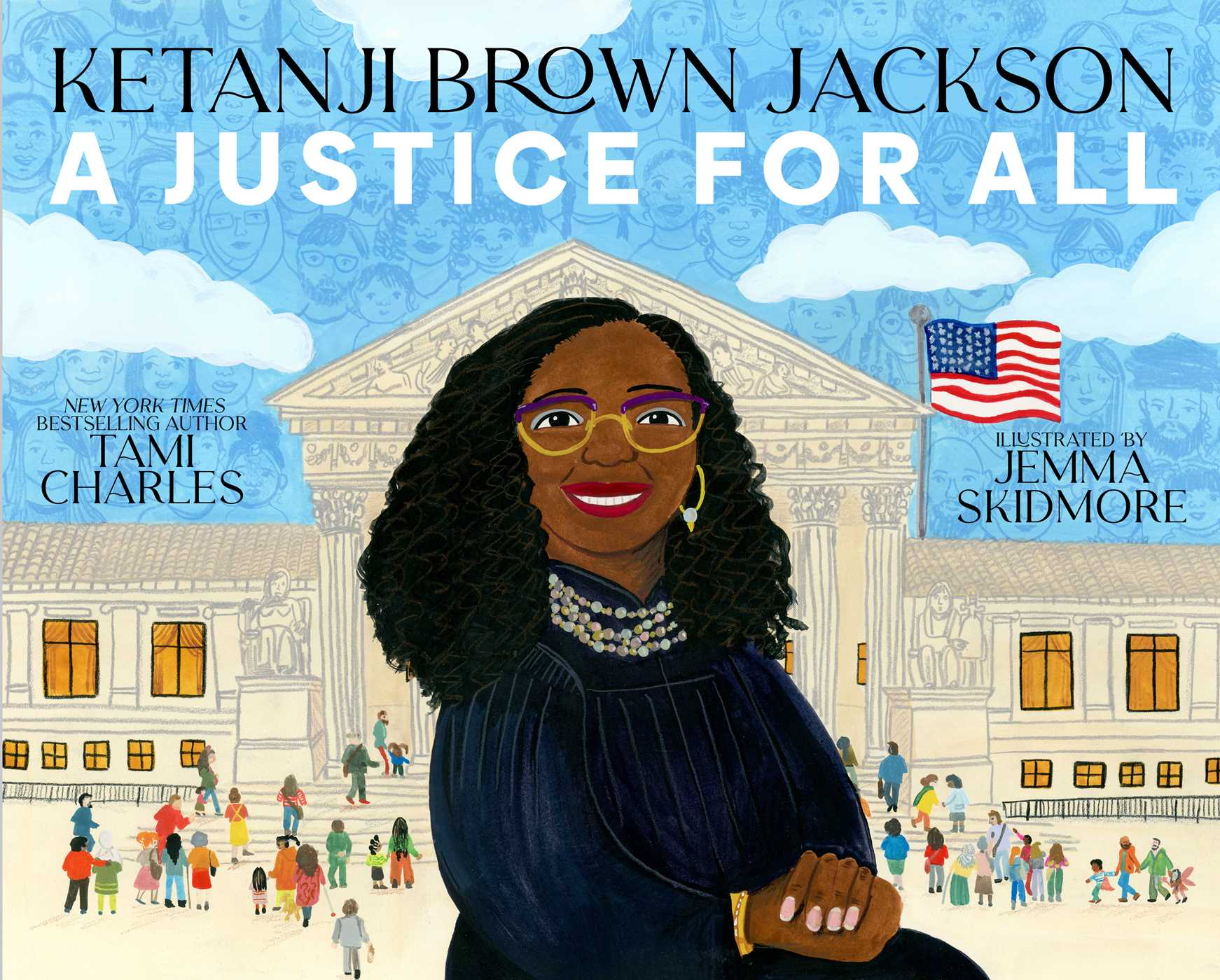
Ketanji Brown Jackson: Justice for All by Tami Charles, illustrated by Jemma Skidmore

Published by Simon and Schuster Books for Young Readers

Summary:  “Every dream begins with the smallest step.”  A young girl visits the Supreme Court Building with her mother, where they see statues of the 115 justices, only six of them women, and none of those women Black…until now.  The story of Ketanji Brown Jackson’s life is told, along with the story of the ancestors who lived in Africa, then were enslaved and forced to come to America.  There’s also the story of her parents, who attended segregated schools and became the first in their families to graduate from college.  Important civil rights cases and other Black female lawyers and judges that helped Ketanji get to the Supreme Court are woven into the narrative.  “And now,” says the girl, “because of them, because of her, I know one day I will and certainly can!”.  Includes an author’s note with additional information, a list of important dates, and facts about the important people and history shown in the art.  40 pages; grades K-5.

Pros:  Like All Rise by Carole Boston Weatherford, this picture book biography of Ketanji Brown Jackson shows not only her own hard work and determination to overcome racist and sexist obstacles, but also the people who came before her that made her rise possible.  The poetic text and illustrations convey big ideas but are presented in ways that make them easily understood by younger readers.

Cons:  While the author’s note mentions how she was inspired by a photo of Brown’s daughter Leila Jackson looking at her mother with loving pride, the photo is not in the book.

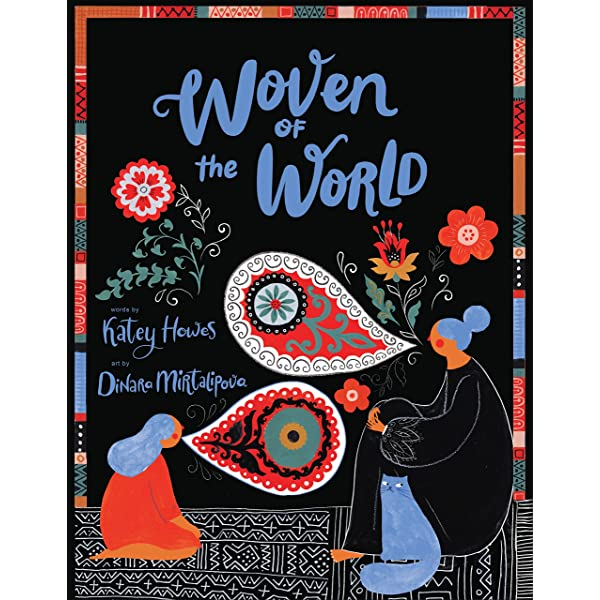
Woven of the World by Katey Howes, illustrated by Dinara Mirtalipova

Published by Chronicle Books

Summary:  As a child learns how to weave from a master, the two of them take a tour through history to look at how weaving has played a role in many past cultures.  From the “silken threads” of ancient China to the “backstrap loom tied to a tree” of nomadic tribes to the “trail of yarn” of immigrants moving to new countries, there are weaving traditions from all around the world.  The final page uses a weaving metaphor for life, with patterns unfolding as the work is done.  Includes additional information on weaving tools and the various cultures described, as well as notes from the author and illustrator.  44 pages; grades K-5.

Pros:  Anyone with even a passing interest in weaving will appreciate the excellent rhyming text and beautiful patterned illustrations, as well as the history lessons from both the main story and the back matter showing how weaving has been a part of so many people and places in history.

Cons:  I had a little trouble figuring out which description in the back matter went with which pages in the main text.

My Powerful Hair by Carole Lindstrom, illustrated by Steph Littlebird

Published by Harry N. Abrams

Summary:  The narrator can’t wait to grow her hair out, believing, as her ancestors did, that hair is a source of strength and memories.  Her mother has always had short hair, having been forced to have it cut at an Indian school and always being told that it was too wild to wear long.  As the girl grows up, she marks important days by how long her hair is and weaves the memory of each day into her hair.  When her grandfather dies, she cuts her hair and sends it with him into the spirit world.  Her mother decides to join her when she begins the journey of growing her hair long again.  Includes an author’s note about indigenous people’s beliefs about hair and her own family’s experience with Indian boarding schools where children were forced to have their hair cut.  48 pages; ages 4-8.

Pros:  A fascinating story that brings to light an aspect of Native American culture that may not be familiar to many readers, and also shows, yet again, the disastrous impact of boarding schools on that culture.  The narrator’s decision to undo the trauma of several generations is inspiring.  I loved the illustrations, which look like they have been painted on wood with brilliant, vibrant colors.

Cons:  I didn’t fully understand the mother’s decision to keep her hair short until I read the author’s note at the end.

How to Write a Poem by Kwame Alexander and Deanna Nikaido, illustrated by Melissa Sweet

Published by Quill Tree Books

Summary:  As they did with How to Write a Book, Melissa Sweet and Kwame Alexander (this time with Deanna Nikaido) dive into the world of poetry.  “Begin with a question/like an acorn waiting for spring,” then close your eyes, use your imagination, listen, explore what you are feeling, find a word or two.  “Now, show us what you’ve found.”  The text begins with a quote from Nikki Giovanni, “We are all either wheels or connectors.  Whichever we are, we must find truth and balance, which is a bicycle.”  The illustrations build on this, with circles, spheres, and bicycles throughout.  32 pages; grades K-5.

Pros:  A gorgeous introduction to poetry with spare but evocative language and riotously fun collage illustrations that spark the imagination.

Cons:  Like How to Write a Book, this strikes me as a book that will appeal more to adults than children.

My Baba’s Garden by Jordan Scott, illustrated by Sydney Smith

Published by Neal Porter Books

Summary:  The author’s note at the beginning tells of his Baba, a Polish survivor of World War II, who settled in a renovated chicken coop in Canada with her husband.  Jordan Scott didn’t know his grandfather, but visited his grandmother every day, forming a bond that transcended their different languages through food, gardening, and collecting worms to enrich the soil.  The story is a memoir of their times together, continuing until the chicken coop is torn down and Baba comes to live with the family.  Although she can’t get out and work in the garden anymore, the boy continues to spend time with her each morning, planting tomatoes on her windowsill, and showing her the worms he finds as she watches from her window.  32 pages; ages 4-8.

Pros:  The team that brought you I Talk Like a River has created another beautiful family story, understated in its narration, but perfectly conveying the love between a child and his grandmother.  

Cons:  My hopes for Sydney Smith to win a Caldecott were dashed when I read on the back flap of the book jacket that he lives in Canada.

Homeland: My Father Dreams of Palestine by Hannah Moushabeck, illustrated by Reem Madooh

Published by Chronicle Books

Summary:  A girl and her two siblings love their father’s bedtime stories, especially those about their homeland, a place the kids have never seen.  Their father tells about visiting his grandparents in the Old City of Jerusalem, with the sights, sounds, smells, and tastes of a bustling city with a rich history.  The story ends with his grandfather releasing hundreds of homing pigeons.  “Won’t they fly away?” asks the boy, to which the grandfather replies, “This is their home.”  It’s the last time their father sees his grandfather, and he shows his kids the rusty key to the family’s home.  The children fall asleep and dream of their homeland.  Includes a glossary of Arabic words and an author’s note (with photos) about the history of Palestine, which is her own homeland.  40 pages; grades K-3.

Pros:  The story and folk art-style illustrations bring to life the family’s homeland in Palestine and beautifully convey the sadness and longing they have to return there.

Cons:  Readers unfamiliar with the history of this region will need some additional information to understand what’s going on.

The Story of the Saxophone by Lesa Cline-Ransome, illustrated by James E. Ransome

Published by Holiday House

Summary:  Although the saxophone is known for its role in American jazz music, its story starts in 19th-century Belgium with a young man named Joseph-Antoine Adelphe Sax.  The son of an instrument maker, Adolphe was curious and inventive.  He loved creating new instruments and decided that symphonies and marching bands needed one whose volume was between a clarinet and a trumpet.  The result, the saxophone, was mostly met with disdain or even downright hatred until the French composer Hector Berlioz fell in love with it.  Soon, the saxophone was sweeping through regimental bands all over Europe.  When France went to war with Mexico in 1861, a member of the Mexican Cavalry Band got his hands on a saxophone and eventually brought it to New Orleans, where jazz musicians embraced it and continue to do so today.  Includes portraits of jazz saxophonists on the endpapers.  40 pages; grades 1-5.

Pros:  This would make an excellent addition to a music library, and budding saxophonists will find the history of their instrument inspiring.  James Ransome’s illustrations bring the various characters and time periods to life.

Cons:  I was looking forward to additional information about Sax and his instrument, with maybe a timeline and additional resources, but there were none of those things.