Caves by Nell Cross Beckerman, illustrated by Kalen Chock

Published by Orchard Books
Summary:  Addressing the reader in the second person (“You want to go in…do you dare?”), the book introduces different features of caves, then shows unusual examples of each one in seven caves around the world.  There’s the Cueva de Los Cristales in Mexico, filled with 39-foot crystals that had to be pumped dry for people to explore. And the Bracken Cave in Texas, summer home to twenty million bats.  The realistic illustrations convey the magnitude of the caves, often showing how small the human explorers are in comparison.  Includes notes from the author and illustrator, lists of cave rules and spelunking equipment, and more fun facts about three of the caves.  40 pages; grades 1-4.

Pros:  The poetic text and gorgeous illustrations combine to make a nonfiction book that invites readers on an adventure, in the spirit of Candace Fleming’s Giant Squid or Jason Chin’s Grand Canyon.  I’d love to see this get some Siebert Award recognition.

Cons:  I wish that there were more fun facts about all of the caves mentioned in the book, not just three.

The Tower of Life: How Yaffa Eliach Rebuilt Her Town in Stories and Photographs by Chana Stiefel, illustrated by Susan Gal

Published by Scholastic Press

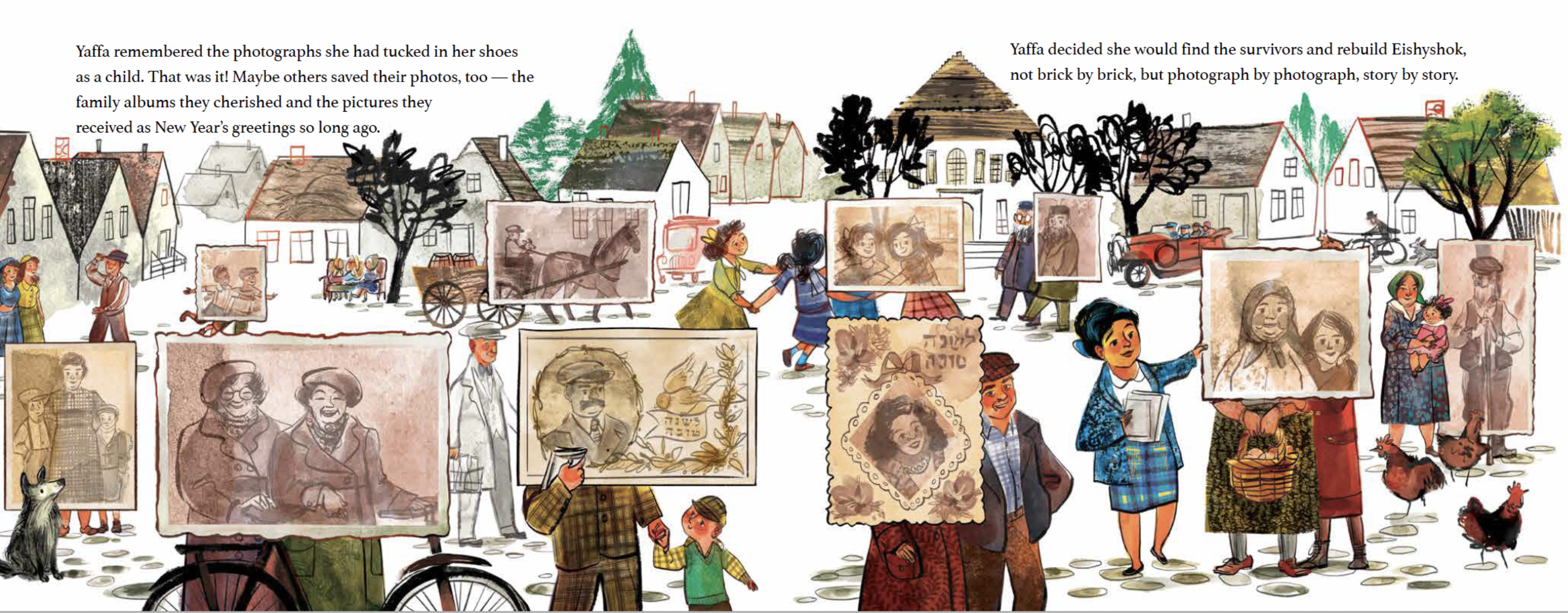
Summary:  Yaffa Eliach had a happy childhood in the Jewish town (shtetl) of Eishyshok, playing with her friends and older brother and helping her grandmother in her photography studio.  But when Yaffa was six years old, German tanks rolled in and the village, along with most of its inhabitants, was destroyed.  Yaffa’s family managed to flee and lived in hiding for the next several years.  They left their possessions behind except for a few photographs Yaffa hid in her shoe.  After the war, Yaffa moved first to Israel, and then to the United States, where she became a history professor specializing in the Holocaust.  When the Holocaust Museum was built in Washington, DC, President Jimmy Carter asked Yaffa to create an exhibit to show the lives of people who were lost.  Yaffa searched all over the world for photographs of people who had lived in Eishyshok.  Over the course of 17 years, she traveled to six continents to collect over 1,000 photos that were turned into the “Tower of Life” exhibit at the Holocaust Museum.  Includes a timeline of Yaffa’s life, a bibliography, and a brief author’s note.  40 pages; grades 1-4.

Pros:  An inspiring story of an amazing woman who emerged from tragedy to create a beautiful tribute that celebrates the lives of those who died in the Holocaust.  The illustrations capture those lives as well, incorporating photos into the paintings.

Cons:  I would have liked more information about Yaffa in the back matter.

Going Places: Victor Hugo Green and His Glorious Book by Tonya Bolden, illustrated by Eric Velasquez

Published by Quill Tree Books

Summary:  Victor Hugo Green had a successful career as a mail carrier in Leonia, New Jersey, but he also liked to travel.  In the 1930’s, more people were buying cars and using them to visit new places.  Black travelers were less hassled in their cars than on trains, but they also faced Jim Crow laws that prevented them from using certain hotels, restaurants, and other establishments, and sundown laws that prohibited them from being in certain towns after dark.  Green used newspaper ads and articles and the knowledge of friends and co-workers to put together a directory of places that were safe to go.  Known as the Green Book, it started as a pamphlet in 1936, covering the New York City area, but continued to grow to cover the entire U.S. as well as Mexico and Canada.  In 1953, Victor Hugo Green retired from his postal career to spend his time running a travel agency and keeping up with the Green Book.  He died in 1960, a few years before the Civil Rights Act of 1964 made much of the Green Book obsolete.  Includes a timeline, selected sources, and a list of places to learn more about the Green Book.  40 pages; grades 2-5.

Pros:  This fascinating look at the man behind the Green Book weaves in plenty of details about the ways racism affected Black travelers for much of the twentieth century.  The vivid oil paintings bring traveling to life with their colorful postcards, reproductions of black-and-white photos, and maps.  Worthy of a consideration for a Coretta Scott King award or honor.

Cons:  While I was hoping to see a page from the actual Green Book, the illustrations offer only tantalizing glimpses.  Guess I will have to peruse the digital editions listed in the back matter.

Bessie the Motorcycle Queen by Charles R. Smith, Jr., illustrated by Charlot Kristensen

Published by Orchard Books

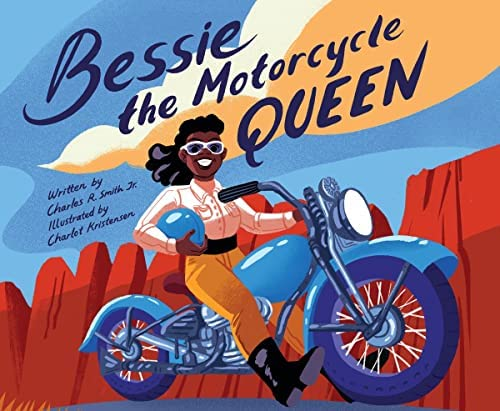
Summary:  A daredevil motorcycle rider named Bessie takes the challenge to ride the Wall of Death, fearlessly showing off with no hands and riding sidesaddle.  When she takes off her helmet, the audience is surprised by her “hidden brown face.”  The year is 1929, and a Black woman riding her motorcycle alone across the country faces potentially dangerous situations, especially in the Jim Crow south, where she outruns a truck full of angry KKK members.  But Bessie is undeterred, choosing her destinations by flipping a penny onto a US map, repairing her bike herself, and sleeping on it when she can’t get a room.  The word VROOM is repeated throughout the story as Bessie zooms off to her next location.  Includes additional information about Bessie Stringfield and a bibliography.  40 pages; grades 1-4.

Pros:  The bouncy rhyming text and beautiful illustrations tell an inspiring story about this little-known woman. Although kids may need some explanations about Jim Crow laws and the KKK, this would be a good Black history read-aloud for primary grades.

Cons:  Unfortunately, not much is known about Bessie, so facts about her life like her birthdate and hometown are uncertain.


Playtime for Restless Rascals by Nikki Grimes, illustrated by Elizabeth Zunon

Published by Sourcebooks Jabberwocky

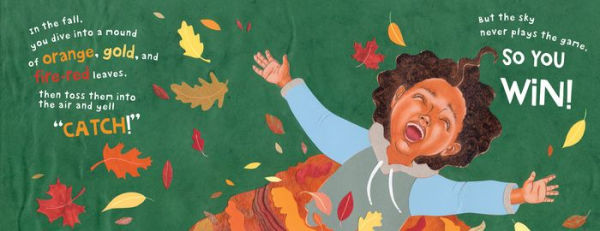
Summary:  In this follow up to Bedtime for Sweet Creatures, a mother wakes her child up by saying it’s time to get to work…which, for the child, is play.  There is playtime indoors and out, with different types of outdoor play depending on the season and the weather.  Afternoon brings imaginary play: tea parties, trains, trucks, and cars.  By late afternoon, Mom is ready for a nap, and the two snuggle briefly on the couch, but when Daddy comes home, it’s back to the business of play.  Finally, the parents sit together, watching their child: “Your job is called play, and your daddy and I both know, you’re an expert.”  32 pages; ages 4-8.

Pros:  A celebration of all types of play, empowering children to use their imaginations.  The collage illustrations add plenty of color, texture, and interest.

Cons:  It would have been nice to see some other kids join in the fun.

Standing in the Need of Prayer: A Modern Retelling of the Classic Spiritual by Carole Boston Weatherford, illustrated by Frank Morrison

Published by Crown Books for Young Readers

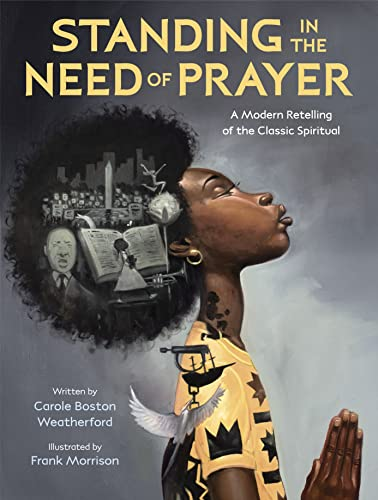
Summary:  Carole Boston Weatherford has created new words based on the traditional spiritual to trace the history of Black people in America.  Beginning with slavery, the verses and illustrations continue through Emancipation, the Great Migration, and the fights for integration.  The last few pages reflect the recent past and present: Florence Griffith Joyner, Colin, Kaepernick, and the Black Lives Matter Movement.  Includes additional information on each of the subjects, a list of online resources, and an author’s note.  32 pages; grades 1-5.

Pros:  Another beautiful resource for teaching Black history, with gorgeous thought-provoking oil illustrations.  The text, including the back matter, could serve as an excellent introduction to a variety of topics; readers can use the excellent list of online resources for further research.

Cons:  I wasn’t familiar with this spiritual and would have liked to have had the traditional words included somewhere.

Cornbread & Poppy by Matthew Cordell

Published by Little, Brown Books for Young Readers

Summary:  Cornbread is a mouse who likes to plan ahead, particularly when winter is coming.  His friend Poppy, on the other hand, prefers to live in the moment, having fun adventures, and not worrying about the future.  So when it starts to get cold, Cornbread is in good shape, but Poppy is not.  All the usual sources of food have already been foraged, so Poppy decides to go up Holler Mountain, a foreboding place rumored to have owls that hunt mice.  In fact, their friend Ms. Ruthie went up the mountain a few years back and was never seen again.  Cornbread is too good a friend to let Poppy go alone, so the two head off on their adventure together.  Without spoiling the ending too much, there is an owl, Ms. Ruthie is okay, Poppy ends up with plenty of food for the winter, and the two discover skiing…which Cornbread loves so much, he decides to ski instead of shoveling his walkway.  80 pages; grades K-2.

Pros:  Caldecott medalist Matthew Cordell proves himself an excellent writer in this beginning chapter book that has an engaging plot, adorable illustrations, and some pretty cozy winter scenes.  Book 2 came out in June; let’s hope there will be more.

Cons:  Seems as though Cornbread is picking up some bad habits from his friend.

Like by Annie Barrows, illustrated by Leo Espinosa

Published by Chronicle Books

Summary:  We’re humans.  We’re different from most other things like tin cans, swimming pools, and excavators.  We’re a bit more like mushrooms, and even more like hyenas, but there are still plenty of differences.  For instance, hyenas don’t remember their birthdays, can’t plan a get-together, and might try to eat your baby brother if they come to your house.  Humans, on the other hand, remember their birthdays, wear clothing (usually), and get embarrassed (as well as feeling other emotions).  We may look different, but there is a lot more that is the same about us.  44 pages; ages 4-8.

Pros:  This quirky and thought-provoking book could serve as a good starting place to compare and contrast humans with all sorts of things…or with each other.  I love the illustrations by Leo Espinosa, who is quickly becoming one of my favorites.

Cons:  It takes a few pages to figure out where this book is going.

Giving Thanks: How Thanksgiving Became a National Holiday by Denise Kiernan, illustrated by Jamey Christoph

Published by Philomel Books

Summary:  Starting with a few thoughts about gratitude and how it’s expressed around the world, the book moves to the history of American Thanksgiving, with Sarah Josepha Hale’s campaign to create a national Thanksgiving holiday.  Abraham Lincoln finally agreed, declaring the holiday for November 26, 1863.  It was challenging to find much to be grateful for in the midst of the Civil War, but people celebrated and have continued to up to the present.  Turkey dinners, marching bands, and soup kitchens are all depicted as ways Thanksgiving is observed, and readers are asked to cite their own favorite parts of Thanksgiving.  Includes additional resources.  32 pages; ages 4-8.

Pros:  An excellent resource for those revisiting the history of Thanksgiving, as no mention is made of the Pilgrims or the Wampanoag.  It’s a good update to Thank You Sarah: The Woman Who Saved Thanksgiving by Laurie Halse Anderson (2002).  The excellent illustrations will serve as a good springboard for discussing kids’ heritages and traditions.

Cons:  It felt like the book tried to cover a lot of ground, making it feel a bit disjointed at times.

Maya’s Song by Renée Watson, illustrated by Bryan Collier

Published by HarperCollins

Summary:  Maya Angelou’s story is told in a collection of free verse poems, illustrated with watercolor and collage illustrations.  The story begins with her birth in 1928 and continues through her childhood spent in California, Arkansas, and Missouri, where “her mother’s boyfriend hurt her body, hurt her soul,” leading Maya to stop speaking for five years.  Her love of poetry helped her to recover her voice, and she went on to become a singer and then a poet, befriending James Baldwin, Martin Luther King, Jr., and Malcolm X.  Her memoir I Know Why the Caged Bird Sings brought her to national prominence; the story ends with her reading a poem at Bill Clinton’s presidential inauguration, fulfilling her grandmother’s prophecy that she would be a preacher and a teacher.  Includes a timeline and notes from the author and illustrator.  48 pages; grades 2-6.

Pros:  This amazing poetry biography is sure to be considered for multiple awards for both the writing and the illustrations.  I was immediately drawn into Maya Angelou’s story; Renée Watson is a masterful poet who tells the most difficult aspects of that story in a way that can be shared with young children.  The illustrations are gorgeous, layered with colors and patterns.

Cons:  No additional resources are given.