I Want to Be a Vase by Julio Torres, illustrated by Julian Glander

Published by Atheneum Books for Young Readers

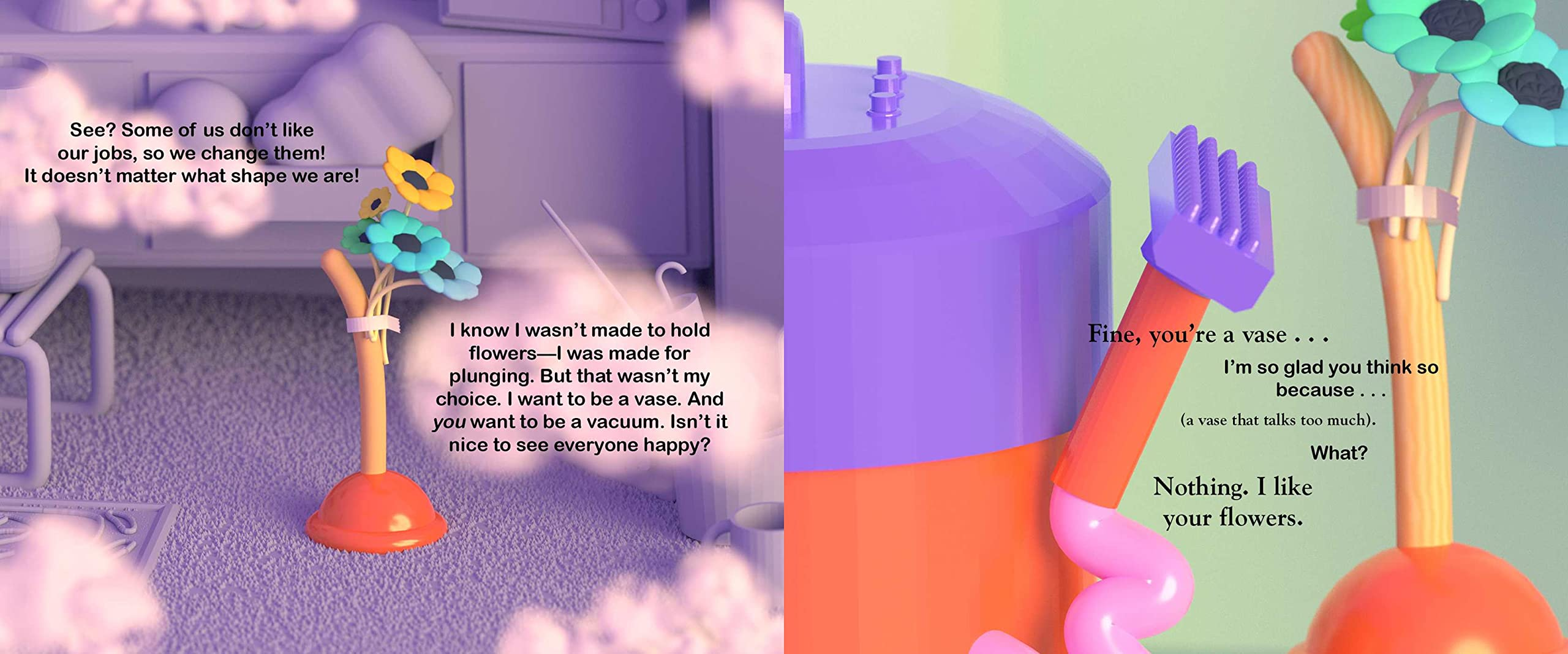
Summary:  A cityscape of skyscrapers is shown, each with many square windows.  The illustrations zoom in on the one round window, eventually entering the apartment where “I have something to say.”  It’s the toilet plunger.  “I want to be a vase.”  The bathtub, toilet, and sink argue back that it’s impossible, but the plunger is determined.  It heads down the hall to the kitchen, where it rubber bands a bunch of flowers around its handle, and voila, it’s a vase!  The vacuum is horrified, but the pot is inspired to become a trash can.  The trash can, it turns out, wants to be a couch cushion.  Before long, everyone’s switching up identities.  When the hair dryer announces it wants to be a vacuum, the vacuum is horrified but comes around when it sees how much faster it can get its work done.  Even the book itself gets in on the act, asking readers on the last page if it can be a hat.  48 pages; ages 4-10.

Pros: This book is definitely original, both in the story and the art, created by a former Saturday Night Live writer and a Disney/Nickelodeon/Cartoon Network animator.  Kids will love the humor and the illustrations, and it’s impossible to miss the “be who you are” message.

Cons:  I have enough trouble with kids balancing library books on their heads without the books themselves inviting readers to wear them like hats.

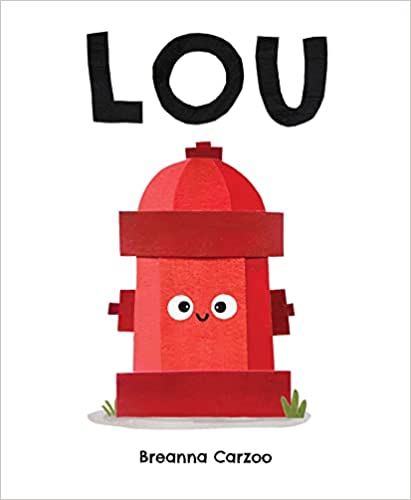
Lou by Breanna Carzoo

Published by HarperCollins

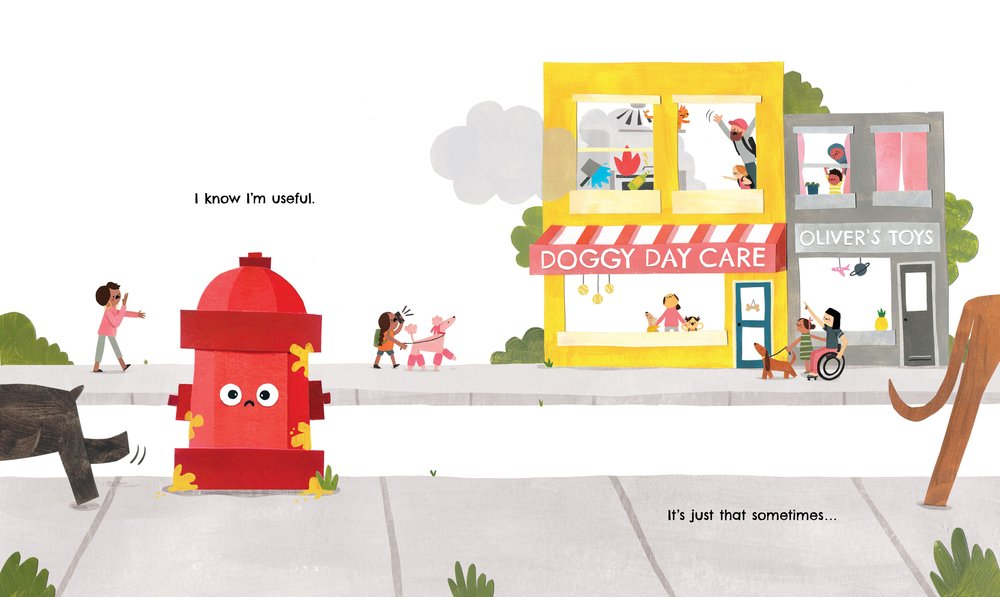
Summary:  “Hello!  My name is Lou, and I’m…a toilet.”  All day every day, dogs sniff, twist, twirl, lift, and then, “well, you know,” as a splashy yellow puddle is shown.  Sure, it’s useful, but sometimes Lou wonders if there’s more to life.  As Lou reflects on this, readers can see underground plumbing, a big red fire truck racing down the street, and gray smoke billowing out of a building.  When the firefighters’ dalmatian runs up, Lou’s sure about what’s next, but then there’s a surprise!  There’s a different kind of twist, twirl, and lift, and Lou discovers a new purpose as the firefighters use Lou’s water to put out the fire.  “How did I not see this before?  My name is Lou, and I’m…a superhero!”  32 pages; ages 3-8.

Pros:  Kids will be drawn in by the bathroom humor, but they’ll come away with a good lesson about finding one’s true calling and the joy of helping others.  The humor, adorable illustrations, and story are sure to make this a big hit with readers.

Cons:  I still don’t understand exactly how fire hydrants work.

More Than Peach: Changing the World…One Crayon at a Time by Bellen Woodard, illustrated by Fanny Liem

Published by Scholastic

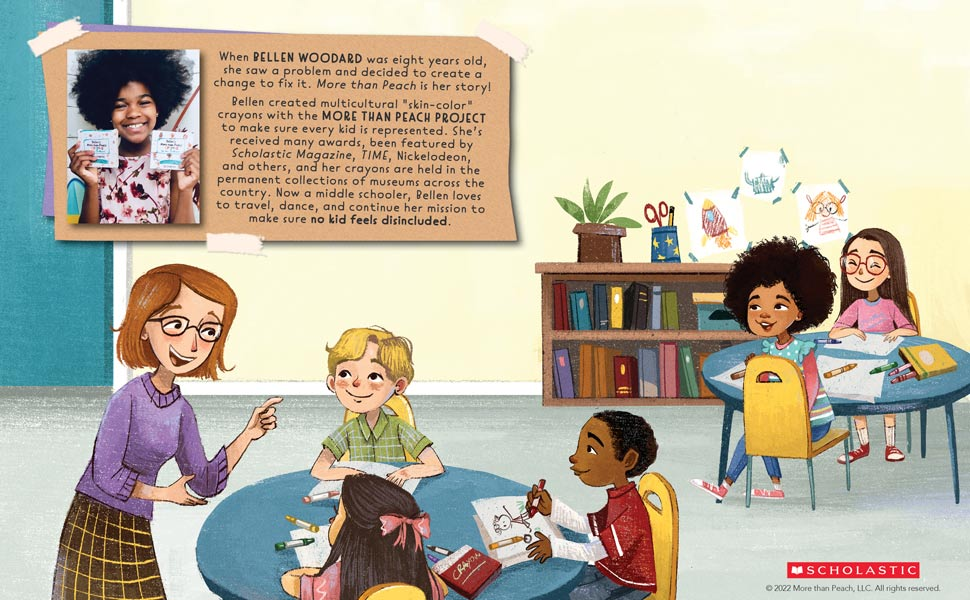
Summary:  When Bellen Woodard noticed that her classmates were using the term “skin-colored” when asking for a peach crayon, she felt confused.  Her mom suggested she hand them the brown crayon instead, but that didn’t feel right either.  She decided to ask them what color they wanted because skin “can be any number of beautiful colors”.  Her friends appreciated the reminder, so she kept going, changing the language in her classroom, her school, and, eventually, the larger world.  The last five pages tell the history of Bellen’s More than Peach Project and give kids steps for creating their own campaigns.  40 pages; grades K-3.  

Pros:  This inspiring story tells how one young girl made a difference in her community and beyond and gives readers good advice, from one kid to another, about how they can become activists.

Cons:  I liked the part of the back matter written in Bellen’s voice, but the page giving her history read like it was written by a proud parent.

What Is Math? by Rebecca Kai Dotlich, illustrated by Sachiko Yoshikawa

Published by Christy Ottaviano Books

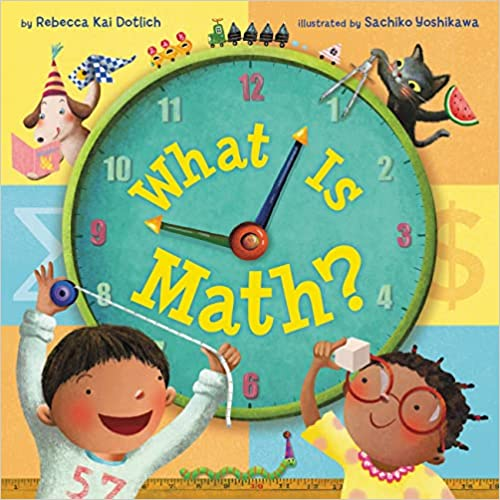
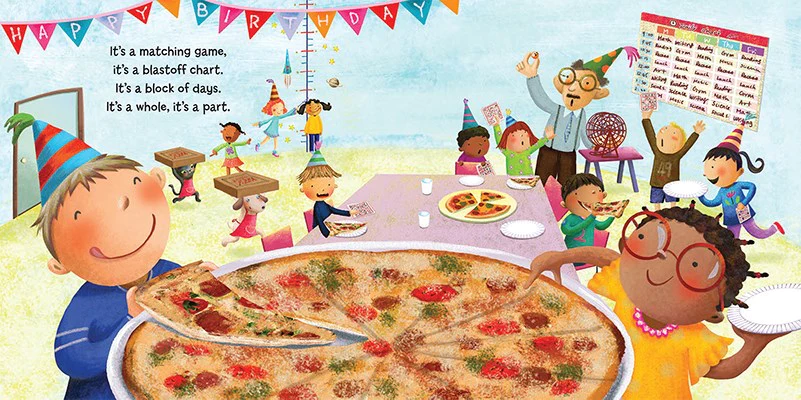
Summary:  Rhyming text and lively illustrations show the many ways that math is used in everyday life from cooking to making change to building a house.  Many mathematical concepts are introduced including counting, measuring, comparing, geometry, money, and patterns.  The illustrations show lots of busy children using math in a variety of activities which may better answer the question of how math is used than what math is.  40 pages; ages 4-8.

Pros:  A spirited introduction to math for preschool and early elementary kids.  It would be fun to spend some time brainstorming about how math is used before reading this book.  There are not enough math picture books in the world, and this is a good addition to that limited collection.

Cons:  I wanted to weep when I reached the last page and discovered there was no back matter.

Berry Song by Michaela Goade

Published by Little, Brown Books for Young Readers

Summary:  A girl learns from her grandmother how to find food in nature: herring eggs and seaweed from the ocean and most of all, berries from the forest.  They list them as they go: blueberry, cranberry, soapberry, cloudberry. They sing and give thanks–gunalchéesh in the Tlingit language–to the Earth for providing food.  Back at home, the whole family pitches in to make a feast from the berries: huckleberry pie, strawberry crisp, jellies, and jams.  Seasons come and go, and on the last page the girl is leading her younger sister to the forest to teach her about gathering berries.  Includes a two-page author’s note about her Tlingit heritage and giving further information about each part of Grandmother’s wisdom: we speak to the land and the land speaks to us; we take care of the land and the land takes care of us; we are part of the land the and the land is part of us.  The berries are shown in photos with their Tlingit names and on the endpapers with both Tlingit and English identification.  40 pages; ages 4-8.

Pros:  Caldecott medalist Michaela Goade will surely be considered for more awards to honor this gorgeous book that celebrates her Tlingit heritage and stewardship of the Earth.

Cons:  After the mouthwatering descriptions of foods made from all the different berries, I would have enjoyed a recipe.

How Old Is Mr. Tortoise? by Dev Petty illustrated by Ruth Chan

Published by Harry N. Abrams

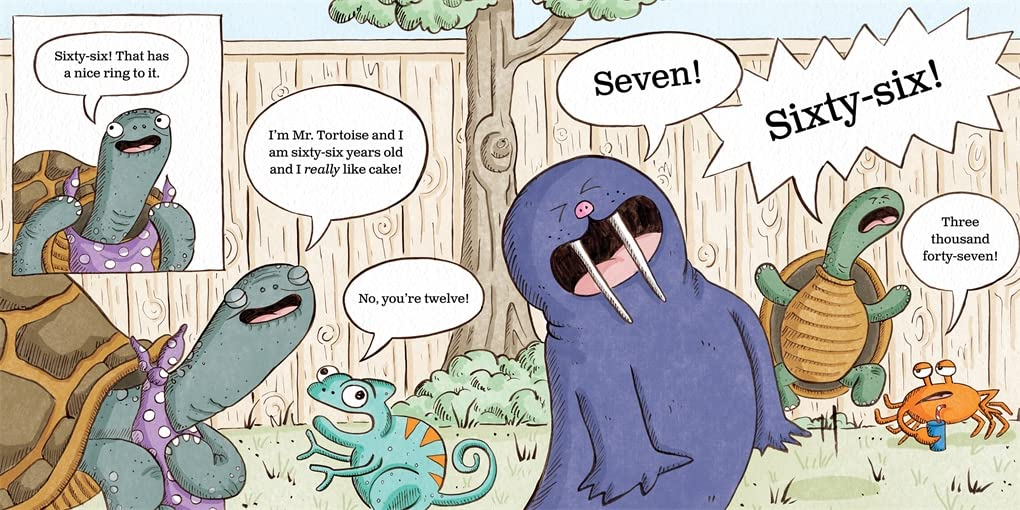
Summary:  Mr. Tortoise knows it’s his birthday, he knows he wants to eat cake with his friends, but he doesn’t know how old he is.  His friends try to help him calculate by counting sections of his shell, quizzing him about his early memories, and looking at a photo of him on a previous birthday.  They’re finally able to arrive at a number that seems accurate: 115.  It’s too many candles to put on the cake, so Mr. Tortoise decides to light one for every friend who’s there to help him celebrate.  He blows out the candles and makes a wish…for more cake.  40 pages; ages 3-8.

Pros:  This comic-inspired picture book is a happy celebration of birthdays, friendship, cake, and creative problem-solving.

Cons:  I’m not convinced that 115 is the Mr. Tortoise’s correct age.


Out of a Jar by Deborah Marcero

Published by G. P. Putnam’s Sons

Summary:  Llewelyn the rabbit, who first rose to prominence as a collector in In A Jar, has taken to stuffing his feelings into jars and storing them in his basement.  Any time he feels an unpleasant emotion like fear or anger, he bottles it up and locks it into a closet, “and that was that”.  Even more enjoyable feelings get tucked away, like the excitement he feels at school when he’s supposed to be listening.  Finally, the closet is full, and Llewelyn isn’t feeling much of anything.  When he tries to force one more jar in, all the jars tumble out and crack open, overwhelming Llewelyn in a mix of all the emotions.  Amidst all of the feelings, he’s surprised that what he mostly feels is relieved.  From then on, whenever Llewelyn has a feeling, “he mustered up the courage to feel them.  To share them.  And when he was ready, to look each feeling in the eye, give it a hug, and let it go.  And that…was that.”  40 pages; ages 4-8.

Pros:  This gorgeously illustrated book is an excellent tool for teaching kids how to deal with strong emotions.

Cons:  I couldn’t figure out why Llewelyn felt like he had to store away his feelings of joy.

Puppy Bus by Drew Brockington 

Published by Harry N. Abrams

Summary:  It’s the first day of school for a boy who’s just moved to a new town, and wouldn’t you know it, he ends up on the wrong bus.  This bus is heading to Leroy’s Puppy School, and is, naturally, filled with puppies.  The boy’s pretty unhappy at first: the subjects they learn are weird, lunch is terrible, and the bathroom is…unconventional.  But the puppies are friendly, there’s outdoor recess, and by the end of the day, the boy is ready to return.  He’s excited the next morning to board the bus…only to find out, it’s the Kitty Bus.  40 pages; ages 3-8.

Pros:  No need to look any further for a book to read on the first day of preschool, kindergarten, or first grade.  The humor and comic-style illustrations will have the whole class feeling right at home in no time.

Cons:  Is Old Yeller really the best choice for a class read-aloud at puppy school?

Happy Sloth Day! by April Pulley Sayre with Jeff Sayre

Published by Beach Lane Books

Summary:  Follow a sloth through its day in the rainforest as it eats, climbs, rests, and hides.  The photos mostly tell the story, along with a few short sentences.  Longer side bars on every other page add additional information.  The story ends with “the changing of the sloths” as the diurnal three-toed sloth falls asleep and the nocturnal two-toed sloth awakens.  Includes additional information about sloths and a list of four resources “for more leisurely chewing.”  48 pages; ages 4-10.

Pros:  April Pulley Sayre’s photos never disappoint, and these capture sloths doing all kinds of interesting things.  The short text and photos make this a good read-aloud for preschoolers, while the sidebars and back matter make it just as good a choice for older kids.

Cons:  A book about sloths is not a thrilling page-turner.

Tomatoes In My Lunchbox by Constantia Manoli, illustrated by Magdalena Mora

Published by Roaring Brook Press

Summary:  The narrator feels uncomfortable at school after moving from another country.  The teacher and other kids have trouble pronouncing her name, and the whole tomato in her lunchbox is different from what the other kids are eating.  She’s surrounded by girls with names like Emma, Olivia, and Chloe, but she can’t figure out how to make friends with them.  One day Chloe asks her where her name is from, and the girl tells her it was her grandmother’s name.  The next day, they learn that they both have the same favorite color, yellow.  When Chloe forgets her lunch, the narrator shares her tomato, and the friendship is sealed.  Includes an author’s note about her family’s move from Cyprus to England that was the inspiration for this story.  32 pages; ages 4-8.

Pros:  An immigrant story that will help readers build empathy for kids who are new at school, and whose name, language, and food may be unfamiliar to others.  Emphasizes the importance of friendship and reaching out.

Cons:  Those tomato stains seem like a nuisance.