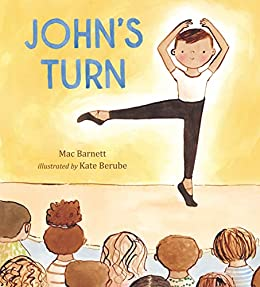
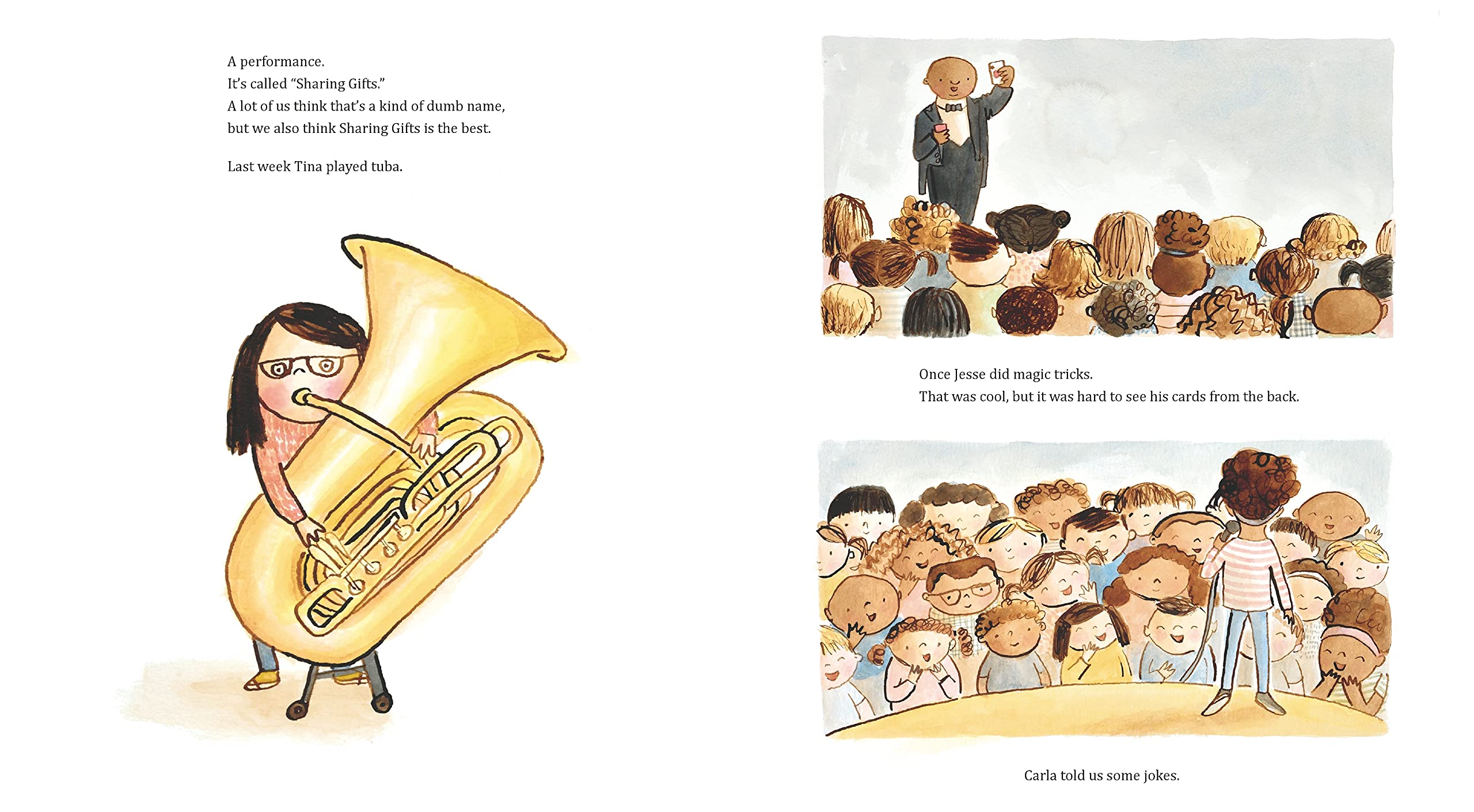
Summary: Every Friday there’s an assembly in the cafeteria: announcements, sometimes a guest, and then one student performs. It’s called “Sharing Gifts.” On this particular Friday, John is signed up to dance. He’s quiet at breakfast, and everyone knows why: he’s nervous. John changes into his ballet clothes during announcements. The music begins, the kids quiet down, and John starts dancing, tentatively at first but then with more confidence. He spins, leaps, and finishes with a bow. There’s a moment of silence, and then the whole school applauds wildly. 32 pages; ages 4-8.
Pros: This simple story really captures John’s courage and the joy he feels when his performance is done. It’s a perfect little slice-of-life tale of school, and the illustrations beautifully portray John’s dance moves.
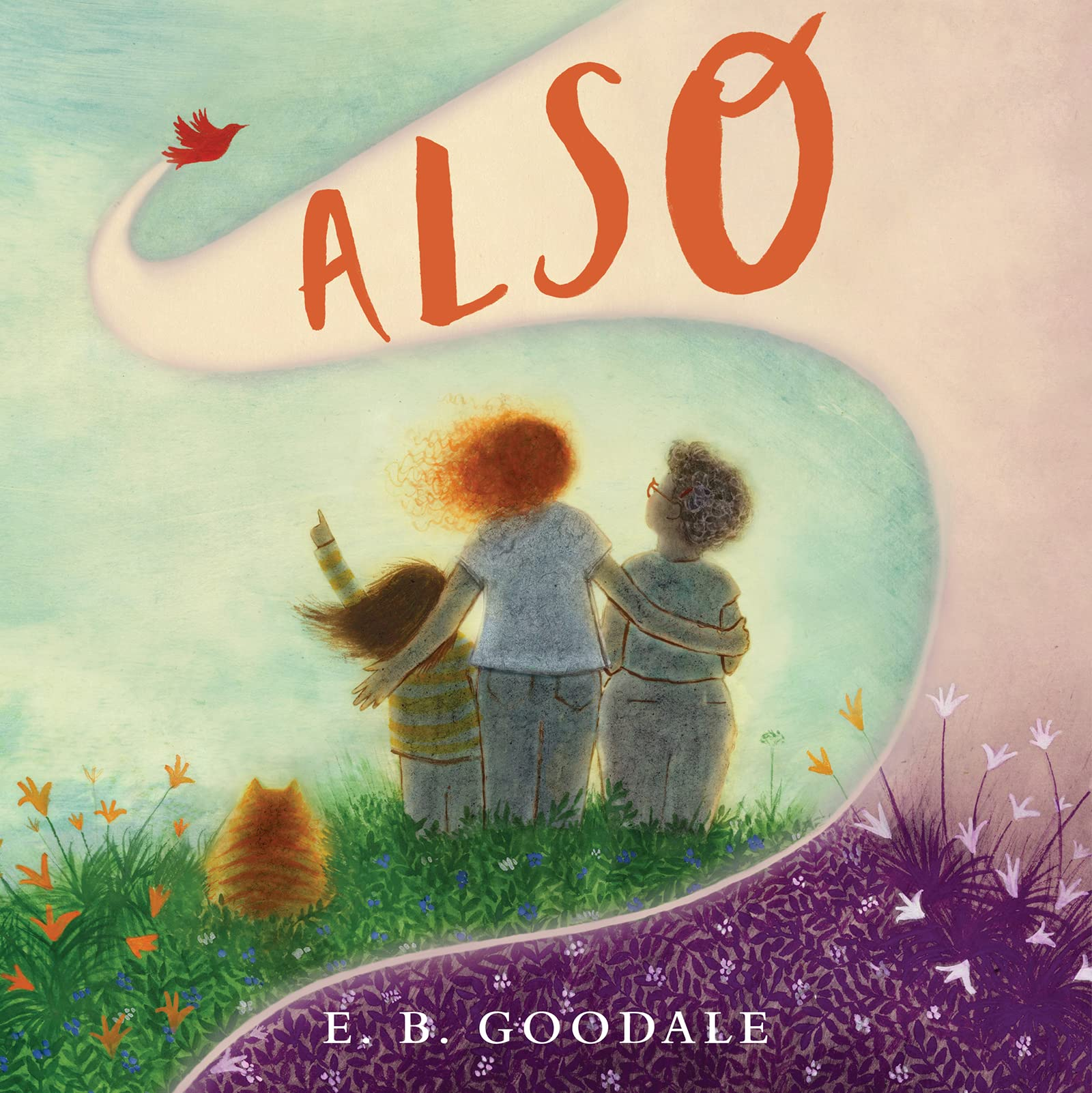
Summary: “Today, I am at my gramma’s house, high on the hill, amongst the blueberry bushes. And also…I am remembering camping with Mama.” The author tells and shows how she, her mother, and her grandmother are all remembering past days even while they are enjoying the present one. The past is shown with purple hues, while the illustrations of the present have a more colorful palette. The narrator concludes with a picture of her as an adult writing at her desk, while she remembers her childhood days. These illustrations have swaths of color going through the purple pictures of the past. Includes a recipe for blueberry ink. 32 pages; ages 4-8.
Pros: This meditation on the past and present would make a nice prompt for writing about a memory. The illustrations help distinguish the past from the present and the variation in the colors show how alive people and places can be in our memories.
Cons: The switch between past and present may be confusing to some kids.
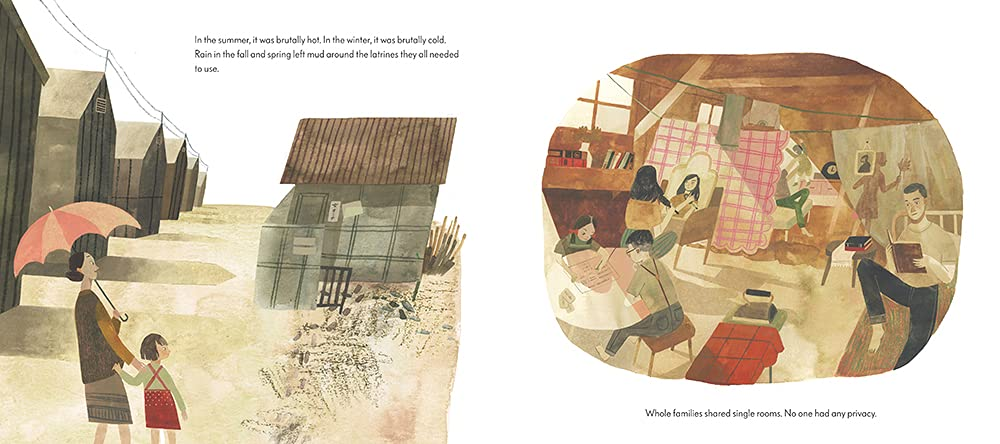
Summary: Tama and George have been at Minidoka, a prison camp for Japanese Americans, for a year. Tama works in the library, and George visits every day to check out a stack of books. The camp is dusty and hot in the summer, brutally cold in the winter, with monotonous days and no privacy for anyone. Tama tries not to think about her previous life, when she would have graduated from college, instead immersing herself in the world of books at the library. When she sighs over a book, George asks her what’s wrong. Tama tries to put into words all that she’s feeling, and George assures her that she’s human to feel that way. Tama realizes that George isn’t coming to the library just to check out a stack of books. The two of them get married and have their first child in camp, and Tama sums up her experiences in her journal: “The miracle is in us. As long as we believe in change, in beauty, in hope.” Includes an author’s note about her grandparents, George and Tama (with a photo), and with additional information about the 120,000 Japanese Americans who were incarcerated during World War II. 40 pages; grades 2-6.
Pros: This moving story does not hesitate from looking at the bleak conditions of Minidoka nor the racism that brought George, Tama, and so many others to live there, but also focuses on the hope and beauty of their story.
Cons: Early elementary kids may not relate to the romance of this story.
Summary: Clara Barton’s role in the battle of Antietam is documented in her own words, poems written by the author, and realistic illustrations of battlefront scenes. She nurses men (including one who is shot as she is giving him water), helps doctors, and cooks gruel from Indian meal she unexpectedly finds used as packing material. At the end of the ordeal, she’s put on a makeshift bed in the back of a wagon and driven 80 miles back to Washington, where she collapses from exhaustion and typhoid fever. Includes several pages of additional biographical information about Clara Barton, a bibliography, and a list of places to visit. 40 pages; grades 2-5.
Pros: The narrative and illustrations combine to portray the horrors of war, as well as the tirelessness that Clara Barton brought to the battlefield. The extensive back matter will help researchers understand more about Barton’s life.
Cons: Kids will need some prior knowledge of the Civil War and Clara Barton’s life to understand what is going on.
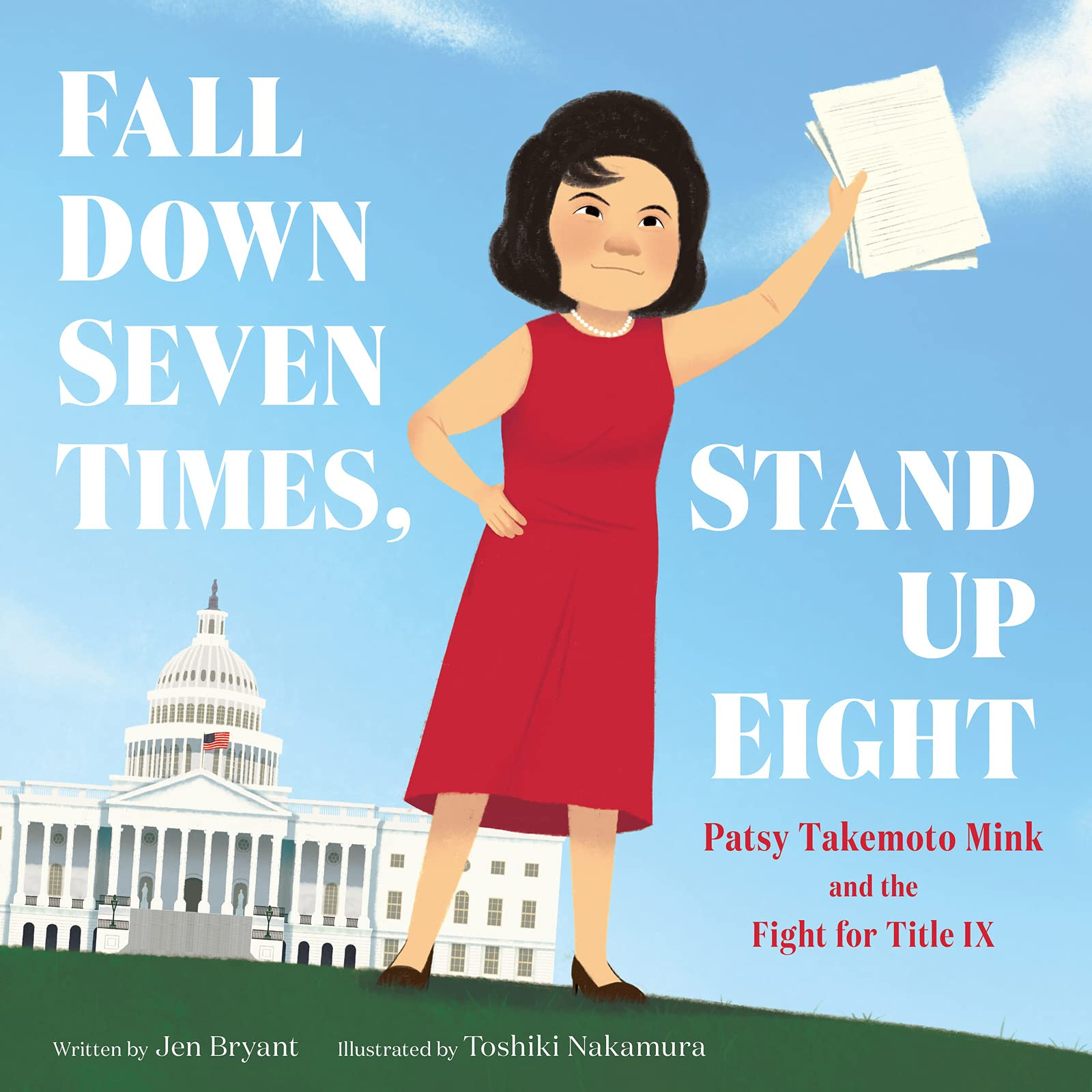
Summary: Growing up in Hawaii, Patsy Takemoto learned about her family’s Japanese heritage, including the expression “fall down seven times, stand up eight” that meant persisting in the face of adversity. Patsy faced adversity over and over again, being rejected from medical schools despite excellent grades, struggling to get a job as a lawyer after graduating from the University of Chicago law school, and being defeated in a bid for Congress. On her second try, though, she won, and in 1965, Patsy Takemoto Mink became the first woman of color in the U.S. Congress. Her personal experiences of discrimination, as well as letters she got from women all over the country, led her to fight for civil rights. She cosponsored Title IX, a bill requiring schools to treat men and women equally. It passed, but another bill was introduced that would have made sports exempt from the ruling. After a fierce fight, that bill was defeated, and Title IX became the law. Includes an author’s note, timeline, and bibliography. 48 pages; grades 1-5.
Pros: This excellent biography tells the story of a woman who may not be known to many but who helped bring about changes that have had a positive impact on girls and women all over the country.
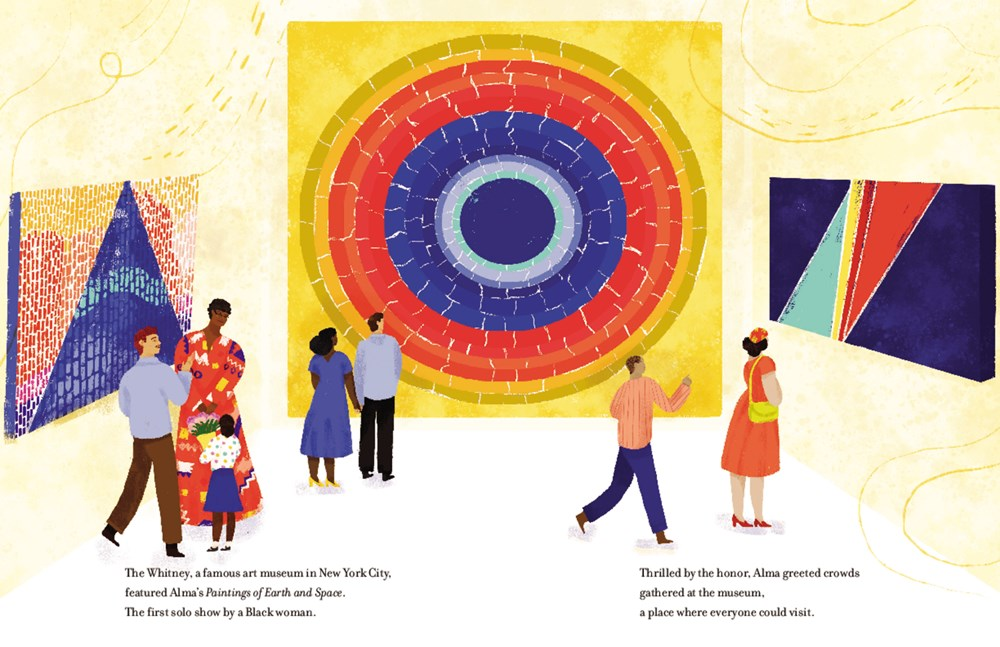
Summary: As a child in Georgia, Alma Thomas loved observing the bright colors around her and making things with her hands. She and her three younger sisters weren’t allowed to go to the white school or library, so their parents filled their house with books and teachers. When Alma was 15, her family moved to Washington, D.C. to give their daughters more opportunities, and Alma graduated from high school and college, where she studied art. She taught for many years before retiring at age 69 and pursuing her own art. Using the bright colors she had loved as a child, she created paintings inspired by nature and by space travel. Alma was the first Black woman to have a solo show at the Whitney Museum in New York. Years after her death in 1978, Barack and Michelle Obama chose one of Alma Thomas’s paintings to hang in the White House, the first artwork there by a Black woman. Includes notes from the author and illustrator, photos, a timeline of events in Alma’s life and the United States during her lifetime, and a list of sources. 40 pages; grades K-4.
Pros: I had never heard of Alma Thomas, but I loved her story and the illustrations inspired by her art. While the intended audience may not appreciate the fact that Alma’s art career took off after she turned 70, I found that inspiring.
Cons: It seemed at odds with the theme of the book that the photo of Alma was in black and white.
Summary: Mary Katharine Goddard grew up in the Connecticut colony with her parents and younger brother William. Unlike most girls of the time, she learned to read and write alongside her brother. When her father died, she and her mother moved to Providence, Rhode Island, while her brother served an apprenticeship as a printer. He started several newspapers but had the unfortunate habit of abandoning them to move onto other endeavors. Mary Katharine learned the business and took over the papers, first in Providence, then in Philadelphia, and finally in Baltimore. When William started a new project, creating a postal service for the colonies, Mary Katharine took on additional responsibilities as postmaster of Baltimore. She was known as a loyal patriot, so when the Continental Congress decided to print a copy of the Declaration of Independence with the names of the signers, they gave her the job. Usually, Mary Katharine used the name M. K. Goddard for her printing work, but for the Declaration she used her full name, the only name of a woman to appear on the document. Includes an author’s note, list of important terms with definitions, and a list of sources. 40 pages; grades 2-5.
Pros: This is a great resource to add to American Revolutionary War units, featuring a little-known but fascinating woman who seems to have been way ahead of her time. The author’s note gives lots of additional information, including the fact that Mary Katharine had an enslaved woman who helped her run her business (and to whom she granted freedom and left all her possessions when she died).
Cons: I saw this recommended for kids as young as 5, but the text-heavy story, small font, and need for some historical context make it a better choice for older kids.
A handful of picture book biographies about women arrived for me at the library this week, and since March is Women’s History Month, I’ll be featuring them for the rest of the week.
Published by Farrar, Straus, and Giroux
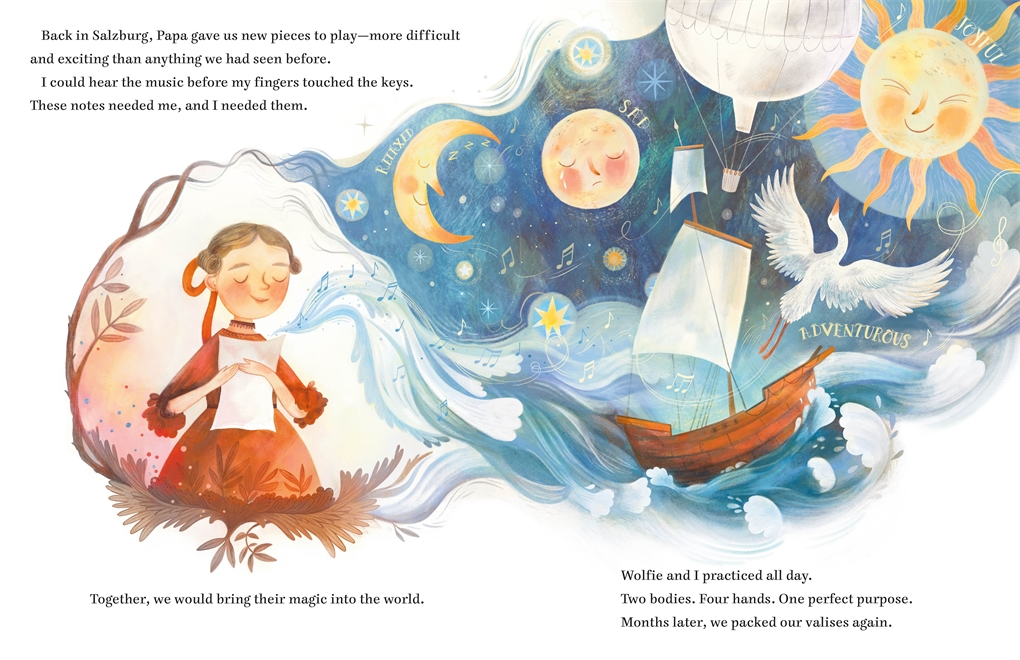
Summary: Maria Anna Mozart, known as Nannerl, tells the story of her life growing up with her younger brother, Wolfie. The two of them took to music at an early age and were playing concert halls in cities across Europe from the ages of five and ten. Nannerl also loved composing, but her father forbade it, saying that writing music was only for men. When Nannerl turned eighteen, she was told that touring was over for her and that she would stay home and get married. Wolfie continued to tour, and their correspondence grew less and less frequent until one devastating day when she learned of his death. Nannerl lived for almost forty more years, returning to Salzburg and her beloved harpsichord. Includes an author’s note explaining that this book is creative nonfiction, not a strict biography; also, a timeline, glossary, and list of books and online sources. 40 pages; grades K-4.
Pros: This is a fascinating story made more interesting by being told in Nannerl’s voice. The illustrations are a beautiful addition, particularly the ones that show the music created by the Mozarts.
Cons: A quick look at Wikipedia tells me there is a lot more to Maria Anna’s story and her relationship with her brother and father than this book is able to cover.
Summary: Raquela and her family live in Spain during a time when it’s forbidden for them to practice their Jewish faith. They celebrate Shabbat each week in their wine cellar, but Raquela has only heard about Passover. One year she asks her parents if they can have a seder. Her mother says it’s too dangerous, but her father, a great fisherman, gets a thoughtful look in his eyes. The night before Passover begins, Raquela’s parents pack a basket, and the next night they sneak onto her dad’s fishing boat. Papá takes them to his favorite secret fishing spot, where they drop anchor and proceed to have a seder dinner. An old fisherman sees them when they return, saying that it must have been a special night for Papá to take his family out fishing with him. Raquela says to her father, “It was a night different from all other nights.” Includes additional information about Passover and the Spanish Inquisition and its consequences for Spanish Jews. 32 pages; grades K-3.
Pros: An excellent book for celebrating Passover that weaves the original Passover story into the Spanish one and focuses on the hope and endurance of both groups of Jews.
Cons: I wouldn’t have objected to a bit more historical back matter.
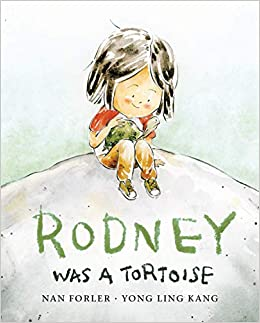
Summary: Bernadette’s oldest friend is Rodney, a tortoise is older than she is, older than her dad, even older than her Great-Aunt Clara. Bernadette loves to play games with Rodney, to bring him to school for show and tell, and to read to him before bedtime. Rodney has always been slow, but he gradually gets slower until one day he dies. Bernadette brings her grief with her to school, where it feels like the other kids don’t really care. Like Rodney, she sits on a rock at recess, drawing deeper into her shell. Then one day, a boy named Amar climbs onto the rock with her, acknowledging her sadness about Rodney and remembering some good things that he remembers about the tortoise. Amar used to have a budgie named Samuel, so he’s not unfamiliar with loss. Bernadette responds by inviting Amar over for a game of Crokinole, something she used to enjoy with Rodney. 40 pages; ages 4-8.
Pros: This gentle tale of love and loss will resonate with anyone who has ever experienced grief.
Cons: I had never heard of Crokinole and had to use my context clues to figure out what it is.








 A Kids Book A Day