Hook, line, and sinker

Sharks Unhooked: The Adventures of Cristina Zenato, Underwater Ranger by Patricia Newman, illustrated by Becca Hall (Millbrook Press, 40 pages, grades 1-5). Although Cristina Zenato grew up in Zaire (now the Democratic Republic of Congo), she and her family were Italian and returned to Italy every summer. There, Cristina grew to love swimming in the sea and was especially fascinated by sharks. She longed to learn how to scuba dive, and she finally got her chance after college on a trip to the Bahamas. Cristina decided to move there and spent hours in the water, getting to know the world underwater. Clad in a chain suit, with mackerel treats, she soon earned the trust of many of the sharks. She learned that sharks often get fishing hooks stuck in their bodies, and soon she was removing them from sharks’ gills, fins, tails, and even their throats. At first, she threw the hooks away, but eventually she collected them to use as an educational tool for humans to learn about their dangers to sharks. Includes additional information about sharks and Cristina Zenato, including a note from Cristina with a photo, and a list of books about sharks.

A Line Can Go Anywhere: The Brilliant, Resilient Life of Artist Ruth Asawa by Caroline McAlister, illustrated by Jamie Green (Roaring Brook Press, 40 pages, grades 2-5). Ruth Asawa first became aware of lines when she drew them in the dirt on her family’s farm in California. The middle of seven children, she had plenty of chores to do on the farm, but she still found time to create art, whether it was practicing calligraphy at Japanese school on Saturdays, making bracelets from discarded wire, or painting a prize-winning poster of the Statue of Liberty. When World War II broke out, an invisible line divided the Japanese and American parts of Ruth’s life. Her father was taken away, and the rest of the family was sent to a camp. Ruth practiced her art there, getting lessons from professional artists who had worked for Disney, and eventually was able to leave camp to go to college. Even after she got married and had six children of her own, she continued to create art, first making wire sculptures with thousands of intersecting lines and later getting commissions to sculpt fountains and a memorial for families imprisoned during World War II. Includes a lengthy author’s note with additional information, a couple of photos of Ruth with her art, and a bibliography.

Both Cristina and Ruth followed their unique dreams, despite the obstacles, and although both have had success in their chosen fields, it’s obvious that their joy in life came from following their passions rather than the external rewards. I was happy to read about a Ruth Asawa retrospective opening at the San Francisco Museum of Modern Art on the very same day that I read this book.

Mathemagical

Zero! The Number That Almost Wasn’t by Sarah Albee, illustrated by Chris Hu (Charlesbridge, 40 pages, grades 3 and up). It’s hard to imagine a world without zero, but for much of human history, calculations were made without it. This book begins with a look at some of the earliest people to use the concept that came to be zero: Babylonians, Mayans, and Indians. Zero came to be accepted in the Arabic world, and European traders to that area brought the idea back to Europe, where it was met with…derision and scorn. While some mathematicians enthusiastically embraced zero, other Europeans mistrusted something that came from a different part of the world and continued to use Roman numerals. The invention of the printing press helped spread the word about zero, and when it was finally universally accepted, it opened the door up up to the complex ideas of modern calculus and physics. Includes additional information about zero and some of the other words we use for the concept, a map of places mentioned in the book, a bibliography, a list of math books for younger readers, a “blurry” timeline of zero, and some notes about the art.

This is a fascinating story of something most of us don’t think about, but which has been a key to scientific and technological advancement. The history of its evolution shows the dangers of not being open to the contributions of other cultures. There’s a lot of information and a huge span of history covered, making me wonder exactly what ages to recommend it for. I can see some older elementary students finding it interesting, but I think it could also be used in middle school or high school STEM classes.

The Five Sides of Marjorie Rice: How to Discover a Shape by Amy Alznauer, illustrated by Anna Bron (Candlewick, 40 pages, grades 2-5). As a child, Marjorie Rice was fascinated by shapes and arts. She learned to read at an early age, starting second grade at the age of five. Despite her interests and intelligence, her parents encouraged her to pursue a career as a secretary, and she didn’t go to college. Marjorie married and had five children. As they grew up, she started reading her son’s Scientific American and particularly enjoyed Martin Gardner’s “Mathematical Games” column. She was intrigued by one column about the problem of finding pentagons that could be tessellated infinitely without gaps. Gardner stated that all such pentagons had been discovered, but a month later, a reader discovered a new one. This inspired Marjorie to look for new ones on her own, and she eventually found four more. In 1995, she was recognized at a Mathematical Association of America meeting with a standing ovation, a true amateur who was motivated solely by her own interests and passion for shapes and art. Includes an author’s note about her personal connections to Marjorie Rice; additional information about the problem Marjorie worked on; information on how to discover a shape; a bibliography; and a couple of photos.

This engaging biography is an inspiration to follow your passions, no matter where you are in life. The storytelling is lively, and I particularly enjoyed the illustrations that do a great job of bringing Marjorie’s work to life. I struggled a little to understand exactly what she was working on, and like the previous book, this is one that may be enjoyed more by older readers with more of a mathematical background.

Home is where the heart is

Sea Legs by Jules Bakes, illustrated by Niki Smith (Graphix, 256 pages, grades 3-7). Janey’s lived on board her parents’ sailboat before, but it’s harder going back to that life this time, after going to public school for third grade and making a good friend named Rae. But she doesn’t have much say in the matter, as her family sets sail for the Caribbean. Life onboard is much different, with unique adventures and natural wonders every day, but also sometimes with boredom and loneliness. When they anchor at one of the islands so her parents can make some money, Janey’s excited to see another girl who looks just a little older than she is. Soon, she’s hanging out with Astrid, who seems cool and courageous, but who is sometimes mean to Janey and takes her on adventures that occasionally turn dangerous. Janey slowly realizes that Astrid is living with an abusive father, forced to take care of her younger half siblings and not allowed to go to school, and that the older girl envies Janey’s secure family and opportunity to get an education. When hurricane season hits hard, Janey is sent to live with her grandmother for several months. On her return, the ship is damaged, Astrid is gone without a trace, and Janey has to learn from her parents how to be resilient and get back out to sea once again. Includes notes from the author and illustrator, friends since the age of 12, about how Jules’s childhood at sea and their friendship inspired this book.

Who can resist the lure of a life at sea? I was curious to read this fictionalized graphic memoir about Jules Bakes’s unique childhood. It ended up surprising me, showing both the good and more difficult sides of this life, with Astrid’s story offering a particularly dark version of it. I was hoping for a little more resolution of Astrid’s story and her friendship with Janey, but the ambiguity felt very realistic.

Home by Matt de la Peña, illustrated by Loren Long (G. P. Putnam’s Sons Books for Young Readers, 48 pages, ages 4+). As they did with their picture book Love, Matt de la Peña and Loren Long offer meditations about home. Whether it’s an apartment next to the highway, a house near the airport, Grandpa’s houseboat, or the back of Dad’s big rig, home has a feeling of familiarity, comfort, and security. But what if you lose your home? “Hurricane rains flood your streets. Or a thick black smoke blankets the sky. Or Papa’s garment factory closes down.” You may have to leave the only home you’ve ever known, but slowly you will find your way back with the help of a father or a grandma or a teacher, because it’s those people who really are your home. And when you look up into the sky at a hawk or a mountain or the stars, you’ll remember the home we all share, “promising that all life is one life and when the winds do come they will carry you home.”

I was blown away by how much is contained in this seemingly simple picture book that could be enjoyed by a preschooler or used in a college class to reflect on all the meanings of the word “home.” The text is lyrical and thought-provoking, and as for the illustrations…well, let’s get on with it already and finally give Loren Long the Caldecott recognition he deserves.

Be the change

Stalactite and Stalagmite: A Big Tale from a Little Cave by Drew Beckmeyer (Atheneum Books for Young Readers, 40 pages, ages 4-8). Two nubs of rock in a cave greet each other as the one above drips a steady stream of water drops onto the one below. They’re friends from the start and enjoy the company of other more transient creatures as they witness the history of life on Earth. First a trilobite, next an Ichtyostega with some new legs, then a triceratops who enjoys a dazzling light display before disappearing. Ice Age creatures give way to early humans, and finally, contemporary human tourists marvel at the stalactite and stalagmite that are almost touching each other. A futuristic city appears outside the cave, then darkness as the two fuse together into a column of stone. Includes additional information about some of the creatures and a timeline of the time period covered in the story.

Enjoy a warm, fuzzy friendship story while simultaneously feeling insignificant as you follow this rocky relationship over millions of years. Drew Beckmeyer makes it look easy to create an amazing picture book with plenty of humor that introduces the entire history of life on earth.

Papilio by Ben Clanton, Corey R. Tabor, and Andy Chou Musser (Viking Books for Young Readers, 48 pages, ages 3-7). Three friends and beloved author-illustrators have created a story in three parts about Papilio, a black swallowtail butterfly. In the first, by Clanton, Papilio hatches from an egg and explores life as a caterpillar before creating a chrysalis. Tabor takes the story from there, narrating from inside a chrysalis that is almost eaten by a bird. Having safely survived, the newly emerged butterfly’s tale is told by Musser, as she learns from other flying insects how to use her wings. The stories are tied together by Papilio’s interactions with a mouse, and readers will enjoy seeing the different depictions of it by the three different artists. Includes additional information about butterfly metamorphosis, as well as notes from each of the creators about how they came up with their stories and illustrations.

I was excited to see this book by Ben Clanton and Corey R. Tabor, who are well-loved in my library (I’m not yet familiar with Musser’s work), and it did not disappoint. Kudos to them for taking on the well-worn tale of butterfly metamorphosis and finding something new. It’s fun to compare the illustrations, which are similar but have distinctive differences from the three different artists.

Caboose by Travis Jonker, illustrated by Ruth Chan (Harry N. Abrams, 40 pages, ages 4-8). Hippo loves being first in line, and he’s learned all kinds of tricks to get there: running, sneaking, even slingshotting to the head of the line. But one day, Hippo takes it too far, and Fish gets hurt. “You may not be first anymore!” declares the teacher, and Hippo is banished to the end of the line. It takes a little adjustment, but before long, Hippo has a series of strategies to make sure he’s always the caboose: walking like a turtle, politely letting everyone go ahead, pretending his sneaker has a giant knot. But “caboosin’ it up” causes Hippo to go too far once again, and now his assigned place is in the middle of the line. And the middle proves to be the best place for him, right in the center of all his classmates.

Hippo definitely cracked me up, and there are lessons to be learned about working with others. Kids may recognize themselves or a classmate as Hippo slowly learns line etiquette and how to be respectful of his classmates. The illustrations are adorable, with a huge variety of animals, but I have to say I struggled a little to grasp the lesson Hippo learned at the end.

Tern around, bright eyes

Sun Bird: The Amazing Journey of the Arctic Tern by Lindsay Moore (Greenwillow Books, 40 pages, ages 4-9). Baby Arctic terns begin life during the Arctic summer, their parents hunting for fish to feed their voracious appetites. The chicks grow and learn to fly as the Arctic days grow shorter. By late summer, they’re ready to begin their migration across the globe to Antarctica. By the time they reach their destination, it’s springtime there, and the terns spend the Antarctic summer resting and growing new feathers for their long journey back north to the Arctic. Includes additional information about the Arctic tern, which has the longest known migration of any animal on Earth and is believed to experience more hours of sunlight, as well as additional resources and a list of references.

Lindsay Moore, author and illustrator of Yoshi and the Ocean and Sea Bear has created another beautiful and fascinating animal book, this one about the Arctic tern. The predominantly blue and white watercolor illustration capture the graceful movements of the birds through the sky and sea, and the poetic text describes their journey with captivating details.

Meet the Mini-Mammals: A Night at the Natural History Museum by Melissa Stewart, illustrated by Brian Lies (Beach Lane Books, 40 pages, ages 4-8). Which mammal is the smallest? After introducing readers to what a mammal is, the ferret museum docent takes them on a tour of an exhibit of ten small mammals, descending in size. Each one is shown in the same size exhibit box to allow for size comparison, and each is accompanied by a paragraph of information, a “tiny tidbit” that compares its weight to a common object, and another illustration showing the animal in action. Kitti’s hog-nosed bat is the tiniest, and after its introduction, the mini mammals are pictured together as they enter a mapparium showing where each one lives in the world. Includes statistics on each mammal and a list of sources.

This award-winning team has created an appealing picture book filled with cute mammals and interesting information about each one. The illustrations are outstanding, and the museum presentation showing the animals in descending order of size is clever and keeps the interest high. Personally, I find mini mammals kind of creepy and rat-like, but putting my biases aside, I must concede that this is an excellent nonfiction picture book.

Intergenerational fun

Kwesi and Nana Ruby Learn to Swim by Kobina Commeh, illustrated by Bárbara Quintino (Barefoot Books, 32 pages, grades K-3). Kwesi wants to swim with his friends, but he’s afraid of the water. When Nana Ruby comes for a visit, he confides his fears to her. She tells him that when she moved to the U.S. from Ghana, many pools were closed to Black people, and she never learned to swim either. They make a deal to learn together, and Nana Ruby tells Kwesi about Mami Wati, a half-woman, half-fish creature from Ghanaian mythology, who will protect them. Their new teacher resembles Mami Wati (except for the fish tail), and she proves to be an excellent instructor. Before long, Kwesi is swimming in the lake with his friends and encouraging Nana Ruby to join them. Includes a glossary, additional information about the Akan people of Ghana, and notes from the author and illustrator about how they both learned to swim as adults.

The history of Black people historically being barred from learning to swim is woven into this story seamlessly, with the uplifting message that it’s never to late to try new things. The illustrations are beautiful, especially those in the water, and Mami Wati is spectacular. The story, from a first-time author, would have benefited from a little more editing to tighten it up a bit.

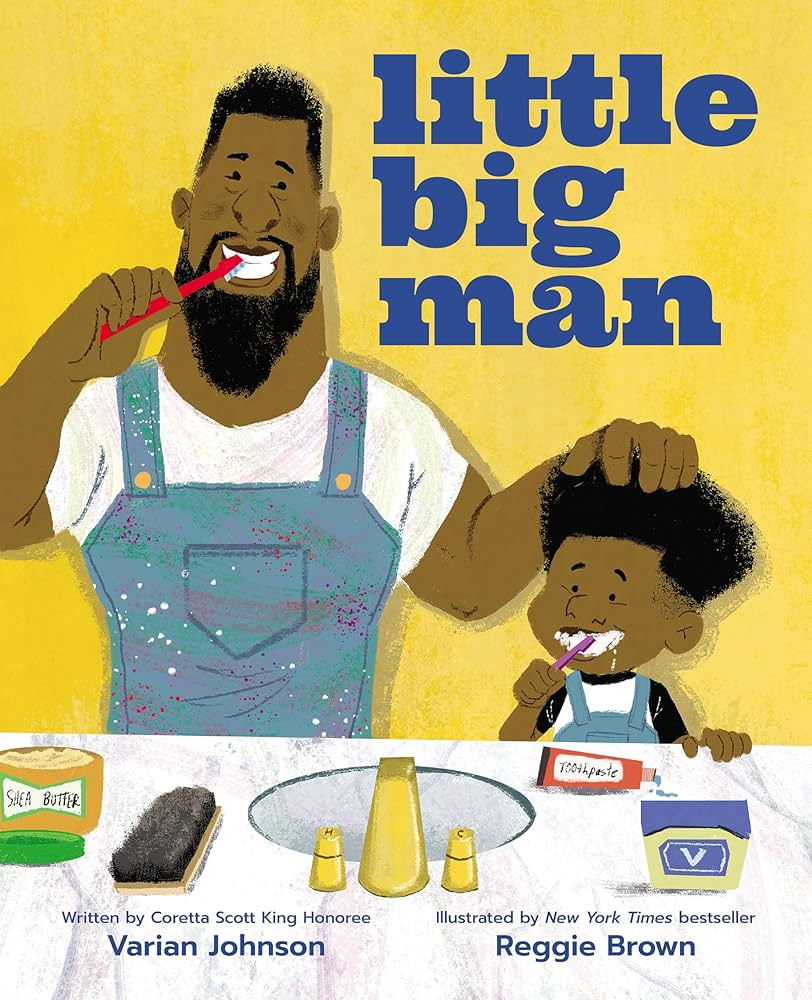
Little Big Man by Varian Johnson, illustrated by Reggie Brown (Orchard Books, 40 pages, ages 4-8). Elijah is disappointed when his father has to work the day he wanted to fly kites together, but Dad tells him, “A new baby means extra work for everyone.” Elijah’s job is to stay quiet around the baby, but he sometimes has trouble remembering. He strengthens his resolve the next day when Dad leaves for work. Their days parallel each other, as they plan, work hard, help others, and clean up after themselves. By the time Dad returns, Elijah has made a beautiful kite and convinces the whole family to play outside for the rest of the afternoon. Thanks to Orchard Books for providing this review copy; the book will be released in May.

This sweet story would make a nice sibling gift, showing various family dynamics and how both kids and adults have to work together to find a balance between work and play. There are lots of action words in a big bold font, and it’s fun to see Elijah and his dad in the illustrations as they perform similar tasks throughout their day. Having said all that, Varian Johnson is one of my favorite middle grade authors, and I hope he gets back to the genre to create more books like Twins and The Parker Inheritance.

Feminism, past and present

Tear This Down by Barbara Dee (Aladdin, 304 pages, grades 4-7). Freya has always liked asking lots of questions and having strong opinions, but as she’s gotten older, she’s learned to stay quiet rather than risk being made fun of. A school project leads her to the discovery that town founder Benjamin Wellstone, an outspoken abolitionist, opposed giving women the vote. Teaming up with new friend Callie, Freya embarks on a series of actions to tear down Wellstone’s statue and replace it with one of a local suffragist Octavia Padgett. After the girls sneak out of the house for some late-night statue vandalism before a big town festival, they are both grounded and forced to reconsider their tactics. Freya’s activist grandmother helps her to see that there’s room for both Benjamin and Octavia in town and leads her to come up with an idea of creating a quilt celebrating the suffragists that unites people rather than tearing them apart.

A good choice for Women’s History Month, the latest by Barbara Dee portrays an idealistic, outspoken protagonist who sometimes feels like her strong opinions need to be silenced. I always enjoy Dee’s books that tackle difficult issues with a light touch. Thanks to Aladdin Books for providing me with a free copy.

One Girl’s Vote: How Lucy Stone Helped Change the Law of the Land by Vivian Kirkfield, illustrated by Rebecca Gibbon (Calkins Creek, 40 pages, grades 2-5). From an early age, Lucy Stone felt the unfairness of the ways she and other girls were treated as inferior to boys. Her teacher called on the boys before Lucy, even though Lucy’s hand was raised first, and her father dictated family policy, including the decision that Lucy would not attend college like her brothers. Lucy was determined, though, and earned enough money to pay her tuition at Oberlin College, the first American college to accept women. But even at Oberlin, there was inequality, and Lucy fought back, organizing a secret women’s debate society and striking for equal wages to men’s for her campus jobs. After graduation, she was hired by William Lloyd Garrison to work for the New England Anti-Slavery Society. She soon became well-known as a passionate speaker, and her work evolved to include women’s rights. The work and travel was exhausting, but Lucy Stone’s voice helped pass the Thirteenth Amendment, abolishing slavery, and paved the way for women to get full voting rights 27 years after her death. Includes a timeline for Lucy Stone and the fight for women’s rights and equality for all, a couple photos, fun facts, and a bibliography.

In my experience, Lucy Stone is lesser known than fellow suffragists Elizabeth Cady Stanton and Susan B. Anthony, so I’m happy to see this delightful picture book that emphasizes Lucy’s early days but gives a nod to her tireless work for abolition and women’s rights. The timeline offers quite a few milestones in women’s history. I did not know that Lucy Stone was married to Elizabeth Blackwell’s brother, and that women who kept their maiden names, as Lucy did, were sometimes called Lucy Stoners.

Kids navigating two worlds

The Interpreter/La Intérprete by Olivia Abtahi, illustrated by Monica Arnaldo (Kokila, 40 pages, ages 5-8). “Some kids had one job: to be a kid. Cecilia worked two.” Cecilia’s second job is the family interpreter, translating English to Spanish for her immigrant parents. This job takes her to places most kids don’t go, like the DMV, the bank, and the car mechanic. Cecilia used to have a partner, but her older brother “got promoted” by going away to college. At a parent-teacher conference, her teacher asks her how she’s doing. Cecilia starts to translate the question, then realizes it’s directed at her…and that she’s not doing great. She finally explodes, and her parents realize she’s under too much pressure. After a family meeting, they get some back-up: her brother comes home for a weekend, and her aunt offers to do some interpreting. Cecilia still loves to help her family, but now they work together to make sure she gets the time she needs to be a kid as well.

I’m so grateful for this book, which I can’t wait to share with my classes of international students, for whom I’m sure it will resonate. I love the illustrations that portray Cecilia in a business suit for her interpreter duties and use cartoon bubbles in blue for English and yellow for Spanish. There’s plenty of humor, but also good advice for kids to take breaks and get support from family members and other adults. The author and illustrator information on the back flap reveals that both of them served as kid interpreters for their own immigrant families.

Home Is a Wish by Julia Kuo (Roaring Brook Press, 32 pages, ages 4-8). A girl lives with her mother and grandmother. Sometimes, she and Mama or Amah go out, but they always come back home again. One day, though, they leave for good, and as they fly across the ocean, the girl wonders if there will ever be a place that feels like home again. The new place feels strange at first, but slowly, the family begins to go out and come back, until it starts to feel like home. There are new friends and newly familiar places, and she realizes that there are different homes for different times: “a home from before, a home for now, even a home for later.”

The immigrant experience is beautifully captured here with brief text and lovely illustrations of both home countries. The pictures and use of the word Amah suggest that the first home might be in Taiwan or China, while the later illustrations could portray Julia Kuo’s current home state of Washington, but the ambiguity makes this a more universal story. It would have been interesting to have an author’s note to learn how much, if any, of this story is based on her own childhood.

Skywalkers, buffalo hunters, and ribbon dancers: three books about Indigenous Americans

To Walk the Sky: How Iroquois Steelworkers Helped Build Towering Cities by Patricia Morris Buckley, illustrated by E. B. Lewis (Heartdrum, 40 pages, grades 1-5). For more than a century, members of the Mohawk tribe from Canada’s Caughnawaga reserve have worked construction as “skywalkers,” balancing on beams high above the ground. Many of them were working on a bridge across the St. Lawrence River near Quebec City that collapsed in August, 1907, killing 75, including 33 from Caughnawaga. Beginning in the 1920’s, Mohawk skywalkers from New York and Canada traveled to New York City to build skyscrapers, including the World Trade Center. After the towers’ destruction on September 11, 2001, skywalkers helped dismantle broken beams and later were an important part of building One World Trade Center. Today, skywalkers continue their work across North America, including Native women who have entered the profession. Includes an author’s note about her family’s connection to the story, additional information about the Quebec bridge collapse and the Kahnawà:ke reserve (formerly Caughnawaga), a glossary, and a list of some of the buildings constructed by skywalkers.

Kids will be fascinated by the story of these skilled, courageous workers who have helped build some of the most famous structures in North America. The Mohawks originally worked as unskilled laborers in exchange for some of their reserve land, but soon proved their fearless skill as skywalkers and have continued the tradition for over a century. Look for YouTube clips to supplement the book with heart-pounding visuals.

The Gift of the Great Buffalo by Carole Lindstrom, illustrated by Aly McKnight (Bloomsbury Children’s Books, 40 pages, grades K-3). Rose is excited to be at the semi-annual Métis buffalo hunt. Pa is a captain for the first time, in command of ten other hunters. After several days of scouting, no buffalo have been seen, and Rose hears Pa saying they’re scarce because of the settlers and their iron horse. Rose is sure she could find the herd, but Pa says she’s too young to help. But Rose is determined, and with the help of a wolf skin, she finds the buffalo, and the men hunt what they need for their people. At the end of the day, she tells Pa she wishes he would take her with him on the next hunt. “I just might,” he replies. Includes an author’s note relating how she enjoyed the Laura Ingalls Wilder books but felt alienated by their portrayal of Native Americans as savages, and how that led her to write this story about the same time and place; also includes additional information about the buffalo hunt and a bibliography.

This is a fascinating parallel story to Laura Ingalls Wilder’s books. Rose has Laura’s same independent spirit and desire to help her family, and she even calls her parents Ma and Pa. It’s a much-needed portrayal of the indigenous people of the plains who are often marginalized in the Little House books.

Raven’s Ribbons by Tasha Spillett, illustrated by Daniel Ramirez (Little, Brown Books for Young Readers, 32 pages, ages 4-8). Raven loves participating in round dances with his family and friends, and his favorite part is watching the ribbon skirts. His grandmother is famous for making these colorful garments that are created with just the right ribbons for each dancer. When Raven asks if he can have a ribbon skirt, Grandma says, “I’ve lived for a long time, Nosesim, and have never seen a boy in a ribbon skirt.” While Raven sleeps, however, she works late into the night, and by morning there is a beautiful ribbon skirt that looks just like a rainbow. “I’ve lived for a long time, Nosesim,” she tells him, “And I’m lucky to see beautiful things that I’ve never seen before.” Includes notes from the author and the illustrator with additional information about the Round Dance and Two-Spirit people.

This simple story celebrates Indigenous dancing as well as offering a gentle, empowering message about being yourself and affirming gender differences. I loved how Grandmother was able to acknowledge both that a boy wearing a ribbon skirt was new to her and that there can be beauty in doing things in a new way.

Two books for Ramadan

Almost Sunset by Wahab Algarmi (HarperAlley, 224 pages, grades 4-7). Hassan is fasting for Ramadan in this graphic novel, and, although it’s his third year doing so, this year seems harder than before. He’s going to the mosque for nightly prayers with his father for the first time, and there’s not as much community support as there was when his family was back in Yemen. Not only is Hassan falling asleep in math class, but he’s not performing up to par on the soccer field, getting shown up by teammate and frenemy Rosie. Everywhere he goes, Hassan sees delicious food, and when some cousins talk him into sneaking off for snacks, he’s wracked with guilt. When Hassan finally tells his soccer coach why his performance is off and he’s leaving practices early, he’s happily surprised to learn that Coach is also observing Ramadan with his own fast. Finally, Eid arrives, and Hassan is rewarded for his determination with a joyous celebration that include friends and family who help him to acknowledge his perseverance and to forgive himself for mistakes.

Muslim kids observing Ramadan will relate to Hassan’s struggles and hopefully learn to open up to those around them about what is going on with them for the month; non-Muslims will learn more about Ramadan and how to support their friends. The artwork is excellent, with lots of wordless pages that move the story along at a good clip, and some funny pictures of Hassan imagining food in all kinds of contexts.

The Gift of Eid by Shifa Saltagi Safadi, illustrated by Aaliya Jaleel (Holiday House, 40 pages, ages 4-8). Yasmine and Mama are shopping in Damascus’s Souq Al-Hamidiyeh. They’re both grieving the recent death of Yasmine’s dad, and Yasmine wishes she could find the perfect Eid gift to bring a smile to Mama’s face. When she sees a sign offering money for jewelry, she sells the chain she’s wearing around her neck. At the Masjid Al-Umawi mosque, Mama and Yasmine meet up again for prayers. At the end, they agree to exchange early Eid gifts, but when Yasmine gives Mama the beautiful box she’s bought for Mama to keep her bracelet in, Mama starts to laugh. She sold the bracelet to buy Yasmine a charm to put on her gold chain. They realize that their love for each other is the greatest gift they can give, and head for home with a charm but no chain, a box but no bracelet, and “all the love we need.” Includes an author’s note about how her childhood in Syria inspired this story.

Based on the O. Henry story The Gift of the Magi, this sweet story introduces readers to daily life in Syria, beautifully portrayed in the illustrations. It’s also a tale of grief and healing, as Yasmine and Mama look for ways to help each other through a difficult time.